森鷗外『最後の一句』に学ぶ——職場で「言うべきことを言える人」を育てる文学研修 Learning from Mori Ōgai’s Saigo no Ikku: A Literary Approach to Developing People Who Speak Up at Work
「管理職向けの研修を実施しているが、毎回フレームワークの説明で終わってしまい、受講者の行動がなかなか変わらない」「心理的安全性の重要性はわかっているが、どうすれば職場に根づかせられるのかが見えてこない」——そのような悩みを抱えている人事教育担当者の方は少なくありません。
“We run management training regularly, but it tends to stop at frameworks — and participant behavior doesn’t seem to change.” “We understand the importance of psychological safety, but we can’t quite see how to make it take root in the workplace.” These are concerns shared by many HR and training professionals.
オスケン株式会社が開発した「Osuken Literary Training(OLT)シリーズ」は、日本文学の名作を精読・対話することで、ビジネスの現場に直結した気づきを引き出す法人向け研修プログラムです。その第1弾で使用するテキストが、森鷗外の短編小説『最後の一句』(1915年)です。本記事では、なぜ100年以上前に書かれた文学作品が現代の職場教育に有効なのか、そして文学を通じてどのような人材育成が可能になるのかを解説します。
The Osuken Literary Training (OLT) Series, developed by Osuken Inc., is a corporate training program that uses close reading and dialogue with classic works of Japanese literature to draw out insights that connect directly to the workplace. The first text in the series is Mori Ōgai’s short story Saigo no Ikku (“The Last Phrase”, 1915). This article explains why a work of literature written more than a hundred years ago remains relevant to workplace learning today — and what kind of human development becomes possible through literary engagement.
目次
『最後の一句』とはどんな物語か What Is “The Last Phrase”?
舞台は江戸時代の大阪。船乗り業を営む桂屋太郎兵衛が、部下の不正に巻き込まれて死刑を宣告されます。残された家族の中で、16歳の長女・いちが一人で行動を起こします。夜中に願書をしたため、夜明け前に妹と弟を連れて奉行所に乗り込み、「父を助ける代わりに、私たち子供を殺してください」と命乞いをするのです。
The story is set in Edo-period Osaka. A shipping merchant named Tarōbei is sentenced to death after being implicated in the wrongdoing of one of his employees. His sixteen-year-old daughter, Ichi, acts alone. In the middle of the night she writes a petition, and before dawn she takes her younger sister and brother to the magistrate’s office, asking that her father be spared — in exchange for their own lives.
幾度も追い返されても、いちは動じません。そして取り調べの最終場面、奉行・佐佐が「身代わりを聞き届けると、お前たちはすぐに殺されるぞ。それでもいいか」と問い詰めます。
Even when turned away repeatedly, Ichi does not waver. In the final interrogation scene, the magistrate Sasa presses her: “If we accept your offer of substitution, you will be killed immediately. Is that still acceptable?”
「よろしゅうございます。……お上のことには間違いはございますまいから」
“That is fine. … There can be no mistake in what the authorities decide.”
この一句が、作品の核心です。表向きは完全な服従の言葉でありながら、「もしお上が正しいなら、父を死刑にした判断も正しいはずですね? それでも私たちは命を差し出します」という権力の正当性への鋭い問いかけが、服従の言葉の奥に静かに潜んでいます。奉行・佐佐の顔に「不意打ちに会ったような驚愕の色」が浮かんだのは、この二重構造を瞬時に理解したからです。
This phrase is the heart of the story. On the surface it is a statement of complete submission — yet quietly beneath the words of compliance lies a sharp challenge to the legitimacy of power: “If the authorities are correct, then the decision to sentence my father must also be correct — and yet here we are, offering our lives.” The magistrate Sasa’s face shows “a look of shock, as if struck by an unexpected blow” — because he grasps the double structure of the phrase instantly.
この物語が「職場の発言力研修」になる理由 Why This Story Works as Workplace Training
本研修では、この作品を通じて参加者に問いかけます。
In this program, participants are invited to reflect on a single question through this work.
「あなたの職場に、この一句を言える人はいますか。あなた自身は、言えますか」
“Is there anyone in your workplace who could say something like this? Could you?”
いちの行動をビジネス文脈に置き換えると、現代の職場に直結する4つの示唆が浮かびます。
When Ichi’s actions are transposed into a business context, four insights emerge that connect directly to the modern workplace.
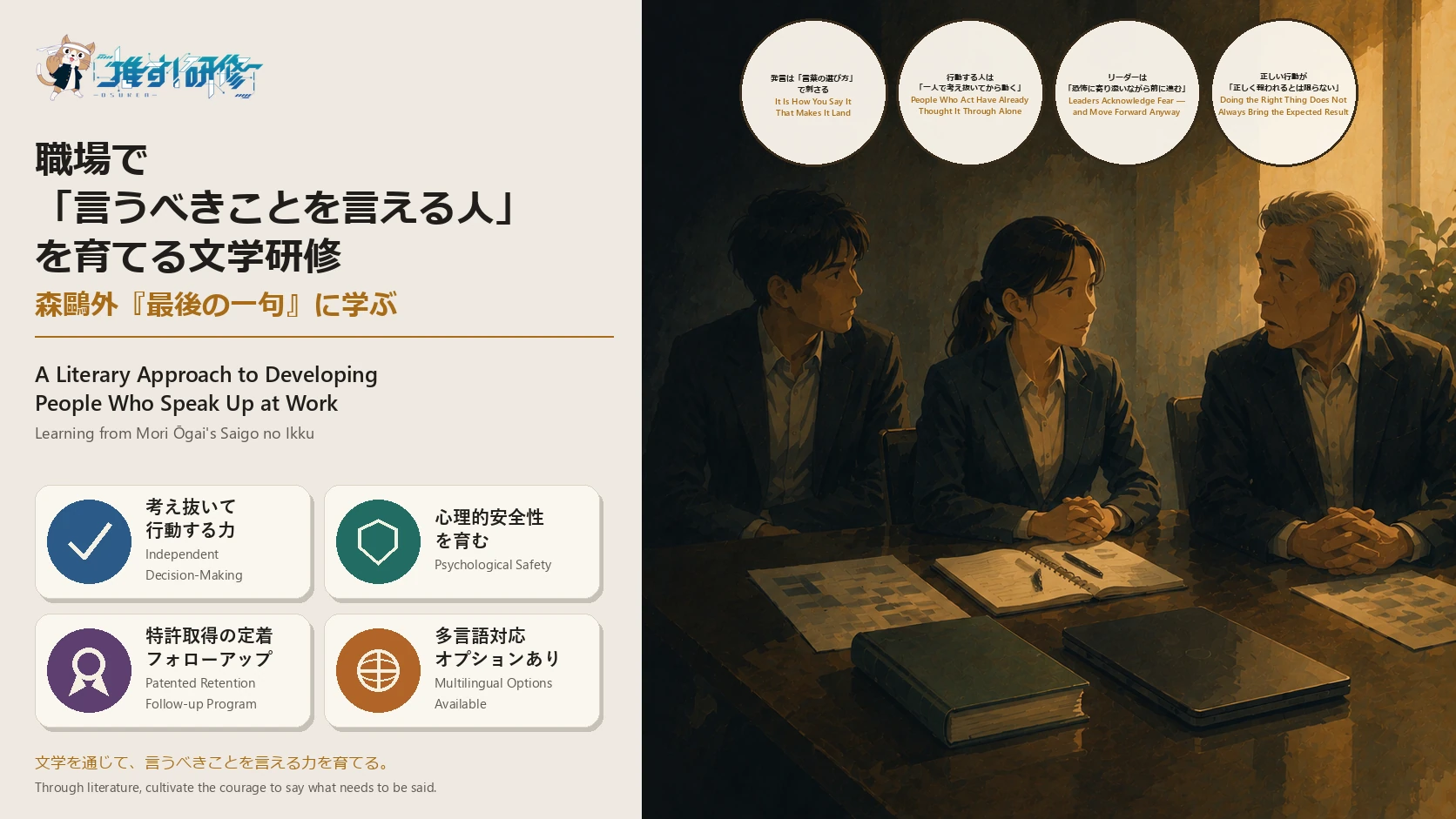
示唆① 発言は「言葉の選び方」で刺さる Insight 1: It Is How You Say It That Makes It Land
いちは単に「助けてください」とは言いませんでした。相手(権力者)の論理を使いながら、その矛盾を突く言葉を選びました。現代の職場でも、上司や組織への建設的な異議申し立ては、「言う・言わない」だけでなく「どう言うか」が問われます。言葉の選び方が、対話の質を決めます。
Ichi did not simply say “please help us.” She chose words that used the logic of those in authority against their own position. In today’s workplace, constructive dissent directed at a manager or the organization is not just a question of whether to speak — it is a question of how. The words you choose determine the quality of the dialogue.
示唆② 行動する人は「一人で考え抜いてから動く」 Insight 2: People Who Act Have Already Thought It Through Alone
いちは布団の中でひとりで考え、「ああ、そうしよう。きっとできるわ」と結論を出してから行動しました。誰かに相談して背中を押してもらったのではなく、自分の内側から意思決定をしたのです。これは、現代のビジネスパーソンが最も身につけることが難しい、自律的な意思決定の構造そのものです。
Ichi thought things through alone in her futon and arrived at a conclusion — “yes, I’ll do it; I know I can” — before she moved. She did not act because someone encouraged her. The decision came from within. This is precisely the structure of autonomous decision-making that many business professionals find hardest to develop.
示唆③ リーダーは「恐怖に寄り添いながら前に進む」 Insight 3: Leaders Acknowledge Fear — and Move Forward Anyway
妹のまつは「怖いわ」と言いました。いちは「ただついてきて、同じようにしていればいい」と答えました。恐怖を否定せず、それでも動ける方向を示す——これはチームを率いるリーダーに求められる姿勢そのものです。心理的安全性は、「怖い」と言える関係性があってこそ育まれます。
Her younger sister Matsu said, “I’m scared.” Ichi replied, “Just come with me and do as I do.” Without dismissing the fear, she showed the direction to move — and that is exactly the posture required of anyone leading a team. Psychological safety begins in a place where it is possible to say “I’m afraid.”
示唆④ 正しい行動が「正しく報われるとは限らない」 Insight 4: Doing the Right Thing Does Not Always Bring the Expected Result
物語の結末で、太郎兵衛の死刑は減刑されます。しかしその理由はいちの行動への感銘ではなく、大嘗会(天皇即位の祭祀)が行われたという政治的偶然でした。鷗外は静かに問いかけています——正しい行動の価値は、結果によって決まるのか、と。成果主義評価が浸透した現代企業において、人事担当者・管理職が向き合うべき本質的なテーマです。
At the end of the story, Tarōbei’s sentence is commuted. But the reason is not that the authorities were moved by Ichi’s actions — it is a political coincidence: the timing of an imperial enthronement ceremony. Ōgai poses the question quietly: is the value of a right action determined by its outcome? This is a fundamental question that managers and HR professionals in today’s results-oriented organizations need to confront.
なぜ「文学」を研修に使うのか Why Use Literature in Training?
「文学を読んで、何が変わるのか」という疑問は当然です。ケーススタディやロールプレイングは、具体的な対応方法や判断の型を学ぶのに適しています。一方、文学作品には「正解がない問い」が内包されており、参加者が自分の解釈を持ち、他者の解釈と出会うことで、自分では気づかなかった思考の枠組みが浮かび上がります。これが、フレームワーク研修では得にくい「深い内省」を生む仕組みです。
The question “what can reading literature actually change?” is entirely reasonable. Case studies and role-play are well suited for learning practical responses and patterns of judgment. Literature, on the other hand, contains questions with no single correct answer — and when participants form their own interpretations and encounter the interpretations of others, frameworks of thinking they had never noticed in themselves come to the surface. This is the mechanism that generates the kind of deep reflection that conventional training rarely reaches.
また文学は、直接的な自己分析よりも安全な距離を保ちながら、自分の経験を語れる場を作ります。「自分はどうか」を問う前に「いちはどうか」を議論することで、参加者の構えがほぐれ、より本音に近い対話が生まれます。
Literature also creates a space in which people can speak about their own experiences from a safe distance — safer than direct self-analysis. By first discussing “what about Ichi?” before asking “what about you?”, participants’ guard naturally softens, and dialogue that comes closer to genuine feeling becomes possible.
プログラム概要 Program Overview
| 項目 Item | 内容 Details |
|---|---|
| 使用テキスト Text | 森鷗外『最後の一句』(青空文庫) Saigo no Ikku (“The Last Phrase”) by Mori Ōgai (Aozora Bunko) |
| 対象者 Participants | 中間管理職・リーダー層(5〜15名) Middle managers and team leaders (5–15 participants) |
| 所要時間 Duration | 半日(3.5時間)〜全日 Half-day (3.5 hrs) to full-day |
| 提供形式 Format | 対面ワークショップ(オンライン対応可) In-person workshop (online delivery available) |
| 多言語対応 Languages | 多言語対応オプションあり(外国籍人材混在チーム向け) Multilingual options available |
| フォローアップ Follow-up | 受講者の理解度に応じた段階的フォローアップを半年以上にわたって実施(特許第7578861号) Patented retention follow-up program spanning more than six months, with intervals tailored to each participant’s level of understanding (Patent No. 7578861) |
テーマは企業の課題に応じて以下の4つから選択・組み合わせが可能です。
The program theme can be selected or combined from the following four options according to your organization’s needs.
- 意思決定と行動力(若手・中堅向け) Decision-making and initiative (for early-career and mid-level employees)
- 心理的安全性とリーダーシップ(管理職向け) Psychological safety and leadership (for managers)
- 組織倫理と発言(管理職・幹部向け) Organizational ethics and speaking up (for managers and senior leaders)
- 正義・結果・プロセス(経営幹部・人事責任者向け) Justice, outcomes, and process (for executives and HR leaders)
文学研修は、行動変容の本質に向き合う研修である Literary Training Gets to the Heart of Behavioral Change
「文学を使った研修」と聞くと、特殊なプログラムのように聞こえるかもしれません。しかし本質は変わりません。良い研修とは、参加者が自分自身と正直に向き合える場を作ることです。
“Training that uses literature” may sound like something unusual. But the essence does not change. Good training is simply the creation of a space in which participants can face themselves honestly.
『最後の一句』のいちは、16歳で、武器も権力も持っていませんでした。持っていたのは、自分で考え、言葉を選び、行動する力だけです。その力を育てることが、本シリーズの目的です。
Ichi in “The Last Phrase” was sixteen years old, with no weapons and no authority. All she had was the ability to think for herself, choose her words, and act. Developing that ability is the purpose of this series.
お問い合わせ・資料請求 Enquiries and Information Requests
オスケン株式会社では、文学作品を活用した法人向け研修プログラムの設計・運営を支援しています。詳細資料・お見積もりは、下記よりお気軽にお問い合わせください。無料相談(オンライン・対面)も承っております。
Osuken Inc. supports the design and delivery of literary-based corporate training programs. For detailed materials or a quote, please feel free to reach out using the contact details below. Free consultations (online or in person) are also available.
- 日商簿記検定3級|貸付金・借入金の仕訳と利息計算 Nissho Bookkeeping Level 3 | Loans Receivable and Loans Payable: Journal Entries and Interest Calculations
- 芥川龍之介『藪の中』に学ぶ——職場で「事実と解釈を見分ける力」を育てる文学研修 Learning from Akutagawa Ryūnosuke's Yabu no Naka: Literature-Based Training for Distinguishing Facts from Interpretations at Work
この記事を書いた人

関連記事
-
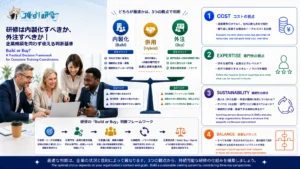
 研修は内製化すべきか、外注すべきか|企業規模を問わず使える判断基準 Build or Buy? A Practical Decision Framework for Corporate Training Coordinators
 -
生成AI×OJT|社員の「使い方」を現場で育てる育成設計の考え方 Generative AI and OJT: How to Build AI Competency Through On-the-Job Learning
-
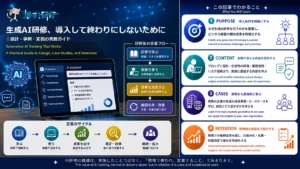
生成AI研修、導入して終わりにしないために|設計・事例・定着の実務ガイド Generative AI Training That Sticks: A Practical Guide to Design, Case Studies, and Retention
-
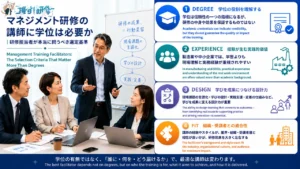
マネジメント研修の講師に学位は必要か|研修担当者が本当に問うべき選定基準 Management Training Facilitators: The Selection Criteria That Matter More Than Degrees
-
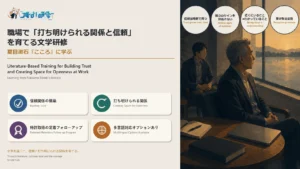
夏目漱石『こころ』に学ぶ——職場で「打ち明けられる関係と信頼」を育てる文学研修 Learning from Natsume Sōseki’s Kokoro: Literature-Based Training for Building Trust and Creating Space for Openness at Work
-
芥川龍之介『藪の中』に学ぶ——職場で「事実と解釈を見分ける力」を育てる文学研修 Learning from Akutagawa Ryūnosuke’s Yabu no Naka: Literature-Based Training for Distinguishing Facts from Interpretations at Work
-
新入社員フォローアップ研修とは? What Is New Employee Follow-Up Training? Purpose, Themes, and Design for HR Professionals
-
研修報告書・レポートの目的と活用法 How to Make the Most of Training Reports: Purpose, Report Design, and Follow-Up