生成AI×OJT|社員の「使い方」を現場で育てる育成設計の考え方 Generative AI and OJT: How to Build AI Competency Through On-the-Job Learning
生成AI研修を実施したにもかかわらず、現場での活用がなかなか進まない——そのような状況に心当たりのある研修担当者・人事担当者の方は少なくないのではないでしょうか。「研修でツールの使い方は学んだが、自分の業務にどう使えばよいかわからない」という声は、業種や規模を問わず多く聞かれます。生成AIの業務活用は、研修室で完結するものではなく、日常業務の中で徐々に育てていくものです。本記事では、OJTを通じて社員の生成AI活用力を現場で高めていくための育成設計の考え方を、実際の企業事例とともに整理していきたいと思います。
Many HR and training coordinators will recognise this situation: generative AI training has been delivered, yet meaningful use in the workplace is slow to follow. “We learned how to use the tool in the training session, but I still don’t know how to apply it to my actual work” — this is a sentiment heard across industries and organizations of all sizes. The ability to apply generative AI effectively at work cannot be fully developed in a training room alone; it is something that develops gradually within the flow of day-to-day work. This article aims to work through, alongside HR professionals and training coordinators, a way of thinking about how to design on-the-job learning that builds genuine AI competency in the workplace — drawing on real corporate examples along the way.
目次
「使いたいが使えていない」——現場の現実 ”I Want to Use It, But I Can’t” — The Reality on the Ground
新入社員を対象にした産業能率大学総合研究所の調査では、「積極的に活用して効率化や新しい価値を生み出したい」とする積極派が20.9%、実務的に活用したい層と合わせると62.9%に上り、実務派・臨機応変派・積極派の3つの選択肢を合わせると、9割以上の新入社員が生成AIを業務で活用する意向を示しています(出典:学校法人産業能率大学総合研究所「2025年度新入社員の会社生活調査(生成AI活用意識編)」2025年8月19日)。一方、東京都在住の20代社員400名を対象にした調査では、「まったく活用していない」が45.5%、「ほとんど活用していない」が26.0%と、合わせて約7割が実際にはほぼ使えていないという実態があります(出典:リ・カレント株式会社「Z世代意識調査」2025年4月8日)。さらに注目したいのは、「今後AI技術をどう活用していきたいか」という問いに対して、最も多かった回答が「わからない」(36.3%)だったという点です。これは単なる「未活用」ではなく、AIが自分の仕事にどう関わりうるのか、そもそもイメージを持てていないという、より根の深い課題を示しています。
A survey of new employees by the Sanno University Institute of Management found that 20.9% described themselves as eager to actively use AI to drive efficiency and create new value, and that figure rises to 62.9% when combined with those who want to use it in practical, task-specific ways. Taken together with a third group open to using it as needed, more than 90% of new employees expressed some intention to use generative AI in their work (Source: Sanno University Institute of Management, “2025 New Employee Survey (Generative AI Awareness Edition),” August 19, 2025). Yet a survey of 400 employees in their twenties living in Tokyo found a striking gap: 45.5% said they “do not use AI at all,” and 26.0% said they “barely use it” — meaning roughly 70% are effectively not using it in practice (Source: Recurrent Co., Ltd., “Generation Z Awareness Survey,” April 8, 2025). Perhaps more telling still, when asked “how would you like to use AI technology going forward,” the single most common answer — at 36.3% — was simply “I don’t know.” This points to something deeper than mere non-use: many young employees haven’t yet formed any concrete picture of how AI could even be relevant to their own work.
活用していない理由として上位に挙がるのは、「現在の業務では活用する機会がない」「使い方がよく分からない」「会社がAIツールを導入していないため使えない」といった項目です。つまり、活用が進まない背景には、本人の意欲だけでなく、活用環境と支援の不足が大きく関係していることが浮かび上がります。集合研修でツールの操作方法を学んでも、「自分の仕事にどう接続するか」を日常業務の中で誰かと一緒に考える機会がなければ、活用は広がりにくい。この問題を解決する一つの現実的なアプローチが、OJTを通じた生成AI活用力の育成です。
The reasons most commonly given for not using AI include “there’s no opportunity to use it in my current work,” “I don’t really know how to use it,” and “the company hasn’t introduced AI tools so I can’t use them.” What emerges from this picture is that limited adoption cannot be attributed to motivation alone; the lack of an enabling environment and adequate support also plays a major role. Even when employees learn how to operate a tool in a group training session, if there is no opportunity within their day-to-day work to think through with someone how to connect it to their actual job, adoption is unlikely to take root. One realistic way to address this is through building AI competency via on-the-job learning.
なぜ集合研修だけでは定着しないのか Why Group Training Alone Doesn’t Lead to Adoption
生成AIには、「知っている」と「使える」の間に大きなギャップがあります。操作の手順を学ぶことはできても、「この業務にAIを使うべきか」「このプロンプトで十分か」「この出力を信頼してよいか」といった判断は、実際の業務文脈の中でしか身につきません。集合研修が「知識のインプット」の場だとすれば、OJTは「業務への接続」を担う場として機能します。研修で学んだことを、自分の仕事の中で試し、振り返り、改善するサイクルを繰り返すことで初めて、生成AIは「使えるスキル」として定着していきます。
There is a significant gap between “knowing about” generative AI and “being able to use it.” While it is possible to learn the steps of operating a tool, the judgments involved — “should I use AI for this task?”, “is this prompt good enough?”, “can I trust this output?” — can only be developed within the context of real work. If group training serves as a space for knowledge input, OJT functions as the space where that knowledge connects to actual work. It is only through repeatedly trying what was learned in training within one’s own job, reflecting on how it went, and refining the approach that generative AI becomes a skill that genuinely sticks.
また、生成AIは急速に進化するツールであるため、研修時点で学んだ操作方法が数か月後には陳腐化している可能性もあります。特定のバージョンやプロンプトの書き方を覚えることよりも、「AIとどう向き合い、どう業務に組み込んでいくか」という姿勢と判断力を育てることのほうが、長期的には重要です。そして、その姿勢と判断力は、日常業務の中での試行錯誤を通じてこそ育まれます。
Generative AI is also a rapidly evolving set of tools, which means that the specific operations learned during training may be outdated within months. Developing the mindset and judgment for how to engage with AI and integrate it into work is more important in the long run than memorizing the steps of any particular version or prompt format. And it is through the trial and error of day-to-day work that that mindset and judgment are genuinely cultivated.
AIは「先輩に聞く」機会を奪うのか——見過ごされがちな逆説 Does AI Reduce the Need to Ask a Senior Colleague? An Overlooked Paradox
生成AI活用をOJTで支援するという発想を進める前に、一つ立ち止まって考えておきたい逆説があります。それは、生成AIそのものが、OJTの前提である「先輩に聞く」という行為を代替してしまう可能性があるという点です。新人や若手にとって、生成AIは「何度でも質問できる」「気軽に聞ける」という利点を持ちます。これは、「こんなことで先輩の時間を取ってもいいのか」とためらいがちな若手にとって、確かに心理的なハードルを下げる効果があります。しかし裏を返せば、AIに質問することで完結してしまい、先輩に相談する機会そのものが減っていくという構造も同時に生まれます。
Before pushing further into the idea of supporting generative AI use through OJT, there is a paradox worth pausing on. It is that generative AI itself can end up substituting for the very act — asking a senior colleague — that OJT depends on. For new hires and junior staff, AI offers the advantage of being something they can ask again and again without hesitation. This genuinely lowers the psychological barrier for those who worry about “taking up a senior colleague’s time with something this trivial.” But the flip side is that if a question gets resolved by asking AI, the underlying opportunity to consult a senior colleague simply doesn’t arise in the first place.
OJTの本質的な価値は、業務知識の伝達だけでなく、「わからないことを人に聞く」という関係性そのものを築くことにもあります。質問を通じて生まれる会話、失敗を共有すること、指導者の判断基準に触れること——これらは、AIとの一対一のやり取りでは代替できません。したがって、OJTに生成AIを組み込む設計では、「AIに聞けば済むこと」と「人に聞くべきこと」を意識的に切り分ける視点が必要になります。たとえば、定型的な情報検索や文章の下書きはAIに任せ、判断が分かれる場面や職場特有の文脈が絡む相談は、あえて人に聞く習慣を維持する、といった設計です。
The essential value of OJT lies not only in transmitting job knowledge but also in building the relationship itself — the habit of turning to another person when something is unclear. The conversations that arise from asking a question, the shared experience of a mistake, exposure to how a mentor actually weighs a judgment call — none of this can be replicated through a one-on-one exchange with AI. Designing OJT that incorporates generative AI therefore requires a deliberate distinction between “things that can be resolved by asking AI” and “things that should be asked of a person.” One practical approach is to delegate routine information lookup and first-draft writing to AI, while deliberately preserving the habit of asking a person when a task involves judgment or depends on workplace-specific context.
この切り分けを仕組みとして機能させるためには、いくつかの具体的な工夫が考えられます。一つは、「AIへの質問ログ」を先輩・上司と定期的に共有する仕組みです。何をAIに質問したかが見える化されることで、先輩は「その質問なら自分にも聞いてほしかった」という場面に気づきやすくなり、会話のきっかけも生まれます。もう一つは、週に一度程度、「今週AIをどう使ったか」を振り返る短い対話の時間を制度として設けることです。これは前述の「振り返る」ステップと重なりますが、AIとのやり取りを人との対話に翻訳し直す機会を意図的に確保するという点に意味があります。三つ目は、業務マニュアルの中で「ここはAIに聞いてよい」「ここは必ず人に確認する」という線引きをあらかじめ明文化しておくことです。判断を個人の感覚に委ねず、組織としての基準を示すことで、AIへの依存が先輩との関係を静かに侵食していくリスクを抑えることができます。
なお、質問ログの共有にあたっては注意も必要です。機密情報や個人情報は共有対象から除外し、目的が監視ではなく支援であることを明確に伝え、共有範囲と利用目的をあらかじめ定めておく必要があります。そうでなければ、社員が「見張られている」と感じ、かえってAIへの率直な質問行動そのものを萎縮させてしまう可能性があります。
A few concrete mechanisms can help make this distinction actually function in practice. One is sharing a log of what employees have asked AI with their manager or senior colleague on a regular basis. Making these questions visible allows a mentor to notice moments where they would have preferred to be asked directly, and naturally opens up conversation. Another is formally scheduling a short weekly conversation to reflect on how AI was used that week. This overlaps with the “reflect together” step described earlier, but its value lies specifically in deliberately creating an opportunity to translate an AI exchange back into a human conversation. A third approach is to spell out, within workplace manuals, exactly which kinds of questions are appropriate to direct to AI and which should always be confirmed with a person. Rather than leaving this distinction to individual judgment, establishing it as an organizational standard helps contain the risk that reliance on AI quietly erodes relationships with senior colleagues.
It is worth noting that sharing a log of AI questions requires care: confidential and personal information should be excluded, the purpose should be clearly communicated as support rather than surveillance, and the scope of sharing and its intended use should be defined in advance — otherwise, the practice risks making employees feel watched, which could discourage open use of AI in the first place.
生成AI活用をOJTで育てる四つのステップ Four Steps for Building AI Competency Through OJT
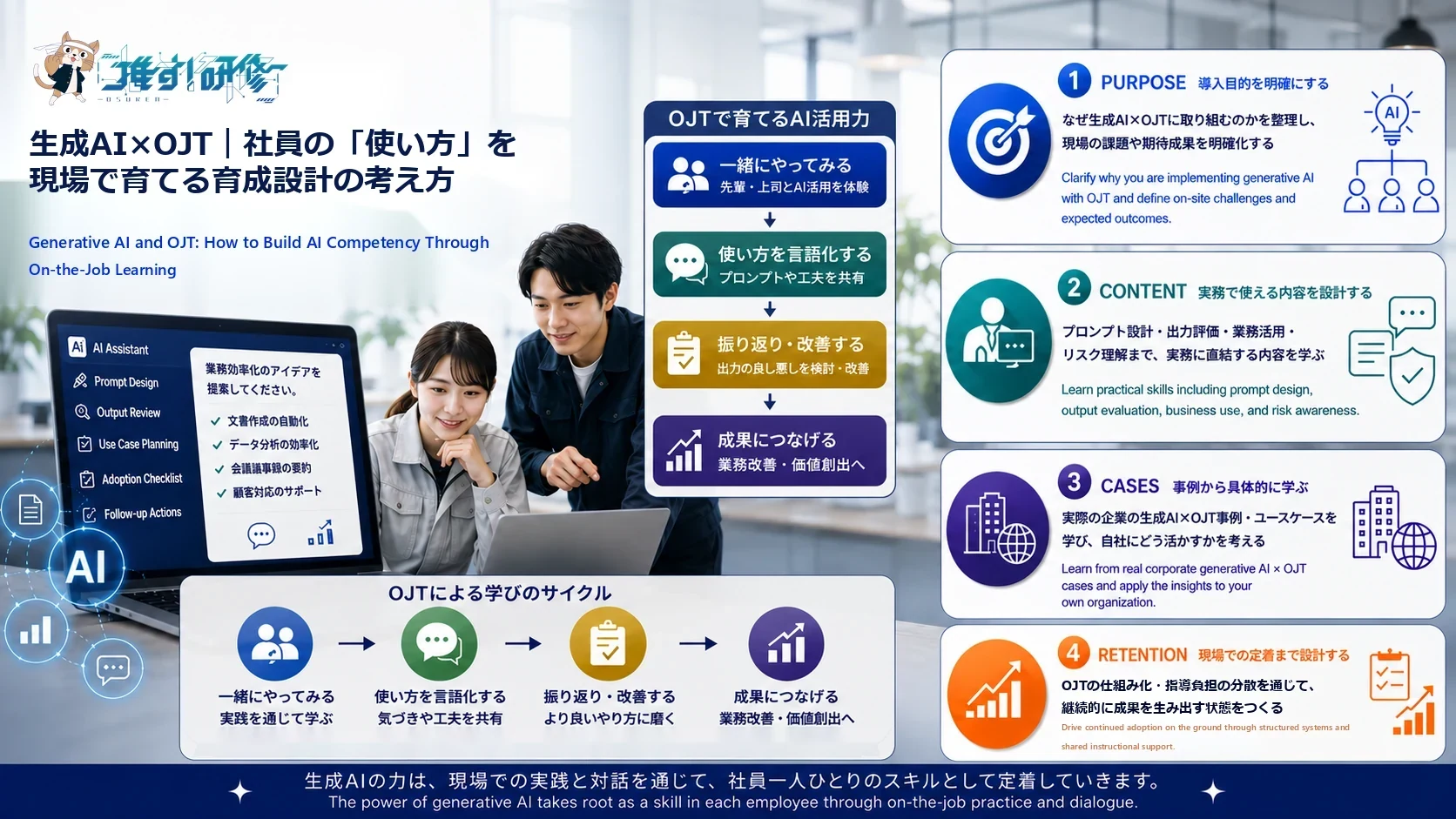
生成AIの業務活用をOJTの中に組み込む際、「見せる・やらせる・振り返る・成果につなげる」という四段階のサイクルを意識することが有効です。これは従来のOJTの基本サイクルと同じですが、生成AIという文脈では、各ステップに固有の意味が生まれます。
When integrating generative AI use into OJT, it is helpful to work through a four-step cycle: show, have them try, reflect together, and connect the results to outcomes. This mirrors the basic cycle of traditional OJT, but within the context of generative AI, each step takes on its own particular meaning.
「見せる」——上司・先輩が実際にAIを使う場面を見せることが、最初の一歩になります。「どんなプロンプトを入力しているか」「出力をどう判断・修正しているか」「どの業務では使わないと判断しているか」——こうした実務上の判断プロセスを目の前で見ることで、部下・後輩は「自分の仕事にも使えそうだ」という具体的なイメージを得やすくなります。
“Show” — having a manager or senior colleague demonstrate actual AI use is the first step. Watching in real time how someone formulates a prompt, how they evaluate and refine the output, and when they decide not to use AI for a particular task gives junior staff a concrete sense of what it might look like to use it in their own work.
「やらせる」——実際の業務の中でAIを試させることが、最も重要なステップです。架空の課題ではなく、自分が明日取り組む実際の仕事でAIを使ってみることで、「自分の業務にどう接続するか」という感覚が身につきます。最初から完璧に使いこなすことを求めず、まず試してみることへの心理的ハードルを下げる設計が重要です。
“Have them try” — this is the most important step: having staff actually try using AI within their real work. Rather than working on a hypothetical exercise, applying AI to a task they will genuinely be tackling tomorrow helps them develop a feel for how it connects to their own job. The design priority at this stage is lowering the psychological barrier to trying — not expecting perfect competency from the start.
「振り返る」——試した結果を上司・先輩と一緒に確認することで、学びが深まります。「うまくいったか」だけでなく、「なぜうまくいったか・いかなかったか」「次はどう使うか」を言語化する機会を設けることで、経験が知識として定着していきます。この振り返りの場こそ、AIを「なんとなく使う」段階から「判断して使う」段階へと移行させる重要な機会です。
“Reflect together” — checking in with a manager or senior colleague on how things went deepens the learning. Creating an opportunity to put into words not just “did it work?” but “why did it work, or why didn’t it?” and “how would I approach this differently next time?” is what allows experience to consolidate into knowledge. This reflective moment is precisely the opportunity that moves people from using AI intuitively or inconsistently to using it deliberately and with sound judgment.
「成果につなげる」——振り返りで得た気づきを、個人の学びで終わらせず、実際の業務改善や成果につなげていくことが、最後の仕上げです。振り返りの中で見えてきた「うまくいった使い方」を、次の業務でも意識的に再現したり、チーム内で共有したりすることで、一人の気づきが組織としての成果に育っていきます。PDCAサイクルにおける「Act(改善・次の行動への反映)」に近い視点であり、学びを学びのままで終わらせない、という姿勢がここで問われます。
“Connect to outcomes” — the final step is ensuring that the insights gained through reflection don’t remain purely personal learning, but are carried forward into actual business improvement and results. By deliberately repeating an approach that worked well, or sharing it with the team, one person’s insight can grow into an organizational outcome. This mirrors the “Act” stage of the PDCA cycle — the discipline of not letting learning stop at learning.
「どの業務にAIを使うか」の判断力をどう育てるか How to Develop the Judgment for When to Use AI
生成AIの業務活用において、最も重要でかつ最も習得が難しいスキルの一つが、「この業務にAIを使うかどうか」を判断する力です。ハルシネーション(AIによる事実誤認)・情報漏洩リスク・著作権への配慮——これらのリスクを理解したうえで、どの業務にどのようにAIを使うかを判断できる社員を育てることが、研修担当者の本質的な目標であるはずです。
Among the skills involved in putting generative AI to use at work, one of the most important — and the most difficult to develop — is the judgment for whether to use AI for a given task in the first place. Hallucination (AI-generated factual errors), the risk of information leakage, and considerations around copyright: developing employees who understand these risks and can make informed decisions about how and when to use AI in their work is, at its core, what training coordinators should be aiming for.
この判断力は、集合研修でリスクの一覧を学ぶだけでは身につきません。実際の業務の中で「このアウトプットは信頼できるか」「この情報を入力してよいか」と立ち止まる経験を積み重ねることで、初めて判断力として定着します。OJTの中で上司が「なぜここでAIを使わないのか」「ここは確認が必要だ」という判断を見せ、言語化する機会をつくることが、社員の判断力育成に直結します。
This kind of judgment cannot be developed simply by going through a list of risks in a group training session. It is only by accumulating experience of pausing in real work situations to ask “can I trust this output?” or “is it appropriate to input this information?” that judgment becomes genuinely internalized. When managers make their own decision-making visible within OJT — showing why they chose not to use AI in a particular case, or flagging where verification is needed — they are directly contributing to the development of their team members’ judgment.
ここには、見落とされがちな構造的な難しさもあります。AIの出力が正しいかどうかを判断するには、そもそもその業務についての一定の専門性が必要です。しかし、新人や若手はまさにその専門性を身につけている最中であるため、AIの誤りに気づけないという「鶏と卵」の問題が生じます。この構造がある限り、新人が生成AIだけを頼りに一人で学ぶことには限界があります。OJTの中で指導者が「ここは一見正しく見えるが、実は現場の実態と違う」といった具体的な誤りの指摘を重ねることで、新人は徐々に自分自身でAIの出力を検証できる専門性を獲得していきます。つまり、指導者の役割は「AIの使い方を教えること」だけでなく、「AIを検証するために必要な業務知識そのものを育てること」へと広がっていくのです。
There is also a structural difficulty here that is easy to overlook. Judging whether an AI output is correct requires a certain degree of domain expertise in the first place. Yet new hires and junior staff are precisely in the process of developing that expertise, which creates a chicken-and-egg problem: they may not yet be equipped to notice when AI has gotten something wrong. Given this structural constraint, there are real limits to what a new employee can learn by relying on generative AI alone. When a mentor repeatedly points out concrete instances within OJT — “this looks correct at first glance, but it doesn’t match how things actually work here” — the new employee gradually builds the expertise needed to verify AI output independently. In other words, the mentor’s role expands beyond “teaching how to use AI” to include cultivating the underlying job knowledge that makes verifying AI possible in the first place.
この鶏と卵の問題に対する現実的な解決策の一つが、AIの関与度を業務の習熟段階に応じて段階的に引き上げていく「スキャフォールディング(足場かけ)」型の設計です。最初の段階では、新人がAIを使って作成したアウトプットを、必ず指導者が確認してからでなければ業務に反映しない、という運用にします。次の段階では、新人自身に「このアウトプットのどこを確認すべきか」をチェックリスト形式で言語化させ、指導者はその確認結果だけを確認する形に移行します。そして習熟が進んだ段階で初めて、新人が自律的にAIの出力を検証し、判断できる状態に到達します。この三段階を意識的に設計することで、「新人に任せすぎて誤りを見逃す」リスクと「いつまでも指導者の確認待ちになる」非効率の両方を避けることができます。また、確認すべき観点をチェックリスト化する過程そのものが、暗黙知だった指導者の判断基準を形式知に変換する機会にもなります。
この設計には、もう一つ見逃せない効果があります。新人のアウトプットを毎回確認するという行為そのものが、指導者自身にとってもAIの癖や誤りやすいパターンを体系的に把握し直す機会になる、という点です。指導者は普段、自分自身の業務でAIを使う際には、無意識のうちに経験則で誤りを避けています。しかし、新人のアウトプットを一件ずつ検証し、「なぜここが誤っているのか」「どう伝えれば新人にも判断できるようになるか」を言語化する過程を通じて、指導者自身も自分の暗黙知を再点検し、より解像度の高いAI活用スキルへと磨き直すことになります。つまりこのスキャフォールディング設計は、新人の育成であると同時に、指導者自身のAIリテラシーを引き上げる場としても機能する——この双方向性を意識して設計することで、OJTはより持続的な仕組みになっていくはずです。
One practical response to this chicken-and-egg problem is a “scaffolding” design that gradually increases the degree of autonomy given to AI-assisted work as proficiency develops. In an initial stage, output that a new employee produces using AI is never reflected in actual work until a mentor has reviewed it. In a subsequent stage, the new employee is asked to articulate, in checklist form, exactly what should be checked in that output — and the mentor reviews only that checklist rather than the output itself. Only once proficiency has developed further does the new employee reach a stage of verifying and judging AI output independently. Deliberately designing these three stages helps avoid both the risk of handing over too much autonomy too soon and missing errors, and the inefficiency of new employees remaining permanently dependent on a mentor’s review. The process of building that checklist also has a secondary benefit: it converts a mentor’s previously tacit judgment criteria into something explicit and shareable.
This design carries one more benefit worth noting. The very act of reviewing a new employee’s output each time gives the mentor an opportunity to systematically re-examine their own sense of AI’s quirks and typical failure patterns. In their own day-to-day work, mentors tend to avoid AI’s errors unconsciously, through accumulated experience and intuition. But by verifying a new employee’s output case by case, and putting into words why something is wrong and how to explain it in a way the new employee can act on, mentors end up re-examining their own tacit knowledge and developing a more explicit and sophisticated understanding of effective AI use. In other words, this scaffolding design functions not only as a way of developing new employees, but also as a space in which the mentor’s own AI literacy is raised. Designing with this reciprocity in mind is what allows OJT to become a more sustainable structure over time.
企業事例から学ぶ:現場定着に成功した取り組み Learning from the Field: Approaches That Have Made AI Adoption Stick
生成AIの業務活用が現場に定着するかどうかは、研修の内容だけでなく、日常業務の中での支援設計に大きく左右されます。以下の二つの事例は、いずれも「研修して終わり」にしない仕組みを意識的に設計した取り組みとして参考になります。
Whether generative AI use takes root in the workplace depends not only on the content of training programs but to a great extent on how support is designed within day-to-day work. The two cases below are both noteworthy for having deliberately designed structures that go beyond “deliver training and stop.”
事例①:株式会社アトレ「AIメンター」戦略 Case ①: Atre Corporation — “AI Mentor” Strategy
首都圏の駅ビルを運営する株式会社アトレは、2025年4月よりGoogleの生成AI「Gemini」を全社員に展開し、「AIメンター」と呼ぶ独自の定着戦略を開始しました。同社の取り組みで特に注目されるのは、AI活用をゲーミフィケーションで可視化した点です。社員のAI活用状況と習熟度を独自の10段階で数値化する「Geminiステータスボード」を設け、社員が自分の成長を実感しながら学べる設計にしました。また、AI活用頻度の高いエキスパート社員が自分の使い方を他部署にオンラインでデモ紹介するという、社員同士が教え合う「横展開型のOJT」の仕組みも特徴的です。導入から約2か月半で全社員の利用率が82%に達し、2026年6月時点では社員の9割が月1回以上Geminiを活用するまでに定着しています(出典:株式会社アトレ プレスリリース「全社員に寄り添う『AIメンター』戦略を始動。」2025年6月24日、流通ニュース「商業施設のデジタル活用 第2回アトレ/社内のAI活用、定着の鍵は『自分事』」)。
Atre Corporation, which operates station building retail complexes across the Greater Tokyo Area, rolled out Google’s generative AI “Gemini” to all employees in April 2025 and launched a proprietary adoption strategy it calls “AI Mentor.” What stands out in the company’s approach is how it used gamification to make AI use visible. A “Gemini Status Board” was introduced that quantifies each employee’s AI use and proficiency across a proprietary ten-level scale, giving staff a tangible sense of their own growth as they develop their skills. The company also established a form of peer-to-peer OJT, in which employees who are frequent, advanced AI users demonstrate their approaches to colleagues in other departments through online sessions. Within roughly two and a half months of launch, usage had reached 82% of all employees, and by June 2026, nine in ten staff were using Gemini at least once a month (Source: Atre Corporation Press Release, “Launching the ‘AI Mentor’ Strategy for All Employees,” June 24, 2025; Ryutsuu News, “Digital Adoption in Commercial Facilities, Part 2: Atre”).
事例②:インソース株式会社「AI-OJT」プラットフォーム Case ②: Insource Co., Ltd. — “AI-OJT” Platform
研修会社のインソース株式会社は2025年10月、企業が保有する事故報告書などの社内文書をAIが自動解析し、数分程度で企業独自のケーススタディ教材を生成するプラットフォーム「AI-OJT」を提供開始しました。このサービスの設計思想は、今回のテーマと直接的に接続します。「汎用的な教材では自分ごと化しにくい」というOJT教育の構造的な課題に対して、自社で実際に起きた事例を教材化することで、受講者が現場を疑似体験できる学びを実現しています。リリース以降50社を超える企業にデモ実演を実施し、2026年2月13日には中堅・中小企業や特定部門向けに、月額55,000円(税込)から利用できるベーシックプランも追加されました。(出典:インソース株式会社「事故報告書をもとにAIがケース教材を自動生成する『AI-OJT』提供開始」2025年10月24日、同「AI活用による事故・不祥事予防教育が月5万円から!『AI-OJT』、新価格プランを提供開始」2026年2月13日)
Training company Insource Co., Ltd. launched a platform called “AI-OJT” in October 2025, which automatically analyzes internal documents such as accident reports and generates company-specific case study materials in just a few minutes. The design philosophy behind this service connects directly to the theme of this article. In response to a structural challenge in OJT education — that generic materials are difficult for participants to see as relevant to their own situation — the platform creates learning materials from incidents that actually occurred within the organization, enabling participants to engage with scenarios they can genuinely recognize as their own. Since launch, the platform has been demonstrated to more than fifty organizations, and on February 13, 2026, a basic plan priced from ¥55,000 per month, tax included, was added for midsize and small companies and for use within individual departments. (Source: Insource Co., Ltd., “Launch of ‘AI-OJT’: AI Automatically Generates Case Study Materials from Accident Reports,” October 24, 2025; Insource Co., Ltd., “AI-Driven Accident and Misconduct Prevention Training From ¥55,000: New Pricing Plans for ‘AI-OJT’,” February 13, 2026)
二つの事例に共通しているのは、「ツールを導入するだけでは人は動かない。日常の中に学びと支援の仕組みを組み込むことで、初めて活用が定着する」という設計思想です。この視点は、生成AIの業務活用をOJTで支援しようとするすべての組織に共通して示唆を持つものといえるでしょう。
What the two cases share is a common design philosophy: “introducing the tool alone is not enough to move people; it is only by embedding learning and support structures into day-to-day work that adoption genuinely takes hold.” This perspective carries implications for any organization seeking to support the practical application of generative AI through on-the-job learning.
「教える側」の負担をどう設計するか——エキスパート依存のリスク Designing for the Burden on “Teachers” — The Risk of Over-Reliance on Experts
OJTを通じた生成AI活用の育成を語るとき、見落とされがちな論点があります。それは、「見せる」役割を担う指導者・エキスパート社員に、正当な評価や負担軽減の仕組みがなければ、この設計自体が持続可能ではないという点です。パーソル総合研究所の調査によると、生成AIを週4日以上活用する「ヘビーユーザー」ほど、周囲への利用支援や使い方の指導に関する負担を感じやすく、AI活用に関する周囲への教育・支援が、正式な業務や評価対象として十分に位置づけられていないことも示唆されています。また、ヘビーユーザーほど「人に教える頻度」が増えている一方で、そうした普及の負担が特定の層に集中していることも指摘されています。(出典:パーソル総合研究所「生成AIとはたらき方に関する実態調査」)
When discussing the development of generative AI competency through OJT, there is a point that is easy to overlook: unless there is proper recognition and workload relief for the mentors and expert employees who take on the “show” role, this design is simply not sustainable. Research from Persol Research and Consulting found that “heavy users” of generative AI — those using it four or more days a week — are more likely to feel burdened by supporting colleagues and providing informal instruction, and the research suggests that education and support for AI use among colleagues is often not formally recognized as part of job duties or performance evaluation. The research also found that while heavy users are teaching others with increasing frequency, the burden of driving broader adoption is concentrated on this specific group. (Source: Persol Research and Consulting, “Survey on Generative AI and Ways of Working”)
この点は、前述したアトレの「横展開型OJT」——エキスパート社員が他部署にデモ紹介するという仕組み——を評価するうえでも重要な視点です。こうした仕組みは、AI活用が得意な社員の善意や積極性に依存したままでは、いずれ特定の社員への負担集中という形で限界を迎える可能性があります。OJTを通じた生成AI活用の育成を組織として設計するのであれば、「教える」という行為そのものを業務の一部として正式に位置づけ、評価や工数の面で報いる仕組みをあわせて検討する必要があるでしょう。指導者を「ボランティア」に頼る設計は、短期的には機能しても、中長期的には持続しにくいという構造を、研修担当者は意識しておく価値があります。
This is an important consideration when evaluating Atre’s “peer-to-peer OJT” approach discussed earlier — where expert employees demonstrate their methods to colleagues in other departments. If such mechanisms continue to rely on the goodwill and initiative of employees who happen to be skilled AI users, they risk eventually running into limits as the burden concentrates on that same small group. If an organization is going to design AI competency development through OJT deliberately, it is worth also considering how to formally position “teaching” as part of the job itself — and how to recognize it through evaluation or allocated time. A design that relies on mentors as unpaid volunteers may work in the short term, but training coordinators are well advised to keep in mind that it tends to be difficult to sustain over the longer term.
具体的には、三つの対応策が考えられます。一つ目は、指導・支援に費やした時間を業務工数として明示的に記録・可視化する仕組みです。「見えない負担」を「見える工数」に変えるだけでも、組織としての評価対象にしやすくなります。二つ目は、指導役を固定化せず、月ごと・案件ごとにローテーションする設計です。特定のエキスパート社員に依存し続けるのではなく、複数の社員が持ち回りで指導役を担うことで、一人当たりの負担を分散できます。三つ目は、繰り返し発生する質問や指導内容をAIを使って形式知化し、FAQやナレッジベースとして蓄積する仕組みです。これは前述のインソース社「AI-OJT」のように、指導者の知見をAIで教材化するアプローチと同じ発想であり、一対一の口頭指導に頼らずに済む部分を増やすことで、指導者本人の負担を実質的に軽減できます。人事評価の項目に「AI活用支援・指導実績」を明示的に加えることも、こうした仕組みを機能させるうえでの後押しになるでしょう。
Three concrete responses are worth considering. The first is explicitly recording and making visible the time spent on mentoring and support as part of workload tracking. Simply converting an “invisible burden” into “visible hours” makes it far easier for an organization to formally recognize and evaluate. The second is rotating the mentoring role rather than fixing it to the same people — by month, or by project. Rather than continuing to rely on the same expert employees indefinitely, distributing the role among several staff members on a rotating basis spreads the burden more evenly. The third is using AI itself to convert recurring questions and mentoring content into explicit, shareable knowledge — building it into an FAQ or knowledge base. This mirrors the same underlying idea behind Insource’s “AI-OJT” platform discussed earlier — turning a mentor’s expertise into reusable teaching material via AI — and by reducing the portion of instruction that depends on one-on-one verbal explanation, it genuinely lightens the mentor’s own load. Explicitly adding “AI mentoring and support contributions” as a criterion in performance evaluation would further reinforce these mechanisms.
上司・先輩自身がAIを使いこなしていない場合 When Managers and Senior Staff Aren’t Confident AI Users Themselves
「OJTでAI活用を支援したいが、自分自身もAIをうまく使いこなせていない」——そう感じている管理職・指導者は少なくないはずです。しかし、これは必ずしも障壁にはなりません。「一緒に学ぶOJT」という設計が、こうした状況では有効に機能する場合があります。指導者が答えを持って教える形ではなく、「自分もまだ試行中だが、一緒にやってみよう」というスタンスで部下と共にAIを試みることは、心理的安全性の観点からも効果的です。AI活用において「失敗していい」という雰囲気は、組織全体のAIリテラシーを高めるうえで重要な土台になります。
“I want to support AI use through OJT, but I’m not fully confident using it myself” — many managers and senior staff are likely to feel this way. This does not have to be a barrier, however. A design of “learning together” can work effectively in this kind of situation. Rather than a model in which the instructor already has the answers, approaching it with the stance of “I’m still figuring this out too, but let’s try it together” is also effective from the perspective of psychological safety. An atmosphere in which “it’s okay to get it wrong” when using AI is an important foundation for raising AI literacy across the organization.
おわりに:生成AI活用力は「現場で育てる」時代へ Closing: Building AI Competency in the Workplace
生成AIの業務活用は、一度の集合研修で完結するスキルではありません。日常業務の中で試し、振り返り、改善するサイクルをOJTとして設計することが、組織全体のAI活用力を底上げする現実的な道筋になると考えられます。ただし、ここまで見てきたとおり、この道筋は単純な一本道ではありません。AIが「先輩に聞く」という関係性そのものを代替してしまうリスク、新人がAIの誤りを見抜くための専門性をまだ持っていないという構造的な難しさ、そして指導を担う社員への負担が特定の層に偏りやすいという組織的な課題——これらを踏まえたうえで初めて、OJTは生成AI活用の育成手法として実効性を持ちます。
「見せる・やらせる・振り返る・成果につなげる」という四段階のサイクルを日常の中に意識的に組み込みながら、AIに聞くべきことと人に聞くべきことを切り分け、指導者の負担を組織として正式に支える——こうした複数の視点を同時に設計に織り込むことが、研修室で学んだことを現場の力に変えていく、有力かつ現実的な方法ではないでしょうか。
Applying generative AI at work is not a skill that can be fully developed in a single group training session. Designing into the flow of daily work a cycle of trying, reflecting, and refining — and treating that as OJT — is arguably the most realistic path to raising AI competency across an organization. As this article has explored, however, that path is not a simple, straight one. The risk that AI substitutes for the very relationship of “asking a senior colleague,” the structural difficulty that new employees don’t yet have the expertise needed to catch AI’s mistakes, and the organizational challenge that the burden of mentoring tends to concentrate on a small group of employees — it is only once these are accounted for that OJT becomes a genuinely effective method for developing generative AI competency.
Deliberately building the four-step cycle of “show, have them try, reflect together, and connect the results to outcomes” into everyday practice, while distinguishing what should be asked of AI from what should be asked of a person, and formally supporting the organizational burden carried by mentors — weaving all of these considerations together into the design offers a practical and credible way to turn what is learned in the training room into real capability in the workplace.
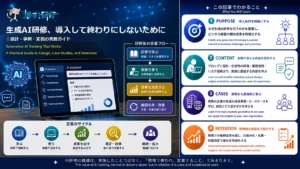
- 生成AI研修、導入して終わりにしないために|設計・事例・定着の実務ガイド Generative AI Training That Sticks: A Practical Guide to Design, Case Studies, and Retention
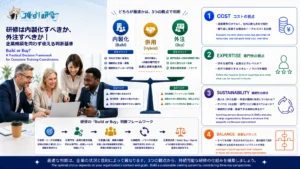
- 研修は内製化すべきか、外注すべきか|企業規模を問わず使える判断基準 Build or Buy? A Practical Decision Framework for Corporate Training Coordinators
この記事を書いた人

関連記事
-
 研修は内製化すべきか、外注すべきか|企業規模を問わず使える判断基準 Build or Buy? A Practical Decision Framework for Corporate Training Coordinators
 -
生成AI研修、導入して終わりにしないために|設計・事例・定着の実務ガイド Generative AI Training That Sticks: A Practical Guide to Design, Case Studies, and Retention
-
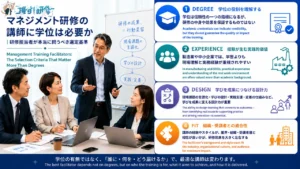
マネジメント研修の講師に学位は必要か|研修担当者が本当に問うべき選定基準 Management Training Facilitators: The Selection Criteria That Matter More Than Degrees
-
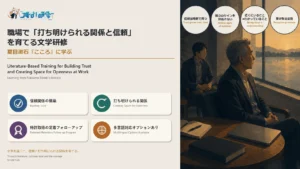
夏目漱石『こころ』に学ぶ——職場で「打ち明けられる関係と信頼」を育てる文学研修 Learning from Natsume Sōseki’s Kokoro: Literature-Based Training for Building Trust and Creating Space for Openness at Work
-
芥川龍之介『藪の中』に学ぶ——職場で「事実と解釈を見分ける力」を育てる文学研修 Learning from Akutagawa Ryūnosuke’s Yabu no Naka: Literature-Based Training for Distinguishing Facts from Interpretations at Work
-
森鷗外『最後の一句』に学ぶ——職場で「言うべきことを言える人」を育てる文学研修 Learning from Mori Ōgai’s Saigo no Ikku: A Literary Approach to Developing People Who Speak Up at Work
-
新入社員フォローアップ研修とは? What Is New Employee Follow-Up Training? Purpose, Themes, and Design for HR Professionals
-
研修報告書・レポートの目的と活用法 How to Make the Most of Training Reports: Purpose, Report Design, and Follow-Up