芥川龍之介『藪の中』に学ぶ——職場で「事実と解釈を見分ける力」を育てる文学研修 Learning from Akutagawa Ryūnosuke’s Yabu no Naka: Literature-Based Training for Distinguishing Facts from Interpretations at Work
「部下から報告を受けたが、上司と内容が食い違っている」「同じ会議に出ていたはずなのに、メンバーによって話の内容がまったく異なる」「誰かが嘘をついているのか、それとも全員が本当のことを言っているのか——判断がつかない」——そのような経験を、職場で一度ならず感じたことのある方は少なくないはずです。
“I received a report from a team member, but it contradicted what the manager said.” “We were all in the same meeting, yet everyone seems to remember it differently.” “Is someone lying — or is everyone telling the truth as they see it?” These are experiences that many professionals encounter more than once in their careers.
オスケン株式会社の「Osuken Literary Training(OLT)シリーズ」第2弾で使用するテキストが、芥川龍之介の短編小説『藪の中』(1922年)です。本記事では、なぜこの作品が「情報・報告・コミュニケーション」をテーマとする法人研修の素材として優れているのかを解説します。
The second text in Osuken Inc.’s Osuken Literary Training (OLT) Series is Akutagawa Ryūnosuke’s short story Yabu no Naka (“In a Grove”, 1922). This article explains why this work stands out as an exceptional text for corporate training on the themes of information, reporting, and communication.
目次
『藪の中』とはどんな物語か What Is “In a Grove”?
舞台は平安時代の山科。藪の中で武士の男が死体となって発見されます。検非違使(当時の警察機構)による取り調べの場で、木樵・旅法師・放免(ほうめん)・媼(おうな)・盗人の多襄丸(たじょうまる)・妻の真砂(まさご)・そして死んだ夫(巫女の口を借りた死霊)の7者が、それぞれの立場から証言します。
The story is set in Heian-period Yamashina. A samurai is found dead in a grove. Before the magistrate, seven witnesses give their accounts: a woodcutter, a traveling monk, a police agent, an old woman, the bandit Tajōmaru, the wife Masago, and the dead husband himself — speaking through a medium.
しかし7者の証言は、互いに矛盾しています。殺したのは誰か。真実はどこにあるのか。作品は最後まで、唯一の正解を示しません。読者は複数の「真実」を前に、どれが本当かを判断できないまま物語が終わります。
Yet the seven accounts contradict one another. Who killed the man? Where does the truth lie? The story never provides a definitive answer. The reader is left facing multiple competing “truths,” with no way to determine which is real.
この構造こそが、作品最大の特徴です。芥川が描いたのは、単純に「嘘をつく人間」ではありません。むしろ、それぞれが自己保護や羞恥、立場や感情に影響されながら、「自分にとっての真実」を語ってしまう人間の姿です。
This structure is the work’s defining feature. What Akutagawa depicts is not simply people who lie, but rather people who, shaped by self-protection, shame, circumstance, and emotion, cannot help but speak the truth as they experience it.
『藪の中』が職場教育のテキストになる理由 Why “In a Grove” Works as a Text for Corporate Training
本研修では、この作品を通じて参加者に問いかけます。
In this program, participants are invited to reflect on a central question through this work.
「あなたの職場で起きた出来事について、あなたはどれだけ『自分が見た通りの真実』を語っていますか。そして、他者の証言をどれだけ『正確な事実』として受け取っていますか」
“When you describe something that happened at work, how much of what you say reflects the truth as you experienced it? And how much do you treat others’ accounts as objective fact?”
7者の証言をビジネス文脈に置き換えると、現代の職場に直結する4つの示唆が浮かびます。
When the seven testimonies are transposed into a business context, four insights emerge that connect directly to the modern workplace.
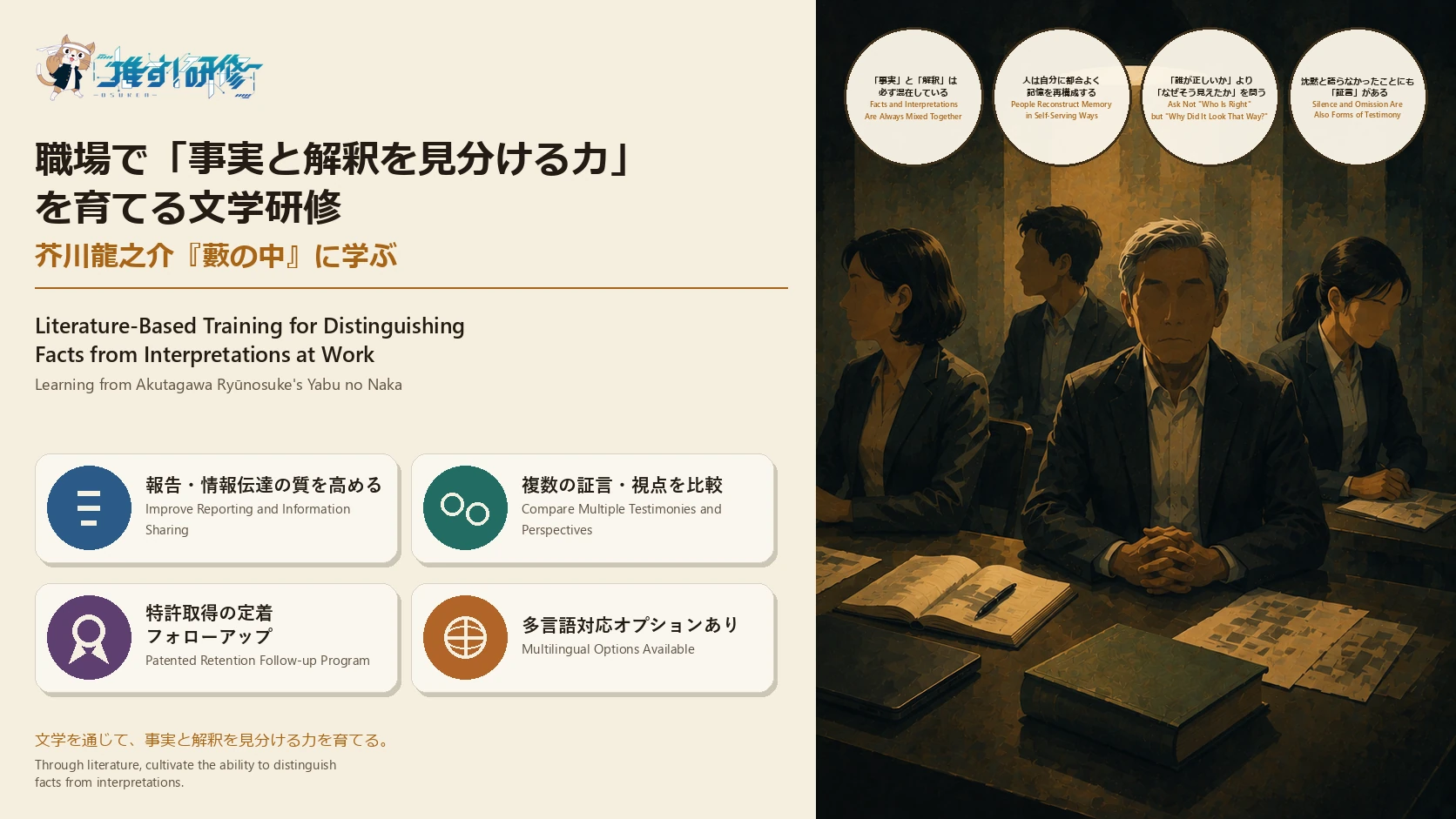
示唆① 「事実」と「解釈」は必ず混在している Insight 1: Facts and Interpretations Are Always Mixed Together
木樵や旅法師は「見たこと」を証言しています。しかしその証言にも、無意識の選択と解釈が混じっています。職場における報告・連絡・相談においても、「客観的な事実の報告」と「話者の解釈や感情が混じった報告」は、常に区別が難しい。この作品は、その境界線の曖昧さを鮮明に可視化します。
The woodcutter and the monk testify to what they witnessed — yet even their accounts carry unconscious choices and interpretations. In workplace reporting and communication, the line between “objective facts” and “accounts shaped by the speaker’s interpretation or emotion” is always difficult to draw clearly. This work makes that blurred boundary visible in striking terms.
示唆② 人は自分に都合よく記憶を再構成する Insight 2: People Reconstruct Memory in Self-Serving Ways
多襄丸・真砂・夫の三者はそれぞれ、自分が最も「まともに見える」証言をしています。嘘をついているというより、記憶そのものが、自己保護のために無意識に書き換えられているのです。トラブル発生時の職場での証言収集や、人事評価・360度フィードバックの解釈において、この視点は不可欠です。
Tajōmaru, Masago, and the dead husband each give the testimony that makes themselves appear most credible. Rather than outright lying, their memories have been unconsciously rewritten in the service of self-protection. This perspective is essential when gathering accounts of workplace incidents, or when interpreting performance reviews and 360-degree feedback.
示唆③ 「誰が正しいか」より「なぜそう見えたか」を問う Insight 3: Ask Not “Who Is Right” but “Why Did It Look That Way?”
『藪の中』を読んだ読者が最初に感じるのは、「犯人は誰か」という問いへの衝動です。しかし作品は意図的にその答えを与えません。「正しい側を決める」ことよりも「それぞれがなぜそう見えたかを理解する」ことの方が、問題解決において本質的である——そのことをこの作品は静かに示しています。管理職が部下のトラブル対応をする場面で、この視点は決定的に重要になります。
The first impulse readers feel upon reading “In a Grove” is the urge to find out who committed the crime. But the story deliberately withholds that answer. Understanding why each person saw what they saw is more essential to resolving a problem than deciding who is right — and the story makes this point with quiet force. For managers handling conflict between team members, this shift in perspective can be decisive.
示唆④ 沈黙と語らなかったことにも「証言」がある Insight 4: Silence and Omission Are Also Forms of Testimony
7者の証言で注目すべきは、「語ったこと」だけではありません。誰が何を語らなかったか、どこで言葉が途切れたかも、重要な情報を含んでいます。媼が「跡は泣き入りて言葉なし」で証言を終える場面は、言語化されない感情が証言全体を支配していることを示します。職場での1on1や面談において、部下が「語らなかったこと」に耳を傾ける力は、管理職の核心的なスキルです。
In the seven testimonies, what deserves attention is not only what was said. Who said nothing, and where words broke off, carries equally important information. The moment when the old woman ends her testimony with “she dissolved into tears and could say no more” shows how unspoken emotion can govern an entire account. The ability to listen for what a team member does not say — in a one-on-one or review conversation — is a core skill for any manager.
なぜ「文学」を研修に使うのか Why Use Literature in Training?
「文学を読んで、何が変わるのか」という疑問は当然です。ケーススタディやロールプレイングは、具体的な対応方法や判断の型を学ぶのに適しています。一方、文学作品には「正解がない問い」が内包されており、参加者が自分の解釈を持ち、他者の解釈と出会うことで、自分では気づかなかった思考の枠組みが浮かび上がります。これが、通常の研修では得にくい「深い内省」を生む仕組みです。
The question “what can reading literature actually change?” is entirely reasonable. Case studies and role-play are well suited for learning practical responses and patterns of judgment. Literature, on the other hand, contains questions with no single correct answer — and when participants form their own interpretations and encounter the interpretations of others, frameworks of thinking they had never noticed in themselves come to the surface. This generates the kind of deep reflection that conventional training rarely reaches.
また文学は、直接的な自己分析とは異なり、作品を介することで参加者の構えが自然にほぐれ、より本音に近い対話が生まれます。「自分はどうか」を問う前に「多襄丸はどうか」「真砂はどうか」を議論することで、職場でのコミュニケーションの歪みが、安全な距離を保ちながら言語化されていきます。
Unlike direct self-analysis, engaging with literature naturally softens participants’ guard, and dialogue that comes closer to genuine feeling becomes possible. By first discussing “what about Tajōmaru?” or “what about Masago?” before asking “what about you?”, the distortions in workplace communication begin to find words — at a safe distance.
プログラムの到達目標 Program Objectives
本プログラムの到達目標は、参加者が「事実」と「解釈」を分けて報告を受け止める力、複数の証言・視点を比較して状況を整理する力、そして一方的な断定を避けながら対話を進める力を身につけることです。
The objective of this program is for participants to develop the ability to distinguish facts from interpretations when receiving reports, compare multiple accounts and perspectives to understand a situation clearly, and conduct dialogue without rushing to one-sided conclusions.
プログラム概要 Program Overview
| 項目 Item | 内容 Details |
|---|---|
| 使用テキスト Text | 芥川龍之介『藪の中』(青空文庫) Yabu no Naka (“In a Grove”) by Akutagawa Ryūnosuke (Aozora Bunko) |
| 対象者 Participants | 中間管理職・リーダー層、人事・コンプライアンス担当者(5〜15名) Middle managers, team leaders, and HR / compliance professionals (5–15 participants) |
| 所要時間 Duration | 半日(3.5時間)〜全日 Half-day (3.5 hrs) to full-day |
| 提供形式 Format | 対面ワークショップ(オンライン対応可) In-person workshop (online delivery available) |
| 多言語対応 Languages | 多言語対応オプションあり(外国籍人材混在チーム向け) Multilingual options available |
| フォローアップ Follow-up | 受講者の理解度に応じた段階的フォローアップを半年以上にわたって実施(特許第7578861号) Patented retention follow-up program spanning more than six months, with intervals tailored to each participant’s level of understanding (Patent No. 7578861) |
テーマは企業の課題に応じて以下の4つから選択・組み合わせが可能です。
The program theme can be selected or combined from the following four options according to your organization’s needs.
- 報告・情報伝達の質と精度(若手・中堅向け) Accuracy and quality in reporting and information sharing (for early-career and mid-level employees)
- 多面的事実の理解とマネジメント(管理職向け) Understanding multiple perspectives and managing conflict (for managers)
- 組織における信頼と証言(管理職・幹部向け) Trust, testimony, and accountability in organizations (for managers and senior leaders)
- 意思決定における不確実性の受容(経営幹部・人事責任者向け) Accepting uncertainty in organizational decision-making (for executives and HR leaders)
文学研修は、行動変容の本質に向き合う研修である Literary Training Gets to the Heart of Behavioral Change
「文学を使った研修」と聞くと、特殊なプログラムのように聞こえるかもしれません。しかし本質は変わりません。良い研修とは、参加者が自分自身と正直に向き合える場を作ることです。
“Training that uses literature” may sound like something unusual. But the essence does not change. Good training is simply the creation of a space in which participants can face themselves honestly.
『藪の中』の7者は、誰一人「嘘をつこう」とは思っていなかったかもしれません。それでも7つの証言は互いに矛盾します。職場のコミュニケーションにも、これに近い構造がしばしば現れます。その事実に気づくことが、より誠実な対話の出発点になります。
Not one of the seven witnesses in “In a Grove” may have intended to deceive. Yet their seven accounts remain irreconcilably at odds. Workplace communication often contains a similar structure. Recognizing this is where more honest dialogue begins.
お問い合わせ・資料請求 Enquiries and Information Requests
オスケン株式会社では、文学作品を活用した法人向け研修プログラムの設計・運営を支援しています。詳細資料・お見積もりは、下記よりお気軽にお問い合わせください。無料相談(オンライン・対面)も承っております。
Osuken Inc. supports the design and delivery of literary-based corporate training programs. For detailed materials or a quote, please feel free to reach out using the contact details below. Free consultations (online or in person) are also available.
文学研修のご相談・お問い合わせ↓
- 森鷗外『最後の一句』に学ぶ——職場で「言うべきことを言える人」を育てる文学研修 Learning from Mori Ōgai's Saigo no Ikku: A Literary Approach to Developing People Who Speak Up at Work
- 夏目漱石『こころ』に学ぶ——職場で「打ち明けられる関係と信頼」を育てる文学研修 Learning from Natsume Sōseki's Kokoro: Literature-Based Training for Building Trust and Creating Space for Openness at Work
この記事を書いた人

関連記事
-
 研修は内製化すべきか、外注すべきか|企業規模を問わず使える判断基準 Build or Buy? A Practical Decision Framework for Corporate Training Coordinators
 -
生成AI×OJT|社員の「使い方」を現場で育てる育成設計の考え方 Generative AI and OJT: How to Build AI Competency Through On-the-Job Learning
-
生成AI研修、導入して終わりにしないために|設計・事例・定着の実務ガイド Generative AI Training That Sticks: A Practical Guide to Design, Case Studies, and Retention
-
マネジメント研修の講師に学位は必要か|研修担当者が本当に問うべき選定基準 Management Training Facilitators: The Selection Criteria That Matter More Than Degrees
-
夏目漱石『こころ』に学ぶ——職場で「打ち明けられる関係と信頼」を育てる文学研修 Learning from Natsume Sōseki’s Kokoro: Literature-Based Training for Building Trust and Creating Space for Openness at Work
-
森鷗外『最後の一句』に学ぶ——職場で「言うべきことを言える人」を育てる文学研修 Learning from Mori Ōgai’s Saigo no Ikku: A Literary Approach to Developing People Who Speak Up at Work
-
新入社員フォローアップ研修とは? What Is New Employee Follow-Up Training? Purpose, Themes, and Design for HR Professionals
-
研修報告書・レポートの目的と活用法 How to Make the Most of Training Reports: Purpose, Report Design, and Follow-Up