研修は内製化すべきか、外注すべきか|企業規模を問わず使える判断基準 Build or Buy? A Practical Decision Framework for Corporate Training Coordinators
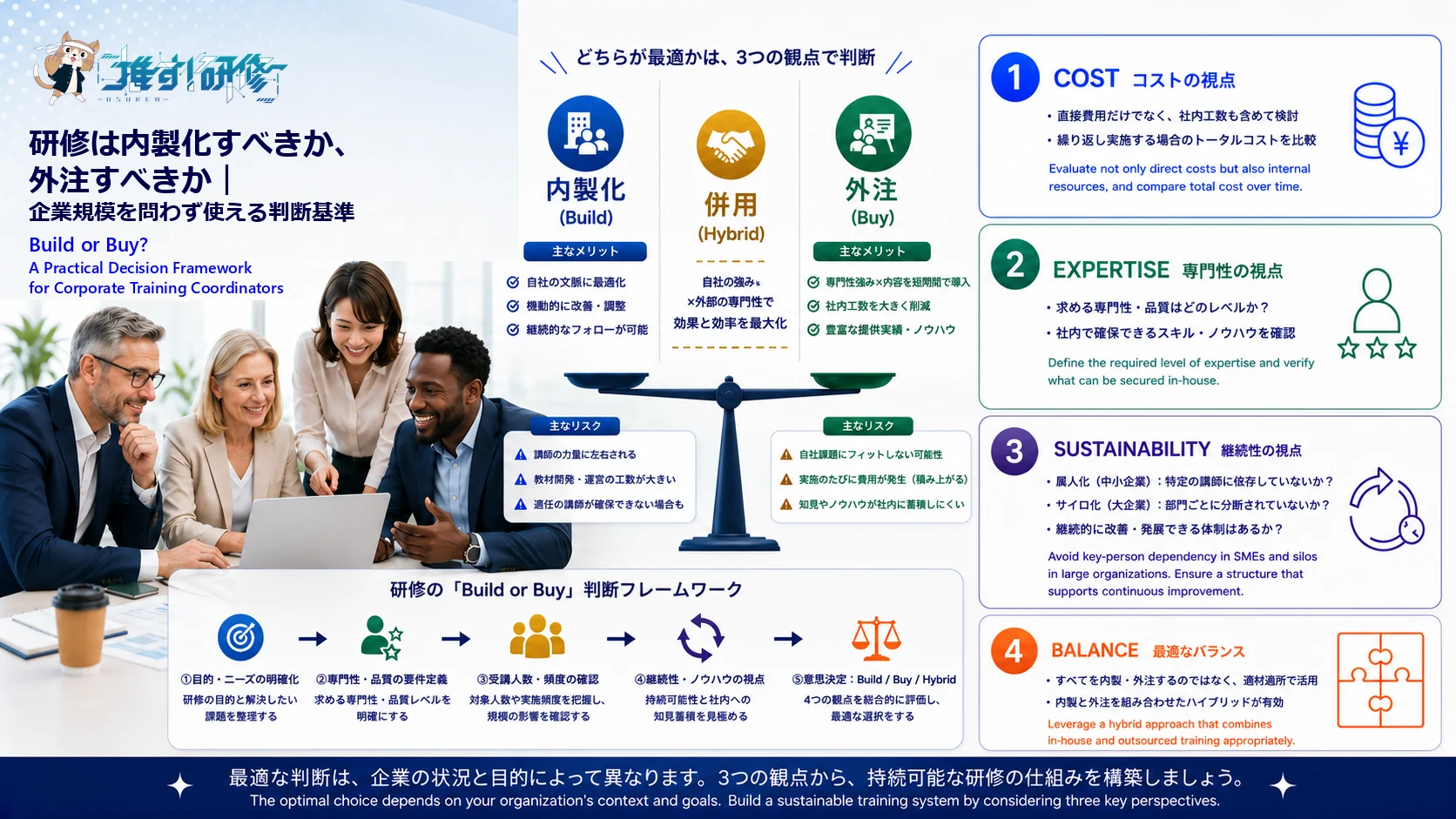
新しい研修ニーズが発生するたびに、研修担当者は「自社で作るか、外部に頼むか」という問いに直面します。この判断軸は、専任の人材開発部門を持つ大手企業にも、限られたリソースで研修を回す中小企業にも共通する課題です。ただし、両者が置かれている制約はまったく異なります。本記事では、コスト・専門性・継続性という三つの観点から、企業規模を問わず活用できる判断枠組みを整理していきたいと思います。
Every time a new training need arises, training coordinators face the same question: build it in-house, or bring in an outside provider? This decision matters just as much to large corporations with dedicated learning and development departments as it does to small and medium-sized enterprises running training with limited resources. Yet the constraints each side operates under are quite different. This article works through that decision along three dimensions — cost, expertise, and sustainability — to arrive at a framework usable regardless of company size.
目次
内製化のメリットとリスク The Benefits and Risks of In-House Training
企業向け研修サービスの市場規模は年々拡大しています。矢野経済研究所の調査によると、2024年度の企業向け研修サービス市場は前年度比4.6%増の5,858億円、2025年度も同水準の伸びで6,130億円と予測されています。(出典:日本経済新聞「矢野経済研究所、企業向け研修サービス市場に関する調査結果を発表」2025年8月)一方で、研修の内製化自体も多くの組織で並行して進んでいます。株式会社LDcubeが実施した調査では、62%の組織が社内トレーナーによる研修を実施していると回答しています。(出典:株式会社LDcube「社内研修・研修内製化の実態と課題」に関する調査)市場全体が拡大する一方で内製化の動きも進んでいるということは、両者が対立する選択肢ではなく、併存し得るものであることを示唆しています。
The market for corporate training services continues to grow year over year. According to research by the Yano Research Institute, Japan’s corporate training services market grew 4.6% year-on-year to ¥585.8 billion in fiscal 2024, with fiscal 2025 projected to grow at a similar rate to ¥613.0 billion. (Source: Nikkei, “Yano Research Institute Publishes Findings on the Corporate Training Services Market,” August 2025) At the same time, in-house training is also expanding across many organizations in parallel. A survey conducted by LDcube Inc. found that 62% of organizations run training using internal trainers. (Source: LDcube Inc., Survey on “The Reality and Challenges of In-House Training”) The fact that the overall market keeps growing even as internalization also advances suggests that the two are not mutually exclusive options, but ones that can coexist.
内製化の利点は明確です。自社の業務文脈に即した内容を作れる、状況に応じて機動的に内容を調整できる、そして研修後のフォローアップまで継続的に担当できるという点です。社内講師は受講者の日常業務を理解しているため、外部委託では実現しにくい、行動変容を意識したきめ細かなフォローアップが可能になります。一方でリスクもあります。研修の質が講師個人の力量に左右されやすいこと、教材開発や運営に相応の社内工数がかかること、そして適任の社内講師が必ずしも確保できるとは限らないことです。特定の講師に依存した体制は、その講師の異動・退職によって研修の質が急激に低下するリスクもはらんでいます。この点は数字にも表れています。厚生労働省「令和6年度能力開発基本調査」では、能力開発や人材育成に関して何らかの問題があるとする事業所が79.9%にのぼっており、多くの企業が指導・育成体制の確保に課題を抱えている実態がうかがえます。(出典:厚生労働省「令和6年度『能力開発基本調査』の結果を公表します」)
The advantages of in-house training are clear: content that fits your organization’s actual working context, the flexibility to adjust on the fly, and the ability to sustain follow-up long after the session ends. Because internal trainers understand participants’ day-to-day work, they can offer the kind of behavior-focused follow-up that outsourced training rarely achieves. But there are real risks too. Quality tends to hinge heavily on the individual trainer’s ability, developing and running the program demands significant internal effort, and a genuinely qualified internal trainer isn’t always available. A structure that depends on a specific trainer also carries the risk that training quality drops sharply if that person is transferred or leaves. This shows up in the numbers as well. The Ministry of Health, Labour and Welfare’s “FY2024 Basic Survey on Human Resource Development” found that 79.9% of establishments report some kind of problem with human resource development, suggesting that securing the people and structures needed to guide and train employees remains a widespread challenge. (Source: Ministry of Health, Labour and Welfare, “Results of the FY2024 Basic Survey on Human Resource Development”)
外注のメリットとリスク The Benefits and Risks of Outsourced Training
外注の最大の利点は、体系化された専門性の高いコンテンツを、短期間で導入できることです。研修会社は多数の企業への提供実績を通じて、プログラムの磨き込みを重ねており、社内だけでは到達しにくい水準のコンテンツを利用できます。また、社内工数を大きく抑えられる点も見逃せません。一方でリスクもあります。標準化されたプログラムは自社特有の課題にフィットしないことがあり、また実施のたびに費用が発生するため、繰り返し利用するほどコストが積み上がっていきます。さらに、外部への依存が続くと、研修に関する知見やノウハウが社内に蓄積されにくいという構造的な課題も生まれます。
The greatest advantage of outsourcing is the ability to bring in sophisticated, well-structured content on short notice. Training providers refine their programs through delivery across many client organizations, giving access to a level of content quality that is difficult to reach internally. Outsourcing also substantially reduces the internal effort required. But there are risks here too. Standardized programs may not fit an organization’s specific challenges, and because costs recur with every session, expenses accumulate the more frequently a program is used. Sustained reliance on outside providers also creates a structural problem: training expertise and know-how rarely accumulate within the organization itself.
コストの実態を正しく比較する——「規模の経済」という論点 Comparing Costs Accurately — The Question of Economies of Scale
外注費用の見た目の額だけで比較すると、判断を誤りやすくなります。厚生労働省「令和6年度能力開発基本調査」によると、OFF-JT(通常の業務を離れて行う研修)や自己啓発支援に費用を支出した企業は54.9%にとどまっており、教育訓練への投資は企業間で大きな差があります。(出典:厚生労働省「令和6年度『能力開発基本調査』の結果を公表します」)また産労総合研究所の調査によると、従業員一人あたりの教育研修費用は2022年度で32,412円であり、2019年の35,628円からコロナ禍で一時24,841円まで落ち込んだ後、回復傾向にあります。(出典:etudes「研修費用の平均相場とは?」。産労総合研究所「2023年度(第47回)教育研修費用の実態調査」を引用。)内製の場合、この費用に加えて、担当者の人件費・作成時間という「見えないコスト」を機会費用として計上する視点が必要になります。
Comparing costs based on the visible price tag of outsourcing alone can easily lead to a mistaken judgment. According to the Ministry of Health, Labour and Welfare’s “FY2024 Basic Survey on Human Resource Development,” only 54.9% of companies spent money on Off-JT (training conducted away from regular duties) or self-directed learning support, meaning investment in training varies considerably from one company to the next. (Source: Ministry of Health, Labour and Welfare, “Results of the FY2024 Basic Survey on Human Resource Development”) A separate survey by the Sanro Research Institute found that the average per-employee training expenditure in fiscal 2022 was ¥32,412 — down from ¥35,628 in 2019, having dipped to as low as ¥24,841 during the pandemic, and now on a recovering trend. (Source: etudes, “What Is the Average Cost of Corporate Training?”, citing the Sanro Research Institute’s 2023 survey.) For in-house training, this figure needs to be considered alongside the “invisible cost” of staff time and labor — a form of opportunity cost that should be factored in as well.
ここに、企業規模による違いが生まれます。大手企業では、同一プログラムを多数の受講者に継続的に展開できれば、教材開発や講師育成にかかる初期コストを一人当たりに分散でき、内製化のコストメリットが生じやすくなります。一方、中小企業では受講者数が限られるため、汎用的な研修を一から開発する場合には初期コストを回収しにくく、外注の方が合理的になることがあります。「規模の経済」が働くかどうかは、内製・外注の判断を左右する重要な要因の一つです。
This is where a difference by company size emerges. In large corporations, when the same program can be delivered repeatedly to a large number of employees, the upfront costs of content development and instructor preparation can be spread across participants, making in-house delivery more cost-effective in some cases. Smaller companies, by contrast, have fewer people to roll a program out to; when a general-purpose program has to be built from scratch, the upfront cost can be harder to recoup, which sometimes makes outsourcing the more rational choice. Whether economies of scale come into play is one of the important factors shaping the build-or-buy decision.
専門性の観点:どこに自社の専門知識が眠っているか Where Does Your Organization’s Expertise Actually Live?
大手企業では、研究開発・技術・品質保証といった部門に、自社固有の専門知識を持つ社員が蓄積されている場合があります。こうした社内エキスパートを「教える人材」として組織的に活用できるかどうかは、大手企業における内製化の成否を左右する重要な要素になります。
Large corporations may have substantial pools of organization-specific expertise concentrated in functions such as R&D, technical operations, and quality assurance. The ability to mobilize these internal experts systematically as trainers is an important factor in the success of in-house delivery at scale.
その象徴的な事例が、日本マクドナルドの「ハンバーガー大学」です。同社の企業内教育機関は1971年、国内1号店の開店よりも1か月早く設立され、現在では年間約14,000人の受講者がハンバーガー大学を卒業しています。注目すべきは、店舗社員はまず各店舗でのOJTを受けたのち、ハンバーガー大学でリーダーシップやマネジメントに関する体系的なコースを受講するという構造です。現場でのOJTと、集中的・体系的な内製教育機関を組み合わせることで、自社固有の基準やマネジメントの考え方を、全社規模で一貫して伝える設計になっていると捉えられます。(出典:日本マクドナルド株式会社「What’s HU|ハンバーガー大学」)
A striking illustration of this is McDonald’s Japan’s “Hamburger University.” The company’s in-house educational institution was established in 1971 — one month before the country’s first store even opened — and today approximately 14,000 employees and crew members take courses at Hamburger University in Japan each year. What stands out is the structure: store employees first receive OJT at their individual restaurants, and only then move on to Hamburger University for structured coursework in leadership and management. By combining frontline OJT with a centralized, systematic in-house institution, the design can be understood as a way of conveying the company’s own standards and approach to management consistently across the entire organization. (Source: McDonald’s Company (Japan), Ltd., “What’s HU | Hamburger University”)
一方、中小企業では、専門知識を持つ社員を研修の企画・講師役に充てる余力が限られる場合が多く、汎用性の高い領域(法令順守・ビジネスマナー・階層別研修など)は外注に委ね、自社固有の技術・品質基準に関わる部分だけを内製に絞り込むという選択が現実的になります。マクドナルドのような大規模な企業内大学を一から作る必要はなく、自社の規模に見合った形で、専門性の核となる部分だけを内製化するという発想が重要です。
Smaller companies often have fewer internal specialists available to take on training roles, so a more realistic choice is to outsource general-purpose areas (legal compliance, business etiquette, level-specific training) and focus in-house efforts narrowly on the technical and quality standards unique to the business. There’s no need to build a McDonald’s-scale corporate university from scratch — the key is internalizing only the core of your organization’s expertise, at a scale that matches your actual size.
継続性の観点:属人化とサイロ化、二つのリスク Sustainability: Two Distinct Risks — Key-Person Dependency and Organizational Silos
内製化を選んだ場合、中小企業では特定の担当者に依存する「属人化」のリスクが大きくなります。誰が講師を務めても一定の品質を維持できる仕組みをどう作るか——これが属人化対策の核心です。教材の標準化、指導マニュアルの整備、評価基準の明確化によって、講師交代時の影響を最小限に抑えられます。これは研修に限らず、専門職の技術継承全般に共通する、組織運営上の基本的な考え方でもあります。
When a company chooses to internalize training, smaller organizations face a significant risk of “key-person dependency” — over-reliance on a single individual. The core of addressing this risk is building a structure that maintains consistent quality no matter who happens to be delivering the training. Standardizing materials, developing instructor manuals, and clarifying evaluation criteria all help minimize the impact when a trainer changes. This isn’t unique to training — it’s a basic principle of organizational management that applies broadly to passing on specialized skills of any kind.
大手企業では、これとは異なる形のリスクが生じます。事業部・拠点ごとに研修が個別に作られ、全社的な一貫性やガバナンスが失われる「サイロ化」です。研修の内容・水準が拠点によってばらつき、異動時に学び直しが必要になるといった非効率も生まれやすくなります。マクドナルドのハンバーガー大学のように全社共通の教育機関を中央に置く設計は、拠点ごとの教育のばらつきを抑えるガバナンスモデルとしても捉えられます。属人化とサイロ化は似て非なるリスクであり、対策の方向性も異なります。属人化への対策が「個人依存からの脱却」であるのに対し、サイロ化への対策は「分散した内製を、いかに一元的なガバナンスのもとに統合するか」という問いになります。
Large corporations face a different kind of risk. Training gets built independently by each business unit or location, and organization-wide consistency and governance erode — a phenomenon best described as “siloing.” Content and quality vary from site to site, and inefficiencies pile up, such as employees needing to relearn material when they transfer. A design like McDonald’s Hamburger University — a centralized, company-wide institution — can be understood as a governance model for containing this kind of siloing. Key-person dependency and siloing are similar-sounding but genuinely distinct risks, and they call for different responses. Where the response to key-person dependency is “moving away from reliance on any one individual,” the response to siloing is a different question entirely: how to bring dispersed pockets of internalization under unified governance.
判断軸の整理:内製・外注・ハイブリッドをどう選ぶか A Decision Matrix: In-House, Outsourced, or Hybrid
研修の性質によって、内製・外注のどちらが適するかは変わります。大まかな目安として、自社独自性が高く、繰り返し実施する頻度の高いテーマは内製に、高度な専門知識や最新のトレンド情報を要し、実施頻度の低いテーマは外注に向いていると整理できます。人事・教育分野の情報媒体である『日本の人事部』も、内製・外注それぞれのメリット・デメリットと、テーマごとの向き不向きという同様の切り口を紹介しています。(出典:『日本の人事部』「研修内製化とは――意味、内製化するメリットとデメリットは」)
Which approach fits best depends on the nature of the training itself. As a rough guide, training that reflects strong organizational uniqueness and gets delivered frequently tends to suit in-house delivery, while training that requires highly specialized or fast-moving knowledge and is delivered less often tends to suit outsourcing. Jinjibu, a well-established Japanese HR and training information portal, offers a similar way of framing the trade-offs and the kinds of themes each approach suits. (Source: Jinjibu, “What Is In-House Training? Its Meaning and the Merits and Drawbacks of Internalization”)
このマトリクスを企業規模の軸と組み合わせると、実務的な使い分けが見えてきます。大手企業には「全社共通基盤は集約して内製化・専門特化領域は外部の最新知見を取り入れる」という切り分けが適します。事業部ごとに個別発注するのではなく、人材開発部門が中心となって全社的な研修ポートフォリオを設計することが、サイロ化を防ぐ鍵になります。中小企業には「自社固有の技術・文化継承は内製に絞り込み、汎用性の高い領域は外注に委ねる」という切り分けが現実的です。多くの企業では、外部プログラムのライセンスを取得したうえで社内講師が展開する、あるいは外部の伴走支援を受けながら社内トレーナーを育成するといった「ハイブリッド型」の運用によって、内製と外注の両方の利点を取り込んでいます。冒頭で紹介した研修サービス市場の拡大傾向も、外部委託と内製化がそれぞれ独立して進むというより、企業が両者を組み合わせながら研修体制を最適化していることの表れと捉えられます。
Combining this matrix with the axis of company size clarifies a practical way to divide the work. For large corporations, the right split is to consolidate and internalize company-wide foundational training, while turning to outside expertise for highly specialized areas that require staying current. Rather than each business unit commissioning training independently, having a central L&D function design the organization’s overall training portfolio is the key to preventing silos. For smaller companies, a more realistic split is to concentrate internal efforts narrowly on preserving proprietary technical knowledge and culture, while outsourcing general-purpose areas. Many organizations capture the benefits of both approaches through a “hybrid” model — internal trainers delivering licensed external programs, or internal trainers being developed with ongoing support from an outside provider. The growth in the training services market noted earlier can itself be read as a sign of this: rather than outsourcing and internalization advancing as separate, competing trends, organizations appear to be combining both to optimize their overall training setup.
これらの論点を、実務で使える形に整理すると、以下のような判断表になります。あくまで目安ですが、自社の状況を当てはめる出発点として活用いただければと思います。
To make these points usable in practice, they can be organized into a decision table like the one below. It is only a general guide, but it can serve as a useful starting point for assessing your own organization’s situation.
| 判断項目 Criterion | 内製向き In-House | 外注向き Outsourced |
|---|---|---|
| 自社固有性 Organizational uniqueness | 高い High | 低い Low |
| 必要な専門性 Required expertise | 社内にある Available internally | 社内にない Not available internally |
| 実施頻度 Frequency of delivery | 高い High | 低い Low |
| 受講人数 Number of participants | 多い Large | 少ない Small |
| 内容更新の主な要因 Primary driver of content updates | 社内事情中心 Driven by internal context | 外部トレンド中心 Driven by external trends |
| 社内講師の確保 Internal trainer availability | 確保可能 Available | 確保困難 Difficult to secure |
| 継続フォローの重要性 Importance of ongoing follow-up | 日常業務に密着したフォローが必要 Requires follow-up embedded in daily work | 単発または外部支援で対応可能 Manageable via one-off or externally provided support |
| 初期開発の余力 Capacity for upfront development | ある Available | ない Not available |
おわりに:「内製か外注か」ではなく「何を、どの規模で、内製するか」 Closing: Not “Build or Buy,” But “What to Build, and at What Scale”
研修の内製化・外注化は、二者択一の問いとして捉えるべきものではありません。研修の性質と自社の規模に応じて使い分けるポートフォリオ思考への転換こそが、この判断を実務的に機能させる鍵になると考えられます。大手企業には、事業部ごとの個別最適に陥らないための全社的なガバナンス——人材開発部門による一元的な研修ポートフォリオ管理——の重要性があります。中小企業には、限られたリソースの中で「自社にしかできないこと」を見極め、そこに内製化の力を集中させるという優先順位づけの重要性があります。
Whether to build training in-house or buy it from outside is not a question with a single, once-and-for-all answer. Shifting toward a portfolio mindset — deciding case by case based on the nature of the training and the scale of the organization — is arguably what makes this decision genuinely workable in practice. For large corporations, this means the importance of company-wide governance — a central L&D function managing the training portfolio as a whole, rather than each business unit optimizing independently. For smaller companies, it means the importance of prioritization: identifying, within limited resources, what only your organization can do — and concentrating internal effort there.
コストの見た目の安さだけで判断せず、専門性の所在と、継続的に運用できる仕組みまで見据えて設計すること。それが、研修投資を長期的な組織能力へとつなげていく、現実的な道筋になるはずです。
Rather than judging on price alone, thinking through where expertise actually resides and designing for a structure that can be sustained over time — that is likely the most realistic path to turning a training investment into lasting organizational capability.
- 生成AI×OJT|社員の「使い方」を現場で育てる育成設計の考え方 Generative AI and OJT: How to Build AI Competency Through On-the-Job Learning
- 危険物乙4|特殊引火物の性状を徹底解説【ジエチルエーテル・二硫化炭素・アセトアルデヒド・酸化プロピレン】 Class B, Group 4 Hazardous Materials Engineer | Properties of Special Flammable Liquids: Diethyl Ether, Carbon Disulfide, Acetaldehyde, and Propylene Oxide Explained
この記事を書いた人

関連記事
-
 生成AI×OJT|社員の「使い方」を現場で育てる育成設計の考え方 Generative AI and OJT: How to Build AI Competency Through On-the-Job Learning
 -
生成AI研修、導入して終わりにしないために|設計・事例・定着の実務ガイド Generative AI Training That Sticks: A Practical Guide to Design, Case Studies, and Retention
-
マネジメント研修の講師に学位は必要か|研修担当者が本当に問うべき選定基準 Management Training Facilitators: The Selection Criteria That Matter More Than Degrees
-
夏目漱石『こころ』に学ぶ——職場で「打ち明けられる関係と信頼」を育てる文学研修 Learning from Natsume Sōseki’s Kokoro: Literature-Based Training for Building Trust and Creating Space for Openness at Work
-
芥川龍之介『藪の中』に学ぶ——職場で「事実と解釈を見分ける力」を育てる文学研修 Learning from Akutagawa Ryūnosuke’s Yabu no Naka: Literature-Based Training for Distinguishing Facts from Interpretations at Work
-
森鷗外『最後の一句』に学ぶ——職場で「言うべきことを言える人」を育てる文学研修 Learning from Mori Ōgai’s Saigo no Ikku: A Literary Approach to Developing People Who Speak Up at Work
-
新入社員フォローアップ研修とは? What Is New Employee Follow-Up Training? Purpose, Themes, and Design for HR Professionals
-
研修報告書・レポートの目的と活用法 How to Make the Most of Training Reports: Purpose, Report Design, and Follow-Up