マネジメント研修とは?人事担当者・経営者が押さえるべき目的・研修内容・設計の要点を徹底解説 What Is Management Training? Purpose, Core Content, and Design Principles for HR and Business Leaders
「管理職に昇格したのに、チームのパフォーマンスが上がらない」「部下の育成に時間を割けず、結局自分でやってしまう」「ハラスメント防止の研修はやっているが、現場の関係性が改善されない」——そのような課題を感じている人事教育担当者・経営者の方は少なくありません。
“We promoted someone to manager, but the team’s performance hasn’t improved.” “Managers can’t find time for developing their people, so they just end up doing everything themselves.” “We run harassment prevention training, but workplace relationships aren’t getting better.” These are concerns that resonate with many HR professionals and business leaders across Japan.
その根本的な原因の多くは、管理職個人の資質の問題ではなく、「マネージャーとしての役割と行動」を体系的に学ぶ機会が与えられていないことにあります。管理職は「優秀なプレイヤーが昇格すればなれるもの」ではなく、「意図的に育成されるべき役割」です。
In most cases, the root cause is not a problem with the individual manager’s character or capability. It lies in the fact that managers are simply never given a structured opportunity to learn what the role of a manager actually requires — and how to act on it. Management is not a role that excellent individual contributors grow into automatically. It is a role that must be deliberately developed.
本記事では、人事教育担当者・経営者・経営層の方を対象に、マネジメント研修の本質的な目的・主要な研修内容・設計の要点・よくある失敗パターンを、実務に直結する視点から解説します。
This article is written for HR professionals, managers, and executives. It covers the essential purpose, core content areas, design principles, and common failure patterns of management training — all from a perspective grounded in practical application.
目次
マネジメント研修とは——「役職」ではなく「役割」を学ぶ場 Management Training: Learning the Role, Not Just the Title
マネジメント研修とは、管理職・リーダー層の社員が、チームの成果に責任を持ち、部下の育成・動機づけ・評価を適切に行うために必要な知識・スキル・マインドセットを習得するための教育プログラムです。
Management training is an educational program designed to help managers and team leaders acquire the knowledge, skills, and mindset required to take ownership of team outcomes and carry out the responsibilities of developing, motivating, and evaluating the people in their charge.
多くの企業では、優秀なプレイヤーが管理職に昇格した後、「あとはよろしく」という形で現場に送り出されます。しかし、「自分が成果を出す」ことに長けた人材が、「チームとして成果を出す」ことに自動的に長けるとは限りません。この移行を支援する体系的な研修がなければ、昇格は本人にとっても組織にとっても機能不全の始まりになりかねません。
In many organizations, high-performing employees are promoted to management and sent back to the field with little more than a handshake. Yet being skilled at delivering individual results does not automatically translate into the ability to drive results through a team. Without structured training to support this transition, a promotion can easily become the beginning of dysfunction — for the manager and the organization alike.
マネジメント研修は、この移行を「偶発的な成長」ではなく「意図的な育成」として設計するための中核的な施策です。管理職が「役職者」ではなく「役割を担う者」として機能し始めるとき、チームのパフォーマンスは構造的に変わります。
Management training is the core initiative for designing this transition as intentional development rather than leaving it to chance. When managers begin to function not merely as title holders but as genuine owners of a role, team performance changes in a structural and lasting way.
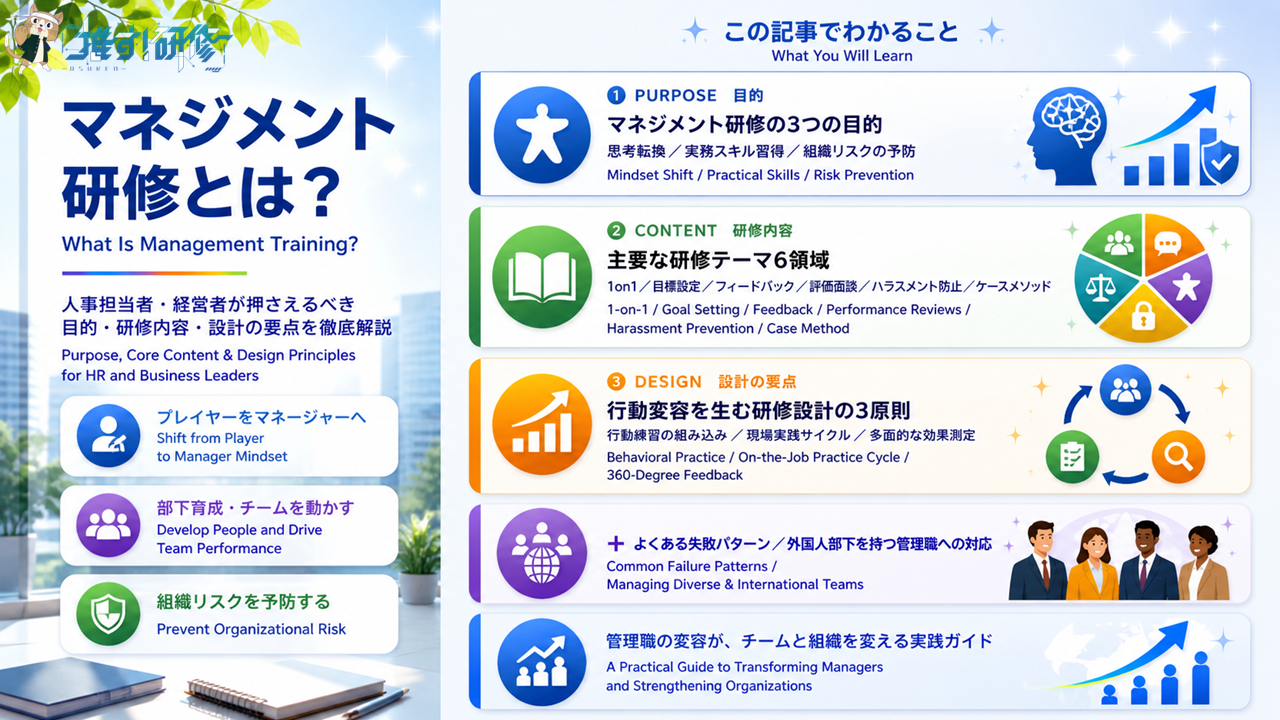
マネジメント研修の3つの目的 The Three Core Purposes of Management Training
マネジメント研修を導入・整備する目的は、単に「管理職に研修を受けさせること」ではありません。組織全体の視点で見たとき、以下の3つの目的が中核をなします。これらを曖昧にしたまま研修を設計しても、現場での行動変容は期待できません。
The purpose of implementing management training is not simply to “put managers through a program.” Viewed from an organizational perspective, three core purposes lie at its heart. Designing training without clearly articulating these purposes first will almost always result in programs that fail to deliver real results in the field.
① プレイヤーからマネージャーへの思考転換 Shifting from Player Mindset to Manager Mindset
マネジメント研修の最も根本的な目的は、「自分が動いて成果を出す」から「チームが動いて成果を出す」への思考の転換を、行動レベルで定着させることです。この転換は頭では理解できても、実際の行動に落とし込むには意図的な訓練と反復が必要です。研修がこのテーマを正面から扱っていない限り、管理職はプレイヤーのまま役職だけが変わった状態が続きます。
The most fundamental purpose of management training is to embed the shift from “I deliver results” to “my team delivers results” at the level of observable, habitual behavior — not just intellectual understanding. This shift can be understood conceptually, yet translating it into consistent daily action requires intentional practice and repetition. Unless training addresses this theme head-on, managers will continue to operate as individual contributors who simply carry a different job title.
② 部下育成・チームマネジメントの実務スキル習得 Developing Practical Skills for People Development and Team Management
管理職には、業務遂行の管理だけでなく、部下一人ひとりの成長を支援する育成者としての役割が求められます。1on1の実施・目標設定・フィードバック・評価面談・OJT指導といった実務スキルを、「知っている」から「使える」レベルまで習熟させることが、マネジメント研修の具体的な成果物です。これらのスキルは理論の理解だけでは身につかず、実践演習・ロールプレイ・職場での実践と振り返りを組み合わせた設計が不可欠です。
Managers are expected to serve not only as task supervisors but as developers of the people in their team. Taking practical skills — one-on-ones, goal setting, feedback, performance reviews, and OJT coaching — from “I know about them” to “I can use them reliably” is the tangible output that management training should deliver. These skills cannot be acquired through theoretical understanding alone; program design must integrate practical exercises, role-play, on-the-job practice, and structured reflection.
③ 組織リスクの予防と心理的安全性の確保 Preventing Organizational Risk and Building Psychological Safety
管理職の言動は、部下の離職・メンタルヘルス不調・ハラスメント問題と直結します。ハラスメント防止・労務管理・コンプライアンスに関する知識と行動基準を管理職が正確に理解していることは、組織防衛の観点から最低限の要件です。さらに、部下が安心して意見を言える「心理的安全性」の高い職場環境を管理職が意図的につくることが、チームのエンゲージメントと生産性を左右します。
A manager’s words and actions have a direct bearing on employee turnover, mental health, and harassment incidents. Ensuring that managers have accurate knowledge of and clear behavioral standards around harassment prevention, labor management, and compliance is a minimum organizational requirement from a risk management perspective. Beyond this baseline, the extent to which managers deliberately cultivate an environment of psychological safety — where team members feel genuinely safe to speak up — is a primary driver of team engagement and productivity.
マネジメント研修の主要な研修内容 Core Content Areas of Management Training
マネジメント研修に盛り込むべき内容は、企業の業種・規模・管理職の経験年数によって異なりますが、実務上カバーすべき主要テーマは以下のとおりです。担当者として重要なのは、「すべてを詰め込む」のではなく、自社の管理職が今最も苦手とする領域に優先順位をつけて設計することです。
The specific content of management training varies by industry, company size, and the experience level of participants, but the following are the core themes that programs should address in practice. What matters most in design is not cramming in everything, but rather prioritizing the areas where your managers currently struggle most and building the program around those needs.
1on1・コーチング One-on-Ones and Coaching
定期的な1on1は、部下の状態把握・課題の早期発見・動機づけ・育成の中核をなすマネジメントの基本動作です。「報告を聞く場」ではなく「部下の思考と行動を引き出す場」として1on1を機能させるには、コーチング的な問いかけの技術が不可欠です。「どう思う?」「何が障壁になっている?」「何があればできそう?」といった問いを自然に使えるようになることが、管理職としての対話力の基礎となります。
Regular one-on-ones are the fundamental management practice for monitoring team member wellbeing, identifying issues early, maintaining motivation, and driving development. For one-on-ones to function as a space that draws out thinking and action — rather than simply receiving status updates — coaching-style questioning is essential. Building the ability to naturally deploy questions such as “What do you think?” “What’s getting in the way?” and “What would make this possible?” forms the foundation of a manager’s conversational capability.
目標設定・進捗管理 Goal Setting and Progress Management
チームとしての成果を出すためには、個人の目標とチームの目標を整合させ、進捗を適切に管理する能力が必要です。「やってみて」と任せるだけのマネジメントと、「何を・いつまでに・どの水準で」を合意したうえで支援するマネジメントでは、部下の成長速度と成果の質が根本的に異なります。目標の具体化・分解・中間チェックの方法を体系的に学ぶことが求められます。
Delivering results as a team requires the ability to align individual goals with team objectives and to manage progress effectively. The difference between simply delegating with “give it a try” and managing with clear agreement on “what, by when, and to what standard” — followed by active support — is fundamental, both in the speed of employee development and in the quality of outcomes. Systematically learning how to clarify, break down, and conduct mid-point checks on goals is a core management competency.
フィードバック Feedback
フィードバックは、部下の成長を加速させる最も強力なツールの一つです。しかし、「指摘」と「フィードバック」は異なります。相手の行動を変えることを目的とし、具体的な事実に基づき、改善の方向性を示す形で伝えることが、フィードバックの本質です。ポジティブフィードバック・建設的フィードバックの両方を適切なタイミングで使い分ける技術は、ロールプレイを通じた実践訓練なしには習得できません。
Feedback is one of the most powerful tools available for accelerating employee development. However, “criticism” and “feedback” are not the same thing. The essence of feedback is communicating with the intent to change behavior — grounded in specific, observable facts and pointing clearly toward a direction for improvement. The skill of deploying both positive and constructive feedback at the right moment cannot be acquired without practical training through role-play and deliberate practice.
評価面談 Performance Review Conversations
人事評価は、管理職が最も「やり方がわからない」と感じる業務の一つです。評価の公平性・透明性を担保しながら、部下の納得感を引き出し、次の成長に向けたモチベーションをつなぐ評価面談は、単なる結果の通知ではなく、部下との対話と合意形成のプロセスです。評価基準の理解・評価エラーの回避・面談の進め方を体系的に学ぶことが、管理職の評価スキルの底上げに不可欠です。
Performance evaluation is one of the areas where managers most frequently report feeling uncertain about how to proceed. A performance review that maintains fairness and transparency while generating genuine understanding from the employee and sustaining motivation toward future growth is not a one-way announcement of results — it is a process of dialogue and mutual agreement. Systematically learning evaluation criteria, how to avoid common rating errors, and how to structure and conduct the conversation itself is essential for raising the quality of performance management across the organization.
ハラスメント防止・労務管理 Harassment Prevention and Workforce Management
管理職が知らなかったでは済まされない領域です。パワーハラスメント・セクシャルハラスメント・マタニティハラスメントの定義と具体的事例、長時間労働の管理と健康配慮義務、メンタルヘルス不調者への対応方法は、管理職として最低限習得すべき法的・実務的知識です。「よかれと思ってやった」が法的リスクにつながるケースも多く、具体的な事例を通じた学習が効果的です。
This is an area where “I didn’t know” is not an acceptable defense. The definitions and concrete examples of power harassment, sexual harassment, and maternity harassment; the management of long working hours and the duty of health consideration; and how to respond to employees showing signs of mental health difficulties — all constitute the minimum legal and practical knowledge that managers must possess. Many cases where managers acted with good intentions have nonetheless led to legal risk, which is why scenario-based learning through concrete examples is the most effective approach.
ケースメソッド研修——経営管理の各テーマを実践的に学ぶ Case Method Training: Learning Core Management Disciplines Through Practice
マーケティング・財務・会計・ファイナンス・経営戦略といった経営管理の各テーマは、管理職が「現場の判断」を経営視点で行うために不可欠な知識体系です。しかし、これらを座学の講義形式で学んでも、実際のビジネス判断には結びつきにくいという課題があります。ケースメソッド研修は、実際の企業経営における意思決定事例を素材に、参加者が自ら分析・議論・判断を行うことで、知識を「使える思考」へと転換する学習手法です。
Core management disciplines — marketing, finance, accounting, corporate finance, and business strategy — form the essential knowledge base that enables managers to make on-the-ground decisions from an organizational perspective. Yet these subjects, when delivered purely as lectures, rarely translate into practical business judgment. Case method training uses real-world business decision-making scenarios as its raw material, requiring participants to analyze, discuss, and reach their own conclusions — converting knowledge into the kind of thinking that can actually be applied.
ケースメソッドの最大の特徴は、「正解のない問い」に向き合う訓練にあります。「この状況でどう判断するか」「あなたがCEOならどうするか」という問いに対して、自分の立場を明確にし、根拠を示しながら他者と議論するプロセスが、管理職としての判断力・論理的思考力・他者の視点を取り込む力を同時に鍛えます。MBAプログラムで広く採用されているこの手法は、企業内のマネジメント研修にも応用可能です。
The defining feature of the case method is that it trains participants to engage with questions that have no single correct answer. The process of taking a clear position, articulating the reasoning behind it, and debating it with peers — in response to questions such as “How would you decide in this situation?” or “What would you do as CEO?” — simultaneously develops managerial judgment, logical thinking, and the ability to genuinely incorporate others’ perspectives. Widely adopted in MBA programs around the world, this method is equally applicable to in-house management training programs.
特に中堅社員から管理職への移行期、または管理職として一定の経験を積んだ社員に対して、財務諸表の読み方・投資判断の考え方・マーケティング戦略の構造・組織設計の原則といった経営管理の基礎を、ケースメソッドを通じて体系的に学ばせることは、経営視点を持ったマネージャーの育成に大きく貢献します。
In particular, for employees in the mid-level to management transition, or for managers who have accumulated some experience in their roles, systematically developing an understanding of how to read financial statements, how to approach investment decisions, how marketing strategy is structured, and the principles of organizational design — through the case method — makes a substantial contribution to developing managers who think and act with genuine organizational perspective.
マネジメント研修の設計の要点 Key Design Principles for Management Training
マネジメント研修は「実施すること」自体が目的ではありません。実際に管理職の行動が変わり、チームと組織に成果が生まれる研修を設計するために、担当者として押さえておくべき要点を以下に示します。
Management training is not an end in itself. Below are the key design principles that HR and training professionals must keep in mind to build programs that genuinely change managerial behavior and produce results for teams and the organization.
「知識インプット」で終わらせず、「行動の練習」を設計に組み込む。マネジメントスキルは「知っている」だけでは身につきません。ロールプレイ・ケーススタディ・実際の部下との1on1実施とその振り返りなど、学んだことを実際に「使う」機会を研修設計に不可欠な要素として組み込むことが、行動変容を生む研修の条件です。座学中心の研修でマネジメントスキルが変わった例はほとんどありません。
Do not let the program end with knowledge input — build in deliberate behavioral practice. Management skills are not acquired through knowing alone. Incorporating opportunities to actually use what has been learned — through role-play, case studies, real one-on-ones with direct reports, and structured reflection — is a non-negotiable element of program design that produces behavior change. There are very few examples of management skill genuinely improving through lecture-based training alone.
現場実践とのサイクルを設計に組み込む。研修の効果は、研修内で完結するものではありません。研修→現場での実践→振り返り→再インプットというサイクルを意図的に設計することで、学びが行動として定着します。1回完結型の研修より、数週間〜数か月をかけた複数回の研修と現場実践を組み合わせたプログラム設計が、マネジメント研修では特に有効です。
Design the program around a cycle that integrates on-the-job practice. The impact of training does not end when the session does. Intentionally designing the cycle of training → field practice → reflection → further input is what makes learning stick as behavior. For management training in particular, a multi-session program design that combines several rounds of training with on-the-job practice over weeks or months is significantly more effective than a single stand-alone session.
効果測定を「研修直後のアンケート」で終わらせない。満足度調査だけでは研修の真の効果は見えません。管理職研修では特に、部下からの多面的なフィードバック(360度評価)を1か月後・3か月後…のタイミングで収集し、研修前後での行動変容を継続的に確認する仕組みを組み込みましょう。「管理職本人の自己評価」と「部下からの評価」のギャップを可視化することが、次の育成課題の特定にも直結します。
Don’t let evaluation end with a post-session satisfaction survey. Satisfaction scores alone reveal very little about actual training impact. For management training in particular, build in a system for collecting multi-source feedback from direct reports — through 360-degree assessment — at intervals such as one month, three months, and beyond. Continuously tracking behavior change before and after training, and making visible the gap between managers’ self-assessment and their team members’ perceptions, directly feeds into identifying the next development priorities.
マネジメント研修でよくある失敗パターン Common Failure Patterns in Management Training
マネジメント研修は、設計や運営の仕方によっては「やった気」で終わるリスクが高い研修領域の一つです。現場でよく見られる失敗パターンを知っておくことが、担当者として研修の質を高める出発点となります。
Management training is one of the program areas most at risk of becoming a “we did it” exercise with little real impact — depending on how it is designed and delivered. Understanding the most common failure patterns in the field is the starting point for any HR professional committed to raising program quality.
昇格直後の「一回だけ」研修になっている。管理職に昇格した直後だけ研修を実施し、その後のフォローアップがない設計は、最も多く見られる失敗です。マネジメントスキルは継続的な実践と振り返りによってしか定着しません。昇格時研修は入口に過ぎず、その後の継続的な支援体制の設計が不可欠です。
A single program delivered only at the point of promotion. Running training once at the moment of promotion, with no follow-up support thereafter, is the most common failure pattern. Management skills only take root through sustained practice and reflection. Promotion-point training is nothing more than an entry point — designing a continuous support structure beyond it is non-negotiable.
現場の上位管理職が関与していない。管理職研修の成果は、受講した管理職の直属の上司(部長・役員など)がフォローに関与しているかどうかで大きく変わります。上位管理職が研修内容を把握せず、日常の業務指示が研修で学んだことと矛盾していれば、受講者は学びを捨てて元の行動に戻ります。上位管理職を設計段階から巻き込むことが、研修効果を組織に根づかせる鍵です。
Senior managers above the participants are not involved. The impact of management training is heavily influenced by whether the direct supervisors of trained managers — department heads, executives — are engaged in follow-up. If senior managers are unaware of what was covered and their day-to-day direction contradicts what participants learned, trainees will abandon their new behaviors and revert to old patterns. Involving senior management from the design stage is the key to embedding training impact into the organization.
「コンプライアンス研修」として形骸化している。ハラスメント防止研修を「やらなければならない法的義務」として位置づけ、知識の確認で終わらせている組織が少なくありません。しかし、ハラスメントの多くは悪意からではなく、マネジメントスキルの未熟さや関係性の構築不足から生まれます。コンプライアンス教育をマネジメント育成の文脈に組み込み、行動変容に直結させる設計が求められます。
Treated as a compliance checkbox with no behavioral dimension. Many organizations position harassment prevention training as a legal obligation to be fulfilled through knowledge confirmation alone. Yet most harassment incidents do not arise from malicious intent — they arise from underdeveloped management skills and poor relationship-building. Integrating compliance education into the broader management development context, and designing it to drive actual behavior change, is what separates programs that protect the organization from those that merely document that training occurred.
外国人部下を持つ管理職への対応 Management Training Considerations for Managers with Foreign National Team Members
技能実習制度の廃止と育成就労制度への移行(2027年施行予定)、および特定技能制度の拡充を背景に、外国籍社員が増加する中、外国人部下を持つ管理職が増えています。日本人部下と同じコミュニケーション・評価・育成の方法が、文化的背景の異なる外国人部下にそのまま通用するとは限りません。
Against the backdrop of the abolition of the Technical Intern Training Program and the transition to the new Ikusei Shuro system — scheduled to take effect in April 2027 — and the continued expansion of the Specified Skilled Worker program, an increasing number of managers now have foreign national employees on their teams. The communication, evaluation, and development approaches that work effectively with Japanese team members do not always translate directly to employees from different cultural backgrounds.
異文化間のコミュニケーションギャップ・言語の壁・評価基準の文化的差異に対応するためには、管理職が「外国人部下との1on1・フィードバック・目標設定の進め方」を具体的に学ぶ機会をマネジメント研修の中に組み込むことが、現代の多様な職場環境において不可欠です。また、バイリンガルの業務指示書・育成計画書の整備は、管理職の負担軽減と外国人社員の早期戦力化の両方に寄与します。
To address cross-cultural communication gaps, language barriers, and cultural differences in how evaluation and feedback are perceived, incorporating into management training specific, practical learning on how to conduct one-on-ones, deliver feedback, and set goals with foreign national team members has become an essential component of management development in today’s diverse workplaces. Developing bilingual work instruction documents and development plans also contributes both to reducing the burden on managers and to accelerating the productive contribution of foreign national employees.
オスケン株式会社では、製造業・食品業・物流業などの職場で働く外国人労働者・外国籍社員向けに、多言語対応研修を提供しています。日本人・外国人社員を問わず、マネジメント研修プログラムの設計・運営管理全般についてもお気軽にご相談ください。
Osuken Inc. provides multilingual training programs for foreign national employees working in manufacturing, food service, logistics, and related industries. We also support the design and operational management of management training programs for all employees. Please do not hesitate to reach out for any training-related enquiries.
まとめ——マネジメント研修は「管理職個人の改善」ではなく「組織の構造的強化」をつくる施策 Summary: Management Training as Structural Organizational Strengthening
マネジメント研修は、適切に設計・運営されることで、プレイヤーからマネージャーへの転換支援・部下育成スキルの習得・組織リスクの予防という3つの経営課題に同時に応える力を持っています。しかしその真の価値は、「管理職個人が変わること」ではなく、「管理職が変わることで、チームが変わり、組織全体のパフォーマンスが構造的に底上げされること」にあります。
When properly designed and managed, management training has the power to simultaneously address three core business challenges: supporting the transition from individual contributor to manager, developing people management skills, and preventing organizational risk. But its true value lies not in individual managers changing, but in the fact that when managers change, their teams change — and the performance of the entire organization improves in a structural and lasting way.
人事教育担当者・経営者にとって問うべきは、「管理職研修を実施したか」ではなく、「研修を受けた管理職の部下は、半年後に成長しているか。チームの成果は変わっているか」です。この問いに「はい」と答えられる研修体系をつくることが、マネジメント研修の最終的なゴールです。
The question HR professionals and executives should be asking is not “did we run management training?” but rather: “Are the direct reports of managers who completed the training growing six months later? Has the team’s performance changed?” Building a training system that can answer “yes” to that question is the ultimate goal of management training.
研修は「実施して終わり」ではありません。設計・実施・現場実践・フォローアップ・効果測定というサイクルを管理職育成に根づかせることが、マネジメント研修を真の「組織力強化投資」として機能させる道です。
Training does not end when the session closes. Embedding the cycle of design, delivery, on-the-job practice, follow-up, and evaluation into your management development system is what transforms management training into a genuine, high-return investment in organizational strength.
- 階層別研修とは?人事担当者・経営者が押さえるべき目的・階層区分・設計の要点を徹底解説 What Is Level-Based Training? Purpose, Level Structure, and Design Principles for HR and Business Leaders
- 研修効果測定とは?——ROI計算式と学習内容定着支援で投資を成果に変える What Is Training Effectiveness Measurement? — How ROI Calculation and Learning Retention Support Turn Training Investment into Measurable Results
この記事を書いた人

関連記事
-
 研修は内製化すべきか、外注すべきか|企業規模を問わず使える判断基準 Build or Buy? A Practical Decision Framework for Corporate Training Coordinators
 -
生成AI×OJT|社員の「使い方」を現場で育てる育成設計の考え方 Generative AI and OJT: How to Build AI Competency Through On-the-Job Learning
-
生成AI研修、導入して終わりにしないために|設計・事例・定着の実務ガイド Generative AI Training That Sticks: A Practical Guide to Design, Case Studies, and Retention
-
マネジメント研修の講師に学位は必要か|研修担当者が本当に問うべき選定基準 Management Training Facilitators: The Selection Criteria That Matter More Than Degrees
-
夏目漱石『こころ』に学ぶ——職場で「打ち明けられる関係と信頼」を育てる文学研修 Learning from Natsume Sōseki’s Kokoro: Literature-Based Training for Building Trust and Creating Space for Openness at Work
-
芥川龍之介『藪の中』に学ぶ——職場で「事実と解釈を見分ける力」を育てる文学研修 Learning from Akutagawa Ryūnosuke’s Yabu no Naka: Literature-Based Training for Distinguishing Facts from Interpretations at Work
-
森鷗外『最後の一句』に学ぶ——職場で「言うべきことを言える人」を育てる文学研修 Learning from Mori Ōgai’s Saigo no Ikku: A Literary Approach to Developing People Who Speak Up at Work
-
新入社員フォローアップ研修とは? What Is New Employee Follow-Up Training? Purpose, Themes, and Design for HR Professionals