QC3|プロセス保証・方針管理・日常管理の基礎知識をわかりやすく解説 QC Level 3 | Process Assurance, Policy Management, and Daily Management Explained
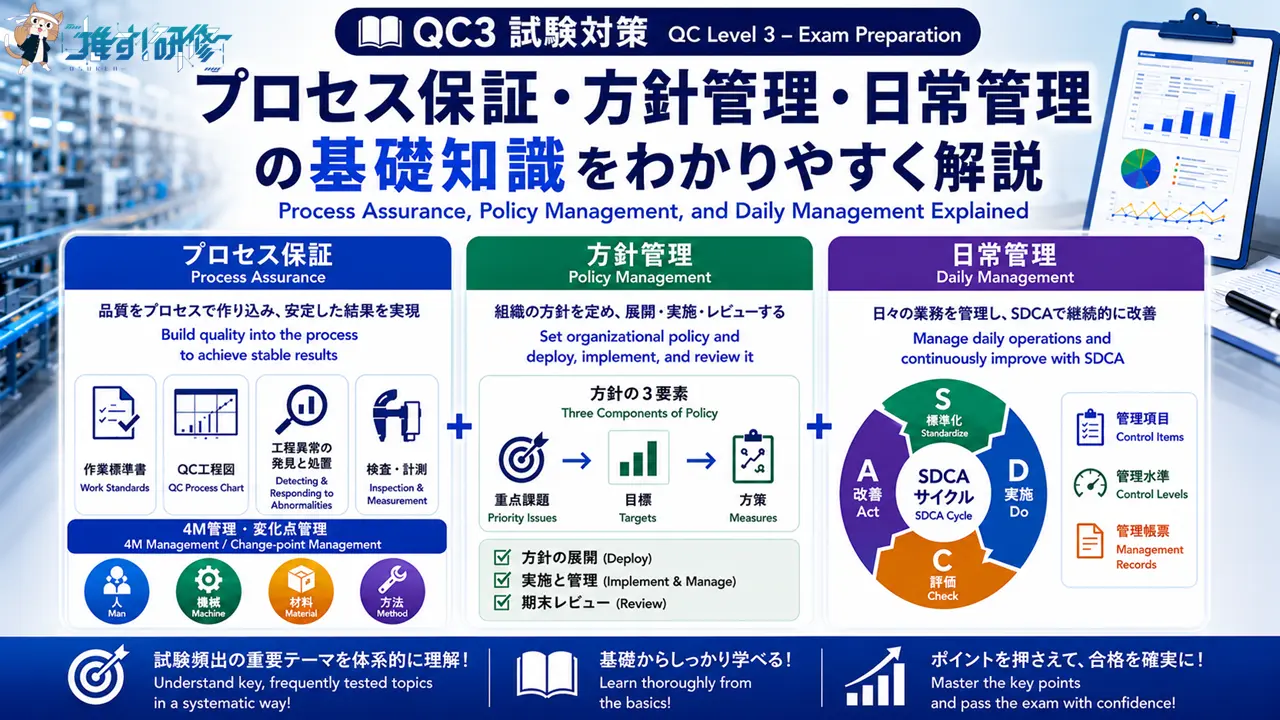
QC検定3級の試験範囲に含まれる「プロセス保証」「方針管理」「日常管理」は、品質経営を理解するうえで重要な頻出テーマです。「なぜ工程で品質を作り込む必要があるのか」「方針管理と日常管理はどう違うのか」といった問いに、この記事でしっかり答えられるようになりましょう。
In the QC Level 3 exam, “process assurance,” “policy management,” and “daily management” are important and frequently examined topics included in the official exam scope. This article will help you answer questions such as why quality must be built into the process, and how policy management and daily management differ from each other.
本記事では、プロセス保証の考え方と作業標準・QC工程図・検査・計測の基礎から、方針管理の仕組みと方針の3要素、日常管理のSDCAサイクルと管理項目まで、試験合格に必要な知識を体系的に解説します。
This article systematically covers everything you need to pass the exam: the concept of process assurance and the fundamentals of work standards, QC process charts, inspection, and measurement; the structure of policy management and the three components of policy; and daily management’s SDCA cycle and control items.
目次
プロセス保証とは / What Is Process Assurance?
プロセス保証とは、プロセスのアウトプットが求められる基準を確実に満たすことができるよう、一連の活動を体系的に維持・管理することです。単に結果を検査するのではなく、決められた手順ややり方に従ってプロセス自体を管理することで、最終的なアウトプットを目的・基準どおりに実現することを目指します。
Process assurance refers to the systematic maintenance and management of a series of activities designed to ensure that process outputs consistently meet required standards. Rather than simply inspecting results at the end, it aims to achieve outputs that conform to objectives and standards by managing the process itself in accordance with established procedures and methods.
プロセス保証の中心的な考え方は「品質をプロセスで作り込む」ことです。これを実現するには、プロセスを構成する4M(人・機械・材料・方法)を適切に管理し、4Mに変化が生じたときには結果である特性も変化していないかを確認する変化点管理を行うことが重要です。
The central concept of process assurance is “building quality into the process.” To achieve this, it is essential to properly manage the 4M factors that make up the process — Man, Machine, Material, and Method — and to practice change-point management, which means verifying that output characteristics have not changed whenever a change occurs in any of the 4M factors.
作業標準書 / Work Standards
作業標準書とは、作業の目的・条件・方法・結果の確認方法などを定めた文書です。品質を安定させるためには、作業標準書に基づいて全員が同じやり方で業務を行えるよう、教育・訓練を継続的に行うことが重要です。作業の標準化によって得られる主な効果として、品質の安定・仕損の防止・能率の向上・作業の安全化があります。
A work standard is a document that specifies the purpose, conditions, methods, and verification procedures for a given task. To stabilize quality, it is important to provide ongoing education and training so that all workers perform tasks in the same way according to the work standard. The main benefits of work standardization include stable quality, prevention of waste and rework, improved efficiency, and enhanced workplace safety.
QC工程図 / QC Process Chart
QC工程図(表)とは、工程の流れに沿って各工程の工程諸要素と管理方法を一覧で示した文書であり、工程管理の基本となるものです。品質管理工程表とも呼ばれます。QC工程図には、管理項目・管理水準・管理方法などが記載されます。
A QC process chart is a document that lists the process elements and control methods for each step in the production flow, and serves as the foundation of process control. It is also called a quality control process chart. A QC process chart records control items, control levels, control methods, and related information.
なお、フローチャートは作業や工程の流れを図で表したものです。一方、QC工程図は工程の流れに加えて、各工程で管理すべき品質特性・管理項目・管理水準・管理方法などを整理したものです。流れを把握するのがフローチャート、品質を管理するための情報まで含めるのがQC工程図と考えると理解しやすくなります。
A flowchart shows the flow of work or process steps. In contrast, a QC process chart includes not only the process flow but also the quality characteristics, control items, control levels, and control methods to be managed at each step. In short, a flowchart is used to understand the process flow, while a QC process chart is used to manage quality within that flow.
QC工程図に記載される管理項目には、結果(品質特性)を評価する管理点と、結果に影響を与える要因系の特性を管理する点検点の2種類があります。
The control items recorded in a QC process chart include two types: control points, which evaluate result characteristics (quality characteristics), and check points, which manage the characteristics of causal factors that influence those results.
工程異常の発見と処置 / Detecting and Responding to Process Abnormalities
工程異常とは、4Mなどの要因の変化によってプロセスが管理状態ではなくなることをいいます。異常を発見した際には、①その状況を関係者で共有し、②まず応急処置(工程を良好な状態に戻すとともに、影響を受けた製品を識別区分すること)を行い、③その後恒久対策(根本原因を追究して再発を防止すること)を実施します。さらに、④他の工程に同様の状態がないかを確認する水平展開も重要です。
A process abnormality refers to a situation in which a process is no longer in a controlled state due to changes in factors such as the 4Ms. When an abnormality is detected, the response involves: ① sharing the situation with relevant personnel; ② taking immediate countermeasures first — restoring the process to a sound condition and segregating any affected products; ③ then implementing permanent countermeasures — identifying the root cause and preventing recurrence. In addition, ④ horizontal deployment, checking whether the same situation exists in other processes, is also important.
工程能力調査と工程解析 / Process Capability Study and Process Analysis
工程能力調査とは、工程がどの程度のばらつきで品質を実現できるかを調べることです。規格値・平均値・ばらつきから工程能力指数を算出し、工程能力の十分性を判定します。工程能力が不十分な場合は、平均値の偏りやばらつきの原因を解析し、設備条件・作業方法・材料・測定方法などを見直し、必要に応じてプロセス設計の変更を検討します。工程解析は、製品のばらつき(特性)と、なぜばらつくのか(要因)の関係を明らかにする方法です。
工程能力指数には主にCpとCpkがあります。Cpは規格幅に対して工程のばらつきがどの程度小さいかを示す指標、Cpkは平均値の偏りも考慮した指標です。
| 指数 / Index | 計算式 / Formula | 特徴 / Feature |
|---|---|---|
| Cp | (上限規格値 − 下限規格値)÷ 6σ (USL − LSL) ÷ 6σ | 規格幅とばらつきの比率。平均値の位置は考慮しない Ratio of specification width to variability; does not consider the position of the mean |
| Cpk | 〔(上限規格値 − 平均値)÷ 3σ〕と〔(平均値 − 下限規格値)÷ 3σ〕の小さい方 The smaller of [(USL − mean) ÷ 3σ] and [(mean − LSL) ÷ 3σ] | 平均値の偏りを考慮した指数。Cp ≥ Cpk の関係が成立する Accounts for the offset of the mean; the relationship Cp ≥ Cpk always holds |
一般的な目安として、Cpkが1.33以上であれば工程能力はおおむね十分と判断されます。ただし、必要な工程能力の水準は製品の重要度や顧客要求によって異なります。Cp = Cpk となるのは平均値が規格の中央に一致している場合です。
As a general guideline, a Cpk of 1.33 or higher is commonly regarded as indicating sufficient process capability. However, the required level of process capability varies depending on product criticality and customer requirements. Cp equals Cpk only when the process mean coincides exactly with the center of the specification range.
工程能力調査とは、工程がどの程度のばらつきで品質を実現できるかを調べることです。規格値・平均値・ばらつきから工程能力指数を算出し、工程能力の十分性を判定します。工程能力が不十分な場合は、平均値の偏りやばらつきの原因を解析し、設備条件・作業方法・材料・測定方法などを見直し、必要に応じてプロセス設計の変更を検討します。工程解析は、製品のばらつき(特性)と、なぜばらつくのか(要因)の関係を明らかにする方法です。
A process capability study examines the degree of variability with which a process can achieve quality requirements. Process capability indices are calculated from specification values, mean values, and variability to determine whether process capability is adequate. If process capability is insufficient, the causes of mean deviation and variability should be analyzed, and equipment conditions, work methods, materials, measurement methods, and, if necessary, the process design should be reviewed. Process analysis is a method for clarifying the relationship between product variability (characteristics) and the reasons for that variability (causes).
※工程能力指数(Cp・Cpk)の計算方法・判定基準・演習問題については、以下の記事をあわせてご参照ください。
※For calculation methods, evaluation criteria, and practice questions on process capability indices (Cp and Cpk), please also refer to the article below.
🔗 QC3|工程能力指数(Cp・Cpk)の計算方法と判定基準をわかりやすく解説
検査と計測 / Inspection and Measurement
検査とは、測定・試験・ゲージ合わせなどの手段を用いた観測と判定によって、製品やサービスの適合性を評価する活動です。検査の目的は、不適合品を後工程や顧客に渡さないこととともに、検査で得られた品質情報を関係部門に伝達して再発防止・未然防止に役立てることです。
Inspection is the activity of evaluating the conformity of products or services through observation and judgment using methods such as measurement, testing, and gauging. The purposes of inspection are both to prevent nonconforming products from being passed to the next process or to customers, and to transmit the quality information obtained through inspection to relevant departments so that it can be used to prevent recurrence and anticipate future problems.
| 分類 / Category | 種類 / Types |
|---|---|
| 検査の段階 Stage of inspection | 受入検査・工程内(中間)検査・最終検査・出荷検査 Incoming inspection, in-process (intermediate) inspection, final inspection, outgoing inspection |
| 検査の方法 Method of inspection | 全数検査・抜取検査・間接検査・無試験検査 100% inspection, sampling inspection, indirect inspection, skip-lot inspection |
| 検査の性質 Nature of inspection | 破壊検査・非破壊検査・官能検査 Destructive inspection, non-destructive inspection, sensory inspection |
計測管理において、測定値は「真の値+誤差」として表されます。測定には必ず誤差が伴うため、測定誤差の分析が正確な計測の前提となります。また、校正とは、標準器などの測定標準と計測器の指示値を比較し、その関係やずれを確認・確立する操作です。なお、ずれが大きい場合に指示値を所定の値に合わせる操作は「調整」と呼ばれ、校正とは区別されます。
In measurement management, a measured value is expressed as “true value + error.” Since measurement always involves some degree of error, analyzing measurement error is a prerequisite for accurate measurement. Calibration is the operation of comparing a measuring instrument’s indicated values against measurement standards (such as reference instruments) and establishing or confirming the relationship and any deviation. The separate operation of adjusting an instrument to bring its indicated values within specification when deviation is found is called “adjustment” and is distinguished from calibration.
方針管理とは / What Is Policy Management?
方針管理とは、トップマネジメントが定めた方針を全部門・全階層が共有し、ベクトルを合わせながら重点指向で達成していく活動です。TQM活動の重要な要素の一つであり、一部の経営層や管理者だけが行うものではなく、組織全体で参画することが求められます。
Policy management is the activity in which the policies established by top management are shared across all departments and all levels of the organization, with efforts aligned in the same direction and focused on priority items. It is a key element of TQM activities and requires participation from the entire organization — not just senior management or a subset of managers.
方針の3要素 / The Three Components of Policy
方針には、一般的に次の3つの要素が含まれます。なお、QC検定公式レベル表(Ver.20150130.2)では「方針(目標と方策)」という表現が使われており、試験上は目標と方策を中心に押さえることが重要です。実務的な理解としては、重点課題・目標・方策の3要素で整理すると体系的に理解しやすくなります。
A policy generally includes the following three components. Note that the official QC Level 3 exam level chart uses the expression “policy (targets and measures)”; for exam purposes, it is important to focus primarily on targets and measures. For practical understanding, organizing the three components — priority issues, targets, and measures — provides a more systematic framework.
| 要素 / Component | 定義 / Definition |
|---|---|
| 重点課題 Priority issues | 組織として優先順位の高いものに絞り込んで取り組む、達成すべき事項 The matters to be achieved by focusing on those of highest priority for the organization |
| 目標 Targets | 重点課題の達成に向けて、客観的に測定可能な形で設定される到達点。達成すべき状態・期限・評価基準を明確にする The measurable endpoint set for achieving priority issues; the target state, deadline, and evaluation criteria are clearly specified |
| 方策 Strategies / Measures | 目標を達成するために選ばれる具体的な手段。複数の手段の中からどれを選び、どのように実施するかを明確にする The specific means chosen to achieve targets; clarifies which of multiple possible measures is selected and how it will be implemented |
方針管理のプロセス / The Policy Management Process
方針管理は、次の4つの事項を中核として進められます。
Policy management is carried out around the following four core activities.
| 順序 / Order | 活動 / Activity | 内容 / Description |
|---|---|---|
| 1 | 組織方針の策定 Establishing organizational policy | トップマネジメントが組織の内外の状況をもとに目指す姿を定め、方針(重点課題・目標・方策)を正式に表明する Top management defines the organization’s direction based on internal and external conditions and formally declares the policy |
| 2 | 組織方針の展開 Deploying organizational policy | 上位の方針をより具体的な下位の方針へブレークダウンし、全部門に展開する。この際、上位と下位の方針が矛盾しないようにすり合わせ(調整)を行う The policy is broken down into more specific lower-level policies and deployed across all departments; alignment (adjustment) is carried out to ensure consistency between levels |
| 3 | 組織方針の実施とその管理 Implementing and managing organizational policy | 実施計画に基づいて各部門が方策を実行し、管理項目・管理水準・管理帳票を用いて進捗を管理する Each department executes its measures according to the implementation plan; progress is managed using control items, control levels, and management records |
| 4 | 期末のレビュー End-of-period review | 目標の達成状況と実施の状況を確認・分析し、その結果を次期の方針・活動に反映させる Achievement of targets and implementation status are reviewed and analyzed; findings are reflected in the following period’s policy and activities |
方針展開とすり合わせ / Policy Deployment and Alignment
方針展開とは、上位の方針(重点課題・目標・方策)をより具体的な下位の方針へとブレークダウンしていく活動です。上位と下位の方針が矛盾しないよう、上位の管理者・下位の管理者・担当者・関係部門などとの間ですり合わせ(調整)を十分に行うことが、方針の一貫した展開につながります。
Policy deployment is the activity of breaking down higher-level policies (priority issues, targets, and measures) into increasingly concrete lower-level policies. Conducting thorough alignment (adjustment) among senior managers, lower-level managers, staff members, and related departments — to ensure that upper- and lower-level policies are consistent — leads to coherent policy deployment throughout the organization.
部門を統括する管理者は、次の3つを策定・作成することが求められます。
Managers overseeing departments are expected to establish and prepare the following three items.
| 作成物 / Document | 内容 / Description |
|---|---|
| 部門の方針 Departmental policy | 部門が当該期間に取り組む重点課題・達成すべき目標・目標達成のための方策をまとめたもの A summary of the priority issues, targets to be achieved, and measures for achieving them that the department will address during the period |
| 実施計画 Implementation plan | 各方策について、誰が・何を・いつ・どこで・どのように行うかを時系列で具体化した計画 A time-based plan specifying who, what, when, where, and how each measure will be carried out |
| 進捗管理のための管理項目・管理水準・管理帳票 Control items, control levels, and management records for progress monitoring | 方針・実施計画の進捗および目標達成状況を定期的に評価・把握するための尺度・基準・記録様式 Metrics, standards, and recording formats for regularly evaluating and monitoring progress against the policy and implementation plan |
日常管理とは / What Is Daily Management?
日常管理とは、各部門が日常的に担当している分掌業務について、その目的を効率的に達成するために必要なすべての活動のことです。TQM活動の中でもっとも基本的で重要な活動であり、維持だけでなく改善(維持向上)を含む活動です。管理間接部門を含むすべての部門で実施されることから、部門別管理と呼ばれることもあります。
Daily management encompasses all the activities necessary for each department to efficiently achieve the purpose of its assigned duties — the routine tasks it is responsible for performing on an ongoing basis. It is the most fundamental and important activity in TQM and includes not only maintenance but also improvement (sustained enhancement). Because it is implemented in all departments — including administrative and indirect departments — it is sometimes called department-level management.
日常管理では、各部門・各担当者の業務分掌を明確にすることが重要です。業務分掌とは、それぞれの部門や担当者が日常的に行う分担された業務のことです。日常管理を実施することで、現場責任者へどれくらいの責任と権限を持たせるかを明確にすることができます。責任と権限が不明確なままでは、異常発生時の対応遅れや処置の抜け漏れにつながるため、誰が何に責任を持ち、どこまでの権限で判断・処置できるかをあらかじめ定めておくことが必要です。
In daily management, it is important to clearly define the scope of duties for each department and each person responsible. The scope of duties refers to the assigned tasks that each department or individual carries out on an ongoing basis. Implementing daily management enables organizations to clarify how much responsibility and authority to vest in front-line supervisors. Without clearly defined responsibilities and authorities, delayed responses to abnormalities and missed corrective actions are likely to occur; it is therefore necessary to specify in advance who is responsible for what and the extent of each person’s authority to judge and act.
SDCAサイクル / The SDCA Cycle
日常管理の基本的なサイクルはSDCA(標準化→実施→確認→処置)のサイクルです。SDCAサイクルは、標準に基づいた業務の維持向上を目的としたサイクルであり、業務が安定した状態を保つために役立ちます。
The fundamental cycle of daily management is the SDCA cycle: Standardize → Do → Check → Act. The SDCA cycle is designed to maintain and improve operations based on standards, and is useful for keeping work processes in a stable state.
| ステップ / Step | 内容 / Description |
|---|---|
| S(標準化) Standardize | 業務の目的・手順・方法を標準として文書化し、全員が共通の方法で行えるようにする Document the purpose, procedures, and methods of work as standards so that everyone can follow a common approach |
| D(実施) Do | 標準に基づいて実際に業務を行う Carry out the actual work in accordance with the standards |
| C(確認) Check | 管理項目と管理水準に照らして実施結果を確認し、異常がないかをチェックする Verify results against control items and control levels; check for any abnormalities |
| A(処置) Act | 異常が発見された場合は応急処置と是正処置を行い、標準の改訂も検討する When an abnormality is found, take immediate and corrective action; consider revising standards as needed |
標準化と変化点管理 / Standardization and Change-Point Management
日常管理において標準化は中心的な役割を果たします。標準とは、業務が効率的に行われるよう共通かつ繰り返し使用されるルールです。多くの人が関わる組織では、個々人がばらばらに行動することでばらつきが生じるため、もっとも優れた方法を標準として定め、全員がこれに従うことが品質の安定につながります。
Standardization plays a central role in daily management. A standard is a rule that is commonly and repeatedly used to ensure that work is performed efficiently. In organizations involving many people, variability arises when individuals act independently; therefore, defining the best method as a standard and having everyone follow it leads to stable quality.
一方、どれほど標準化が進んでいても、人の異動・原材料の変更・設備のメンテナンスなど4Mの変化によって異常が発生する場合があります。このような変化を特定して管理することを変化点管理といいます。変化点管理を行うことで、プロセスの安定状態を維持することができます。
However, no matter how thoroughly standardization is implemented, abnormalities can arise due to changes in the 4Ms — such as personnel transfers, changes in raw materials, or equipment maintenance. Identifying and managing such changes is called change-point management. Practicing change-point management helps maintain processes in a stable state.
管理項目・点検項目・管理水準 / Control Items, Check Items, and Control Levels
日常管理では、プロセスの結果を定期的に監視することが重要です。管理項目(管理点)とは、目標の達成状況を管理するために選定した評価尺度のことです。一方、点検項目(点検点)とは、プロセスの結果に大きな影響を与え、直接制御できる原因系の特性のことです。
In daily management, it is important to regularly monitor process results. A control item (control point) is a measurement indicator selected to manage the degree of target achievement. In contrast, a check item (check point) refers to a characteristic of a causal factor that has a large influence on process results and can be directly controlled.
管理水準とは、管理項目が安定状態にあるかを客観的に評価するための基準値のことです。選定した管理項目を管理水準などとあわせて整理した表を管理項目一覧表と呼び、QC工程図もその一例です。
A control level is a reference value used to objectively evaluate whether a control item is in a stable state. A table that organizes selected control items together with their control levels and related information is called a control item list, of which the QC process chart is one example.
方針管理と日常管理の関係 / The Relationship Between Policy Management and Daily Management
方針管理と日常管理はTQMの両輪です。それぞれの特徴を比較して理解しておきましょう。
Policy management and daily management are the two pillars of TQM. Review the following comparison of their key characteristics.
| 日常管理 Daily Management | 方針管理 Policy Management | |
|---|---|---|
| 目的 Purpose | 分掌業務の目的を効率的に達成する Efficiently achieve the purpose of assigned duties | 組織全体で方針を共有し重点指向で達成する Share policy across the organization and achieve it with a priority focus |
| 基本サイクル Basic cycle | SDCAサイクル SDCA cycle | PDCAサイクル PDCA cycle |
| 対象範囲 Scope | 各部門の分掌業務全体 All assigned duties of each department | 重点課題・目標・方策 Priority issues, targets, and measures |
| 改善の方向性 Direction of improvement | 維持向上(現状の安定的な改善) Sustained enhancement (stable, incremental improvement) | 現状打破(革新的・大幅な改善) Breaking from the status quo (innovative, substantial improvement) |
| 参加範囲 Participants | 全部門(直接・間接部門を問わず) All departments (both direct and indirect) | 全部門・全階層 All departments and all levels |
まとめ / Summary
このテーマの試験における重要ポイントをまとめます。
Here is a summary of the key exam points for these topics.
- プロセス保証の中心は「品質の作り込み」 検査で不良を発見するのではなく、4Mを管理してプロセス自体で品質を実現する考え方
The core of process assurance is “building in quality” — Rather than detecting defects through inspection, quality is achieved within the process itself by managing the 4M factors - 工程異常への対応は3段階 ①応急処置(現状回復+識別区分)→②恒久対策(根本原因の追究+再発防止)→③水平展開(他工程への展開)
Three stages of responding to process abnormalities — ① Immediate countermeasures (restoring the process + segregating affected products) → ② Permanent countermeasures (identifying root cause + preventing recurrence) → ③ Horizontal deployment (applying lessons to other processes) - 方針の3要素 重点課題・目標・方策。方針は「全部門・全階層」の参画の下で「重点指向」で達成する
Three components of policy — Priority issues, targets, and measures; policy is achieved through the participation of “all departments and all levels” with a “priority focus” - 方針管理のプロセスは4段階 ①策定→②展開(すり合わせが重要)→③実施と管理→④期末レビュー(次期への反映)
Four stages of the policy management process — ① Establishment → ② Deployment (alignment is key) → ③ Implementation and management → ④ End-of-period review (reflecting findings in the next period) - 日常管理の基本サイクルはSDCA S:標準化→D:実施→C:確認→A:処置。方針管理のPDCAとは区別して覚える
The basic cycle of daily management is SDCA — S: Standardize → D: Do → C: Check → A: Act; distinguish this from the PDCA cycle used in policy management - 管理点と点検点の違い 管理点=結果(品質特性)を評価する管理項目、点検点=原因系の要因(プロセスへの影響が大きい直接制御可能な特性)を評価する管理項目
Difference between control points and check points — Control point: a control item that evaluates results (quality characteristics); Check point: a control item that evaluates causal factors (directly controllable characteristics that significantly influence process results)
練習問題 理解を確認しよう / Practice Questions: Test Your Understanding
ここまでの内容を試験形式で確認しましょう。解答と解説は各問題の直下に記載しています。
Let’s check your understanding with exam-style practice questions. The answer and explanation appear directly below each question.
問題1 Question 1
プロセス保証に関する次の記述のうち、正しいものはどれか。
Which of the following statements about process assurance is correct?
- プロセス保証とは、完成した製品を全数検査することによって、出荷品の品質を保証する活動である。
Process assurance is the activity of guaranteeing the quality of shipped products by conducting 100% inspection of all finished products. - 工程能力調査では、製品のばらつきがどの原因から生じているのかを分析し、真の原因を特定する。
A process capability study analyzes which cause is responsible for product variability and identifies the true cause. - 工程異常が発生した際は、まず応急処置を行って工程を正常な状態に戻すとともに、影響を受けた製品を識別区分することが求められる。
When a process abnormality occurs, immediate countermeasures should first be taken to restore the process to a normal state, and any affected products should be identified and segregated. - 作業標準書は、管理者が個別に定めるものであり、作業者が内容を変更することは品質管理上望ましい。
Work standards are defined individually by managers, and it is desirable from a quality management perspective for workers to modify the content as they see fit.
解答:3 Answer: 3
選択肢3が正解です。工程異常への対応では、まず応急処置として工程を良好な状態に回復させ、異常の影響を受けた製品を他の製品と混在させないよう識別・区分します。その後、根本原因を追究して再発防止のための恒久対策を実施します。選択肢1は誤りです。プロセス保証の中心的な考え方は「品質をプロセスで作り込む」ことであり、最終検査だけで品質を保証しようとするアプローチとは根本的に異なります。選択肢2は誤りです。これは工程解析の説明です。工程能力調査は、規格値・平均値・ばらつきをもとに工程能力指数を算出し、工程が品質基準を満たす能力を持っているかを確認する活動です。選択肢4は誤りです。作業標準書は全員が共通の方法で業務を行うための基準であり、個人が無断で変更することは品質のばらつきを生む原因となります。
Option 3 is correct. When responding to a process abnormality, immediate countermeasures are first taken to restore the process to a sound condition and to identify and segregate any affected products so they are not mixed with conforming ones. Permanent countermeasures are then implemented to identify the root cause and prevent recurrence. Option 1 is incorrect: the central concept of process assurance is “building quality into the process” — it is fundamentally different from an approach that relies solely on final inspection to guarantee quality. Option 2 is incorrect: this describes process analysis. A process capability study uses specification values, mean values, and variability to calculate process capability indices and to verify whether the process has the capability to meet quality standards. Option 4 is incorrect: work standards serve as the common baseline for everyone to perform tasks in the same way; unauthorized individual modifications would introduce variability and undermine quality.
問題2 Question 2
方針管理に関する次の記述のうち、誤っているものはどれか。
Which of the following statements about policy management is incorrect?
- 方針管理は、全部門・全階層の参画の下で、ベクトルを合わせて重点指向で進める活動である。
Policy management is an activity carried out with the participation of all departments and all levels of the organization, aligning efforts in the same direction with a priority focus. - 方針には一般的に、重点課題・目標・方策の3つの要素が含まれる。
A policy generally includes three components: priority issues, targets, and measures. - 方針展開では、上位の方針(重点課題・目標・方策)を下位の方針へブレークダウンする際に、上位と下位の間でのすり合わせ(調整)を十分に行うことが重要である。
In policy deployment, it is important to conduct thorough alignment (adjustment) between upper and lower levels when breaking down higher-level policies (priority issues, targets, and measures) into lower-level policies. - 方針管理の期末レビューでは、目標の達成度だけを確認すれば十分であり、目標達成のために採用した方策の適切さを分析する必要はない。
In the end-of-period review of policy management, it is sufficient to confirm only whether targets were achieved; there is no need to analyze whether the measures adopted to achieve the targets were appropriate.
解答:4 Answer: 4
選択肢4が誤りです。方針管理の期末レビューでは、目標の達成・未達成の確認にとどまらず、目標を達成するために選んだ方策が適切であったかどうかも分析することが求められます。目標値を達成していたとしても、採用した方策に改善の余地がないかを確認し、その結果を次期の方針および活動に反映させることが期末レビューの目的です。選択肢1は正しい記述です。方針管理は経営者や一部の管理者だけが関与するものではなく、全部門・全階層が参画します。選択肢2は正しい記述です。重点課題・目標・方策の3要素で整理すると、方針管理を体系的に理解しやすくなります。試験上は特に「目標と方策」の関係を押さえておきましょう。選択肢3は正しい記述です。上位の方針と下位の方針が整合するよう関係者間でのすり合わせを行うことが、方針の一貫した展開の鍵となります。
Option 4 is incorrect. The end-of-period review in policy management requires not only confirming whether targets were achieved or missed, but also analyzing whether the measures chosen to achieve those targets were appropriate. Even when target values have been met, it is important to examine whether there is room for improvement in the measures adopted, and to reflect those findings in the policies and activities for the following period. Option 1 is correct: policy management involves the participation of all departments and all levels — not just senior management or a select group of managers. Option 2 is correct: Organizing policy into the three components of priority issues, targets, and measures helps provide a systematic understanding of policy management. For exam purposes, it is especially important to understand the relationship between targets and measures. Option 3 is correct: conducting alignment among stakeholders to ensure consistency between upper- and lower-level policies is the key to coherent policy deployment.
問題3 Question 3
日常管理に関する次の記述のうち、正しいものはどれか。
Which of the following statements about daily management is correct?
- 日常管理は、製造部門など直接部門のみが実施する活動であり、間接部門はその対象外である。
Daily management is an activity carried out only by direct departments such as manufacturing; indirect departments are excluded from its scope. - 日常管理の基本的なサイクルはPDCAであり、SDCAサイクルは方針管理に用いられる。
The fundamental cycle of daily management is PDCA, while the SDCA cycle is used in policy management. - 日常管理は現状の維持を目的とした活動であり、改善活動は日常管理の範囲には含まれない。
Daily management is an activity aimed solely at maintaining the current state; improvement activities are not included within its scope. - 管理項目(管理点)は目標達成のための結果系を評価する尺度であり、点検項目(点検点)は原因系の特性を管理するための尺度である。
A control item (control point) is a measure for evaluating result-related factors to manage target achievement, while a check item (check point) is a measure for managing cause-related characteristics.
解答:4 Answer: 4
選択肢4が正解です。管理項目(管理点)は、プロセスの結果である品質特性など「結果系」を評価する尺度として選定したものです。点検項目(点検点)は、そのプロセスの結果に大きな影響を与え直接制御が可能な「原因系の特性」を管理するための尺度です。この区別はQC検定3級の頻出ポイントです。選択肢1は誤りです。日常管理は管理間接部門を含むすべての部門で実施されます。製造部門など直接部門のみの活動ではありません。選択肢2は誤りです。日常管理の基本サイクルはSDCA(標準化→実施→確認→処置)です。PDCAは改善活動や方針管理で用いられるサイクルです。選択肢3は誤りです。日常管理は現状の維持にとどまらず、改善(維持向上)を含む活動です。方針管理では現状を大きく改善する現状打破の改善活動が行われますが、日常管理でも継続的な小改善は行われます。
Option 4 is correct. A control item (control point) is selected as a measure for evaluating “result-related” factors such as quality characteristics — the outputs of the process. A check item (check point) is a measure for managing “cause-related characteristics” — those that have a large influence on process results and can be directly controlled. This distinction is a frequently tested point in the QC Level 3 exam. Option 1 is incorrect: daily management is implemented in all departments, including administrative and indirect departments — it is not limited to direct departments such as manufacturing. Option 2 is incorrect: the fundamental cycle of daily management is SDCA (Standardize → Do → Check → Act); PDCA is the cycle used in improvement activities and policy management. Option 3 is incorrect: daily management encompasses not only the maintenance of the current state but also improvement (sustained enhancement); while policy management involves more radical improvement initiatives aimed at breaking from the status quo, continuous small-scale improvements are also carried out within daily management.
- 危険物乙4|単体・化合物・混合物と状態変化の基礎知識 Class B, Group 4 Hazardous Materials Engineer | Simple Substances, Compounds, Mixtures, and Changes of State
- ITパスポート試験|プロジェクトマネジメントの基礎知識と計算問題 IT Passport Exam | Project Management: Fundamentals and Calculation Problems
この記事を書いた人

関連記事
-
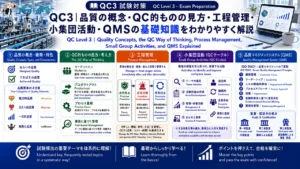
 QC3|品質の概念・QC的ものの見方・工程管理・小集団活動・QMSの基礎知識をわかりやすく解説 QC Level 3 | Quality Concepts, the QC Way of Thinking, Process Management, Small Group Activities, and QMS Explained
 -
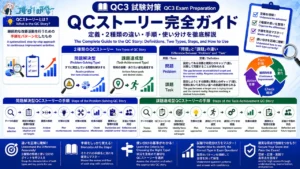
QC3|QCストーリー(問題解決型の8手順・課題達成型の9手順)の違いと使い分けをわかりやすく解説 QC Level 3 | QC Story: 8-Step Problem-Solving vs. 9-Step Task-Achievement Explained
-
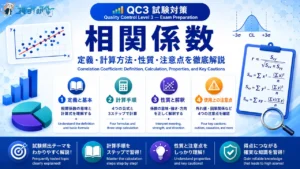
QC3|相関係数の計算方法・性質・使用上の注意点をわかりやすく解説 QC Level 3 | Correlation Coefficient: Calculation, Properties, and Key Cautions Explained
-
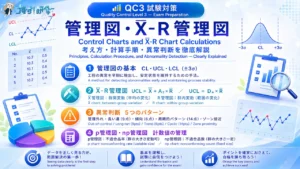
QC3|管理図の考え方とX̄-R管理図の計算方法をわかりやすく解説 QC Level 3 | Control Charts and X̄-R Chart Calculations Explained
-
QC3|工程能力指数 Cp・Cpkの計算方法と評価基準 QC Level 3 | Process Capability Index: Cp and Cpk Calculation and Evaluation Criteria
-
QC3|QC7つ道具(2) ヒストグラム・散布図・チェックシート・グラフの使い方 QC Level 3 | The 7 QC Tools (Part 2): How to Use Histograms, Scatter Diagrams, Check Sheets, and Graphs
-
QC3|QC7つ道具(1)層別・パレート図・特性要因図の使い方 QC Level 3 | The 7 QC Tools (Part 1): How to Use Stratification, Pareto Charts, and Cause-and-Effect Diagrams
-
QC3の難易度は?合格率・勉強時間・他の資格との比較で徹底解説 How Difficult Is the QC3 Exam? Pass Rates, Study Time, and Comparison with Other Certifications