QC3|品質の概念・QC的ものの見方・工程管理・小集団活動・QMSの基礎知識をわかりやすく解説 QC Level 3 | Quality Concepts, the QC Way of Thinking, Process Management, Small Group Activities, and QMS Explained
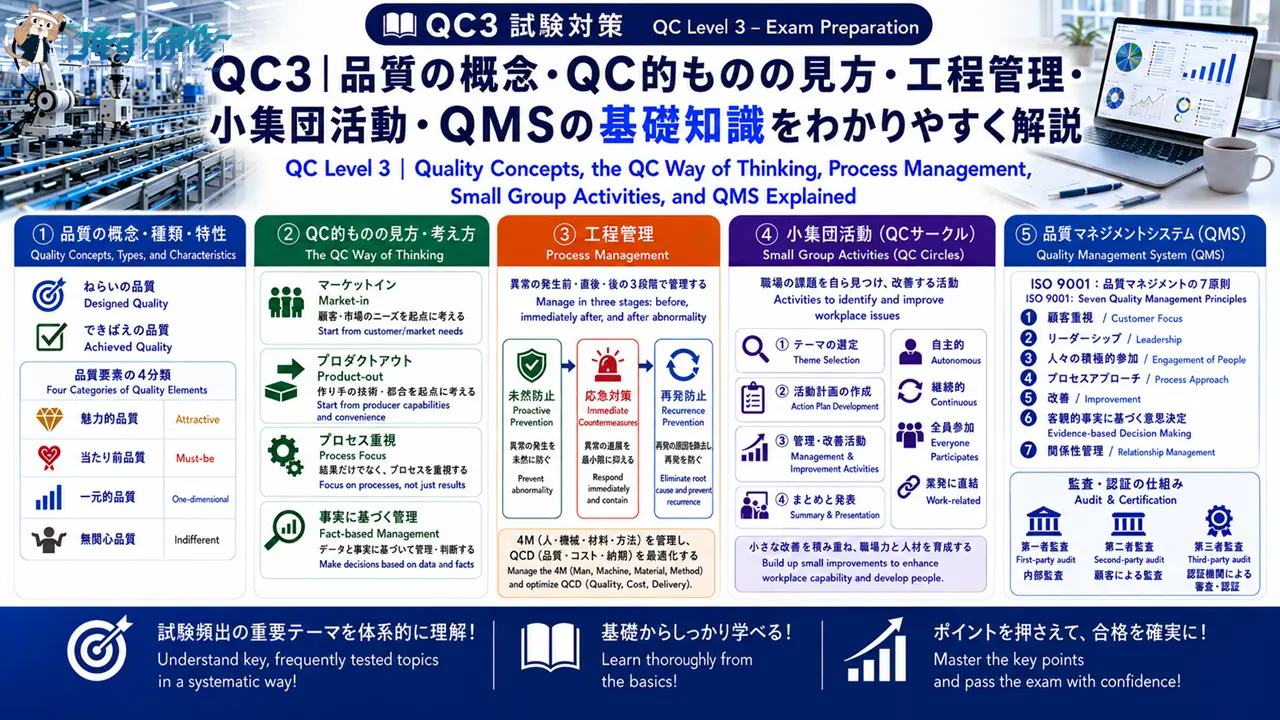
QC3の試験範囲に含まれる「品質の種類と概念」「QC的ものの見方・考え方」「工程の管理」「小集団活動と人材育成」「品質マネジメントシステム」は、品質管理の根幹をなす頻出テーマです。「ねらいの品質とできばえの品質はどう違うのか」「マーケットインとプロダクトアウトを混同しないためにはどう整理すればよいか」「QCサークル活動のテーマ解決ステップの順序は何か」——こうした問いに、この記事でしっかり答えられるようになりましょう。
In the QC Level 3 exam, topics such as “types and concepts of quality,” “the QC way of thinking,” “process management,” “small group activities and human resource development,” and “quality management systems” are core themes that appear repeatedly. This article will help you clearly answer questions such as: How do designed quality and achieved quality differ? How should you organize your understanding to avoid confusing market-in and product-out? And what is the correct order of the steps in QC circle theme-solving activities?
本記事では、品質の定義・種類・品質特性から、QC的ものの見方・考え方の主要概念、工程管理のプロセス重視と応急対策・再発防止・未然防止の体系、小集団活動(QCサークル)の仕組みと人材育成の考え方、さらにISO 9001に基づく品質マネジメントシステムの認証制度まで、試験合格に必要な知識を体系的に解説します。
This article systematically covers everything you need to pass the exam: quality definitions, types, and quality characteristics; key concepts in the QC way of thinking; process-oriented management and the framework of immediate countermeasures, recurrence prevention, and proactive prevention; the structure of small group activities (QC circles) and the principles of human resource development; and the ISO 9001-based quality management system certification framework.
目次
品質とは何か——定義・種類・特性 / What Is Quality? — Definitions, Types, and Characteristics
品質管理を学ぶうえで、まず「品質」そのものを正確に定義することが出発点となります。試験では品質の定義そのものよりも、各種類の品質の名称と意味の対応が繰り返し問われます。
When studying quality management, the starting point is a precise understanding of what “quality” itself means. Rather than testing the definition itself, the exam repeatedly asks you to match the names of various types of quality with their meanings.
品質の定義 / Definition of Quality
品質とは、対象に本来備わっている特性の集まりが、要求事項をどの程度満たしているかを示す度合いのことです。ここでいう要求事項とは、明示されているもの、明示されていないが了解されているもの、または義務として期待されているニーズや期待を指します。製品に対する要求事項のうち品質に関するものを要求品質といい、品質要素として項目化されます。
Quality refers to the degree to which a collection of inherent characteristics of a subject meets its requirements. Requirements here include those that are stated, those that are not stated but understood, and those expected as obligations. Among the requirements for a product, those relating to quality are called required quality and are itemized as quality elements.
ねらいの品質とできばえの品質 / Designed Quality and Achieved Quality
ねらいの品質(設計品質)とは、顧客や社会のニーズをもとに、製品・サービスの目標として設計段階で定めた品質のことです。これに対してできばえの品質(製造品質・適合の品質)とは、ねらいの品質を目指して実際に製造・提供した結果、どの程度それに適合できたかを示す品質のことです。製造工程では、ねらいの品質に適合するようQCD(品質・コスト・納期)を満たすかたちで製造することが求められます。
Designed quality (also called target quality) is the quality defined at the design stage as the goal for a product or service, based on the needs of customers and society. In contrast, achieved quality (manufacturing quality / conformance quality) refers to the degree to which the actual manufactured or delivered product or service conforms to the designed quality. In the manufacturing process, production must be carried out in a way that satisfies QCD (quality, cost, and delivery) in conformance with the designed quality.
品質要素の4分類 / Four Categories of Quality Elements
品質要素は顧客の受け止め方によって次の4種類に分類されます。試験では特に魅力的品質と当たり前品質の定義の違いが問われます。
Quality elements are classified into the following four categories based on how customers perceive them. The exam particularly focuses on the difference in definition between attractive quality and must-be quality.
| 種類 / Type | 内容 / Description | 例 / Example |
|---|---|---|
| 魅力的品質 Attractive quality | 充足されれば満足を感じるが、不足していても仕方がないと受け取られる品質要素 A quality element that gives satisfaction when fulfilled but is accepted without dissatisfaction when absent | エアコンの空気清浄・AI機能 Air purification / AI features in an air conditioner |
| 当たり前品質 Must-be quality | 充足されても当然と感じるが、不足していると不満を引き起こす品質要素 A quality element taken for granted when fulfilled but causing dissatisfaction when absent | エアコンの冷暖房機能 Heating and cooling function of an air conditioner |
| 一元的品質 One-dimensional quality | 充足されれば満足し、不足すれば不満を感じる品質要素 A quality element that gives satisfaction when fulfilled and dissatisfaction when absent | — |
| 無関心品質 Indifferent quality | 充足されても不足していても、満足にも不満にもならない品質要素 A quality element that generates neither satisfaction nor dissatisfaction regardless of whether it is fulfilled | — |
品質特性・代用特性・社会的品質 / Quality Characteristics, Substitute Characteristics, and Societal Quality
品質特性とは、品質要素を客観的に評価するための性質のことです。品質特性を直接測定することが難しい場合には、同等または近似した評価として他の品質特性で代替することがあり、これを代用特性と呼びます。たとえば、製品の強度を直接測るかわりに硬度を測定する場合がこれにあたります。
A quality characteristic is a property used to objectively evaluate a quality element. When it is difficult to measure a quality characteristic directly, another quality characteristic may be used as an equivalent or approximate substitute; this is called a substitute characteristic. For example, measuring hardness instead of directly measuring product strength is a typical case.
また、社会的品質とは、製品・サービスまたはその提供プロセスが、生産者と顧客以外の第三者に与える迷惑や影響の程度のことです。排気ガスが周辺住民に与える影響などが代表例です。社会的品質を満たすとは、第三者への影響をある程度以下に抑えることを意味します。
Societal quality refers to the degree to which a product, service, or its provision process affects third parties — those other than the producer and the customer — through nuisance or harm. The impact of exhaust emissions on nearby residents is a typical example. Meeting societal quality means keeping the impact on third parties below a certain level.
顧客満足と顧客価値 / Customer Satisfaction and Customer Value
顧客満足とは、顧客の期待が満たされている程度に関する顧客の受け止め方のことです。苦情がないことが必ずしも顧客満足が高いことを意味するわけではない点に注意が必要です。一方、顧客価値とは、製品・サービスを通じて顧客が認識する価値であり、現時点では認識されていない将来の価値も含まれます。このため顧客満足(現時点の受け止め方)とは区別して理解することが必要です。
Customer satisfaction refers to the customer’s perception of the degree to which their expectations have been met. Note that the absence of complaints does not necessarily mean high customer satisfaction. Customer value, on the other hand, refers to the value that a customer perceives through a product or service, including potential future value not yet recognized by the customer. For this reason, customer value must be understood as distinct from customer satisfaction (which reflects current perception only).
QC的ものの見方・考え方 / The QC Way of Thinking
QC的ものの見方・考え方は、品質管理の土台となる思考様式です。試験で繰り返し問われる重要分野の一つで、各概念の名称と定義の対応を正確に押さえることが合格への近道です。
The QC way of thinking forms the foundation of quality management. As one of the important areas repeatedly tested on the QC Level 3 exam, accurately matching each concept’s name with its definition is the key to passing.
マーケットインと品質第一 / Market-In and Quality First
マーケットインとは、顧客のニーズや市場の動向を調査・分析したうえで、それに応える製品・サービスを開発・提供する考え方です。これに対してプロダクトアウトとは、生産者の都合や得意な技術を中心に据えて製品を作り、市場に提供する考え方です。品質管理では、生産者と顧客の双方が利益を得るWin-Winの関係を構築するためにも、マーケットインの考え方が重視されます。
Market-in refers to the approach of researching and analyzing customer needs and market trends, then developing and providing products and services that respond to them. In contrast, product-out refers to the approach of creating products centered on the producer’s strengths and capabilities and supplying them to the market. In quality management, the market-in approach is emphasized as a means of building a Win-Win relationship in which both the producer and the customer benefit.
品質第一(品質優先)とは、品質を高めることを短期的な利益よりも優先する考え方であり、全部門・全員参加で取り組むものです。顧客が満足する品質の保証された製品を作り出すことが、長期的な企業の成長につながります。
Quality first refers to the principle of prioritizing the improvement of quality over short-term profits, with the participation of all departments and all members. Creating products with assured quality that satisfies customers leads to long-term business growth.
主要概念の一覧 / Summary of Key Concepts
以下の表に、試験頻出のQC的ものの見方・考え方の主要概念を整理します。
The following table summarizes the key QC thinking concepts that appear frequently on the exam.
| 概念 / Concept | 定義・内容 / Definition and Description |
|---|---|
| 後工程はお客様 The next process is the customer |
自分の担当業務のアウトプットを受け取る次の工程を「お客様」としてとらえ、満足してもらえる仕事を渡すという考え方。社内の人であっても同様に考える。 Treats the next process that receives one’s output as a “customer,” aiming to pass on work that satisfies them — even when the recipient is a colleague within the same organization. |
| プロセス重視 Process focus |
結果だけでなく、結果を生み出すプロセス(仕事のやり方・仕組み)に着目して改善する考え方。「品質は工程で作り込め」が基本理念。 An approach that focuses not only on results but on the process (how work is done and how systems are structured) that produces them. The basic principle is “build quality into the process.” |
| 重点指向 Priority focus |
多くの課題の中から、結果への影響が大きい重要な要因に絞り込んで優先的に取り組む考え方。全体最適の視点で判断する。 An approach of focusing efforts on the factors that have the greatest impact on results, rather than addressing all issues equally. Decisions are made from the perspective of overall optimization. |
| 事実に基づく管理 Fact-based management |
経験や勘だけに頼らず、客観的なデータに基づいて判断・管理を行う考え方。ファクト・コントロールとも呼ばれる。 An approach of making decisions and managing operations based on objective data rather than relying solely on experience or intuition. Also called fact control. |
| 三現主義 Three-actuals principle |
現場・現物・現実という3つの「現」を重視し、実際に現場に行き現物を確認して現実を正確に把握する考え方。 An approach emphasizing the three “actuals” — actual place, actual thing, and actual situation — by going to the real site, examining the real object, and accurately understanding the real situation. |
| 5ゲン主義 Five-Gen Principle |
三現主義に原理・原則を加えた考え方。現場・現物・現実・原理・原則という5つの「ゲン」をもとに、事実を正確に把握して物事の本質に迫る。 An approach based on the five “gen” elements: actual place (genba), actual thing (genbutsu), actual situation (genjitsu), principles (genri), and rules (gensoku) — used to accurately grasp facts and get to the essence of matters. |
| 源流管理 Upstream management |
顧客に喜ばれる品質を明らかにし、仕事の流れの上流(源流)にさかのぼって品質の機能や原因を掘り下げ、問題を前工程で処置していく考え方。下流での対策はコストが大きくなるため、上流で解決することが重要。 An approach of clarifying the quality that delights customers, tracing back to the upstream source of the work flow to investigate quality functions and causes, and addressing problems at earlier stages. Solving issues upstream is important because corrective action costs increase downstream. |
| 目的志向 Purpose orientation |
仕事を行う際に、その目的を常に意識しながら自律的に行動する考え方。達成したい目標や理想像を明確に描くことが行動の出発点となる。 An approach of always keeping the purpose of one’s work in mind and acting autonomously toward it. Clearly envisioning the goal or ideal outcome to be achieved is the starting point for action. |
| 見える化 Visualization |
問題・課題・プロセスの状態など、普段は目に見えない情報を関係者全員が共有できるよう視覚的に表現すること。気づき→考え→行動のサイクルを促す。 Visually expressing information that is normally invisible — such as problems, issues, and process status — so that all relevant parties can share it. Promotes a cycle of awareness → thinking → action. |
| 全員参加 Total participation |
品質管理活動を製造部門や検査部門だけでなく、営業・技術・管理部門など全部門の構成員が積極的に関与して進める考え方。 An approach in which all members of the organization — not just manufacturing or inspection departments but also sales, engineering, and administrative departments — actively participate in quality management activities. |
| 人間性尊重 Respect for humanity |
人間らしさや個性・尊厳を重んじ、一人ひとりの能力を最大限に発揮できる職場環境を整える考え方。QCサークル活動の根本理念の一つ。 An approach of valuing human qualities, individuality, and dignity, and creating a workplace environment where each person can fully develop their capabilities. One of the fundamental principles of QC circle activities. |
| 従業員満足(ES) Employee Satisfaction (ES) |
従業員の満足度を高めることが、職場の活性化・顧客満足の向上・企業業績の向上につながるという考え方。 The idea that increasing employee satisfaction leads to workplace vitalization, improved customer satisfaction, and better organizational performance. |
工程の管理 / Process Management
工程の管理は、QC3の中でも出題頻度が高い分野です。プロセス重視の考え方を土台に、4M管理・応急対策・再発防止・未然防止・源流管理の体系を整理して理解することが重要です。
Process management is a frequently examined area in the QC Level 3 exam. It is important to build on the process-focused approach and develop a systematic understanding of 4M management, immediate countermeasures, recurrence prevention, proactive prevention, and upstream management.
4M・5M・4S・5S / 4M, 5M, 4S, and 5S
工程(プロセス)は、インプットをアウトプットに変換する一連の活動です。工程を適切に管理するためには、工程を構成する要素を把握する必要があります。
A process is a series of activities that transforms inputs into outputs. To manage a process appropriately, it is necessary to understand the elements that make up the process.
| 用語 / Term | 内容 / Description |
|---|---|
| 4M | 人(Man)・機械(Machine)・材料(Material)・方法(Method) Man, Machine, Material, Method |
| 5M | 4Mに測定(Measurement)を加えたもの 4M plus Measurement |
| 4S | 整理・整頓・清掃・清潔 Sort, Set in order, Shine, Sanitize |
| 5S | 4Sにしつけ(Sustain)を加えたもの 4S plus Sustain (Discipline) |
| QCD | 品質(Quality)・コスト(Cost)・納期(Delivery) Quality, Cost, Delivery |
| QCD+PSME | QCDに生産性(Productivity)・安全(Safety)・士気・倫理(Morale / Moral)・環境(Environment)を加えた総合品質の考え方 QCD plus Productivity, Safety, Morale / Moral, and Environment — a concept of comprehensive quality |
応急対策・再発防止・未然防止の体系 / Framework of Immediate Countermeasures, Recurrence Prevention, and Proactive Prevention
工程で異常が発生した場合の対応は、次の3段階の順序で進めることが基本です。この順序は試験で繰り返し確認される重要ポイントです。
When an abnormality occurs in a process, the standard approach follows three stages in sequence. This sequence is an important point that is repeatedly tested on the exam.
| 段階 / Stage | 名称 / Name | 内容 / Description |
|---|---|---|
| 異常発生前 Before abnormality | 未然防止 Proactive prevention | 実施に伴って発生する可能性があると考えられる問題をあらかじめ計画段階で洗い出し、問題が起こらないよう処置を講じておくこと Identifying potential problems that may arise during implementation in advance at the planning stage and taking measures to prevent them from occurring |
| 異常発生直後 Immediately after abnormality | 応急対策(応急処置) Immediate countermeasures | 異常が発生したときに、工程を良好な状態に戻すとともに、異常の影響を受けた製品を他の製品と混在させないよう識別・区分すること When an abnormality occurs, restoring the process to a sound condition and identifying and segregating any products affected by the abnormality to prevent mixing with conforming products |
| 応急対策後 After immediate countermeasures | 再発防止(恒久対策) Recurrence prevention (permanent countermeasures) | 問題が発生した根本的な原因を突き止め、同じ原因で再び問題が起こらないよう恒久的な対策を講じること Identifying the root cause of the problem and implementing permanent measures to prevent the same cause from triggering the problem again |
重要な補足として、特性と要因・原因の違いも押さえておきましょう。特性とは製品やサービスが持つ固有の性質のことです。要因とは特性に影響を与える可能性のあるもの全般を指し、そのうち特性への影響が実際に確認されたものを原因と呼びます。工程解析では、特性と要因の因果関係を明らかにしていくことが重要です。
As an important supplement, also note the distinction between characteristics, factors, and causes. A characteristic refers to the inherent properties of a product or service. Factors refer to anything that may potentially influence a characteristic; among these, those whose influence on the characteristic has actually been confirmed are called causes. In process analysis, it is important to clarify the causal relationship between characteristics and factors.
後工程はお客様・源流管理 / The Next Process Is the Customer / Upstream Management
「後工程はお客様」の考え方に基づけば、悪い品質のものは「流さない・作らない・受け取らない」という姿勢が求められます。これが組織全体で実践されることで、最終的な顧客への品質保証が実現します。
Based on the concept that “the next process is the customer,” the required attitude is to never pass on, never produce, and never accept poor-quality work. When this is practiced throughout the entire organization, quality assurance to the ultimate customer is achieved.
また、源流管理の観点では、問題の発生を下流で検知して対処するよりも、上流の工程で品質機能や要因を管理し、問題が後から発生しないようにすることが重要です。一般に、下流での対策は修正コストや顧客への影響が大きくなる傾向があります。
From the perspective of upstream management, it is more important to manage quality functions and factors at earlier stages of the process so that problems do not arise later, rather than detecting and addressing problems downstream. In general, corrective action taken downstream tends to involve greater rework costs and a larger impact on customers.
小集団活動(QCサークル)と人材育成 / Small Group Activities (QC Circles) and Human Resource Development
小集団活動とQCサークルは、試験での出題頻度が高い重要テーマです。定義の正確な把握とテーマ解決ステップの順序を確実に覚えることが得点につながります。
Small group activities and QC circles are important topics with high exam frequency. Accurately understanding the definitions and reliably memorizing the order of the theme-solving steps will directly contribute to your score.
小集団活動の2分類 / Two Types of Small Group Activities
小集団活動とは、共通の目的を持つ少人数のメンバーが協力して改善活動に取り組む方法です。主に2種類に分類されます。
Small group activities refer to an approach in which a small number of members with a shared purpose cooperate to engage in improvement activities. They are classified mainly into two types.
| 種類 / Type | 活動の形 / Form | 代表例 / Example | 特徴 / Feature |
|---|---|---|---|
| 職場別グループ Workplace-based group | ボトムアップ Bottom-up | QCサークル QC circle | 自主的に活動する Activities are carried out autonomously |
| 目的別グループ Purpose-based group | トップダウン Top-down | プロジェクトチーム Project team | 特定の目標達成後に解散する Disbanded after achieving a specific goal |
QCサークル活動の定義と特徴 / Definition and Features of QC Circle Activities
QCサークルとは、第一線の職場で働く人々が、継続的に製品・サービス・仕事などの質の管理・改善を行う小グループです。その活動は運営を自主的に行い、QCの考え方や手法を活用し、創造性を発揮し、自己啓発・相互啓発をはかりながら進めます。
A QC circle is a small group of front-line workers who continuously engage in the management and improvement of the quality of products, services, and their work. Activities are carried out autonomously, making use of QC thinking and methods, exercising creativity, and promoting self-development and mutual development among members.
- 職場内の活動であるため、取り上げるテーマは会社の業務と関係のあるものに限られる。他の組織の問題や個人の趣味に関するテーマは適切ではない。
Since activities take place within the workplace, the themes addressed must be related to the company’s operations. Themes involving the affairs of other organizations or personal hobbies are not appropriate. - 自主性を重んじるが、活動の初期段階では経営者・管理者が方針を示し、環境を整え、教育を行うことも重要である。
Although autonomy is valued, it is also important during the initial stages of activities for management to set direction, create the right environment, and provide education. - 経営者・管理者はTQMなどの全社的活動を実践するとともに、人間性を尊重し全員参加をめざした指導・支援を行う。
Management implements company-wide activities such as TQM and provides guidance and support that respects human dignity and aims for total participation.
テーマ解決活動のステップ(頻出)/ Theme-Solving Activity Steps (Frequently Tested)
QCサークルのテーマ解決活動は、一般的に以下の順序で実施されます。この順序は試験で繰り返し問われる重要ポイントです。
QC circle theme-solving activities are generally carried out in the following sequence. This sequence is an important point that is repeatedly tested on the exam.
① テーマの選定 → ② 活動計画の作成 → ③ 管理・改善活動 → ④ まとめと発表
① Theme selection → ② Action plan development → ③ Management and improvement activities → ④ Summary and presentation
1つのテーマが完結したら、同じメンバーが次のテーマを取り上げて継続的に活動します。また、活動の成果は上司や他の職場の仲間に認めてもらうことも重要です。
When one theme is completed, the same members take up the next theme and continue their activities. It is also important for the results of activities to be recognized by supervisors and colleagues in other workplaces.
※ここで示したステップはQCサークル活動全体の進め方を整理したものです。問題解決型・課題達成型のQCストーリーにおける詳細な手順とは区別して押さえましょう。
▶ QC3|QCストーリー(問題解決型の8手順・課題達成型の9手順)の違いと使い分けをわかりやすく解説
* The steps shown here represent the overall flow of QC circle activities. Be sure to distinguish these from the detailed procedures used in QC story approaches such as the problem-solving type and the task-achieving type.
▶ QC Level 3 | QC Story: 8-Step Problem-Solving vs. 9-Step Task-Achievement Explained
人材育成と品質管理教育 / Human Resource Development and Quality Management Education
人材育成とは、長期的な視野に立って企業に貢献できる人材を育てることであり、単なる教育・訓練の実施にとどまらず、主体性・自立性をもった人間としての能力向上をめざすものです。「品質管理は教育に始まり教育に終わる」と言われるように、継続的な人材育成が品質管理の根幹をなします。
Human resource development refers to cultivating people who can contribute to the organization from a long-term perspective, going beyond mere education and training to aim for the improvement of capabilities as independent, self-motivated individuals. As the saying goes, “quality management begins and ends with education,” underscoring that continuous human resource development forms the backbone of quality management.
| 種類 / Type | 内容 / Description |
|---|---|
| OJT(職場内教育訓練) On the Job Training | 日常の仕事を通じて適当な機会をとらえながら行う教育。職場の現場で直接指導する。 Education conducted by taking advantage of opportunities through daily work; direct on-site instruction in the workplace. |
| Off-JT(職場外教育訓練) Off the Job Training | 通常の業務から離れて行う研修・集合教育。 Training and group education conducted away from regular duties. |
| SD(自己啓発) Self-Development | 個人が自主的に学習・能力開発を行う活動。 Activities in which individuals voluntarily engage in learning and capability development. |
品質管理教育には、価値観の習得・知識と技能の習得・それらの実務への適用能力の向上という3つの目的があります。特に、学んだ知識を実際の現場で活用・応用する体験を通して学ぶ教育を実践教育と呼びます。また、組織の全構成員が必要な力量を持っているかを定期的に確認し、計画的に教育訓練を実施することが重要です。
Quality management education has three purposes: developing values, acquiring knowledge and skills, and improving the ability to apply them in actual work. In particular, education that involves learning through the experience of applying and utilizing acquired knowledge in real workplace settings is called practical education. It is also important to periodically verify whether all members of the organization possess the necessary competence and to implement education and training in a planned manner.
品質マネジメントシステム / Quality Management System
品質マネジメントシステムに関する設問は出題頻度は高くありませんが、監査の種類とISO 9001の原則については正確に覚えておく必要があります。
Questions on the quality management system are not asked frequently, but the types of audits and the principles of ISO 9001 must be memorized accurately.
監査(審査)の3種類 / Three Types of Audits
品質マネジメントシステムの認証制度では、監査を行う主体によって3種類に分類されます。試験では各監査の名称と定義の対応が問われます。
In the QC Level 3 exam, audits are classified into three types based on who conducts them. The exam tests your ability to match the name and definition of each type.
| 種類 / Type | 実施主体 / Conducted by | 備考 / Notes |
|---|---|---|
| 第一者監査(内部監査) First-party audit (internal audit) | 供給者(組織)自らが自組織を監査する The supplier (organization) itself audits its own organization | 品質マネジメントシステムにおける内部監査はこれにあたる Internal audits in a QMS fall into this category |
| 第二者監査 Second-party audit | 購入者(顧客)が直接供給者を監査する The purchaser (customer) directly audits the supplier | — |
| 第三者監査 Third-party audit | 第三者機関(審査登録・認証機関)が監査する A third-party body (certification/registration body) conducts the audit | 品質マネジメントシステムの認証はこれにあたる QMS certification falls into this category |
ISO 9001の品質マネジメントの7原則 / Seven Principles of Quality Management in ISO 9001
- 顧客重視 / Customer focus
- リーダーシップ / Leadership
- 人々の積極的参加 / Engagement of people
- プロセスアプローチ / Process approach
- 改善 / Improvement
- 客観的事実に基づく意思決定 / Evidence-based decision making
- 関係性管理 / Relationship management
まとめ / Summary
- 品質の種類と定義 ねらいの品質(設計品質)とできばえの品質(製造品質)を区別する。魅力的品質・当たり前品質・一元的品質・無関心品質の4分類と、顧客満足(現時点の受け止め方)と顧客価値(将来価値も含む)の違いを押さえる。
Types and definitions of quality — Distinguish between designed quality and achieved quality. Know the four categories of quality elements and the difference between customer satisfaction (current perception) and customer value (including future value). - QC的ものの見方・考え方の主要概念 マーケットイン・品質第一・後工程はお客様・プロセス重視・重点指向・事実に基づく管理・三現主義・源流管理・見える化・全員参加・人間性尊重・従業員満足の各定義を正確に区別する。
Key QC thinking concepts — Accurately distinguish the definitions of market-in, quality first, the next process is the customer, process focus, priority focus, fact-based management, three-actuals principle, upstream management, visualization, total participation, respect for humanity, and employee satisfaction. - 異常対応の3段階の順序 未然防止(発生前)→応急対策(発生直後:工程回復+識別区分)→再発防止(根本原因の追究)の順序と意味を正確に覚える。
Three-stage response sequence for abnormalities — Memorize the sequence: proactive prevention (before occurrence) → immediate countermeasures (immediately after: restoring the process + segregating affected products) → recurrence prevention (identifying the root cause). - QCサークルのテーマ解決ステップ 「テーマの選定→活動計画の作成→管理・改善活動→まとめと発表」の順序は繰り返し問われる重要ポイント。取り上げるテーマは会社の業務に関係するものに限る。
QC circle theme-solving steps — The sequence “theme selection → action plan development → management and improvement activities → summary and presentation” is an important point that is repeatedly tested. Themes must be related to the company’s operations. - 人材育成の3種類の教育 OJT(職場内・日常業務を通じた教育)・Off-JT(職場外研修)・SD(自己啓発)の違いを区別する。実践教育は学んだ知識を現場で活用する体験を通して学ぶ教育。
Three types of human resource development education — Distinguish between OJT, Off-JT, and SD. Practical education involves learning through the experience of applying acquired knowledge in real workplace settings. - 監査の3種類とISO 9001の7原則 第一者(内部)・第二者(購入者)・第三者(認証機関)の定義を区別する。QMS認証は第三者監査、内部監査は第一者監査。ISO 9001の7原則の名称を覚える。
Three types of audits and seven principles of ISO 9001 — Distinguish the definitions of first-party, second-party, and third-party audits. QMS certification is a third-party audit; internal audits are first-party audits. Memorize the names of ISO 9001’s seven principles.
練習問題 理解を確認しよう / Practice Questions: Test Your Understanding
ここまでの内容を試験形式で確認しましょう。解答と解説は各問題の直下に記載しています。
Let’s check your understanding with exam-style practice questions. The answer and explanation appear directly below each question.
問題1 Question 1
品質の種類に関する記述として、正しいものはどれか。
Which of the following statements about types of quality is correct?
- ねらいの品質(設計品質)とは、ねらいの品質を目指して製造した結果、実際にどれだけ適合できたかを示す品質のことである。
Designed quality refers to the degree to which the product actually conforms to the target in the manufacturing process aimed at achieving the designed quality. - 魅力的品質とは、充足されなければ不満を感じるが、充足されれば当たり前と感じる品質要素のことである。
Attractive quality refers to a quality element that causes dissatisfaction when absent but is taken for granted when fulfilled. - 顧客満足とは、顧客の期待が満たされている程度に関する顧客の受け止め方であり、苦情がないことが必ずしも顧客満足が高いことを意味するわけではない。
Customer satisfaction refers to the customer’s perception of the degree to which their expectations have been met; the absence of complaints does not necessarily mean high customer satisfaction. - 代用特性とは、品質特性を客観的に評価するための性質のことである。
A substitute characteristic refers to the property used to objectively evaluate a quality element.
解答:3 Answer: 3
選択肢3が正解です。顧客満足は「顧客の期待が満たされている程度に関する顧客の受け止め方」であり、苦情がないからといって顧客満足が高いとは限りません。選択肢1は誤りです。この説明はできばえの品質(製造品質・適合の品質)の定義です。ねらいの品質は設計段階で目標として定める品質です。選択肢2は誤りです。「充足されなければ不満、充足されれば当たり前」は当たり前品質の説明です。魅力的品質は「充足されれば満足を感じるが、充足されなくても仕方がないと受け取られる品質要素」です。選択肢4は誤りです。これは品質特性の説明です。代用特性は、品質特性を直接測定することが困難な場合に同等または近似した評価として使用する他の品質特性のことです。
Option 3 is correct. Customer satisfaction refers to “the customer’s perception of the degree to which their expectations have been met”; the absence of complaints does not necessarily indicate high customer satisfaction. Option 1 is incorrect: this describes achieved quality (manufacturing quality / conformance quality), not designed quality. Option 2 is incorrect: “causes dissatisfaction when absent but taken for granted when fulfilled” describes must-be quality. Attractive quality is “a quality element that gives satisfaction when fulfilled but is accepted without dissatisfaction when absent.” Option 4 is incorrect: this describes a quality characteristic. A substitute characteristic is another quality characteristic used as an equivalent or approximate substitute when direct measurement of the required quality characteristic is difficult.
問題2 Question 2
QC的ものの見方・考え方に関する記述として、誤っているものはどれか。
Which of the following statements about the QC way of thinking is incorrect?
- 重点指向とは、多くの課題の中から結果への影響が大きいものに絞って優先的に取り組む考え方であり、局部最適ではなく全体最適の視点で判断することが求められる。
Priority focus refers to the approach of concentrating efforts on those factors with the greatest impact on results among many issues; decisions are required from a perspective of overall optimization, not local optimization. - 源流管理とは、問題が発生した後に根本原因を追究して再発を防止する活動のことである。
Upstream management refers to the activity of identifying the root cause after a problem has occurred and preventing its recurrence. - 見える化とは、問題や業務プロセスの状態など普段は見えにくい情報を、関係者全員が共有できるよう視覚的に表現することである。
Visualization refers to visually expressing information that is normally difficult to see — such as problems and process status — so that all relevant parties can share it. - マーケットインとは、顧客のニーズや市場の動向をもとに製品・サービスを開発・提供する考え方であり、プロダクトアウトとは生産者の都合を優先して製品を市場に提供する考え方である。
Market-in refers to the approach of developing and providing products and services based on customer needs and market trends; product-out refers to the approach of supplying products to the market based on the producer’s own convenience.
解答:2 Answer: 2
選択肢2が誤りです。源流管理は「問題が発生した後に原因を追究する」活動ではありません。源流管理とは、仕事の流れの上流にさかのぼって品質の機能や要因を管理し、問題が後から発生しないようにあらかじめ処置を講じていく考え方です。問題発生後の対応は応急対策・再発防止であり、源流管理とは区別されます。選択肢1は正しい記述です。選択肢3は正しい記述です。選択肢4は正しい記述です。
Option 2 is incorrect. Upstream management is not an activity that “identifies causes after a problem has occurred.” It refers to tracing back to the upstream source of the work flow to manage quality functions and factors, and taking measures in advance to prevent problems from arising later. Responding after a problem has occurred falls under immediate countermeasures and recurrence prevention, which are distinct from upstream management. Options 1, 3, and 4 are all correct.
問題3 Question 3
小集団活動・人材育成・品質マネジメントシステムに関する記述として、正しいものはどれか。
Which of the following statements about small group activities, human resource development, and quality management systems is correct?
- QCサークルのテーマ解決活動のステップは「活動計画の作成→テーマの選定→管理・改善活動→まとめと発表」の順で実施される。
The steps in QC circle theme-solving activities are carried out in the order: “action plan development → theme selection → management and improvement activities → summary and presentation.” - 日常業務を通じて適当な機会をとらえながら行う教育のことをOff-JTといい、業務から離れて実施する研修のことをOJTという。
Education conducted by taking advantage of opportunities through daily work is called Off-JT, while training conducted away from regular duties is called OJT. - 品質マネジメントシステムの認証は第三者監査であり、供給者自らが自組織を監査する内部監査は第一者監査にあたる。
QMS certification is a third-party audit, while the internal audit in which the supplier audits its own organization is a first-party audit. - QCサークル活動では自主性が重視されるため、経営者・管理者は活動の初期段階であっても一切関与してはならない。
Since autonomy is emphasized in QC circle activities, management must not be involved at any stage, including the initial stages.
解答:3 Answer: 3
選択肢3が正解です。品質マネジメントシステムの認証は第三者機関が実施するため第三者監査、内部監査は組織自らが行うため第一者監査です。選択肢1は誤りです。正しい順序は「テーマの選定→活動計画の作成→管理・改善活動→まとめと発表」です。選択肢2は誤りです。OJTが日常業務を通じた職場内の教育訓練、Off-JTが職場外での研修・集合教育です。説明が入れ替わっています。選択肢4は誤りです。QCサークル活動は自主性を重んじますが、特に活動の初期段階では、経営者・管理者が方針を示し、環境を整え、必要な教育を行うことが重要です。
Option 3 is correct. QMS certification is conducted by a third-party body, making it a third-party audit; internal audits conducted by the organization itself are first-party audits. Option 1 is incorrect: the correct sequence is “theme selection → action plan development → management and improvement activities → summary and presentation.” Option 2 is incorrect: OJT refers to workplace-based education through daily work; Off-JT refers to off-site training. The descriptions are reversed. Option 4 is incorrect: while autonomy is valued, it is important during the initial stages for management to set direction, create the right environment, and provide education.
- 危険物乙4|酸と塩基・酸化と還元・金属腐食の基礎知識 Class B, Group 4 Hazardous Materials Engineer | Acids and Bases, Oxidation and Reduction, and Metal Corrosion
- 日商簿記検定3級|未払金・未収入金・前払金・前受金・仮払金・仮受金の仕訳を解説 Nissho Bookkeeping Level 3 | Six Key Receivable and Payable Accounts Explained
この記事を書いた人

関連記事
-
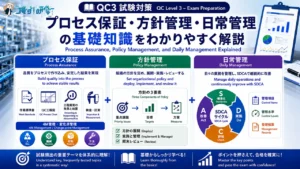
 QC3|プロセス保証・方針管理・日常管理の基礎知識をわかりやすく解説 QC Level 3 | Process Assurance, Policy Management, and Daily Management Explained
 -
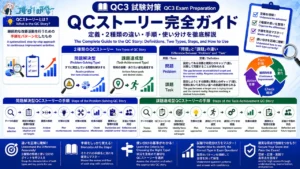
QC3|QCストーリー(問題解決型の8手順・課題達成型の9手順)の違いと使い分けをわかりやすく解説 QC Level 3 | QC Story: 8-Step Problem-Solving vs. 9-Step Task-Achievement Explained
-
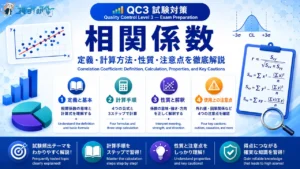
QC3|相関係数の計算方法・性質・使用上の注意点をわかりやすく解説 QC Level 3 | Correlation Coefficient: Calculation, Properties, and Key Cautions Explained
-
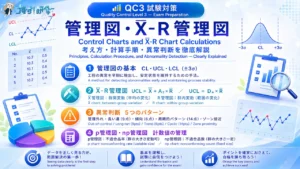
QC3|管理図の考え方とX̄-R管理図の計算方法をわかりやすく解説 QC Level 3 | Control Charts and X̄-R Chart Calculations Explained
-
QC3|工程能力指数 Cp・Cpkの計算方法と評価基準 QC Level 3 | Process Capability Index: Cp and Cpk Calculation and Evaluation Criteria
-
QC3|QC7つ道具(2) ヒストグラム・散布図・チェックシート・グラフの使い方 QC Level 3 | The 7 QC Tools (Part 2): How to Use Histograms, Scatter Diagrams, Check Sheets, and Graphs
-
QC3|QC7つ道具(1)層別・パレート図・特性要因図の使い方 QC Level 3 | The 7 QC Tools (Part 1): How to Use Stratification, Pareto Charts, and Cause-and-Effect Diagrams
-
QC3の難易度は?合格率・勉強時間・他の資格との比較で徹底解説 How Difficult Is the QC3 Exam? Pass Rates, Study Time, and Comparison with Other Certifications