危険物乙4|酸と塩基・酸化と還元・金属腐食の基礎知識 Class B, Group 4 Hazardous Materials Engineer | Acids and Bases, Oxidation and Reduction, and Metal Corrosion
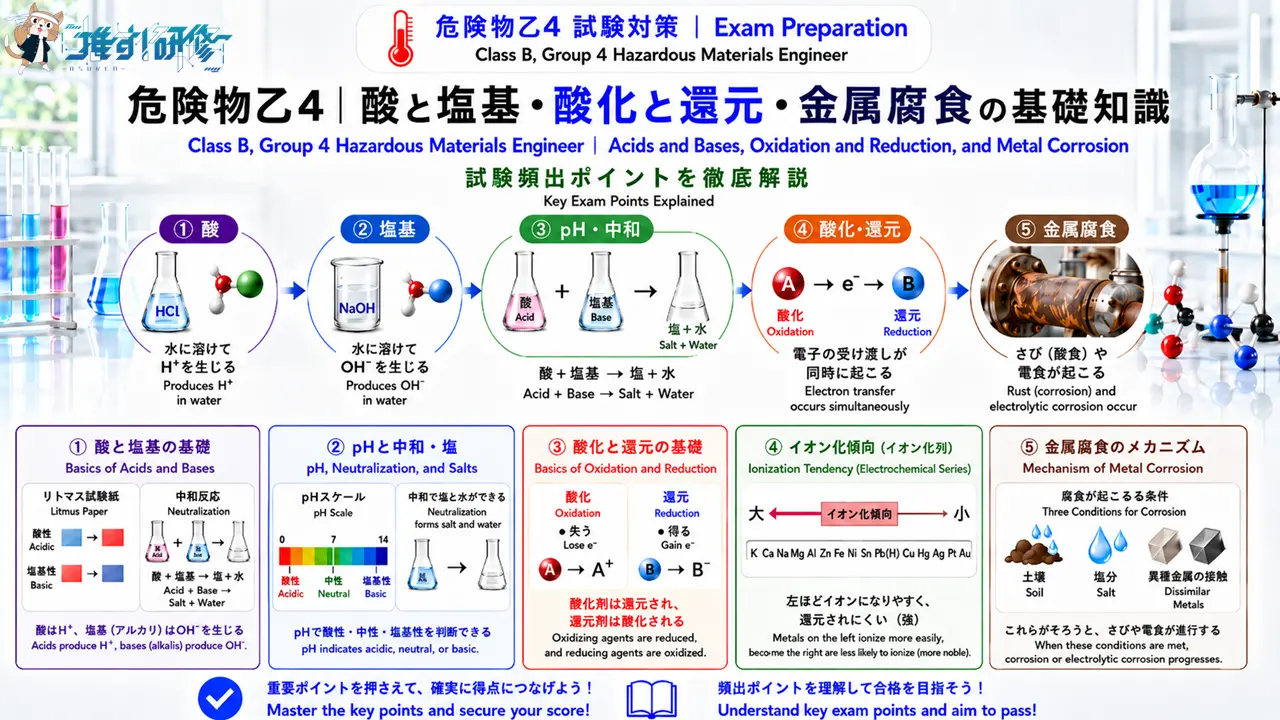
危険物乙4の試験では、「酸と塩基」「酸化と還元」は物理学・化学の基礎として繰り返し出題される最重要テーマです。「なぜ塩酸は酸性なのか」「酸化と還元はなぜ同時に起きるのか」「金属が腐食するメカニズムとは何か」——こうした問いに明確に答えられるよう、この記事で基礎から整理しましょう。
In the Class B, Group 4 Hazardous Materials Engineer exam, “acids and bases” and “oxidation and reduction” are among the most important topics in physics and chemistry, appearing repeatedly. This article will help you clearly answer questions such as: Why is hydrochloric acid acidic? Why do oxidation and reduction always occur simultaneously? And what is the mechanism behind metal corrosion?
本記事では、酸・塩基の定義とその特徴、水素イオン指数(pH)の読み方、中和と塩のしくみ、酸化・還元の定義と酸化剤・還元剤の関係、そして金属のイオン化傾向と腐食のメカニズムまで、試験合格に必要な知識を体系的に解説します。
This article systematically covers everything you need to pass the exam: the definitions and characteristics of acids and bases; how to read the hydrogen ion index (pH); the mechanism of neutralization and salt formation; the definitions of oxidation and reduction and the relationship between oxidizing and reducing agents; and the ionization tendency of metals and the mechanism of corrosion.
目次
酸と塩基 / Acids and Bases
水溶液の性質を理解するうえで、酸と塩基の定義は出発点となります。試験では定義そのものだけでなく、リトマス試験紙の色の変化や中和反応についても問われます。
Understanding the definitions of acids and bases is the starting point for understanding the properties of aqueous solutions. The exam tests not only the definitions themselves, but also the color changes of litmus paper and neutralization reactions.
酸・塩基の定義 / Definitions of Acids and Bases
酸とは、水に溶けると電離して水素イオン(H⁺)を生じる物質、または他の物質に水素イオン(H⁺)を与えることができる物質をいいます。塩酸(塩化水素)がその代表例です。塩化水素は水中で次のように電離します。
An acid is a substance that dissociates in water to produce hydrogen ions (H⁺), or a substance that can donate hydrogen ions (H⁺) to other substances. Hydrochloric acid (hydrogen chloride) is a typical example. Hydrogen chloride dissociates in water as follows.
HCl ⇌ H⁺ + Cl⁻
塩基とは、水に溶けると電離して水酸化物イオン(OH⁻)を生じる物質、または他の物質から水素イオン(H⁺)を受け取ることができる物質をいいます。水酸化ナトリウムがその代表例です。
A base is a substance that dissociates in water to produce hydroxide ions (OH⁻), or a substance that can accept hydrogen ions (H⁺) from other substances. Sodium hydroxide is a typical example.
NaOH ⇌ Na⁺ + OH⁻
なお、塩基のうち水に溶けるものを特にアルカリと呼びます。酸・塩基の強弱は、水溶液中に電離するH⁺とOH⁻の量によって決まります。
Among bases, those that dissolve in water are specifically called alkalis. The strength of an acid or base is determined by the amount of H⁺ or OH⁻ produced when it dissociates in aqueous solution.
酸性と塩基性の主な特徴 / Key Characteristics of Acidic and Basic Solutions
| 酸性 / Acidic | 塩基性(アルカリ性)/ Basic (Alkaline) |
|---|---|
| ① 青色リトマス紙を赤に変える Turns blue litmus paper red | ① 赤色リトマス紙を青に変える Turns red litmus paper blue |
| ② すっぱい味がある Has a sour taste | ② ぬるぬるした感触・苦みがある Has a slippery feel and bitter taste |
| ③ 亜鉛や鉄など一部の金属を溶かして水素を発生させることがある Can dissolve certain metals such as zinc and iron, producing hydrogen gas | ③ フェノールフタレイン溶液を赤色に変える Turns phenolphthalein solution red |
| ④ 水溶液中でH⁺を放出する Releases H⁺ in aqueous solution | ④ 水溶液中でOH⁻を放出する Releases OH⁻ in aqueous solution |
| ⑤ 塩基と中和して塩をつくる Reacts with a base to form a salt | ⑤ 酸と中和して塩をつくる Reacts with an acid to form a salt |
※危険物や薬品を味わったり、直接手で触れたりして性質を確認してはいけません。上記の特徴は試験上の知識として押さえてください。
* Never taste chemicals or touch them directly to identify their properties. Treat the characteristics listed above as exam concepts only.
酸性酸化物と塩基性酸化物、両性酸化物 / Acidic Oxides, Basic Oxides, and Amphoteric Oxides
酸化物にも酸や塩基としてはたらくものがあります。試験では3種類の分類と代表例の組み合わせが問われます。
Some oxides behave as acids or bases. The exam tests your knowledge of these three categories and their representative examples.
| 種類 / Type | 性質 / Property | 代表例 / Examples |
|---|---|---|
| 酸性酸化物 Acidic oxide | 水と反応して酸を生じるか、塩基と反応して塩を生じる。非金属元素の酸化物に多い。 Reacts with water to form an acid, or with a base to form a salt. Common among nonmetal oxides. | CO₂、SO₂、NO₂、SiO₂ |
| 塩基性酸化物 Basic oxide | 水と反応して塩基を生じるか、酸と反応して塩を生じる。金属元素の酸化物に多い。 Reacts with water to form a base, or with an acid to form a salt. Common among metal oxides. | CaO、Na₂O、CuO |
| 両性酸化物 Amphoteric oxide | 酸に対しては塩基性、塩基に対しては酸性を示す。 Acts as a base toward acids and as an acid toward bases. | Al₂O₃、ZnO |
水素イオン指数(pH)/ The Hydrogen Ion Index (pH)
水溶液の酸性・塩基性の度合いを数値で表すために水素イオン指数(pH:ピーエイチまたはペーハー)が用いられます。25℃の水溶液中には必ずH⁺とOH⁻の両方が存在し、その積は一定です。そのためH⁺の濃度が上がるとOH⁻の濃度は下がり、逆もまた然りです。
The hydrogen ion index (pH) is used to express the degree of acidity or alkalinity of an aqueous solution numerically. At 25°C, both H⁺ and OH⁻ are always present in aqueous solution, and their product is constant. Therefore, when the concentration of H⁺ increases, the concentration of OH⁻ decreases, and vice versa.
試験でまず覚えるべき3点は次のとおりです。
The three essential facts to memorize for the exam are as follows.
- pH = 7:中性(純水・25℃)/ pH = 7: Neutral (pure water at 25°C)
- pH < 7:酸性(値が小さいほど強い酸性)/ pH < 7: Acidic (lower value = stronger acid)
- pH > 7:塩基性(値が大きいほど強い塩基性)/ pH > 7: Basic (higher value = stronger base)
重要な注意点として、水素イオン濃度([H⁺])が高くなるほど、pHの値は小さくなります。逆も同様で、OH⁻濃度が高くなるほどpHは大きくなります。試験では「H⁺濃度が高いとpHも大きい」という誤りの選択肢が頻出しますので注意してください。
One important point to note: as the hydrogen ion concentration ([H⁺]) increases, the pH value decreases. The reverse is equally true: as OH⁻ concentration increases, pH increases. Watch out for the common wrong answer on the exam that claims a higher H⁺ concentration corresponds to a higher pH.
pHと酸性・中性・塩基性の関係を以下に整理します(25℃の場合)。
The relationship between pH and the acid/neutral/basic classification is summarized below (at 25°C).
| pH範囲 / pH range | 性質 / Property | [H⁺]の目安 / Approximate [H⁺] |
|---|---|---|
| pH < 7 | 酸性 / Acidic (値が小さいほど強い酸性 / Lower = stronger acid) | 1.0 × 10⁻⁶ mol/L より大 Greater than 1.0 × 10⁻⁶ mol/L |
| pH = 7 | 中性 / Neutral (純水・25℃ / Pure water at 25°C) | 1.0 × 10⁻⁷ mol/L |
| pH > 7 | 塩基性 / Basic (値が大きいほど強い塩基性 / Higher = stronger base) | 1.0 × 10⁻⁷ mol/L より小 Less than 1.0 × 10⁻⁷ mol/L |
pHの計算問題では、[H⁺] = 1.0 × 10⁻ⁿ mol/L のとき、pH = n となることを覚えておきましょう。たとえば [H⁺] = 1.0 × 10⁻² mol/L ならば pH = 2(強い酸性)、[H⁺] = 1.0 × 10⁻¹¹ mol/L ならば pH = 11(強い塩基性)です。
For pH calculation problems, remember that when [H⁺] = 1.0 × 10⁻ⁿ mol/L, then pH = n. For example, if [H⁺] = 1.0 × 10⁻² mol/L, then pH = 2 (strongly acidic); if [H⁺] = 1.0 × 10⁻¹¹ mol/L, then pH = 11 (strongly basic).
中和と塩 / Neutralization and Salts
酸と塩基が反応して塩と水が生成される反応を中和反応といいます。
The reaction between an acid and a base to produce a salt and water is called a neutralization reaction.
酸 + 塩基 → 塩 + 水 / Acid + Base → Salt + Water
例:塩酸と水酸化ナトリウムが反応すると、塩化ナトリウム(食塩)と水が生じます。
Example: When hydrochloric acid reacts with sodium hydroxide, sodium chloride (table salt) and water are produced.
HCl + NaOH → NaCl + H₂O
塩の分類 / Classification of Salts
塩は中和反応で生成される物質ですが、その組成によって3種類に分類されます。また、塩の名称と水溶液の酸性・塩基性は必ずしも一致しないことに注意が必要です。たとえば炭酸水素ナトリウム(NaHCO₃)は酸性塩に分類されますが、その水溶液は弱い塩基性を示します。
Salts are produced in neutralization reactions and are classified into three types based on their composition. It is important to note that the name of a salt does not necessarily correspond to the acidity or basicity of its aqueous solution. For example, sodium bicarbonate (NaHCO₃) is classified as an acidic salt, yet its aqueous solution is weakly basic.
| 種類 / Type | 特徴 / Characteristic | 例 / Example |
|---|---|---|
| 正塩 Normal salt | 酸のHも塩基のOHも残っていない塩 Neither H from acid nor OH from base remains | NaCl、Na₂SO₄、Na₂CO₃、CH₃COONa、NH₄Cl |
| 酸性塩 Acid salt | 酸に由来するHが残っている塩 Salt in which H derived from the acid remains | NaHSO₄、NaHCO₃ |
| 塩基性塩 Basic salt | 塩基に由来するOHが残っている塩 Salt in which OH derived from the base remains | MgCl(OH)、CuCl(OH) |
塩の加水分解 / Hydrolysis of Salts
塩が水に溶けて水の分子と反応し、酸性または塩基性を示す反応を加水分解といいます。加水分解が起きるかどうか、またその結果どちらの性質を示すかは、塩を構成する酸と塩基の強弱の組み合わせで決まります。
The reaction in which a salt dissolves in water and reacts with water molecules to produce an acidic or basic solution is called hydrolysis. Whether hydrolysis occurs, and which property results, depends on the combination of strong or weak acid and base from which the salt was formed.
| 塩の組成 / Salt composition | 加水分解 / Hydrolysis | 水溶液の性質 / Solution property |
|---|---|---|
| 強酸 + 強塩基 Strong acid + Strong base | しない / Does not occur | 中性 / Neutral |
| 弱酸 + 強塩基 Weak acid + Strong base | する / Occurs | 塩基性 / Basic |
| 強酸 + 弱塩基 Strong acid + Weak base | する / Occurs | 酸性 / Acidic |
| 弱酸 + 弱塩基 Weak acid + Weak base | する / Occurs | 酸・塩基の強弱関係によって異なる Depends on the relative strengths of the acid and base |
酸化と還元 / Oxidation and Reduction
酸化・還元の概念には「狭い意味」と「広い意味」の2つのレベルがあります。試験では特に広い意味の定義と、酸化・還元が常に同時に起きるという点が問われます。
The concept of oxidation and reduction exists at two levels: a narrow definition and a broader definition. The exam particularly focuses on the broader definitions and the fact that oxidation and reduction always occur simultaneously.
酸化・還元の定義 / Definitions of Oxidation and Reduction
| 視点 / Perspective | 酸化 / Oxidation | 還元 / Reduction |
|---|---|---|
| 酸素 / Oxygen | 酸素を得る / Gains oxygen | 酸素を失う / Loses oxygen |
| 水素 / Hydrogen | 水素を失う / Loses hydrogen | 水素を得る / Gains hydrogen |
| 電子 / Electrons | 電子を失う / Loses electrons | 電子を得る / Gains electrons |
最も重要な点として、酸化と還元は必ず同時に起こります。ある物質が酸化されるとき、別の物質が同時に還元されます。この反応全体を酸化還元反応と呼びます。「同一反応系において酸化と還元は同時には起こらない」という記述は誤りです。
The most important point: oxidation and reduction always occur simultaneously. When one substance is oxidized, another substance is reduced at the same time. This overall reaction is called a redox reaction. Any statement claiming that oxidation and reduction do not occur simultaneously in the same reaction is incorrect.
酸化剤と還元剤 / Oxidizing Agents and Reducing Agents
酸化剤とは、相手の物質を酸化させる物質のことで、自身は還元されます。還元剤とは、相手の物質を還元させる物質のことで、自身は酸化されます。
An oxidizing agent is a substance that oxidizes another substance; in doing so, it is itself reduced. A reducing agent is a substance that reduces another substance; in doing so, it is itself oxidized.
| 酸化剤 / Oxidizing agent | 還元剤 / Reducing agent | |
|---|---|---|
| 相手への作用 Effect on the other substance | 相手を酸化する Oxidizes the other substance | 相手を還元する Reduces the other substance |
| 自身の変化 Change in itself | 自身は還元される Is itself reduced | 自身は酸化される Is itself oxidized |
| 主な例 Key examples | 酸素(O₂)、ハロゲン(Cl₂・Br₂・I₂)、過マンガン酸カリウム(KMnO₄)、オゾン(O₃)、過酸化水素(H₂O₂)※ O₂, halogens (Cl₂, Br₂, I₂), KMnO₄, O₃, H₂O₂ * | 水素(H₂)、一酸化炭素(CO)、ナトリウム(Na)、カリウム(K)、硫化水素(H₂S) H₂, CO, Na, K, H₂S |
※ 過酸化水素(H₂O₂)は通常は酸化剤としてはたらきますが、過マンガン酸カリウム(KMnO₄)のような強力な酸化剤に対しては例外的に還元剤としてはたらきます。この二面性は試験頻出の論点です。
* Hydrogen peroxide (H₂O₂) normally acts as an oxidizing agent, but exceptionally acts as a reducing agent when reacting with a stronger oxidizing agent such as potassium permanganate (KMnO₄). This dual nature is a frequently tested point.
金属と非金属・イオン化傾向と腐食 / Metals and Nonmetals, Ionization Tendency, and Corrosion
危険物乙4の試験では、金属配管の腐食メカニズムが出題されることがあります。腐食を理解するためには、金属のイオン化傾向を把握しておく必要があります。
In the Class B, Group 4 exam, the corrosion mechanism of metal pipes may appear as a test topic. Understanding corrosion requires an understanding of the ionization tendency of metals.
金属と非金属の特性 / Properties of Metals and Nonmetals
| 特性 / Property | 金属 / Metal | 非金属 / Nonmetal |
|---|---|---|
| イオンへのなりやすさ Tendency to form ions | 陽イオンになりやすい Tends to form cations | 陰イオンになりやすいものが多い Many tend to form anions |
| 酸化物の性質 Nature of oxides | 塩基性酸化物をつくる Forms basic oxides | 酸性酸化物をつくる Forms acidic oxides |
| 電気・熱伝導性 Electrical/thermal conductivity | 良導体 Good conductors | 不導体(炭素は例外) Poor conductors (carbon is an exception) |
| 常温での状態 State at room temperature | 固体(水銀は例外) Solid (mercury is an exception) | 固体・液体・気体さまざま Solid, liquid, or gas |
金属のイオン化傾向 / Ionization Tendency of Metals
金属原子が陽イオンになろうとする傾向をイオン化傾向といい、その大きさの順に並べたものをイオン化列といいます。イオン化傾向が大きいほど、化学的に活性で他の物質と反応しやすく、腐食(さび)が生じやすい特性があります。
The tendency of a metal atom to become a cation is called its ionization tendency, and metals arranged in order of this tendency form the ionization series. The greater the ionization tendency, the more chemically reactive the metal — and the more prone it is to corrosion (rusting).
【イオン化傾向:大 → 小】
[Ionization tendency: Large → Small]
K Ca Na Mg Al Zn Fe Ni Sn Pb (H₂) Cu Hg Ag Pt Au
金属の腐食 / Metal Corrosion
金属が周囲の物質と化学的・電気的に反応して表面から消耗していく現象を腐食といいます。地中に埋設された鋼製配管では、鉄が陽イオンに変化して溶け出すことで腐食が進行します。腐食を防ぐ代表的な方法として、エポキシ樹脂等の合成樹脂で配管の表面を完全に被覆する方法があります。
The phenomenon in which a metal reacts chemically or electrochemically with surrounding substances and deteriorates from its surface is called corrosion. In underground steel pipes, corrosion progresses as iron transforms into cations and dissolves. A primary method of preventing corrosion is to completely coat the surface of the pipe with a synthetic resin such as epoxy resin.
配管が特に腐食しやすい環境条件を以下に示します。
The environmental conditions under which pipes are especially prone to corrosion are shown below.
| 腐食しやすい環境 / Environments prone to corrosion |
|---|
| ① 酸性が強い土壌、または塩分濃度が高い土壌に埋設されている場合 Buried in strongly acidic soil or soil with high salt concentration |
| ② 土質の異なる地層にまたがって埋設されている場合 Buried across soil layers of different composition |
| ③ 直流電気鉄道の軌道に近い地中に埋設されている場合(迷走電流の影響) Buried near the tracks of a DC railway (subject to stray currents) |
| ④ 鉄製(鋼製)の配管が、鉄よりもイオン化傾向の小さい金属と接している場合 Iron (steel) pipe in contact with a metal that has a lower ionization tendency than iron |
④について補足します。異なる金属が接触している場合、イオン化傾向の大きい金属(陽極側)の腐食が促進されます。鉄(Fe)よりイオン化傾向の小さい銅(Cu)などと接触することで、鉄側の腐食が加速します。これを電食(ガルバニック腐食)といいます。
A note on condition ④: when two different metals are in contact, corrosion of the metal with the higher ionization tendency (the anodic side) is accelerated. When iron (Fe) is in contact with a metal such as copper (Cu), which has a lower ionization tendency, corrosion of the iron side accelerates. This is called galvanic corrosion.
まとめ / Summary
このテーマの試験における重要ポイントをまとめます。
Here is a summary of the key exam points for this topic.
- 酸・塩基の定義 酸はH⁺を生じる・与える物質。塩基はOH⁻を生じる・H⁺を受け取る物質。青リトマス→赤が酸性、赤リトマス→青が塩基性。
Definitions of acids and bases — Acids produce or donate H⁺; bases produce OH⁻ or accept H⁺. Acid turns blue litmus red; base turns red litmus blue. - pHの読み方 pH=7が中性、pH<7が酸性、pH>7が塩基性。H⁺濃度が高いほどpHは小さい。
Reading pH — pH = 7 is neutral; pH < 7 is acidic; pH > 7 is basic. Higher H⁺ concentration means lower pH. - 塩の分類と加水分解 正塩・酸性塩・塩基性塩の区別。強酸+強塩基の塩は中性。弱酸+強塩基→塩基性。強酸+弱塩基→酸性。弱酸+弱塩基は酸・塩基の強弱関係によって異なる。
Salt classification and hydrolysis — Normal, acidic, and basic salts. Strong acid + strong base = neutral; weak acid + strong base = basic; strong acid + weak base = acidic. Weak acid + weak base depends on the relative strengths of the acid and base. - 酸化・還元の同時性 酸化と還元は必ず同時に起こる。「同時には起こらない」という選択肢は誤り。
Simultaneous occurrence of oxidation and reduction — Oxidation and reduction always occur simultaneously. Any option claiming they do not is incorrect. - 酸化剤・還元剤の識別 酸化剤は相手を酸化し自身は還元される。還元剤は相手を還元し自身は酸化される。H₂O₂は通常酸化剤だが強酸化剤に対しては還元剤になる。
Identifying oxidizing and reducing agents — An oxidizing agent oxidizes the other substance and is itself reduced. A reducing agent reduces the other substance and is itself oxidized. H₂O₂ is normally an oxidizing agent but acts as a reducing agent against stronger oxidizing agents. - イオン化傾向と腐食 イオン化傾向の大きい金属ほど腐食しやすい。配管腐食の防止にはエポキシ樹脂等による被覆が有効。酸性土壌・塩分の多い土壌・迷走電流・異種金属との接触が腐食を促進する。
Ionization tendency and corrosion — The higher a metal’s ionization tendency, the more prone it is to corrosion. Coating with epoxy resin or other synthetic resins is an effective prevention method. Acidic soil, high-salt soil, stray currents, and contact with dissimilar metals all accelerate corrosion.
練習問題 理解を確認しよう / Practice Questions: Test Your Understanding
ここまでの内容を試験形式で確認しましょう。解答と解説は各問題の直下に記載しています。
Let’s check your understanding with some exam-style practice questions. The answer and explanation appear directly below each question.
問題1 Question 1
酸と塩基に関する記述として、誤っているものはどれか。
Which of the following statements about acids and bases is incorrect?
- 酸は水に溶けると電離して水素イオン(H⁺)を生じる物質、または他の物質に水素イオンを与える物質をいう。
An acid is a substance that dissociates in water to produce hydrogen ions (H⁺), or a substance that donates hydrogen ions to other substances. - 塩基は水に溶けると電離して水酸化物イオン(OH⁻)を生じる物質、または他の物質から水素イオンを受け取る物質をいう。
A base is a substance that dissociates in water to produce hydroxide ions (OH⁻), or a substance that accepts hydrogen ions from other substances. - 酸は赤色リトマス紙を青色に変える。
Acids turn red litmus paper blue. - 酸は亜鉛など一部の金属を溶かして水素ガスを発生させることがある。
Acids can dissolve certain metals such as zinc, producing hydrogen gas. - 酸と塩基が反応すると塩と水が生成される。
When an acid reacts with a base, a salt and water are produced.
解答:3 Answer: 3
選択肢3が誤りです。酸は青色リトマス紙を赤色に変えます。赤色リトマス紙を青色に変えるのは塩基(アルカリ)です。試験でリトマス紙の色変化は頻出で、「酸→青を赤に」「塩基→赤を青に」と方向をセットで覚えましょう。選択肢1・2は酸・塩基の正しい定義です。選択肢4は酸の正しい性質で、例えばZn + H₂SO₄ → ZnSO₄ + H₂のように亜鉛が硫酸に溶けて水素が発生します。選択肢5は中和反応の正しい説明です。
Option 3 is incorrect. Acids turn blue litmus paper red — not the other way around. It is bases (alkalis) that turn red litmus paper blue. Litmus paper color changes are frequently tested, so memorize the direction: acid turns blue to red; base turns red to blue. Options 1 and 2 are correct definitions of acids and bases. Option 4 correctly describes a property of acids — for example, zinc dissolves in sulfuric acid to produce hydrogen: Zn + H₂SO₄ → ZnSO₄ + H₂. Option 5 correctly describes neutralization.
問題2 Question 2
酸化と還元に関する記述として、誤っているものはどれか。
Which of the following statements about oxidation and reduction is incorrect?
- 物質が酸素を得る反応を酸化という。
A reaction in which a substance gains oxygen is called oxidation. - 物質が電子を失う反応を酸化という。
A reaction in which a substance loses electrons is called oxidation. - 酸化剤とは、相手の物質を酸化する物質のことで、自身は酸化される。
An oxidizing agent is a substance that oxidizes another substance; in doing so, it is itself oxidized. - 酸化と還元は同一反応系内で必ず同時に起こる。
Oxidation and reduction always occur simultaneously within the same reaction system. - ハロゲン(Cl₂・Br₂・I₂)は酸化剤としてはたらく。
Halogens (Cl₂, Br₂, I₂) act as oxidizing agents.
解答:3 Answer: 3
選択肢3が誤りです。酸化剤は相手を酸化しますが、自身は還元されます(酸化されるのではありません)。「酸化剤=自身が還元される」「還元剤=自身が酸化される」というペアで覚えてください。選択肢1・2はいずれも酸化の正しい定義です(酸素を得る/電子を失う)。選択肢4は重要な原則で、酸化と還元は必ず同時に進行します。選択肢5も正しく、ハロゲン類(Cl₂・Br₂・I₂)は相手物質から電子を奪う性質があるため、酸化剤としてはたらきます。
Option 3 is incorrect. An oxidizing agent oxidizes the other substance, but is itself reduced — not oxidized. Remember the pair: “oxidizing agent = itself reduced”; “reducing agent = itself oxidized.” Options 1 and 2 are both correct definitions of oxidation (gains oxygen / loses electrons). Option 4 states an important principle: oxidation and reduction always proceed simultaneously. Option 5 is also correct: halogens (Cl₂, Br₂, I₂) strip electrons from other substances and therefore act as oxidizing agents.
問題3 Question 3
地中に埋設された金属配管の腐食に関する記述として、正しいものはどれか。
Which of the following statements about the corrosion of underground metal pipes is correct?
- アルカリ性が強い土壌に埋設された鉄製配管は特に腐食しやすい。
Iron pipes buried in strongly alkaline soil are especially prone to corrosion. - 交流電気鉄道の軌道に近い地中に埋設された配管は、迷走電流の影響を受けやすい。
Pipes buried near the tracks of an AC railway are susceptible to the effects of stray currents. - 鉄製の配管が、鉄よりもイオン化傾向の小さい金属と接している場合、鉄側の腐食が促進される。
When an iron pipe is in contact with a metal that has a lower ionization tendency than iron, corrosion of the iron side is accelerated. - 土質が均一な地層に埋設された配管は、腐食が促進されやすい。
Pipes buried in a uniformly composed soil layer are prone to accelerated corrosion. - 塩分濃度の低い土壌は腐食を促進する。
Soil with low salt concentration promotes corrosion.
解答:3 Answer: 3
選択肢3が正解です。鉄(Fe)よりもイオン化傾向の小さい金属(例:銅Cu)が接触していると、イオン化傾向の大きい鉄側が優先的に陽イオンとなって溶け出し、腐食が加速します(電食・ガルバニック腐食)。選択肢1は誤りで、腐食を促進するのはアルカリ性土壌ではなく酸性が強い土壌です。選択肢2は誤りで、迷走電流の影響を受けるのは直流電気鉄道であり、交流鉄道ではありません。選択肢4は誤りで、腐食を促進するのは土質の異なる地層にまたがる場合であり、均一な土質では促進されません。選択肢5は誤りで、腐食を促進するのは塩分濃度の高い土壌です。
Option 3 is correct. When a metal with a lower ionization tendency than iron (e.g., copper, Cu) is in contact with iron, the iron, having the higher ionization tendency, preferentially dissolves as cations, and corrosion is accelerated (galvanic corrosion). Option 1 is incorrect: it is strongly acidic soil — not alkaline soil — that promotes corrosion. Option 2 is incorrect: stray currents arise from DC (direct current) railways, not AC railways. Option 4 is incorrect: corrosion is promoted when a pipe is buried across layers of different soil types, not in uniform soil. Option 5 is incorrect: it is soil with high salt concentration that promotes corrosion.
- 夏目漱石『こころ』に学ぶ——職場で「打ち明けられる関係と信頼」を育てる文学研修 Learning from Natsume Sōseki's Kokoro: Literature-Based Training for Building Trust and Creating Space for Openness at Work
- QC3|品質の概念・QC的ものの見方・工程管理・小集団活動・QMSの基礎知識をわかりやすく解説 QC Level 3 | Quality Concepts, the QC Way of Thinking, Process Management, Small Group Activities, and QMS Explained
この記事を書いた人

関連記事
-
 危険物乙4|第一石油類の性状を徹底解説【ガソリン・ベンゼン・トルエン・アセトンほか】 Class B, Group 4 Hazardous Materials Engineer | Properties of Category 1 Petroleum: Gasoline, Benzene, Toluene, Acetone, and More Explained
 -
危険物乙4|特殊引火物の性状を徹底解説【ジエチルエーテル・二硫化炭素・アセトアルデヒド・酸化プロピレン】 Class B, Group 4 Hazardous Materials Engineer | Properties of Special Flammable Liquids: Diethyl Ether, Carbon Disulfide, Acetaldehyde, and Propylene Oxide Explained
-
危険物乙4|単体・化合物・混合物と状態変化の基礎知識 Class B, Group 4 Hazardous Materials Engineer | Simple Substances, Compounds, Mixtures, and Changes of State
-
危険物乙4|保安距離と保有空地の対象施設・数値基準をわかりやすく解説 Class B Group 4 Hazardous Materials Engineer | Safety Distances and Open Space Requirements Explained
-
危険物乙4|免状の交付・書換え・再交付の申請先と手続きをわかりやすく解説 Class B Group 4 Hazardous Materials Engineer | License Issuance, Amendment, Reissuance, and Surrender: Application Authorities and Procedures Explained
-
危険物乙4|熱の移動の基礎知識 伝導・対流・放射 Class B, Group 4 Hazardous Materials Engineer | Heat Transfer Fundamentals: Conduction, Convection, and Radiation
-
危険物乙4|静電気の基礎知識と防止対策 Class B, Group 4 Hazardous Materials Engineer | Static Electricity: Fundamentals and Prevention Measures
-
危険物乙4「運搬の基準」完全まとめ|試験頻出ポイントを徹底解説 Class B, Group 4 — Complete Guide to Hazardous Materials Transportation Standards | Key Exam Points Explained