危険物乙4|静電気の基礎知識と防止対策 Class B, Group 4 Hazardous Materials Engineer | Static Electricity: Fundamentals and Prevention Measures
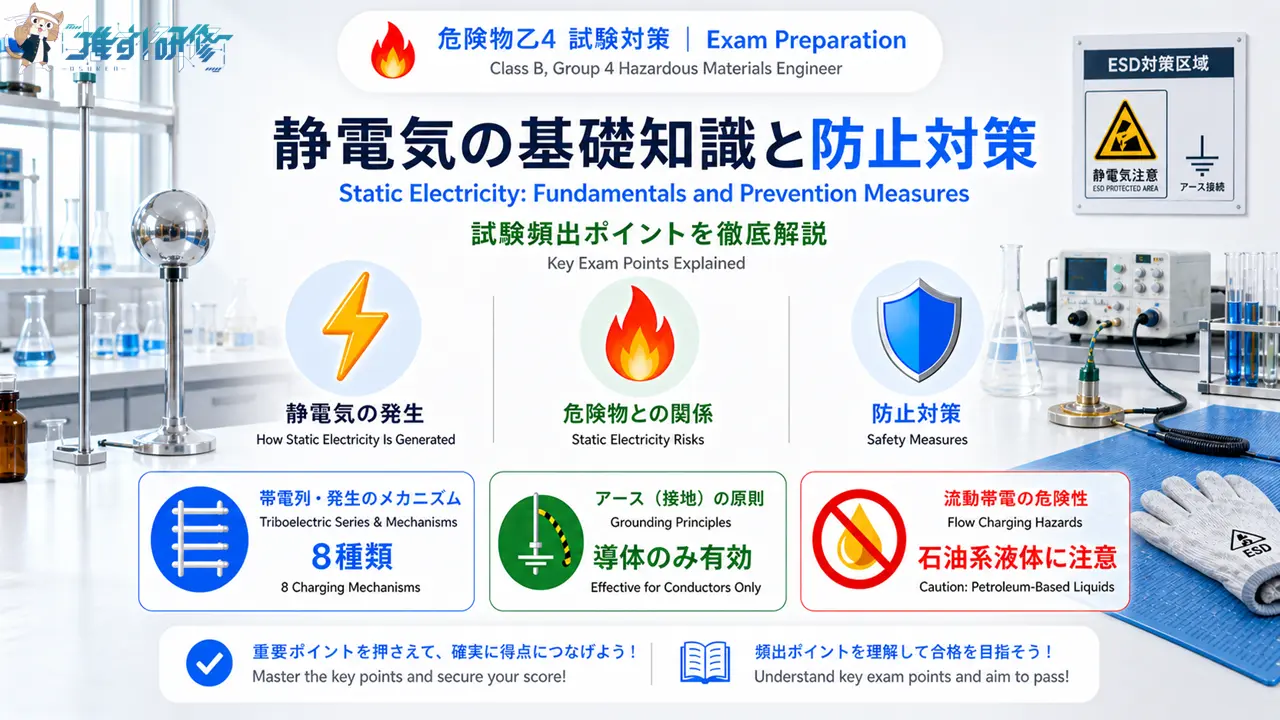
危険物乙4の試験では、「静電気」が火災や爆発の火種(点火源)として繰り返し出題される重要テーマです。「静電気ってなんとなく知っているけど、説明できない」という方も大丈夫です。本記事では、物理や化学が苦手な方でも「なるほど」とイメージできるよう、やさしい言葉でていねいに解説します。
In the Class B, Group 4 Hazardous Materials Engineer exam, “static electricity” is a recurring and important topic — it is one of the main ignition sources for fires and explosions. If your reaction is “I’ve heard of static electricity, but I can’t really explain it,” don’t worry. This article uses plain, accessible language so that even readers who struggle with physics or chemistry can build a clear mental picture.
静電気がどんな仕組みで生まれるのか、危険物の現場でなぜ危険なのか、そしてどうすれば防げるのかを、試験に出るポイントに絞って説明します。
This article explains — focused strictly on what the exam tests — how static electricity is generated, why it is dangerous in hazardous materials workplaces, and what can be done to prevent it.
目次
静電気とは / What Is Static Electricity?
静電気とは、電線の中を流れる電気とは違い、ある物体の表面や内部にたまったまま動かない電気のことです。この「電気がたまった状態」のことを「帯電(たいでん)」と呼びます。冬にドアノブで「バチッ」とくるのは、体にたまった静電気が一気に放電する瞬間です。
Unlike the electricity that flows through wires, static electricity is electricity that builds up and stays put on or inside an object rather than flowing. This built-up state is called “electrification” (帯電). The sharp “zap” you get from a doorknob in winter is the moment all that stored charge releases at once.
2種類の異なる物質が触れ合ってから離れると、両者の間で電子やイオン(電気の粒)の受け渡しが起こります。このとき、電気の粒を多く受け取った側はマイナスに帯電し、粒が多く残った側はプラスに帯電します。電気の粒が物体間を移動することでも帯電が生じます。
When two different materials come into contact and then separate, a transfer of electrons or ions (tiny electrical particles) takes place between them. As a result, the side that receives more of these particles becomes negatively charged, while the side that retains more becomes positively charged. Electrification can also occur when charged particles move between objects directly.
2つの物体の間でどれだけ電気が移動しても、移動の前と後で、全体の電気の量は変わりません。「A がもらった分だけ、B から減る」だけです。これを電気量保存の法則と呼びます。
No matter how much charge moves between two objects, the total amount of charge in the system stays exactly the same before and after. Whatever A gains, B loses by the same amount. This is known as the law of conservation of charge.
静電気の基本的な性質 / Basic Properties of Static Electricity
電気には「プラス(+)」と「マイナス(-)」の2種類があります。同じ種類の電荷どうしは反発し合い、違う種類の電荷どうしは引き合います。この力をクーロン力(静電気力)と呼びます。磁石のN極とS極が引き合い、同じ極どうしが反発するのと同じイメージです。
There are two types of charge: positive (+) and negative (−). Like charges repel each other, while unlike charges attract. This force is called the Coulomb force (electrostatic force). Think of it like the poles of a magnet — opposite poles attract, same poles push apart.
電気の量を表す単位はクーロン(C)です。電気素量とは、電荷のいちばん小さな単位で、電子1個や陽子1個が持つ電気の量にあたります。すべての電気量は、この最小単位の整数倍になっています。
The unit of electric charge is the coulomb (C). The elementary charge is the smallest possible unit of charge — it equals the amount of charge carried by a single electron or proton. Every quantity of charge is a whole-number multiple of this value.
電気を通しにくい(絶縁性の高い)素材ほど、静電気がたまりやすいです。ゴムやプラスチックが典型例で、固体・液体・気体を問わず帯電は起こります。
Materials that do not conduct electricity well — that is, materials with high insulating properties — are more prone to static electricity buildup. Rubber and plastics are classic examples. Electrification can occur in solids, liquids, and gases alike.
帯電列 / The Triboelectric Series
帯電列とは、異なる素材を擦り合わせたときに、プラスに帯電しやすい素材を上位に、マイナスに帯電しやすい素材を下位に並べた順序表です。2つの素材が帯電列の上で離れた位置にあるほど、触れ合ったり擦れたりしたときに多くの電気が移動します。「相性が遠いほど、多くの静電気が生まれる」とイメージすると覚えやすいです。
The triboelectric series is a ranking in which materials that tend to acquire a positive charge when rubbed are placed higher, and those that tend to acquire a negative charge are placed lower. The further apart two materials are on this list, the more charge is transferred when they touch or rub together. A helpful way to remember it: the more “opposite” two materials are on the series, the more static electricity they produce.
帯電列では、髪の毛・毛皮・ガラス・ナイロン・レーヨン・木綿などがプラス寄りの素材として並びます。一方、ゴム・ポリエステル・アクリル・ポリエチレン・塩化ビニル・テフロンなどはマイナス寄りの素材として並びます。リストの両端に近い組み合わせほど、移動する電荷の量が多くなります。
In the triboelectric series, materials such as human hair, fur, glass, nylon, rayon, and cotton are positioned toward the positive end. Materials such as rubber, polyester, acrylic, polyethylene, PVC, and PTFE (Teflon) are toward the negative end. Combinations closer to opposite ends of the list transfer the most charge.
例として、ガラス棒と木綿を擦り合わせると、ガラス棒はプラス、木綿はマイナスに帯電します。帯電列での位置が離れた組み合わせほど、発生する静電気の量が多くなります。
For example, rubbing a glass rod against cotton causes the glass rod to charge positively and the cotton negatively. The greater the separation between two materials on the series, the more static electricity they generate together.
繊維の分類と静電気 / Fiber Types and Static Electricity
繊維は大きく天然繊維と化学繊維の2つに分かれます。
Fibers are broadly classified into two categories: natural fibers and man-made fibers.
天然繊維はさらに植物繊維(綿・ジュートなど)と動物繊維(羊毛・カシミヤなど)に分かれます。化学繊維は再生繊維(キュプラ・レーヨンなど)、半合成繊維(アセテートなど)、合成繊維(ナイロン・ポリエステル・アクリルなど)の3種類に分かれます。
Natural fibers are further divided into plant fibers (such as cotton and jute) and animal fibers (such as wool and cashmere). Man-made fibers fall into three types: regenerated fibers (such as cupro and rayon), semi-synthetic fibers (such as acetate), and synthetic fibers (such as nylon, polyester, and acrylic).
アクリル・ポリエステル・ナイロンは「三大合成繊維」と呼ばれています。これらはいずれも水分を吸いにくいため、電気が逃げにくく静電気が起きやすいという共通の特徴があります。一方、再生繊維のキュプラは帯電しにくい特性があり、高品質な衣類の裏地として広く使われています。
Acrylic, polyester, and nylon are known as the three major synthetic fibers. All three absorb little moisture, which means charge cannot escape easily — making them especially prone to static electricity. Cupro, a regenerated fiber, has the opposite property — it resists static buildup — and is widely used as a lining material in high-quality garments.
静電気が発生するメカニズム / Mechanisms of Static Electricity Generation
静電気はさまざまな「物理的な動き」によって生まれます。危険物を扱う現場でどんな場面に帯電が起きやすいかを、具体的にイメージしながら覚えましょう。試験では、各メカニズムの名前と「どんな場面で起こるか」を答えさせる問題がよく出ます。
Static electricity is generated by various kinds of physical action. Try to picture the specific workplace situations where each type of charging is most likely to occur. The exam frequently tests the name of each mechanism and the scenario in which it takes place.
静電気が発生するメカニズムは8種類に整理できます。①混合・かくはん帯電は液体や粉末をかき混ぜるときに起こります。②接触帯電は異なる物質が触れ合って引き離されるときに生じます。③剥離帯電は貼り合わさった面や接着面をはがすときに起こります。④破砕帯電は固体の物質を砕いたり壊したりするときに起こります。⑤噴出帯電は液体や気体が勢いよく吹き出すときに生じます。⑥流動帯電は液体がパイプや貯槽の中を移動するときに発生します。⑦摩擦帯電は異なる素材の物体をこすり合わせて引き離すときに起こります。⑧その他として、液体の落下・物体への衝突・細かい液滴の飛散などによっても帯電が生じます。
The mechanisms of static electricity generation can be organized into eight types. ① Mixing/agitation charging occurs when liquids or powders are stirred or blended. ② Contact charging occurs when different materials touch and are then separated. ③ Separation charging occurs when bonded or adhered surfaces are pulled apart. ④ Fracture charging occurs when solid material is crushed or broken. ⑤ Spray charging occurs when liquid or gas is forcefully expelled through an opening. ⑥ Flow charging occurs when liquid moves through piping or storage tanks. ⑦ Triboelectric charging occurs when objects of different materials are rubbed together and then separated. ⑧ Other types include charging from liquid droplet fall, impact on objects, and fine droplet dispersion.
流動帯電の仕組み(重要) / How Flow Charging Works (Key Topic)
流動帯電は、危険物の移送・移し替えの場面で特に注意が必要なメカニズムです。少し込み入った話ですが、順を追って読めば必ず理解できます。
Flow charging requires particular attention during the transfer and transportation of hazardous materials. It is a slightly involved mechanism, but if you read through it step by step, it will make sense.
液体がパイプの中を流れるとき、液体の中に含まれるマイナスの粒(マイナスイオン)が、パイプの内壁に引き寄せられます。その結果、パイプの内壁側とその近くの液体に、プラスとマイナスの層が重なった状態ができます。これを電気二重層と呼びます。
As liquid flows through a pipe, negative particles (negative ions) in the liquid are drawn toward the inner wall of the pipe. This creates overlapping layers of positive and negative charge at the liquid-wall boundary — a phenomenon called the electric double layer.
液体が流れ続けることで、パイプ側はマイナスに、流れる液体側は多くの場合プラスに帯電していきます。ガソリンをはじめとする石油系の液体はもともと電気を通しにくいため、流動帯電が起こりやすい代表的な物質です。
As the liquid continues to flow, the pipe gradually acquires a negative charge while the flowing liquid acquires a positive charge in most cases. Petroleum-based liquids such as gasoline conduct electricity poorly, making them among the most typical substances prone to flow charging.
目の細かいフィルターを液体が通過するときは、フィルター素材との接触面積が増え、なおかつ流れる速度も上がるため、帯電量が一気に増えます。フィルターの設置位置や液体の流速の管理が重視されるのはこのためです。
When liquid passes through a fine-pore filter, both the contact area with the filter material and the liquid velocity increase significantly, causing the charge to spike sharply. This is exactly why the placement of filters and the control of flow velocity in piping systems are so important.
静電気と危険物の関係 / Static Electricity and Hazardous Materials
第4類危険物(ガソリン・灯油・アルコールなどの引火性液体)は、蒸発しやすく燃えやすい気体(可燃性蒸気)を発生させます。この蒸気が漂っているところに静電気の放電による火花が散ると、それが着火源となって火災や爆発につながるおそれがあります。次のような作業や状況では特に帯電・放電が起きやすいため、注意が必要です。
Group 4 hazardous materials — flammable liquids such as gasoline, kerosene, and alcohol — readily produce flammable vapors. If a static discharge spark occurs where these vapors are present, it can serve as an ignition source and trigger a fire or explosion. The following operations and situations are particularly prone to charge buildup and discharge, and require careful attention.
引火性液体が静電気を帯びやすい代表的な状況を以下に示します。
The following are typical situations in which flammable liquids are particularly prone to static electrification.
- 圧力をかけた液体が細い口やひび割れなどから外部に吹き出すとき
When pressurized liquid is expelled through a narrow opening, crack, or similar aperture - 液体が霧状の細かい粒になって空気中に飛び散るとき
When liquid breaks up into fine droplets and disperses in the air - 電気を通しにくい液体がパイプの中を移動するとき
When a liquid with low electrical conductivity moves through piping - 液体どうし、または液体と粉末を混ぜ合わせてかき回すとき
When liquids are mixed with each other, or with powders, and stirred
なお、液体を日光に当てているだけでは、静電気の帯電は起こりません。静電気が発生するには、こする・流れる・剥がすといった「物理的な動き」が必ず必要です。試験では「直射日光にさらすと帯電する」という誤りの選択肢としてよく登場します。
It is important to note that simply exposing a liquid to sunlight does not cause it to become electrostatically charged. Static electricity always requires some form of physical action — rubbing, flowing, or peeling — to be generated. On the exam, “exposure to direct sunlight causes electrification” frequently appears as an incorrect answer choice.
静電誘導と誘電分極 / Electrostatic Induction and Dielectric Polarization
帯電した物体のそばに別の物体を置くと、その物体自身は帯電していなくても、電気的な変化が起こります。「金属かどうか」によって現象の名前が変わります。
When an object is placed near a charged body, electrical changes occur in that object even if it is not itself charged. Which phenomenon occurs depends on whether the material is a conductor or not.
静電誘導は金属などの「導体(電気を通す素材)」に起こる現象です。導体の中では電子が自由に動けるため、帯電体に近い側に逆の電荷が、遠い側に同じ電荷が現れます。一方、誘電分極はゴムやプラスチックなどの「絶縁体(電気を通さない素材)」に起こる現象です。絶縁体の中では電子が自由に動けないため、分子・原子の内部で小さなずれ(分極)が生じ、素材の両端にだけ電荷が現れます。
Electrostatic induction occurs in conductors — materials that conduct electricity, such as metals. Because electrons can move freely in a conductor, the end near the charged body acquires an opposite charge and the far end acquires a like charge. Dielectric polarization, by contrast, occurs in insulators — materials that do not conduct electricity, such as rubber and plastics. Because electrons cannot move freely in an insulator, small internal shifts (polarization) occur within molecules and atoms, causing charge to appear only at the two ends of the material.
静電気の防止対策 / Prevention Measures for Static Electricity
静電気による火災・爆発を防ぐには、「そもそも静電気を発生させない」対策と「たまった静電気を安全に逃がす」対策の2つの方向から取り組む必要があります。試験では、具体的な作業場面でどの対策が有効かを判断させる問題がよく出ます。
Preventing fires and explosions from static electricity requires a two-pronged approach: keeping static electricity from forming in the first place, and safely discharging any charge that does build up. The exam frequently asks you to identify which measure is appropriate in a given workplace situation.
静電気の発生を抑える対策 / Measures to Suppress Static Electricity Generation
- 電気を通しにくい素材どうしが触れ合ったり擦れたりする機会を減らす
Reduce opportunities for insulating materials to come into contact with or rub against each other - 電気を通しにくい液体をパイプで移送する速度は低く保つ。速度を変えるときは急に変えず、少しずつ調整する
Keep the transfer speed of insulating liquids in piping low. When adjusting speed, avoid abrupt changes and make adjustments gradually - 物質どうしが接する面積や押し当てる力を小さくし、接触の回数も抑える
Reduce the contact area and pressure between materials, and minimize the frequency of contact - 素材を引き離すときは、できるだけゆっくり行う
Separate materials as slowly as possible - はじめから帯電しにくい素材・材料を選んで使う
Actively select and use materials that are less prone to static charge buildup - 液体や粉体に異物や不純物が混入しないようにする
Prevent foreign matter and impurities from entering liquids or powders - 静電気除去装置から出るイオン化した空気を使って、帯電を電気的に打ち消す
Use ionized air produced by static elimination devices to electrically neutralize accumulated charge - 帯電を抑える効果のある塗料や添加剤(除電剤)を使用する
Use coatings or additives with antistatic properties (antistatic agents)
静電気を意図的に放散させる対策 / Measures to Intentionally Dissipate Static Electricity
- 帯電しやすい設備や機器はあらかじめ接地(アース)しておく。ホースは内部に導電線を組み込んだものを使う。さらに、導電性のある履物や作業着を着用する
Ground (earth) equipment and devices that are prone to charge accumulation before use. Use hoses with a conductive wire built into them. Also, wear conductive footwear and clothing - 帯電している可能性がある物体は、接地して電荷を逃がす
Discharge charge from objects that may have become electrified by connecting them to ground - 作業場の湿度を上げることで、空気中の水分を通じて電荷が外部へ逃げやすくなる
Raise humidity in the work area; increased moisture in the air allows charge to dissipate more easily - 高電圧放電・放射線照射・静電誘導などの方法で空気をイオン化し、帯電を中和する
Neutralize static charge by ionizing the air using methods such as high-voltage discharge, radiation, or electrostatic induction - 電気抵抗が高くて除電しにくいガソリンなどの非水溶性液体は、特に慎重に扱う
Handle non-water-soluble liquids such as gasoline — which have high electrical resistance and are difficult to discharge — with particular care - タンクへの注油やかくはんなどの作業が終わったら、しばらくそのまま静置してから次の作業に移る
After completing operations such as filling a tank or agitating its contents, allow a set period of rest before proceeding to the next task
重要ポイント / Key Point
接地(アース)は、金属などの「電気を通す素材(導体)」に対する帯電防止策として有効です。しかし、ゴムやプラスチックのような「電気を通さない素材(不導体)」には効果がありません。不導体の帯電を抑えるには、摩擦の機会を減らす・湿度を上げる・除電剤を使うといった別の手段を組み合わせることが必要です。
Grounding (earthing) is effective as an antistatic measure for conductors — materials that carry electricity, such as metals. However, it has no effect on non-conducting materials (non-conductors / insulators) such as rubber and plastics. Preventing static buildup in non-conductors requires a combination of other approaches: reducing friction, raising ambient humidity, and using antistatic agents.
まとめ / Summary
危険物乙4における静電気の重要ポイントをまとめます。
Here is a summary of the key points on static electricity for the Class B, Group 4 exam.
- 帯電が起きやすい条件 電気を通しにくい素材ほど帯電しやすく、固体・液体・気体のいずれにも起こる
Conditions favoring electrification — Materials with lower conductivity are more prone to electrification; it can occur in solids, liquids, and gases - 帯電列の考え方 帯電列上で2つの素材の位置が離れているほど、接触や摩擦で多くの電荷が移動する
The triboelectric series — The greater the separation between two materials on the series, the more charge transfers through contact or friction - 流動帯電の特性 石油系液体は導電性が低く流動帯電が起きやすい。フィルターの目が細かいほど帯電量が増加する
Flow charging characteristics — Petroleum-based liquids have low conductivity and are prone to flow charging; finer filter pores result in greater charge accumulation - 日光照射は帯電の原因にならない 日光にさらすだけでは液体の帯電は起こらない(試験頻出の誤り選択肢)
Sunlight does not cause electrification — Sunlight exposure alone does not cause a liquid to become electrostatically charged (a frequently tested incorrect option) - アースの有効範囲 接地は導体にのみ有効であり、不導体には効果がない
Scope of grounding — Grounding is effective only for conductors; it does not work for non-conductors
練習問題 静電気の理解を確認しよう / Practice Questions: Test Your Understanding
ここまでの内容を試験形式で確認しましょう。解答と解説は各問題の直下に記載しています。
Let’s test what you’ve learned with some exam-style practice questions. The answer and explanation for each question appear directly below it.
問題1 / Question 1
静電気の基本的な性質について、次の記述のうち適切でないものはどれか。
Regarding the fundamental properties of static electricity, which of the following statements is not correct?
- 帯電は固体・液体・気体のいずれにも生じる。
Electrification can occur in solids, liquids, and gases alike. - 電気的な絶縁性が高い材料ほど、静電気が生じやすい傾向がある。
Materials with higher electrical insulation properties tend to be more prone to static electricity generation. - 2つの物体間で電荷が移動しても、全体の電気量の合計は移動前と変わらない。
Even when charge moves between two objects, the total amount of charge in the system remains the same as before the transfer. - 異なる極性の電荷同士は互いに反発する。
Charges of opposite polarity repel each other.
解答:4 / Answer: 4
プラスとマイナスのように極性が異なる電荷どうしは「引き合う(引力)」のであり、反発しません。反発するのは同じ極性の電荷どうしです。磁石のN極とS極が引きつけ合うのと同じです。選択肢1は正しく、帯電は固体・液体・気体のすべてに起こります。選択肢2は正しく、絶縁性が高い素材ほど電荷が逃げにくく蓄積しやすいです。選択肢3は電気量保存の法則の正しい説明です。
Charges of opposite polarity — positive and negative — attract each other; they do not repel. It is charges of the same polarity that repel each other. Think of magnets: the N and S poles pull together. Option 1 is correct: electrification occurs in solids, liquids, and gases. Option 2 is correct: materials with higher insulating properties hold charge more easily because it cannot escape. Option 3 is a correct statement of the law of conservation of charge.
問題2 / Question 2
引火性液体が静電気を帯びやすい状況として、当てはまらないものはどれか。
Which of the following situations does not apply as a condition under which flammable liquids are likely to become electrostatically charged?
- 細い開口部や亀裂から液体が勢いよく吹き出すとき。
When liquid is forcefully expelled through a narrow opening or crack. - 電気を通しにくい液体がパイプの中を移動するとき。
When a liquid with low electrical conductivity moves through a pipe. - 複数の液体や液体と粉末をかき混ぜる作業を行うとき。
When multiple liquids, or a liquid and a powder, are stirred together. - 容器に入れた液体を屋外で日光にさらしたまま長時間放置するとき。
When liquid in a container is left outdoors exposed to sunlight for an extended period.
解答:4 / Answer: 4
日光に当てるという環境的な条件だけでは、液体に静電気がたまることはありません。帯電が起こるには「こする・流れる・剥がす・混ぜる」といった物理的な動きが不可欠です。選択肢1は噴出帯電、選択肢2は流動帯電、選択肢3は混合・かくはん帯電にそれぞれ対応する正しい記述です。「日光だけでは帯電しない」という点は試験で繰り返し問われる重要知識です。
Sunlight exposure alone — as an environmental condition — cannot cause a liquid to build up static charge. Physical action is always necessary: rubbing, flowing, peeling, or stirring. Option 1 corresponds to spray charging, Option 2 to flow charging, and Option 3 to mixing/agitation charging — all correct. The point that “sunlight alone does not cause electrification” is a key concept tested repeatedly on the exam.
問題3 / Question 3
静電気による災害を防ぐための取り組みとして、適切なものはどれか。
Which of the following is an appropriate measure for preventing disasters caused by static electricity?
- ゴム製の配管にも接地(アース)を施せば、帯電を完全に防ぐことができる。
Applying grounding (earthing) to rubber piping can completely prevent electrification. - 液体の移送速度を一気に高めると、流動帯電の発生を抑えることができる。
Rapidly increasing the liquid transfer speed suppresses the generation of flow charging. - 作業エリアの湿度を上げることで、帯電した電気を外部に逃がしやすくなる。
Raising the humidity in the work area makes it easier for accumulated charge to escape to the surroundings. - 静電気が蓄積すると電気分解が起こり、帯電量は自然に減少する。
When static electricity accumulates, electrolysis occurs and the amount of charge naturally decreases.
解答:3 / Answer: 3
湿度を上げると空気中の水分が増え、その水分を通じて電荷が外に逃げやすくなります。これは静電気を放散させる有効な方法です。選択肢1は誤りで、アースはゴムのような不導体には効果がなく、導体にのみ有効な手段です。選択肢2は誤りで、移送速度を急激に変えると、かえって帯電を促進するおそれがあります。流速は急変させず、ゆっくり段階的に調整することが基本です。選択肢4は誤りで、静電気がたまっても電気分解は起こらず、帯電量が自然に減ることはありません。
Raising humidity increases moisture in the air, and charge can dissipate through that moisture — making it an effective way to remove accumulated static electricity. Option 1 is incorrect: grounding does not work on non-conductors like rubber; it is only effective for conductors. Option 2 is incorrect: abruptly increasing transfer speed can actually promote electrification rather than suppress it; the basic principle is to adjust flow velocity gradually. Option 4 is incorrect: static charge accumulation does not cause electrolysis, and the charge does not decrease naturally on its own.
- 建築・建設業の外国人労働者が定着しない本当の理由と現場で機能する解決策 The Real Reasons Foreign Workers Leave the Construction Industry — and Solutions That Actually Work on the Ground
- 危険物乙4|熱の移動の基礎知識 伝導・対流・放射 Class B, Group 4 Hazardous Materials Engineer | Heat Transfer Fundamentals: Conduction, Convection, and Radiation
この記事を書いた人

関連記事
-
 危険物乙4|アルコール類の性状を徹底解説【メタノール・エタノール・n-プロピルアルコール・イソプロピルアルコール】 Class B, Group 4 Hazardous Materials Engineer | Properties of Alcohols: Methanol, Ethanol, n-Propyl Alcohol, and Isopropyl Alcohol Explained
 -
危険物乙4|第一石油類の性状を徹底解説【ガソリン・ベンゼン・トルエン・アセトンほか】 Class B, Group 4 Hazardous Materials Engineer | Properties of Category 1 Petroleum: Gasoline, Benzene, Toluene, Acetone, and More Explained
-
危険物乙4|特殊引火物の性状を徹底解説【ジエチルエーテル・二硫化炭素・アセトアルデヒド・酸化プロピレン】 Class B, Group 4 Hazardous Materials Engineer | Properties of Special Flammable Liquids: Diethyl Ether, Carbon Disulfide, Acetaldehyde, and Propylene Oxide Explained
-
危険物乙4|酸と塩基・酸化と還元・金属腐食の基礎知識 Class B, Group 4 Hazardous Materials Engineer | Acids and Bases, Oxidation and Reduction, and Metal Corrosion
-
危険物乙4|単体・化合物・混合物と状態変化の基礎知識 Class B, Group 4 Hazardous Materials Engineer | Simple Substances, Compounds, Mixtures, and Changes of State
-
危険物乙4|保安距離と保有空地の対象施設・数値基準をわかりやすく解説 Class B Group 4 Hazardous Materials Engineer | Safety Distances and Open Space Requirements Explained
-
危険物乙4|免状の交付・書換え・再交付の申請先と手続きをわかりやすく解説 Class B Group 4 Hazardous Materials Engineer | License Issuance, Amendment, Reissuance, and Surrender: Application Authorities and Procedures Explained
-
危険物乙4|熱の移動の基礎知識 伝導・対流・放射 Class B, Group 4 Hazardous Materials Engineer | Heat Transfer Fundamentals: Conduction, Convection, and Radiation