危険物乙4|保安距離と保有空地の対象施設・数値基準をわかりやすく解説 Class B Group 4 Hazardous Materials Engineer | Safety Distances and Open Space Requirements Explained
目次
はじめに Introduction
危険物乙4の法令科目において、保安距離と保有空地は数値の正確な暗記が求められる頻出テーマです。「どの施設にどれだけの距離・空地が必要か」「保安距離が必要な施設と保有空地が必要な施設はどう異なるのか」——この2点を体系的に整理することが、法令分野での得点に直結します。本記事では、保安距離の定義・保安対象物ごとの距離基準・保有空地が必要な製造所等の種類・空地の幅まで、試験対策に必要な知識を網羅的に解説します。
Among the legal subject areas in the Class B, Group 4 Hazardous Materials Engineer exam, safety distances and open space requirements are frequently tested topics that demand precise memorization of numerical values. Understanding two fundamental questions — “which facilities require what distances or open space widths?” and “how do facilities requiring safety distances differ from those requiring open spaces?” — is central to scoring well on the legal subject. This article provides a comprehensive explanation of all key exam points: the definition of safety distances, the required distances for each type of protected object, the types of facilities requiring open spaces, and the applicable width standards.
保安距離とは What Is a Safety Distance?
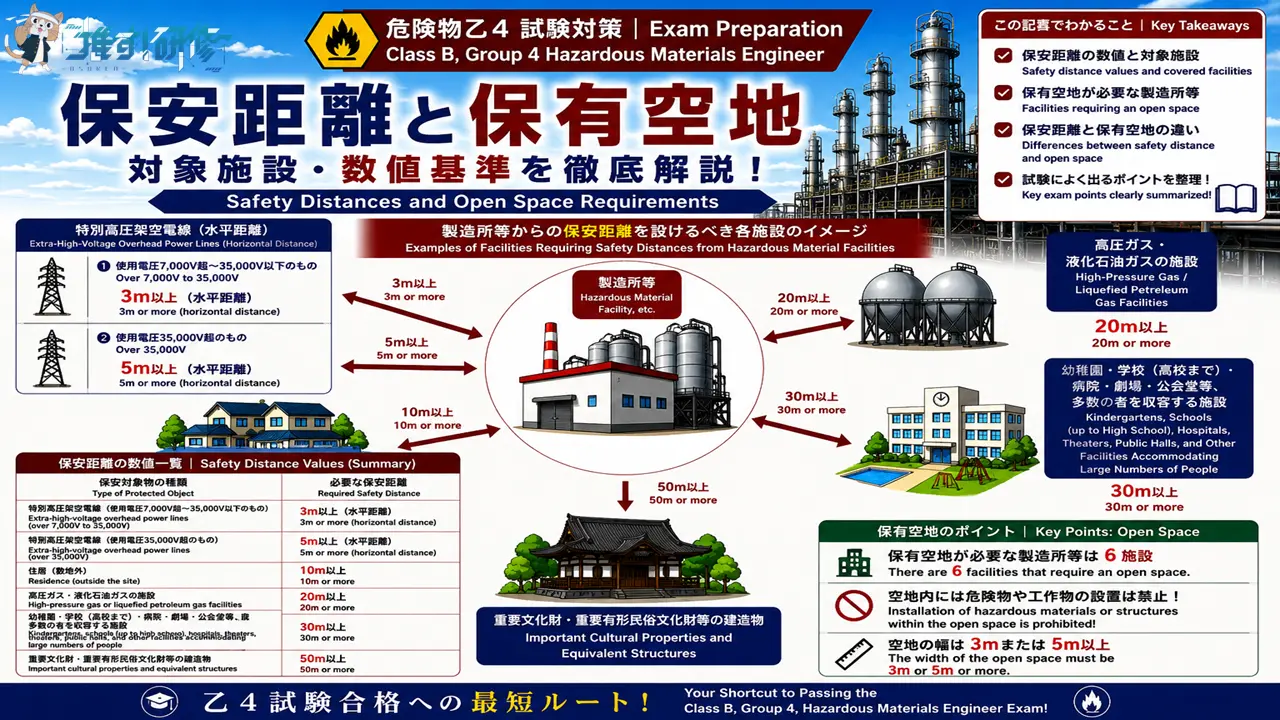
保安距離とは、製造所等において火災または爆発事故が発生した際に、周辺の住宅・施設等への被害の波及を防ぐとともに、火災の拡大防止と近隣住民の避難を確保することを目的として、製造所等の外壁からその周囲の保安対象物の外側までの間に設けなければならない一定の距離のことです。ただし、当該建築物等との間に防火上有効な塀がある場合は、特例基準が適用されることがあります。
A safety distance is a minimum separation that must be maintained between the outer wall of a hazardous materials facility and the outer boundary of surrounding protected objects, with the aim of preventing damage from fires or explosions, stopping the spread of fire, and securing evacuation routes for nearby residents. However, where a fireproof wall of sufficient effectiveness stands between the facility and the object in question, specific exceptions may apply.
保安対象物ごとの保安距離 Required Safety Distance by Type of Protected Object
保安対象物の種類によって必要な距離は異なります。試験では各数値が直接問われるため、保安対象物の種類と距離の組み合わせを正確に記憶することが不可欠です。なお、特別高圧架空電線に対する保安距離は「水平距離」で計測する点も試験頻出の確認ポイントです。
The required distance varies depending on the type of protected object. Since specific numerical values are directly tested on the exam, it is essential to memorize the correct distance for each type. Note also that the safety distance for extra-high-voltage overhead power lines is measured as a “horizontal distance” — a point that is frequently tested.
| 保安対象物の種類 / Type of Protected Object | 必要な保安距離 / Required Safety Distance |
|---|---|
| 特別高圧架空電線(使用電圧7,000Vを超え35,000V以下のもの) Extra-high-voltage overhead power lines (over 7,000V to 35,000V) | 3m以上(水平距離) 3m or more (horizontal distance) |
| 特別高圧架空電線(使用電圧35,000Vを超えるもの) Extra-high-voltage overhead power lines (over 35,000V) | 5m以上(水平距離) 5m or more (horizontal distance) |
| 製造所等の存する敷地の外にある住居 Residences located outside the site of the facility | 10m以上 10m or more |
| 高圧ガスまたは液化石油ガスの施設 High-pressure gas or liquefied petroleum gas facilities | 20m以上 20m or more |
| 幼稚園・学校(高等専門学校まで。大学・短期大学は対象外)・病院・劇場・公会堂等、多数の者を収容する施設 Kindergartens, schools (up to colleges of technology; universities and junior colleges are NOT covered), hospitals, theaters, public halls, and other facilities accommodating large numbers of people | 30m以上 30m or more |
| 重要文化財・重要有形民俗文化財等の建造物 Important cultural properties, important tangible folk cultural properties, and equivalent structures | 50m以上 50m or more |
保安距離が必要な製造所等 Facilities Required to Maintain a Safety Distance
保安距離の確保が義務づけられているのは、以下の5種類の製造所等のみです。この5施設は試験でほぼ毎回問われる最重要事項であるため、確実に暗記してください。
The obligation to maintain a safety distance applies exclusively to the following five types of facilities. These five facility types appear in virtually every exam and must be memorized without fail.
| 番号 / No. | 保安距離が必要な施設 / Facilities Requiring a Safety Distance |
|---|---|
| ① | 製造所 / Manufacturing facility |
| ② | 屋内貯蔵所 / Indoor storage facility |
| ③ | 屋外貯蔵所 / Outdoor storage facility |
| ④ | 屋外タンク貯蔵所 / Outdoor tank storage facility |
| ⑤ | 一般取扱所 / General handling operation |
一方、給油取扱所・販売取扱所・屋内タンク貯蔵所・地下タンク貯蔵所・移動タンク貯蔵所・簡易タンク貯蔵所には保安距離は不要です。また、他の用途に供する建物の内部に設置される屋内貯蔵所も保安距離の適用外となります。
By contrast, service stations, sales operations, indoor tank storage facilities, underground tank storage facilities, mobile tank storage facilities, and small-scale tank storage facilities are all exempt from the safety distance requirement. In addition, indoor storage facilities installed within buildings used for other purposes are also exempt.
試験頻出の注意ポイント Common Exam Pitfalls
保安距離の問題で受験者が誤答しやすいポイントを以下に整理します。
The following are the points where exam candidates most frequently make mistakes on safety distance questions.
| よくある誤解 / Common Misconception | 正しい知識 / Correct Knowledge |
|---|---|
| 大学・短期大学も学校として30mの保安距離が必要 Universities and junior colleges also require a 30m safety distance as “schools” | 大学・短期大学は対象外。幼稚園から高等専門学校までが対象(一定の社会福祉施設も対象となる) Universities and junior colleges are NOT covered. Coverage applies from kindergarten through colleges of technology (certain social welfare facilities are also covered) |
| 同一敷地内の住居にも10mの保安距離が必要 Residences on the same site also require a 10m safety distance | 同一敷地内の住居は対象外。製造所等の敷地の「外」にある住居のみが対象 Residences on the same site are NOT covered. Only residences located outside the facility’s site are subject |
| 重要文化財を保管している倉庫も50mの保安距離が必要 Warehouses storing important cultural properties also require a 50m safety distance | 保管する「倉庫」は対象外。建造物そのものが重要文化財として指定されている場合のみ対象 Warehouses that merely store important cultural properties are NOT covered. Only structures that are themselves designated as important cultural properties are subject |
保有空地とは What Is an Open Space?
保有空地とは、火災発生時における消防活動の円滑な実施と、隣接施設への延焼防止を目的として、製造所等の周囲に義務づけられた空地のことです。保有空地の内部に物品を置くことは法令上禁止されており、消防車両や消防隊員が迅速にアクセスできる状態を常時維持しなければなりません。
An open space is an area required to be kept clear around a hazardous materials facility, with the aim of ensuring smooth fire-fighting operations and preventing fire from spreading to adjacent facilities. Placing any items within the open space is prohibited under the law, and the area must at all times remain accessible for fire vehicles and fire-fighting personnel.
保有空地が必要な製造所等 Facilities Required to Maintain an Open Space
保有空地が必要な施設は、保安距離が必要な5施設に屋外に設ける簡易タンク貯蔵所を加えた6施設が基本です(法令上はさらに地上設置の移送取扱所を含む7施設)。保安距離が不要な施設であっても保有空地が必要となる場合があることが試験のポイントです。
The facilities required to maintain an open space are, as a basic rule, the five facilities subject to safety distance requirements plus above-ground small-scale tank storage facilities, giving six facility types (seven if above-ground transfer operations are included as specified in the law). The key exam point is that some facilities exempt from safety distance requirements are still required to maintain an open space.
| 番号 / No. | 保有空地が必要な施設 / Facilities Requiring an Open Space | 保安距離との関係 / Relation to Safety Distance Requirement |
|---|---|---|
| ① | 製造所 / Manufacturing facility | 保安距離も必要 / Safety distance also required |
| ② | 屋内貯蔵所 / Indoor storage facility | 保安距離も必要 / Safety distance also required |
| ③ | 屋外貯蔵所 / Outdoor storage facility | 保安距離も必要 / Safety distance also required |
| ④ | 屋外タンク貯蔵所 / Outdoor tank storage facility | 保安距離も必要 / Safety distance also required |
| ⑤ | 一般取扱所 / General handling operation | 保安距離も必要 / Safety distance also required |
| ⑥ | 屋外に設ける簡易タンク貯蔵所 Above-ground small-scale tank storage facility | 保安距離は不要・保有空地は必要 Safety distance NOT required; open space IS required |
保有空地の幅 Required Open Space Width
製造所および一般取扱所における保有空地の幅は、取り扱う危険物の指定数量の倍数によって決まります。試験では製造所・一般取扱所の空地の幅が最もよく出題されます。
The required open space width for manufacturing facilities and general handling operations is determined by the multiple of the designated quantity of hazardous materials handled. The width requirements for manufacturing facilities and general handling operations are the most frequently tested values.
| 施設の種類 / Facility Type | 指定数量の倍数 / Multiple of Designated Quantity | 保有空地の幅 / Required Open Space Width |
|---|---|---|
| 製造所・一般取扱所 Manufacturing facility / General handling operation | 10以下 / 10 or less | 3m以上 / 3m or more |
| 製造所・一般取扱所 Manufacturing facility / General handling operation | 10を超えるもの / Over 10 | 5m以上 / 5m or more |
| 屋外に設ける簡易タンク貯蔵所 Above-ground small-scale tank storage facility | — | タンク周囲1m以上 1m or more around the tank |
屋内貯蔵所の保有空地の幅は、指定数量の倍数と建築構造(耐火構造・不燃材料か否か)の組み合わせによって細かく規定されています。屋外タンク貯蔵所については、指定数量の倍数が4,000を超える場合は、タンクの最大直径とタンク高さのいずれか大きい方の値と同じ距離(ただし15m以上)が必要です。
The required open space width for indoor storage facilities is determined by a detailed matrix combining the multiple of the designated quantity with the structural type (whether or not the facility is fire-resistant or made of non-combustible materials). For outdoor tank storage facilities, when the multiple of the designated quantity exceeds 4,000, the required distance equals the greater of the tank’s maximum diameter or tank height (with a minimum of 15m).
保安距離と保有空地の比較 Comparing Safety Distances and Open Space Requirements
2つの制度は混同しやすいため、以下の表で相違点を整理してください。
Since the two requirements are easily confused, use the following table to clarify the key differences.
| 比較項目 / Comparison | 保安距離 / Safety Distance | 保有空地 / Open Space |
|---|---|---|
| 目的 / Purpose | 周辺施設・住居への被害防止と避難確保 Preventing damage to surrounding structures and securing evacuation routes | 消防活動の円滑化と延焼防止 Enabling smooth fire-fighting operations and preventing fire spread |
| 対象施設の数 / Number of facility types | 5種類 / 5 types | 6種類(移送取扱所含む場合は7種類) 6 types (7 if transfer operations included) |
| 物品設置の可否 / Placement of items | 特段の規定なし / No specific prohibition | 禁止 / Prohibited |
| 距離の基準 / Basis for distance | 保安対象物の種類ごとに固定値 Fixed value for each type of protected object | 指定数量の倍数・施設構造等による Based on multiple of designated quantity, structural type, etc. |
覚え方のコツ Memorization Tips
保安距離の数値を覚えるコツ Tips for Memorizing Safety Distance Values
保安距離の数値は「3・5・10・20・30・50」の6段階です。保安対象物の社会的重要性や収容人数・危険性が大きくなるほど距離が長くなる、という規則性で覚えると整理しやすくなります。
Safety distance values follow a six-step progression: 3 / 5 / 10 / 20 / 30 / 50 metres. An effective strategy is to link increasing distances with the increasing social importance, occupancy size, or risk level of the protected object.
| 距離 / Distance | 保安対象物 / Protected Object | 覚え方のヒント / Memory Tip |
|---|---|---|
| 3m | 特別高圧架空電線(〜35,000V) Extra-high-voltage lines (up to 35,000V) | 電線は最小距離(水平で3m) Smallest distance — horizontal 3m for power lines |
| 5m | 特別高圧架空電線(35,000V超) Extra-high-voltage lines (over 35,000V) | 電圧が高いほど距離も長い Higher voltage = greater distance |
| 10m | 敷地外の住居 Residences outside the site | 住む場所には10m(敷地内は対象外) 10m for dwellings (same-site excluded) |
| 20m | 高圧ガス・LPG施設 High-pressure gas / LPG facilities | 爆発危険がある施設には20m 20m for facilities with explosion risk |
| 30m | 学校(幼〜高専)・病院・劇場等 Schools (kindergarten to college of technology), hospitals, theaters, etc. | 大勢の人が集まる場所には30m 30m where large numbers gather |
| 50m | 重要文化財等の建造物 Important cultural properties | 取り替えのきかないものには最大50m 50m for irreplaceable structures |
施設の種類を覚えるコツ Tips for Memorizing Which Facilities Are Covered
保安距離が必要な5施設:「製造所・屋内貯蔵所・屋外貯蔵所・屋外タンク貯蔵所・一般取扱所」を声に出して繰り返すことが有効です。この5施設に屋外の簡易タンク貯蔵所を加えると、保有空地が必要な施設のベースとなる6施設になります。
Repeating aloud — “Manufacturing / Indoor storage / Outdoor storage / Outdoor tank / General handling” — is an effective way to memorize the five facilities requiring safety distances. Adding above-ground small-scale tank storage to these five gives you the base six facilities requiring open spaces.
除外パターンの覚え方 Tip for Memorizing Exemption Patterns
「大学はアウト・倉庫はアウト・同じ敷地の住居はアウト」の3パターンを確実に押さえましょう。試験でよく使われる引っかけです。
Commit the three exemption patterns to memory: “Universities out / Warehouses out / Same-site residences out.” These three are the most commonly used traps in exam questions.
試験本番での解き方|得点力を上げるコツ Exam Strategies | Tips for Scoring Higher
コツ1:選択肢の「施設名」を即チェックする Tip 1: Check the Facility Name in Each Option Immediately
問題文に以下のキーワードが出てきたら、即座に対応する判断を下してください。
When the following keywords appear in a question, make an immediate judgment.
- 「給油取扱所」「販売取扱所」「地下タンク貯蔵所」「移動タンク貯蔵所」→ 保安距離も保有空地も不要
“Service station” / “Sales operation” / “Underground tank storage” / “Mobile tank storage” → Neither safety distance NOR open space required - 「屋外に設ける簡易タンク貯蔵所」→ 保安距離は不要、保有空地は必要(タンク周囲1m以上)
“Above-ground small-scale tank storage” → No safety distance, but open space IS required (1m or more around the tank) - 「大学」「短期大学」→ 保安距離の対象外(幼稚園〜高等専門学校のみ)
“University” / “Junior college” → NOT subject to safety distance (kindergarten through colleges of technology only) - 「同一の敷地内にある住居」→ 保安距離の対象外
“Residence on the same site” → NOT subject to safety distance - 「重要文化財を保管する倉庫」→ 保安距離の対象外(建造物そのものが指定されていることが条件)
“Warehouse storing important cultural properties” → NOT subject (the structure itself must be designated)
コツ2:数値を確実に覚える Tip 2: Memorize the Key Numbers Without Fail
- 重要文化財等の建造物:50m以上(保安距離の最大値)
Important cultural properties: 50m or more (largest safety distance value) - 特別高圧架空電線(〜35,000V):3m以上・水平距離(保安距離の最小値)
Extra-high-voltage lines (up to 35,000V): 3m or more, horizontal distance (smallest safety distance value) - 製造所・一般取扱所の保有空地:倍数10以下→3m以上、10超→5m以上
Open space (manufacturing/general handling): multiple ≤10 → 3m; multiple >10 → 5m - 屋外の簡易タンク貯蔵所の保有空地:タンク周囲1m以上
Open space for above-ground small-scale tank storage: 1m or more around the tank
コツ3:「保有空地あり・保安距離なし」の施設を確実に識別する Tip 3: Identify Facilities Requiring Open Space but Not Safety Distance
「保有空地は必要だが保安距離は不要」という施設の代表例は「屋外に設ける簡易タンク貯蔵所」です。この1施設を確実に覚えておくことで、施設の組み合わせを問う問題で得点できます。
The representative example of a facility that requires an open space but NOT a safety distance is the above-ground small-scale tank storage facility. Memorizing this one exception reliably enables you to score on questions involving combinations of facility types.
まとめ Summary
- 保安距離とは製造所等の外壁から保安対象物の外側まで確保する距離で、火災・爆発による被害防止と避難確保を目的とする
A safety distance is the separation maintained from a facility’s outer wall to the outer edge of surrounding protected objects, aimed at preventing fire/explosion damage and securing evacuation routes - 保安距離の数値は3m・5m・10m・20m・30m・50mの6段階(電線は水平距離)
Safety distance values are a six-step progression: 3m / 5m / 10m / 20m / 30m / 50m (measured horizontally for power lines) - 保安距離が必要な施設は5施設(製造所・屋内貯蔵所・屋外貯蔵所・屋外タンク貯蔵所・一般取扱所)のみ
Only five facility types require a safety distance: manufacturing facilities, indoor storage, outdoor storage, outdoor tank storage, and general handling operations - 大学・短大は対象外。同一敷地内住居は対象外。重要文化財を保管する倉庫は対象外
Universities and junior colleges are not covered. Same-site residences are not covered. Warehouses storing cultural properties are not covered - 保有空地が必要な施設は保安距離の5施設に屋外の簡易タンク貯蔵所を加えた6施設が基本
The facilities requiring an open space are the five safety-distance facilities plus above-ground small-scale tank storage, for a base of six facility types - 保有空地内への物品設置は禁止
Placing items within the open space is prohibited - 製造所・一般取扱所の保有空地:指定数量の倍数10以下→3m以上、10超→5m以上
Open space (manufacturing/general handling): multiple ≤10 → 3m; multiple >10 → 5m
保安距離と保有空地は、数値・対象施設・適用除外の3点から毎回出題される最重要テーマです。「5施設の保安距離・6施設の保有空地」「大学・倉庫・同一敷地住居は除外」「保有空地内は物品禁止」という3つの軸を確実に押さえることが、法令科目での得点力向上に直結します。
Safety distances and open space requirements are among the most important exam topics, tested every time from three angles: numerical values, covered facility types, and exemptions. Mastering three key frameworks — “5 facilities for safety distances, 6 for open spaces”; “universities, warehouses, same-site residences excluded”; and “no items in the open space” — directly translates into improved performance in the legal subject area.
練習問題 保安距離と保有空地の理解を確認しよう Practice Questions | Test Your Understanding
ここまで学んだ内容を確認するため、試験形式の練習問題に挑戦しましょう。解答は各問題の下に記載しています。
To consolidate what you have learned, try the following exam-style practice questions. The answer for each question is provided directly below it.
問題1 Question 1
法令上、保安距離を確保しなければならない製造所等の組み合わせとして、正しいものはどれか。
Under the law, which of the following is a correct combination of facilities that are required to maintain a safety distance?
- 製造所・給油取扱所・屋外貯蔵所 / Manufacturing facility, service station, outdoor storage facility
- 屋内タンク貯蔵所・屋外タンク貯蔵所・一般取扱所 / Indoor tank storage facility, outdoor tank storage facility, general handling operation
- 製造所・屋内貯蔵所・屋外タンク貯蔵所 / Manufacturing facility, indoor storage facility, outdoor tank storage facility
- 地下タンク貯蔵所・屋外貯蔵所・一般取扱所 / Underground tank storage facility, outdoor storage facility, general handling operation
解答:3 / Answer: 3
保安距離が必要なのは「製造所・屋内貯蔵所・屋外貯蔵所・屋外タンク貯蔵所・一般取扱所」の5施設です。選択肢3の製造所・屋内貯蔵所・屋外タンク貯蔵所はすべてこの5施設に含まれるため正解です。選択肢1の給油取扱所は保安距離が不要な施設のため誤りです。選択肢2の屋内タンク貯蔵所は5施設に含まれないため誤りです。選択肢4の地下タンク貯蔵所も同様に対象外であるため誤りです。選択肢に含まれる施設が5施設のいずれかに該当しない場合、その選択肢は即座に除外できます。
The five facilities required to maintain a safety distance are: manufacturing facilities, indoor storage facilities, outdoor storage facilities, outdoor tank storage facilities, and general handling operations. Option 3 — manufacturing facility, indoor storage facility, and outdoor tank storage facility — consists entirely of facilities from this list and is correct. Option 1 is incorrect because service stations are exempt. Option 2 is incorrect because indoor tank storage facilities are not among the five. Option 4 is incorrect because underground tank storage facilities are also exempt. Whenever a facility in a given option falls outside the five, that option can be eliminated immediately.
問題2 Question 2
法令上、製造所と保安対象物との間に保たなければならない保安距離として、正しいものはどれか。ただし、当該建築物等との間に防火上有効な塀はないものとし、特例基準が適用されるものを除く。
Under the law, which of the following correctly states the safety distance to be maintained between a manufacturing facility and the specified protected object? Assume no effective fireproof wall is present, and exclude cases where exception standards apply.
- 使用電圧が35,000Vを超える特別高圧架空電線からは、水平距離3m以上 / Extra-high-voltage overhead power lines exceeding 35,000V: horizontal distance of 3m or more
- 製造所の存する敷地と同一の敷地内にある住居からは、10m以上 / Residences on the same site as the manufacturing facility: 10m or more
- 重要文化財として指定されている建造物からは、50m以上 / Buildings designated as important cultural properties: 50m or more
- 高校からは、50m以上 / Senior high schools: 50m or more
解答:3 / Answer: 3
選択肢3の「重要文化財として指定されている建造物からは50m以上」が正解です。選択肢1は誤りで、使用電圧が35,000Vを超える特別高圧架空電線に対する保安距離は水平距離5m以上であり、3mではありません。選択肢2は誤りで、保安距離の対象となる住居は製造所等の「敷地の外」に存するものに限られ、同一敷地内の住居は対象外です。選択肢4は誤りで、高校を含む学校・病院・劇場等の多数収容施設に対する保安距離は30m以上であり、50mではありません。
Option 3 — “50m or more from buildings designated as important cultural properties” — is correct. Option 1 is incorrect: the safety distance for extra-high-voltage power lines exceeding 35,000V is a horizontal distance of 5m or more, not 3m. Option 2 is incorrect: only residences located outside the facility’s site are subject to the safety distance requirement; residences on the same site are exempt. Option 4 is incorrect: the required safety distance from schools (including senior high schools), hospitals, theaters, and other facilities accommodating large numbers of people is 30m or more, not 50m.
問題3 Question 3
法令上、保有空地について述べた記述として、誤っているものはどれか。
Which of the following statements about open space requirements is incorrect under the law?
- 保有空地は、消防活動の確保と延焼防止を目的として製造所等の周囲に設けられる。 / Open spaces are established around hazardous materials facilities to ensure fire-fighting operations and prevent fire spread.
- 保有空地内に物品を置くことは禁止されている。 / Placing items within the open space is prohibited.
- 保有空地が必要な製造所等の種類と保安距離が必要な製造所等の種類は同一である。 / The types of facilities required to maintain an open space are identical to those required to maintain a safety distance.
- 製造所において指定数量の倍数が10を超える場合、保有空地の幅は5m以上でなければならない。 / For a manufacturing facility where the multiple of the designated quantity exceeds 10, an open space width of at least 5m is required.
解答:3 / Answer: 3
選択肢3が誤りです。保有空地が必要な施設は、保安距離が必要な5施設に屋外に設ける簡易タンク貯蔵所を加えた6施設(移送取扱所を含めれば7施設)であり、保安距離が必要な5施設とは一致しません。保安距離が不要な施設であっても保有空地が必要となる場合があるため、両者の施設リストは同一ではありません。選択肢1・2・4はいずれも正しい記述です。
Option 3 is incorrect. The facilities required to maintain an open space consist of the five facilities subject to safety distance requirements plus above-ground small-scale tank storage facilities — a total of six (or seven if transfer operations are included) — and therefore do not match the five safety-distance facilities exactly. Because some facilities exempt from safety distance requirements are still required to maintain an open space, the two lists are not identical. Options 1, 2, and 4 are all correct statements.
- 日商簿記3級|小口現金の仕訳 Nissho Bookkeeping Level 3 | Petty Cash Journal Entries
- QC3|QCストーリー(問題解決型の8手順・課題達成型の9手順)の違いと使い分けをわかりやすく解説 QC3 | QC Story: 8-Step Problem-Solving vs. 9-Step Task-Achievement Explained
この記事を書いた人

関連記事
-
 危険物乙4|アルコール類の性状を徹底解説【メタノール・エタノール・n-プロピルアルコール・イソプロピルアルコール】 Class B, Group 4 Hazardous Materials Engineer | Properties of Alcohols: Methanol, Ethanol, n-Propyl Alcohol, and Isopropyl Alcohol Explained
 -
危険物乙4|第一石油類の性状を徹底解説【ガソリン・ベンゼン・トルエン・アセトンほか】 Class B, Group 4 Hazardous Materials Engineer | Properties of Category 1 Petroleum: Gasoline, Benzene, Toluene, Acetone, and More Explained
-
危険物乙4|特殊引火物の性状を徹底解説【ジエチルエーテル・二硫化炭素・アセトアルデヒド・酸化プロピレン】 Class B, Group 4 Hazardous Materials Engineer | Properties of Special Flammable Liquids: Diethyl Ether, Carbon Disulfide, Acetaldehyde, and Propylene Oxide Explained
-
危険物乙4|酸と塩基・酸化と還元・金属腐食の基礎知識 Class B, Group 4 Hazardous Materials Engineer | Acids and Bases, Oxidation and Reduction, and Metal Corrosion
-
危険物乙4|単体・化合物・混合物と状態変化の基礎知識 Class B, Group 4 Hazardous Materials Engineer | Simple Substances, Compounds, Mixtures, and Changes of State
-
危険物乙4|免状の交付・書換え・再交付の申請先と手続きをわかりやすく解説 Class B Group 4 Hazardous Materials Engineer | License Issuance, Amendment, Reissuance, and Surrender: Application Authorities and Procedures Explained
-
危険物乙4|熱の移動の基礎知識 伝導・対流・放射 Class B, Group 4 Hazardous Materials Engineer | Heat Transfer Fundamentals: Conduction, Convection, and Radiation
-
危険物乙4|静電気の基礎知識と防止対策 Class B, Group 4 Hazardous Materials Engineer | Static Electricity: Fundamentals and Prevention Measures