危険物乙4|第一石油類の性状を徹底解説【ガソリン・ベンゼン・トルエン・アセトンほか】 Class B, Group 4 Hazardous Materials Engineer | Properties of Category 1 Petroleum: Gasoline, Benzene, Toluene, Acetone, and More Explained
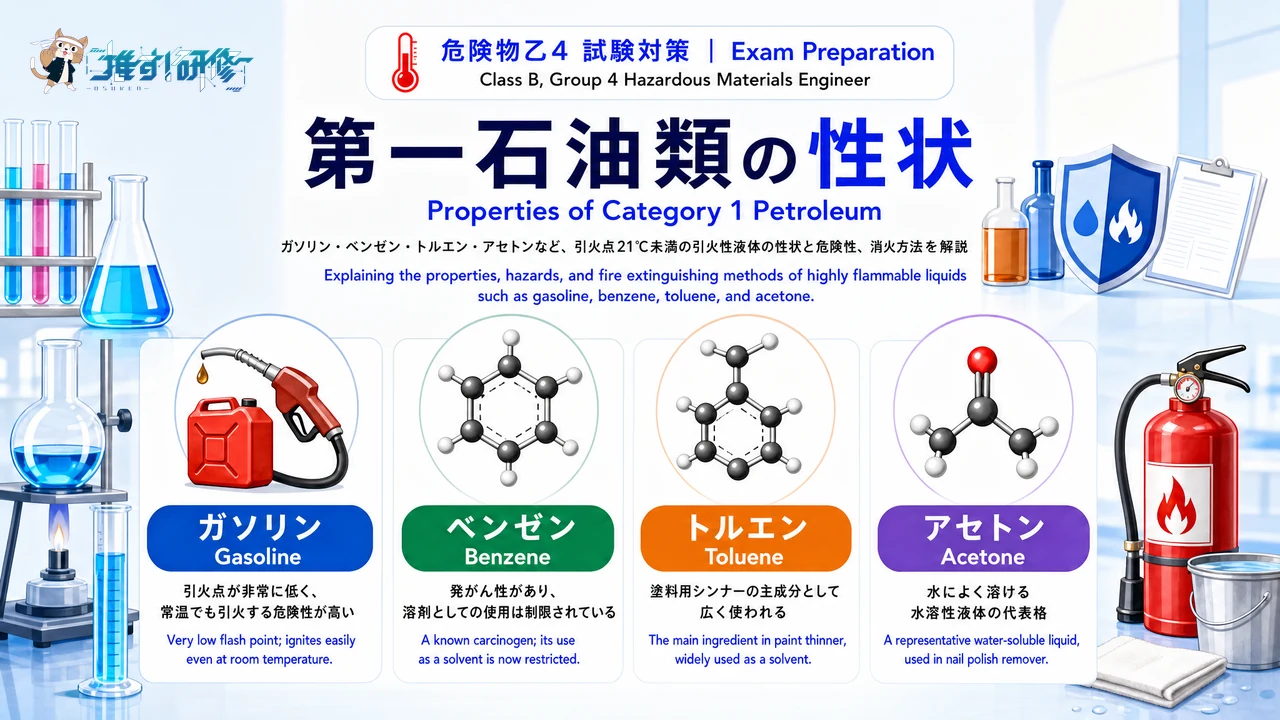
危険物乙4の第4類危険物のうち、ガソリンをはじめとする「第一石油類」は、私たちの生活に最も近い危険物であり、試験科目「危険物の性質並びにその火災予防及び消火の方法」でも毎回のように問われる中心テーマです。本記事では、第一石油類の定義と共通する危険性を整理したうえで、ガソリン・ベンゼン・トルエン・アセトンなど代表的な7物質の性状を、試験対策の観点からわかりやすく解説します。
Among the Group 4 hazardous materials covered by the Class B, Group 4 Hazardous Materials Engineer exam, Category 1 Petroleum — gasoline being the best-known example — is the group closest to our everyday lives, and it appears in almost every sitting of the “Properties and Fire Extinguishing” subject. This article organizes the definition and shared hazards of Category 1 Petroleum, then explains the properties of seven representative substances, including gasoline, benzene, toluene, and acetone, with a focus on what matters for exam preparation.
目次
第一石油類とは What Is Category 1 Petroleum?
第一石油類とは、1気圧において引火点が21℃未満の引火性液体のうち、特殊引火物に該当しないものをいいます。消防法では「アセトン、ガソリンその他」の品名として例示されており、引火点の上限が「21℃未満」であることが分類の境界線です。特殊引火物(発火点100℃以下、または引火点-20℃以下かつ沸点40℃以下)に該当する物質は、引火点が21℃未満であっても第一石油類には含まれません。また、第一石油類は水に溶けるかどうかで非水溶性液体と水溶性液体に分けられ、指定数量は非水溶性が200L、水溶性が400Lと異なります。ガソリン・ベンゼン・トルエンは非水溶性、アセトン・ピリジンは水溶性の代表例です。
Category 1 Petroleum is defined as a flammable liquid with a flash point below 21°C at 1 atmosphere that does not qualify as a special flammable liquid. The Fire Service Act lists this category with the examples “acetone, gasoline, and others,” and the upper limit of “below 21°C” is the boundary that defines the group. A substance that meets the criteria for a special flammable liquid (ignition point at or below 100°C, or flash point at or below -20°C combined with a boiling point at or below 40°C) is excluded from Category 1 Petroleum even if its flash point is below 21°C. Category 1 Petroleum is further divided into non-water-soluble and water-soluble liquids, and the designated quantity differs accordingly: 200 liters for non-water-soluble and 400 liters for water-soluble substances. Gasoline, benzene, and toluene are typical non-water-soluble examples, while acetone and pyridine are typical water-soluble ones.
第一石油類に共通する危険性 Common Hazards Across Category 1 Petroleum
第一石油類に共通する最大の特徴は、引火点が常温より低い物質がほとんどで、冬の屋外のような低温でも引火の危険があることです。加えて、いずれも蒸気比重が1より大きく(2〜4程度)、発生した蒸気は空気より重いため、床面や地面をはうように広がり、離れた低い場所に滞留してそこで着火源に出会うことがあります。液体の比重はいずれも1より小さいため、水に浮いて燃え広がる性質があり、棒状の水をかける消火は火災を拡大させるおそれがあります。さらに、ガソリンやベンゼンのような非水溶性の物質は電気を通さない不導体であるため、配管内の流動や容器への注入、かくはんなどによって静電気が発生・蓄積しやすく、その放電火花が着火源となる点も共通する注意点です。
The single most important shared characteristic of Category 1 Petroleum is that most of these substances have flash points below room temperature, so they can ignite even at low temperatures such as outdoors in winter. In addition, every one of them has a vapor density greater than 1 (roughly 2 to 4), meaning the vapor they generate is heavier than air, spreads along floors and the ground, and can accumulate in distant low-lying spots where it may meet an ignition source. Their liquid specific gravity is below 1 in every case, so they float on water and can spread a fire further — which is why applying a straight stream of water risks making the fire worse. Furthermore, non-water-soluble substances such as gasoline and benzene are electrical non-conductors, so static electricity readily builds up during flow through pipes, filling of containers, or stirring, and the resulting spark discharge can act as an ignition source. This is another shared point of caution.
ガソリンの性状 Properties of Gasoline
ガソリンは、炭素数がおおむね4〜10の炭化水素が混ざり合った混合物で、単一の化学式では表せません。引火点は-40℃以下、発火点は約300℃、燃焼範囲は1.4〜7.6vol%で、沸点は38〜220℃と幅があります。比重は0.65〜0.75と水よりかなり軽く、蒸気比重は3〜4と空気の3倍以上の重さです。特有の臭気は成分そのものに由来するもので、人工的に臭いを付けているわけではありません。自動車用ガソリンは、灯油や軽油と見分けやすいよう油溶性の染料でオレンジ色に着色されていますが、工業用ガソリンは無色透明です。また、電気の不導体で静電気を帯びやすいこと、過酸化水素や硝酸のような酸化性物質(第1類・第6類の危険物)と混ざると発熱・発火・爆発のおそれがあること、合成ゴムやプラスチックに浸透して膨潤させることも、試験で問われやすい性質です。
Gasoline is a mixture of hydrocarbons with roughly 4 to 10 carbon atoms and cannot be written as a single chemical formula. Its flash point is -40°C or lower, its ignition point about 300°C, and its combustion range 1.4–7.6 vol%, while its boiling point spans a wide range of 38–220°C. With a specific gravity of 0.65–0.75 it is considerably lighter than water, and its vapor density of 3–4 makes the vapor more than three times heavier than air. Its characteristic odor comes from the components themselves; no odorant is added artificially. Automotive gasoline is dyed orange with an oil-soluble colorant so that it can be told apart from kerosene and diesel, whereas industrial gasoline is colorless and transparent. Other properties frequently tested include the fact that it is an electrical non-conductor prone to static charge, that mixing it with oxidizing substances such as hydrogen peroxide or nitric acid (Group 1 and Group 6 hazardous materials) can cause heat generation, ignition, or explosion, and that it penetrates and swells synthetic rubber and plastics.
ガソリンは、言うまでもなく自動車や小型機械の燃料として最も身近な第一石油類です。エンジン内での異常燃焼(ノッキング)の起こりにくさを表す指標がオクタン価で、数値が高いほどノッキングしにくく、レギュラーとハイオクの違いはこのオクタン価の差にあります。ガソリンスタンドの給油口付近に「静電気除去シート」が設置されているのは、まさにガソリンが静電気で引火しやすい不導体だからです。また、空になったガソリン携行缶やタンクの内部にはわずかな残留分から燃焼範囲内の蒸気がつくられていることがあり、「空だから安全」とは言えない点も、日常生活と試験の両方で覚えておきたい知識です。
Gasoline is, needless to say, the most familiar Category 1 Petroleum substance, used as fuel for cars and small machinery. The octane number is an index of how resistant a fuel is to abnormal combustion (knocking) inside the engine; the higher the number, the less likely knocking occurs, and the difference between regular and premium gasoline lies in this octane number. The static-discharge pads installed near the filling nozzles at gas stations exist precisely because gasoline is a non-conductor that ignites easily from static electricity. Another point worth remembering both in daily life and on the exam is that an “empty” gasoline can or tank is not necessarily safe: the small residue inside can generate vapor within the combustion range.
ベンゼン・トルエンの性状 Properties of Benzene and Toluene
ベンゼン(C6H6)とトルエン(C6H5CH3)は、いずれもベンゼン環をもつ芳香族炭化水素で、無色で特有の芳香があり、水には溶けませんがアルコールやジエチルエーテルなど多くの有機溶剤にはよく溶け、樹脂や油脂を溶かす力に優れています。比重はどちらも0.9で、電気の不導体として静電気を帯びやすい点も共通です。一方で数値には明確な差があります。ベンゼンは引火点-11℃、発火点約498℃、沸点80℃、燃焼範囲1.2〜7.8vol%であるのに対し、トルエンは引火点4℃、発火点約480℃、沸点111℃、燃焼範囲1.1〜7.1vol%で、トルエンのほうが引火点も沸点も高く、揮発しにくい物質です。ベンゼンは凝固点が5.5℃と高いため冬季には固まることがあり、蒸気の毒性はベンゼンのほうが強いものの、トルエンも長期間吸い続けると神経系への障害を招きます。トルエンは濃硝酸と濃硫酸の混酸でニトロ化されると、第5類危険物のトリニトロトルエン(TNT)になることも押さえておきましょう。
Benzene (C6H6) and toluene (C6H5CH3) are both aromatic hydrocarbons containing a benzene ring. Both are colorless with a characteristic aromatic odor, insoluble in water but readily soluble in many organic solvents such as alcohol and diethyl ether, and excellent at dissolving resins and fats. Both have a specific gravity of 0.9, and both are electrical non-conductors that readily accumulate static charge. Their numerical values, however, differ clearly. Benzene has a flash point of -11°C, an ignition point of about 498°C, a boiling point of 80°C, and a combustion range of 1.2–7.8 vol%, whereas toluene has a flash point of 4°C, an ignition point of about 480°C, a boiling point of 111°C, and a combustion range of 1.1–7.1 vol%. Toluene thus has both a higher flash point and a higher boiling point, making it the less volatile of the two. Benzene’s freezing point of 5.5°C is high enough that it can solidify in winter. Benzene vapor is the more toxic, but long-term inhalation of toluene also causes damage to the nervous system. It is also worth remembering that when toluene is nitrated with a mixture of concentrated nitric and sulfuric acids, it forms trinitrotoluene (TNT), a Group 5 hazardous material.
ベンゼンは、かつては塗料や接着剤の溶剤として広く使われていましたが、発がん性が明らかになったことから、現在では溶剤としての使用は厳しく制限され、主にスチレンやナイロンといった合成樹脂・合成繊維の原料として化学工場の中で使われています。トルエンはベンゼンより毒性が低いことから、塗料の希釈剤(シンナー)や接着剤、印刷インキの溶剤として今も広く流通しています。ホームセンターで売られている塗料用シンナーの主成分がトルエンであることを思い浮かべると、「引火点4℃、常温で十分に引火する」という数値が身近に感じられるはずです。
Benzene was once widely used as a solvent in paints and adhesives, but after its carcinogenicity became clear, its use as a solvent is now strictly restricted; today it is mainly consumed inside chemical plants as a raw material for synthetic resins and fibers such as styrene and nylon. Toluene, being less toxic than benzene, remains in wide circulation as a paint thinner, adhesive solvent, and printing-ink solvent. If you picture the paint thinner sold at any hardware store — whose main component is toluene — the figure “flash point 4°C, easily ignited at room temperature” will feel much closer to home.
アセトンの性状 Properties of Acetone
アセトン(CH3COCH3)は、第一石油類の中で水溶性液体の代表として最も重要な物質です。無色で特異な臭気があり、引火点-20℃、発火点約465℃、沸点56℃、燃焼範囲2.5〜12.8vol%、比重0.8、蒸気比重2.0という数値をもちます。水に任意に溶けるだけでなく、アルコールやジエチルエーテル、クロロホルムなどの有機溶剤にもよく溶ける「両親媒性」(水にも油にもなじむ性質)が最大の特徴です。20℃でも揮発性が高く、蒸気が発生しやすいため、密栓と換気が欠かせません。過酸化水素や硝酸などの第6類危険物(酸化性液体)と混ぜると酸化反応によって発火するおそれがあります。消火の際は、水溶性であるため一般の泡消火剤では泡が溶けて消えてしまうことから、水溶性液体用の泡消火剤(耐アルコール泡)を使用します。また、水を霧状に噴霧すれば、冷却と希釈の両方の効果で消火できる点も、非水溶性の物質との大きな違いです。
Acetone (CH3COCH3) is the most important substance in Category 1 Petroleum as the representative water-soluble liquid. It is colorless with a distinctive odor, and its key values are a flash point of -20°C, an ignition point of about 465°C, a boiling point of 56°C, and a combustion range of 2.5–12.8 vol%, along with a specific gravity of 0.8 and a vapor density of 2.0. Its defining characteristic is that it is “amphiphilic” — it mixes freely with water and also dissolves readily in organic solvents such as alcohol, diethyl ether, and chloroform. It is highly volatile even at 20°C and generates vapor easily, so tight sealing and ventilation are essential. Mixing it with Group 6 hazardous materials (oxidizing liquids) such as hydrogen peroxide or nitric acid can trigger an oxidation reaction leading to ignition. For firefighting, because ordinary foam dissolves and collapses on a water-soluble liquid, foam designed for water-soluble liquids (alcohol-resistant foam) must be used. Water applied as a fine spray can also extinguish an acetone fire through combined cooling and dilution — a major difference from non-water-soluble substances.
アセトンは、マニキュアの除光液の主成分として最もよく知られています。除光液を開けたときに鼻をつく独特の臭いと、あっという間に乾いてしまう感覚は、アセトンの「特異な臭気」と「高い揮発性」そのものです。工業的にはプラスチック系接着剤や塗料の溶剤、化学実験室ではガラス器具の洗浄・乾燥用の溶剤として広く使われています。水にも油にも溶けるという両親媒性は、油汚れを落としたあとに水で流せるという実用上の利点につながっています。
Acetone is best known as the main ingredient in nail polish remover. The sharp smell that hits your nose when you open a bottle of remover, and the way it dries almost instantly, are acetone’s “distinctive odor” and “high volatility” in action. Industrially it is used as a solvent for plastic adhesives and paints, and in chemistry laboratories it is widely used for rinsing and drying glassware. Its amphiphilic nature — dissolving in both water and oil — brings a practical benefit: it can lift oily residue and then be rinsed away with water.
酢酸エチル・エチルメチルケトン・ピリジンの性状 Properties of Ethyl Acetate, Ethyl Methyl Ketone, and Pyridine
代表的な4物質に加えて、試験では次の3物質もしばしば登場します。酢酸エチル(CH3COOC2H5)は無色で果実のような甘い香りをもち、引火点-4℃、発火点約426℃、沸点77℃、燃焼範囲2.0〜11.5vol%、比重0.9です。水には少ししか溶けないため非水溶性に区分されますが、ほとんどの有機溶剤には溶けます。エチルメチルケトン(メチルエチルケトン、CH3COC2H5)はアセトンによく似た構造のケトンで、引火点-9℃、発火点約404℃、沸点80℃、燃焼範囲1.7〜11vol%、比重0.8。水には少し溶け、消火には水溶性液体用の泡消火剤や霧状の水が有効です。ピリジン(C5H5N)は窒素を含む環状化合物で、無色ながら特異な悪臭があり、引火点20℃と第一石油類の上限(21℃未満)ぎりぎりの数値をもちます。発火点約482℃、沸点115.5℃、燃焼範囲1.8〜12.4vol%、比重0.98で、窒素原子が水と水素結合をつくるため水によく溶ける水溶性液体です。
In addition to the four main substances, the following three also appear on the exam from time to time. Ethyl acetate (CH3COOC2H5) is colorless with a sweet, fruit-like odor; its flash point is -4°C, ignition point about 426°C, boiling point 77°C, combustion range 2.0–11.5 vol%, and specific gravity 0.9. Because it dissolves only slightly in water it is classified as non-water-soluble, yet it dissolves in almost all organic solvents. Ethyl methyl ketone (methyl ethyl ketone, CH3COC2H5) is a ketone structurally similar to acetone, with a flash point of -9°C, ignition point about 404°C, boiling point 80°C, combustion range 1.7–11 vol%, and specific gravity 0.8. It dissolves slightly in water, and foam for water-soluble liquids or a fine water spray is effective for extinguishing it. Pyridine (C5H5N) is a nitrogen-containing ring compound, colorless but with a distinctive foul odor, and its flash point of 20°C sits right at the upper edge of Category 1 Petroleum (below 21°C). Its ignition point is about 482°C, boiling point 115.5°C, combustion range 1.8–12.4 vol%, and specific gravity 0.98; because its nitrogen atom forms hydrogen bonds with water, it is a highly water-soluble liquid.
酢酸エチルの「果実臭」は、実際にパイナップルやバナナの香りの成分の一つでもあり、食品用の香料や、除光液・塗料の溶剤として使われています。エチルメチルケトンは塗料・接着剤・印刷インキの溶剤として工業的に大量に使われ、作業現場では「MEK」という略称で呼ばれることが多い物質です。ピリジンは医薬品や農薬を合成する際の原料・溶媒として使われるほか、その強い悪臭を逆手にとって、燃料用アルコールに誤飲防止のための変性剤として少量加えられてきた歴史があります。
The “fruity odor” of ethyl acetate is genuinely one of the aroma components of pineapples and bananas, and the compound is used as a food flavoring as well as a solvent in nail polish remover and paints. Ethyl methyl ketone is consumed industrially in large volumes as a solvent for paints, adhesives, and printing inks, and on the shop floor it is usually referred to by its abbreviation “MEK.” Pyridine serves as a raw material and solvent in the synthesis of pharmaceuticals and agrochemicals, and — turning its strong foul odor to advantage — it has historically been added in small amounts to fuel alcohol as a denaturant to discourage accidental ingestion.
7物質の性状比較表 Comparison Table of the Seven Substances
スクロールできます
| 物質名 / Substance | 引火点 / Flash point | 発火点 / Ignition point | 沸点 / Boiling point | 比重 / Specific gravity | 燃焼範囲 / Combustion range | 水溶性 / Water solubility |
|---|---|---|---|---|---|---|
| ガソリン Gasoline | -40℃以下 | 約300℃ | 38〜220℃ | 0.65〜0.75 | 1.4〜7.6vol% | 非水溶性 / Non-soluble |
| ベンゼン Benzene | -11℃ | 約498℃ | 80℃ | 0.9 | 1.2〜7.8vol% | 非水溶性 / Non-soluble |
| トルエン Toluene | 4℃ | 約480℃ | 111℃ | 0.9 | 1.1〜7.1vol% | 非水溶性 / Non-soluble |
| 酢酸エチル Ethyl acetate | -4℃ | 約426℃ | 77℃ | 0.9 | 2.0〜11.5vol% | 非水溶性 / Non-soluble |
| エチルメチルケトン Ethyl methyl ketone | -9℃ | 約404℃ | 80℃ | 0.8 | 1.7〜11vol% | 非水溶性 / Non-soluble |
| アセトン Acetone | -20℃ | 約465℃ | 56℃ | 0.8 | 2.5〜12.8vol% | 水溶性 / Soluble |
| ピリジン Pyridine | 20℃ | 約482℃ | 115.5℃ | 0.98 | 1.8〜12.4vol% | 水溶性 / Soluble |
消火方法の使い分け Choosing the Right Extinguishing Method
第一石油類の消火で最初に確認すべきことは、その物質が非水溶性か水溶性かです。ガソリン・ベンゼン・トルエンのような非水溶性液体には、泡・粉末・二酸化炭素・ハロゲン化物などによる窒息消火が基本で、棒状に水を放射する消火は不適当です。これらは水より軽く水に溶けないため、水をかけると液体が水面に浮いて広がり、火災の範囲をかえって拡大させてしまうからです。一方、アセトンやピリジンのような水溶性液体には、一般の泡消火剤は泡が液体に溶けて消えてしまうため効果がなく、水溶性液体用の泡消火剤(耐アルコール泡)を使用します。水溶性液体の場合は、霧状の水による冷却・希釈も有効な手段となります。いずれの場合も、蒸気が低所に滞留している可能性を考え、消火後も換気と再着火の防止を続けることが重要です。
The first thing to check when extinguishing a Category 1 Petroleum fire is whether the substance is non-water-soluble or water-soluble. For non-water-soluble liquids such as gasoline, benzene, and toluene, smothering with foam, dry powder, carbon dioxide, or halogenated agents is the standard approach, and a straight stream of water is inappropriate. Because these liquids are lighter than water and do not dissolve in it, applying water causes the burning liquid to float and spread, enlarging the fire instead of suppressing it. By contrast, for water-soluble liquids such as acetone and pyridine, ordinary foam is ineffective because it dissolves into the liquid and collapses, so foam designed for water-soluble liquids (alcohol-resistant foam) must be used. For water-soluble liquids, cooling and dilution with a fine water spray is also an effective option. In every case, bear in mind that vapor may still be lingering in low-lying areas, and continue ventilating and guarding against re-ignition even after the flames are out.
試験対策のポイント Key Points for Exam Preparation
第一石油類の出題は、①定義と指定数量、②ガソリンの性状、③水溶性・非水溶性の区別と消火方法、の3本柱に集約されます。定義は「1気圧で引火点21℃未満」、指定数量は非水溶性200L・水溶性400Lという数字をまず固めましょう。ガソリンについては「引火点-40℃以下、発火点約300℃、燃焼範囲1.4〜7.6vol%、比重は1より小さく蒸気比重は3〜4」の組み合わせが繰り返し問われ、「発火点が100℃より低い」「蒸気は空気より軽い」「無臭のため付臭剤が添加されている」といった誤りの選択肢を見抜けるかがカギです。物質の見分けでは、水溶性はアセトンとピリジン、芳香族はベンゼンとトルエン、引火点が第一石油類の上限に最も近いのはピリジン(20℃)と整理しておくと、選択肢を効率よく絞れます。消火については「非水溶性には棒状注水は不可、水溶性には耐アルコール泡」というルールを、理由(水より軽い/泡が溶ける)とセットで理解しておきましょう。
Exam questions on Category 1 Petroleum boil down to three pillars: (1) the definition and designated quantities, (2) the properties of gasoline, and (3) the water-soluble/non-water-soluble distinction and the corresponding extinguishing methods. Start by fixing the numbers: the definition is “flash point below 21°C at 1 atmosphere,” and the designated quantities are 200 liters for non-water-soluble and 400 liters for water-soluble substances. For gasoline, the combination “flash point -40°C or lower, ignition point about 300°C, combustion range 1.4–7.6 vol%, specific gravity below 1, vapor density 3–4” is tested again and again, and the key is spotting incorrect options such as “its ignition point is below 100°C,” “its vapor is lighter than air,” or “an odorant is added because it is odorless.” When distinguishing substances, organizing them as water-soluble = acetone and pyridine, aromatic = benzene and toluene, and closest to the Category 1 upper limit = pyridine (20°C) lets you narrow down the options efficiently. For firefighting, understand the rule “no straight stream of water for non-water-soluble liquids; alcohol-resistant foam for water-soluble liquids” together with the reasons behind it (lighter than water / foam dissolves).
まとめ Summary
第一石油類は、ガソリンやシンナー、除光液など、日常生活の中で実際に手にする機会が多い危険物です。だからこそ、「常温で引火する」「蒸気は重く低所にたまる」「水に浮いて燃え広がる」という共通の性質と、水溶性か非水溶性かによる消火方法の違いを、数値と理由の両面から理解しておくことが、試験本番の得点にも、実務での安全にも直結します。
Category 1 Petroleum includes gasoline, paint thinner, nail polish remover, and other hazardous materials that many of us actually handle in daily life. That is exactly why understanding their shared properties — “ignites at room temperature,” “heavy vapor that settles in low places,” “floats on water and spreads fire” — together with the difference in extinguishing methods between water-soluble and non-water-soluble liquids, both in terms of numbers and the reasons behind them, leads directly to points on exam day and to safety in practice.
練習問題 理解を確認しよう Practice Questions: Test Your Understanding
ここまでの内容を、試験と同じ五肢択一の形式で、3問を確認してみましょう。
Let’s check what you have learned with three five-option multiple-choice questions in the same format as the exam.
問題1 Question 1
法令上の第一石油類に関する記述として、正しいものはどれか。
ア 1気圧において引火点が21℃以上70℃未満のものをいう。
イ 指定数量は、水溶性液体か非水溶性液体かにかかわらず200Lである。
ウ ガソリン、ベンゼン、トルエンは非水溶性液体、アセトン、ピリジンは水溶性液体に区分される。
エ 引火点が-20℃以下で沸点が40℃以下のものも、引火点が21℃未満であれば第一石油類に含まれる。
オ 第4類危険物の中で、指定数量が最も少なく設定されている。
Which of the following statements about Category 1 Petroleum under the Fire Service Act is correct?
A. It refers to substances with a flash point of 21°C or higher and below 70°C at 1 atmosphere.
B. The designated quantity is 200 liters regardless of whether the liquid is water-soluble or non-water-soluble.
C. Gasoline, benzene, and toluene are classified as non-water-soluble liquids, while acetone and pyridine are classified as water-soluble liquids.
D. A substance with a flash point at or below -20°C and a boiling point at or below 40°C is also included in Category 1 Petroleum as long as its flash point is below 21°C.
E. It has the smallest designated quantity of any Group 4 hazardous material.
解答:ウ
解説:第一石油類は1気圧で引火点21℃未満のもの(アは第二石油類の定義)で、指定数量は非水溶性200L・水溶性400Lと異なる(イは誤り)。引火点-20℃以下かつ沸点40℃以下のものは特殊引火物に該当し、第一石油類から除かれる(エは誤り)。第4類で指定数量が最も少ないのは特殊引火物の50Lである(オは誤り)。
Answer: C
Explanation: Category 1 Petroleum refers to substances with a flash point below 21°C at 1 atmosphere (A describes Category 2 Petroleum), and the designated quantity differs: 200 liters for non-water-soluble and 400 liters for water-soluble liquids (B is incorrect). A substance with a flash point at or below -20°C and a boiling point at or below 40°C is a special flammable liquid and is excluded from Category 1 Petroleum (D is incorrect). The smallest designated quantity in Group 4 belongs to special flammable liquids, at 50 liters (E is incorrect).
問題2 Question 2
自動車用ガソリンの性状に関する記述として、誤っているものはどれか。
ア 引火点は-40℃以下であり、冬季の屋外でも引火する危険がある。
イ 発火点は約300℃であり、100℃より低いことはない。
ウ 蒸気比重は3〜4で、蒸気は空気より重く低い場所に滞留しやすい。
エ 本来は無臭であるため、漏えいに気づきやすいよう付臭剤が添加されている。
オ 電気の不導体であり、流動により静電気が発生しやすい。
Which of the following statements about the properties of automotive gasoline is incorrect?
A. Its flash point is -40°C or lower, so it can ignite even outdoors in winter.
B. Its ignition point is about 300°C and is never below 100°C.
C. Its vapor density is 3–4, so the vapor is heavier than air and tends to accumulate in low-lying areas.
D. Because it is naturally odorless, an odorant is added so that leaks can be noticed easily.
E. It is an electrical non-conductor, and static electricity is readily generated when it flows.
解答:エ
解説:ガソリンには成分そのものに由来する特有の臭気があり、付臭剤は添加されていない。自動車用ガソリンに人工的に加えられているのは、灯油・軽油と識別するためのオレンジ色の着色剤(油溶性染料)である。ア・イ・ウ・オはいずれも正しい記述である。
Answer: D
Explanation: Gasoline has a characteristic odor that comes from its components themselves; no odorant is added. What is added artificially to automotive gasoline is an orange oil-soluble dye, so that it can be distinguished from kerosene and diesel. Statements A, B, C, and E are all correct.
問題3 Question 3
第一石油類の性状と消火に関する記述として、正しいものはどれか。
ア アセトンは水に溶けないため、一般の泡消火剤による窒息消火が最も有効である。
イ ベンゼンとトルエンはいずれも芳香族炭化水素で、水には溶けないが多くの有機溶剤に溶ける。
ウ トルエンはベンゼンより引火点が低く、より揮発しやすい。
エ ガソリンの火災には、比重が1より大きく水に沈むため、棒状注水による消火が有効である。
オ ピリジンは非水溶性液体であり、引火点は第一石油類の中で最も低い。
Which of the following statements about the properties and extinguishing of Category 1 Petroleum is correct?
A. Acetone does not dissolve in water, so smothering with ordinary foam is the most effective extinguishing method.
B. Benzene and toluene are both aromatic hydrocarbons that do not dissolve in water but dissolve in many organic solvents.
C. Toluene has a lower flash point than benzene and is more volatile.
D. For a gasoline fire, a straight stream of water is effective because gasoline has a specific gravity greater than 1 and sinks in water.
E. Pyridine is a non-water-soluble liquid and has the lowest flash point in Category 1 Petroleum.
解答:イ
解説:アセトンは水によく溶ける水溶性液体で、一般の泡消火剤は泡が溶けて効果がないため、水溶性液体用の泡消火剤を用いる(アは誤り)。トルエンの引火点は4℃で、ベンゼンの-11℃より高く、揮発しにくい(ウは誤り)。ガソリンは比重0.65〜0.75と水より軽く水に浮くため、棒状注水は火災を拡大させるおそれがあり不適当である(エは誤り)。ピリジンは水溶性液体で、引火点20℃は第一石油類の中ではむしろ高いほうである(オは誤り)。
Answer: B
Explanation: Acetone is a highly water-soluble liquid, and ordinary foam is ineffective because it dissolves, so foam for water-soluble liquids must be used (A is incorrect). Toluene’s flash point of 4°C is higher than benzene’s -11°C, making it less volatile (C is incorrect). Gasoline has a specific gravity of 0.65–0.75, lighter than water, and floats on it, so a straight stream of water is inappropriate because it risks spreading the fire (D is incorrect). Pyridine is a water-soluble liquid, and its flash point of 20°C is among the highest, not the lowest, in Category 1 Petroleum (E is incorrect).
- ITパスポート試験の難易度は?合格率・合格基準・勉強時間を徹底解説 IT Passport Exam Difficulty: Pass Rates, Passing Criteria, and Study Time Explained
- 危険物乙4|アルコール類の性状を徹底解説【メタノール・エタノール・n-プロピルアルコール・イソプロピルアルコール】 Class B, Group 4 Hazardous Materials Engineer | Properties of Alcohols: Methanol, Ethanol, n-Propyl Alcohol, and Isopropyl Alcohol Explained
この記事を書いた人

関連記事
-
 危険物乙4|アルコール類の性状を徹底解説【メタノール・エタノール・n-プロピルアルコール・イソプロピルアルコール】 Class B, Group 4 Hazardous Materials Engineer | Properties of Alcohols: Methanol, Ethanol, n-Propyl Alcohol, and Isopropyl Alcohol Explained
 -
危険物乙4|特殊引火物の性状を徹底解説【ジエチルエーテル・二硫化炭素・アセトアルデヒド・酸化プロピレン】 Class B, Group 4 Hazardous Materials Engineer | Properties of Special Flammable Liquids: Diethyl Ether, Carbon Disulfide, Acetaldehyde, and Propylene Oxide Explained
-
危険物乙4|酸と塩基・酸化と還元・金属腐食の基礎知識 Class B, Group 4 Hazardous Materials Engineer | Acids and Bases, Oxidation and Reduction, and Metal Corrosion
-
危険物乙4|単体・化合物・混合物と状態変化の基礎知識 Class B, Group 4 Hazardous Materials Engineer | Simple Substances, Compounds, Mixtures, and Changes of State
-
危険物乙4|保安距離と保有空地の対象施設・数値基準をわかりやすく解説 Class B Group 4 Hazardous Materials Engineer | Safety Distances and Open Space Requirements Explained
-
危険物乙4|免状の交付・書換え・再交付の申請先と手続きをわかりやすく解説 Class B Group 4 Hazardous Materials Engineer | License Issuance, Amendment, Reissuance, and Surrender: Application Authorities and Procedures Explained
-
危険物乙4|熱の移動の基礎知識 伝導・対流・放射 Class B, Group 4 Hazardous Materials Engineer | Heat Transfer Fundamentals: Conduction, Convection, and Radiation
-
危険物乙4|静電気の基礎知識と防止対策 Class B, Group 4 Hazardous Materials Engineer | Static Electricity: Fundamentals and Prevention Measures