危険物乙4|単体・化合物・混合物と状態変化の基礎知識 Class B, Group 4 Hazardous Materials Engineer | Simple Substances, Compounds, Mixtures, and Changes of State
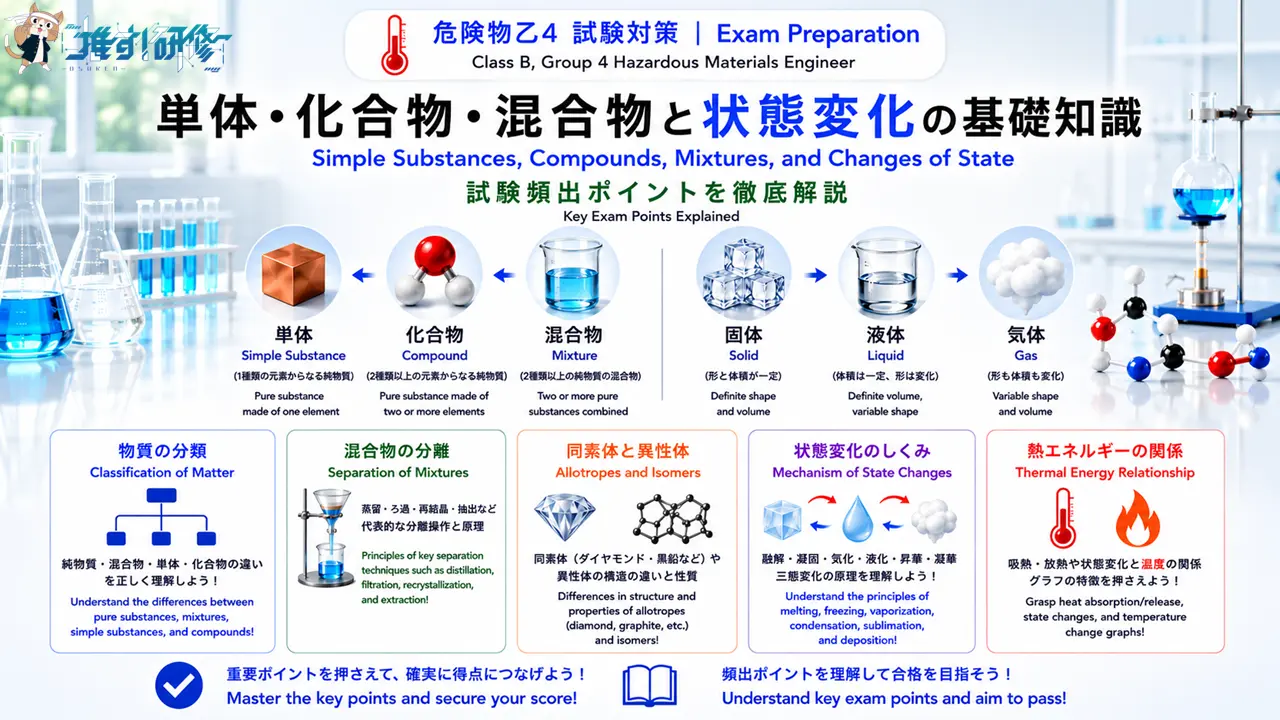
危険物乙4の試験では、「物質の分類」と「状態変化」は物理学・化学の基礎として毎回出題される重要テーマです。「ガソリンや灯油はなぜ混合物なのか」「加熱しても温度が上がらない瞬間があるのはなぜか」といった疑問に、この記事でしっかり答えられるようになりましょう。
In the Class B, Group 4 Hazardous Materials Engineer exam, “classification of matter” and “changes of state” are core topics in physics and chemistry that appear on every exam. This article will help you answer questions such as why gasoline and kerosene are classified as mixtures, and why temperature can stop rising temporarily during heating.
本記事では、純物質・混合物・単体・化合物の分類から、混合物を分離する操作、同素体と異性体、さらに物質の三態変化と状態変化にともなう熱エネルギーの関係まで、試験合格に必要な知識を体系的に解説します。
This article systematically covers everything you need to pass the exam: the classification of pure substances, mixtures, elements, and compounds; separation techniques for mixtures; allotropes and isomers; and the three states of matter along with the thermal energy changes that accompany state transitions.
目次
物質の分類 / Classification of Matter
すべての物質は、まず純物質と混合物に大別されます。純物質とは化学的に見て単一の成分だけで構成される物質のことで、固有の化学組成を持ちます。これに対して混合物とは、2種類以上の純物質が化学的な結びつきを持たないまま混じり合っているものです。
All matter is first divided into two broad categories: pure substances and mixtures. A pure substance is composed of a single chemical component and has a defined chemical composition. A mixture, by contrast, consists of two or more pure substances combined without any chemical bonding between them.
混合物の重要な特徴として、蒸留・ろ過などの物理的な操作によって複数の純物質に分離できるという点があります。ガソリンや灯油が混合物に分類されるのは、いずれも複数の炭化水素からなるためです。空気も窒素・酸素などからなる混合物です。
An important characteristic of mixtures is that they can be separated into their component pure substances by physical operations such as distillation or filtration. Gasoline and kerosene are classified as mixtures because each consists of multiple hydrocarbon compounds. Air is also a mixture, composed of nitrogen, oxygen, and other gases.
単体と化合物 / Elements and Compounds
純物質はさらに単体と化合物に区分されます。
Pure substances are further divided into elements (simple substances) and compounds.
単体とは、1種類の元素のみからなる純物質です。水素(H₂)・酸素(O₂)・硫黄(S)・リン(P)・水銀(Hg)などが代表例です。単体の名称は通常その元素名と同じですが、オゾン(O₃)のように元素名(酸素)と異なる名称を持つものもあります。
An element (simple substance) is a pure substance consisting of only one type of element. Common examples include hydrogen (H₂), oxygen (O₂), sulfur (S), phosphorus (P), and mercury (Hg). The name of an element is usually the same as the element itself, though exceptions exist — for instance, ozone (O₃) is a different substance from oxygen despite being made of the same element.
化合物とは、2種類以上の元素からなる純物質です。水(H₂O)・二酸化炭素(CO₂)・塩化ナトリウム(NaCl)・エタノール(C₂H₅OH)などが代表例です。化合物は化学的な分解によって複数の成分に分けることができます。たとえば水は電気分解によって水素と酸素に分解できます。
A compound is a pure substance made up of two or more different elements. Common examples include water (H₂O), carbon dioxide (CO₂), sodium chloride (NaCl), and ethanol (C₂H₅OH). Compounds can be broken down into their components by chemical means — for example, water can be decomposed into hydrogen and oxygen by electrolysis.
物質の分類を整理すると次のようになります。
The classification of matter can be summarized as follows.
| 分類 / Category | 定義 / Definition | 主な例 / Examples |
|---|---|---|
| 純物質 単体 Pure substance — Element | 1種類の元素からなる Composed of one element | H₂、O₂、S、P、Hg、O₃ |
| 純物質 化合物 Pure substance — Compound | 2種類以上の元素からなる Composed of two or more elements | H₂O、CO₂、NaCl、C₂H₅OH |
| 混合物 Mixture | 2種類以上の純物質が混合 Two or more pure substances combined | 空気、ガソリン、灯油、食塩水、海水 Air, gasoline, kerosene, salt water, seawater |
混合物の分離 / Separation of Mixtures
混合物を構成する成分を取り出すには、物質の物理的な性質の違いを利用した操作が用いられます。試験では各操作の名称と原理の対応が問われます。
Separating the components of a mixture relies on differences in the physical properties of each substance. The exam tests your ability to match the name of each technique with its underlying principle.
| 操作 / Technique | 原理 / Principle | 代表例 / Example |
|---|---|---|
| ろ過 Filtration | ろ紙を用いて液体と不溶性固体を分離する Separates liquid from insoluble solid using filter paper | 泥水から泥を分離 Separating mud from muddy water |
| 蒸留 Distillation | 液体を含む混合物を沸騰させ、生じた蒸気を冷却して再び液体として回収する Boils a liquid mixture, then cools and collects the vapor | 海水からの水の分離 Separating water from seawater |
| 分留 Fractional distillation | 沸点の差を利用し、沸点の低い成分から順に分離する Separates components in order of increasing boiling point | 原油からLPガス・ガソリン・灯油・軽油・重油を分離 Refining crude oil into LPG, gasoline, kerosene, light oil, and heavy oil |
| 昇華 Sublimation | 昇華しやすい物質を混合物から加熱・冷却で分離する Separates a readily sublimable substance by heating and cooling | ヨウ素と塩化ナトリウムの混合物からヨウ素を分離 Separating iodine from a mixture with sodium chloride |
| 再結晶 Recrystallization | 温度による溶解度の差を利用し、固体の不純物を除去する Removes solid impurities by exploiting differences in solubility at different temperatures | 硝酸カリウムの精製 Purification of potassium nitrate |
| 抽出 Extraction | 目的とする成分を適切な溶媒に溶かし出して分離する Dissolves the target component in a suitable solvent to separate it | コーヒー・紅茶の製造 Making coffee or tea |
| 遠心分離 Centrifugation | 遠心力を利用して目的とする成分を分離する Uses centrifugal force to separate components | 洗濯機による脱水 Spin-drying in a washing machine |
| クロマトグラフィー Chromatography | 溶媒に運ばれる移動速度の違いを利用して分離する Separates components based on differences in migration speed through a medium | 水性ペンのインクを成分に分離 Separating ink components from a water-based pen |
試験に頻出の重要ポイントとして、「希釈」は混合物の分離操作ではなく、溶媒の量を増やして濃度を下げる操作です。「分離」の選択肢として紛れ込む誤りの選択肢として登場することがあります。
One key exam point: “Dilution” is not a separation technique — it simply increases the amount of solvent to reduce concentration. It sometimes appears as a misleading incorrect option among the separation techniques.
同素体と異性体 / Allotropes and Isomers
試験では「同素体」と「異性体」の区別が問われます。名前が似ていますが、定義は全く異なります。
The exam distinguishes between “allotropes” and “isomers.” Although the terms sound similar, their definitions are completely different.
同素体 / Allotropes
同素体とは、同じ元素から構成されるものの、原子の配列や結合の形式が異なるために性質も異なる単体のことです。覚え方として「SCOP(スコップ)」という語呂合わせがよく使われます。
Allotropes are different forms of the same element in which the arrangement or bonding of atoms differs, resulting in different physical and chemical properties. A common memory aid in Japanese uses the acronym “SCOP” (S for sulfur, C for carbon, O for oxygen, P for phosphorus).
| 元素 / Element | 同素体の種類 / Allotropes |
|---|---|
| 硫黄 S / Sulfur | 斜方硫黄・単斜硫黄・ゴム状硫黄 Rhombic sulfur, monoclinic sulfur, plastic sulfur |
| 炭素 C / Carbon | 黒鉛(グラファイト)・ダイヤモンド Graphite, diamond |
| 酸素 O / Oxygen | 酸素(O₂)・オゾン(O₃) Oxygen (O₂), ozone (O₃) |
| リン P / Phosphorus | 黄リン・赤リン・黒リン White phosphorus, red phosphorus, black phosphorus |
異性体 / Isomers
異性体とは、分子式(原子の種類と数)は同じでも、構造が異なる物質のことです。代表例がエタノール(C₂H₅OH)とジメチルエーテル(CH₃OCH₃)です。どちらも炭素2個・水素6個・酸素1個で構成されていますが、原子の並び方がまったく異なり、性質も異なります。このように分子式は同じで構造式が異なる異性体を、特に構造異性体と呼びます。
Isomers are substances that share the same molecular formula (the same types and numbers of atoms) but have different structures. The classic example is ethanol (C₂H₅OH) and dimethyl ether (CH₃OCH₃). Both contain two carbon atoms, six hydrogen atoms, and one oxygen atom, yet their atomic arrangements — and therefore their properties — are completely different. Isomers that differ in structural formula like this are specifically called structural isomers.
同素体と異性体の区別を表でまとめます。
The distinction between allotropes and isomers is summarized below.
| 同素体 / Allotropes | 異性体 / Isomers | |
|---|---|---|
| 共通点 Commonality | 同じ元素から構成される Composed of the same element | 同じ分子式(原子の種類・数が同じ) Same molecular formula |
| 相違点 Difference | 原子の配列・結合形式が異なる単体 Differ in atomic arrangement/bonding; are simple substances | 原子のつながり方(構造)が異なる物質 Differ in how atoms are connected (structure) |
| 代表例 Examples | O₂とO₃、黒鉛とダイヤモンド O₂ and O₃, graphite and diamond | エタノールとジメチルエーテル Ethanol and dimethyl ether |
物質の三態と状態変化 / The Three States of Matter and Changes of State
物質は温度や圧力の条件によって固体・液体・気体の3つの状態(三態)をとります。この三態間の変化を状態変化といい、化学変化とは異なる物理変化です。なお、木材・石炭などは、加熱すると三態変化の前に熱分解や炭化が起こるため、純物質のような明確な融点・沸点を示しません。
Matter exists in three states — solid, liquid, and gas — depending on temperature and pressure conditions. Transitions between these three states are called changes of state and are physical changes, not chemical ones. Wood and coal, for example, undergo thermal decomposition or carbonization before any clear change of state occurs, and therefore do not exhibit the distinct melting or boiling points seen in pure substances.
三態の特徴 / Characteristics of the Three States
| 状態 / State | 粒子の配列 / Particle arrangement | 形・体積 / Shape and volume |
|---|---|---|
| 固体 / Solid | 規則正しく並んでおり、わずかに振動する Regularly arranged; particles vibrate slightly | 形・体積ともに一定 Fixed shape and volume |
| 液体 / Liquid | 不規則に集合し、ゆっくりと動く Irregularly arranged; particles move slowly | 形は変化するが体積はほぼ一定 Variable shape; volume nearly constant |
| 気体 / Gas | ばらばらに自由に飛び回る Particles move freely and randomly | 形・体積ともに不定 No fixed shape or volume |
状態変化の名称 / Names of State Changes
状態変化にはそれぞれ固有の名称があります。
Each type of state change has a specific name.
| 変化の方向 / Direction | 名称 / Name | 熱の出入り / Heat exchange |
|---|---|---|
| 固体 → 液体 Solid → Liquid | 融解 / Melting (Fusion) | 吸熱(熱を吸収) Endothermic (absorbs heat) |
| 液体 → 固体 Liquid → Solid | 凝固 / Solidification | 放熱(熱を放出) Exothermic (releases heat) |
| 液体 → 気体 Liquid → Gas | 気化(蒸発・沸騰)/ Vaporization (evaporation / boiling) | 吸熱(熱を吸収) Endothermic (absorbs heat) |
| 気体 → 液体 Gas → Liquid | 凝縮(液化)/ Condensation | 放熱(熱を放出) Exothermic (releases heat) |
| 固体 → 気体 Solid → Gas | 昇華 / Sublimation | 吸熱(熱を吸収) Endothermic (absorbs heat) |
| 気体 → 固体 Gas → Solid | 昇華(逆昇華)/ Deposition | 放熱(熱を放出) Exothermic (releases heat) |
「蒸発」は液体の表面からのみ気化する現象を指し、液体の内部から気化する現象を特に沸騰と呼びます。沸騰が起こる温度を沸点といいます。また、純物質では、一定圧力下で融解や凝固が起こる温度は物質ごとに固有の値を示し、この温度を融点・凝固点といいます。
“Evaporation” refers to vaporization that occurs only at the surface of a liquid. When vaporization occurs throughout the interior of a liquid, it is called boiling, and the temperature at which this occurs is called the boiling point. For pure substances at constant pressure, the temperature at which melting and solidification occur is fixed for each substance and is called the melting point / freezing point.
状態変化と温度・熱エネルギーの関係 / State Changes, Temperature, and Thermal Energy
純物質を一定圧力下で一定の速さで加熱し続けると、融解や沸騰などの状態変化が起きている間は温度が一定に保たれます。これは加えた熱エネルギーが温度上昇ではなく状態変化のために使われるためです。この現象は加熱曲線(温度-時間グラフ)で確認できます。なお、ガソリン・灯油などの混合物は沸点が一点に定まらず沸点範囲を示すため、この関係は純物質に特有の性質です。
When a pure substance is heated at a constant rate under constant pressure, temperature remains constant while a change of state — such as melting or boiling — is occurring. This is because the supplied heat energy is used for the state transition rather than raising the temperature. This behavior is visible on a heating curve (a temperature–time graph). Note that mixtures such as gasoline and kerosene do not have a single fixed boiling point but exhibit a boiling range, so this constant-temperature behavior is a characteristic of pure substances.
状態変化に関わる熱エネルギーの名称と関係式をまとめます。
The names of the thermal energies involved in state changes and their relationships are summarized below.
| 名称 / Name | 内容 / Description | 関係 / Relationship |
|---|---|---|
| 融解熱 Heat of fusion | 固体が融解するときに吸収する熱 Heat absorbed when a solid melts | 融解熱 = 凝固熱 Heat of fusion = Heat of solidification |
| 凝固熱 Heat of solidification | 液体が凝固するときに放出する熱 Heat released when a liquid solidifies | |
| 気化熱(蒸発熱) Heat of vaporization (heat of evaporation) | 液体が気化するときに吸収する熱 Heat absorbed when a liquid vaporizes | 気化熱(蒸発熱)= 凝縮熱 Heat of vaporization = Heat of condensation |
| 凝縮熱 Heat of condensation | 気体が凝縮するときに放出する熱 Heat released when a gas condenses | |
| 昇華熱 Heat of sublimation | 固体が直接気体になるときに吸収する熱 Heat absorbed when a solid converts directly to gas | 昇華熱 = 融解熱 + 気化熱 Heat of sublimation = Heat of fusion + Heat of vaporization |
気化熱が大きいほど、蒸発時に周囲から多くの熱を奪います。主な物質の気化熱を比較すると、水(約2256 J/g)は他の液体に比べて著しく大きく、冷却効果が最も高い物質の一つです。この性質は、水が冷却消火に有効な理由の一つです。ただし、ガソリン・灯油など第4類危険物の液体火災では、水を直接注ぐと燃焼液が水面に浮いて燃焼面積を広げるおそれがあるため、泡消火剤・粉末消火剤・二酸化炭素消火剤などが用いられます。
The larger a substance’s heat of vaporization, the more heat it draws from its surroundings when it evaporates. Comparing common substances, water (approximately 2,256 J/g) has a remarkably high heat of vaporization, making it one of the most effective cooling agents. This property is one reason why water is highly effective as a cooling agent in fire suppression. However, for liquid fires involving Class B, Group 4 hazardous materials such as gasoline or kerosene, applying water directly is dangerous — the burning liquid floats on water and can spread the fire. In such cases, foam, dry powder, or carbon dioxide extinguishing agents are used instead.
潮解と風解 / Deliquescence and Efflorescence
状態変化に関連する現象として、潮解と風解も確認しておきましょう。
Two phenomena related to state changes are also worth knowing: deliquescence and efflorescence.
潮解とは、固体の物質が空気中の水分を吸収して自然に溶解していく現象です。塩素酸ナトリウム・硫酸アンモニウムなどが代表例です。風解とは、結晶水を含む物質が空気中に放置されると、結晶水の一部または全部が失われる現象です。結晶炭酸ナトリウム(炭酸ナトリウム十水和物)・結晶硫酸ナトリウム(硫酸ナトリウム十水和物)などが代表例です。
Deliquescence is the process by which a solid absorbs moisture from the surrounding air and gradually dissolves. Sodium chlorate and ammonium sulfate are typical examples. Efflorescence is the process by which a hydrated crystalline substance loses part or all of its water of crystallization when left in open air. Crystalline sodium carbonate (sodium carbonate decahydrate) and crystalline sodium sulfate (sodium sulfate decahydrate) are typical examples.
まとめ / Summary
このテーマの試験における重要ポイントをまとめます。
Here is a summary of the key exam points for this topic.
- 物質の分類 純物質(単体・化合物)と混合物を正確に区別する。ガソリン・灯油・空気は混合物。
Classification of matter — Accurately distinguish pure substances (elements and compounds) from mixtures. Gasoline, kerosene, and air are all mixtures. - 混合物の分離 ろ過・蒸留・分留・昇華・再結晶・抽出・遠心分離・クロマトグラフィーの8操作。「希釈」は分離操作ではない。
Separation of mixtures — Know the eight techniques: filtration, distillation, fractional distillation, sublimation, recrystallization, extraction, centrifugation, and chromatography. “Dilution” is not a separation technique. - 同素体と異性体の区別 同素体の代表例としてSCOP(硫黄・炭素・酸素・リン)を覚える。異性体は分子式が同じで構造が異なる別の物質。
Allotropes vs. isomers — The SCOP elements (S, C, O, P) are the key allotrope examples to know for the exam. Isomers are different substances with the same molecular formula but different structures. - 状態変化の名称と熱の出入り 融解・気化(蒸発・沸騰)・昇華(固→気)は吸熱。凝固・凝縮・昇華(気→固)は放熱。
State change names and heat exchange — Melting, vaporization (evaporation / boiling), and sublimation (solid → gas) are endothermic. Solidification, condensation, and deposition (gas → solid) are exothermic. - 純物質では、状態変化中は温度が一定 加熱曲線において、融解・沸騰が進む間は温度変化がない。ガソリン・灯油など混合物は沸点範囲を示すため、この特性は純物質に固有。
Temperature is constant during a state change in pure substances — On a heating curve, temperature does not change while melting or boiling is in progress. Mixtures such as gasoline exhibit a boiling range rather than a fixed boiling point. - 水の気化熱は特に大きい 約2256 J/gで主要な液体の中で最大級。冷却消火に有効な理由の一つ。ただし、第4類危険物の液体火災では燃焼面積を広げるおそれがあるため直接注水は避ける。
Water has an exceptionally high heat of vaporization — Approximately 2,256 J/g, among the highest of common liquids, and one reason why water is effective for cooling in fire suppression. However, direct application of water to Class B, Group 4 liquid fires must be avoided, as it can spread the burning liquid and enlarge the fire.
練習問題 理解を確認しよう / Practice Questions: Test Your Understanding
ここまでの内容を試験形式で確認しましょう。解答と解説は各問題の直下に記載しています。
Let’s check your understanding with some exam-style practice questions. The answer and explanation appear directly below each question.
問題1 Question 1
物質の分類に関する記述として、正しいものはどれか。
Which of the following statements about the classification of matter is correct?
- 空気は、窒素と酸素の化合物である。
Air is a compound of nitrogen and oxygen. - 食塩水は、塩化ナトリウムと水の化合物である。
Salt water is a compound of sodium chloride and water. - ガソリンは、種々の炭化水素からなる混合物である。
Gasoline is a mixture consisting of various hydrocarbons. - 二酸化炭素は、炭素と酸素の混合物である。
Carbon dioxide is a mixture of carbon and oxygen.
解答:3 Answer: 3
選択肢3が正解です。ガソリンは複数種類の炭化水素が混合した混合物で、分留によって原油から得られます。選択肢1は誤りで、空気は窒素・酸素などが化学的結合なしに混じり合った混合物です。化合物は2種類以上の元素が化学的に結びついた純物質であり、空気には該当しません。選択肢2も誤りで、食塩水は塩化ナトリウムと水という2つの純物質の混合物であり、化合物ではありません。選択肢4も誤りで、二酸化炭素(CO₂)は炭素と酸素が化学的に結びついた化合物(純物質)です。
Option 3 is correct. Gasoline is a mixture of multiple hydrocarbon compounds obtained from crude oil by fractional distillation. Option 1 is incorrect: air is a mixture in which nitrogen, oxygen, and other gases are combined without chemical bonding — not a compound. A compound is a pure substance in which two or more elements are chemically bonded. Option 2 is also incorrect: salt water is a mixture of two pure substances (sodium chloride and water), not a compound. Option 4 is incorrect: carbon dioxide (CO₂) is a compound — a pure substance in which carbon and oxygen are chemically bonded.
問題2 Question 2
同素体の組み合わせとして、正しいものはどれか。
Which of the following is a correct pair of allotropes?
- エタノールとジメチルエーテル
Ethanol and dimethyl ether - 銀と水銀
Silver and mercury - 酸素(O₂)とオゾン(O₃)
Oxygen (O₂) and ozone (O₃) - 水素(H₂)と酸素(O₂)
Hydrogen (H₂) and oxygen (O₂)
解答:3 Answer: 3
選択肢3が正解です。酸素(O₂)とオゾン(O₃)はいずれも酸素元素(O)のみから構成されますが、分子の構造が異なるため性質も異なる同素体です。選択肢1のエタノールとジメチルエーテルは、分子式は同じ(C₂H₆O)ですが構造が異なる「異性体」であり、同素体ではありません。選択肢2の銀(Ag)と水銀(Hg)はそれぞれ異なる元素からなる別々の単体であり、同素体の関係にはありません。選択肢4の水素と酸素は元素が異なるため、同素体にはなりません。
Option 3 is correct. Oxygen (O₂) and ozone (O₃) are both composed solely of the element oxygen (O), but differ in molecular structure and therefore in properties — making them allotropes. Option 1: ethanol and dimethyl ether share the same molecular formula (C₂H₆O) but differ in structure — they are isomers, not allotropes. Option 2: silver (Ag) and mercury (Hg) are separate elements and have no allotropic relationship. Option 4: hydrogen and oxygen are different elements and cannot be allotropes of each other.
問題3 Question 3
物質の状態変化に関する記述として、誤っているものはどれか。
Which of the following statements about changes of state is incorrect?
- 液体が気体に変化する現象を気化といい、このとき熱を吸収する。
The change from liquid to gas is called vaporization, and heat is absorbed during this process. - 固体が液体に変化する際、加えた熱はすべて温度の上昇に使われる。
When a solid melts, all the heat supplied is used to raise the temperature. - 固体から直接気体に変化する現象を昇華といい、このとき熱を吸収する。
The direct change from solid to gas is called sublimation, and heat is absorbed during this process. - 水の気化熱は、多くの液体と比較して著しく大きい。
The heat of vaporization of water is remarkably large compared with most other liquids.
解答:2 Answer: 2
選択肢2が誤りです。固体が融解している間、加えた熱エネルギーは温度上昇ではなく状態変化のために消費されます。このため、融解が続いている間は温度が一定に保たれます(加熱曲線上の水平部分)。選択肢1は正しい記述です。液体から気体への変化(気化)は吸熱変化で、表面からの気化を蒸発、内部からの気化を沸騰と呼びます。選択肢3も正しく、昇華(固→気)は吸熱変化で、昇華熱は融解熱と気化熱の和に等しくなります。選択肢4も正しく、水の気化熱(約2256 J/g)はジエチルエーテル(351.6 J/g)やエタノール(858.1 J/g)などと比較して著しく大きく、これが消火における水の冷却効果の根拠の一つです。
Option 2 is incorrect. While a solid is melting, the heat supplied is used for the state change itself, not to raise temperature. As a result, temperature remains constant throughout the melting process (the flat portion of a heating curve). Option 1 is correct: vaporization (liquid → gas) is endothermic. Vaporization occurring only at the surface of a liquid is called evaporation; vaporization throughout the interior of a liquid is called boiling. Option 3 is also correct: sublimation (solid → gas) is endothermic, and the heat of sublimation equals the sum of the heat of fusion and the heat of vaporization. Option 4 is correct: water’s heat of vaporization (approximately 2,256 J/g) is far higher than that of diethyl ether (351.6 J/g) or ethanol (858.1 J/g), and this is one reason why water is so effective at cooling in fire suppression.
- QC3|QCストーリー(問題解決型の8手順・課題達成型の9手順)の違いと使い分けをわかりやすく解説 QC3 | QC Story: 8-Step Problem-Solving vs. 9-Step Task-Achievement Explained
- QC3|プロセス保証・方針管理・日常管理の基礎知識をわかりやすく解説 QC3 | Process Assurance, Policy Management, and Daily Management Explained
この記事を書いた人

関連記事
-
 危険物乙4|アルコール類の性状を徹底解説【メタノール・エタノール・n-プロピルアルコール・イソプロピルアルコール】 Class B, Group 4 Hazardous Materials Engineer | Properties of Alcohols: Methanol, Ethanol, n-Propyl Alcohol, and Isopropyl Alcohol Explained
 -
危険物乙4|第一石油類の性状を徹底解説【ガソリン・ベンゼン・トルエン・アセトンほか】 Class B, Group 4 Hazardous Materials Engineer | Properties of Category 1 Petroleum: Gasoline, Benzene, Toluene, Acetone, and More Explained
-
危険物乙4|特殊引火物の性状を徹底解説【ジエチルエーテル・二硫化炭素・アセトアルデヒド・酸化プロピレン】 Class B, Group 4 Hazardous Materials Engineer | Properties of Special Flammable Liquids: Diethyl Ether, Carbon Disulfide, Acetaldehyde, and Propylene Oxide Explained
-
危険物乙4|酸と塩基・酸化と還元・金属腐食の基礎知識 Class B, Group 4 Hazardous Materials Engineer | Acids and Bases, Oxidation and Reduction, and Metal Corrosion
-
危険物乙4|保安距離と保有空地の対象施設・数値基準をわかりやすく解説 Class B Group 4 Hazardous Materials Engineer | Safety Distances and Open Space Requirements Explained
-
危険物乙4|免状の交付・書換え・再交付の申請先と手続きをわかりやすく解説 Class B Group 4 Hazardous Materials Engineer | License Issuance, Amendment, Reissuance, and Surrender: Application Authorities and Procedures Explained
-
危険物乙4|熱の移動の基礎知識 伝導・対流・放射 Class B, Group 4 Hazardous Materials Engineer | Heat Transfer Fundamentals: Conduction, Convection, and Radiation
-
危険物乙4|静電気の基礎知識と防止対策 Class B, Group 4 Hazardous Materials Engineer | Static Electricity: Fundamentals and Prevention Measures