危険物乙4「運搬の基準」完全まとめ|試験頻出ポイントを徹底解説 Class B, Group 4 — Complete Guide to Hazardous Materials Transportation Standards | Key Exam Points Explained
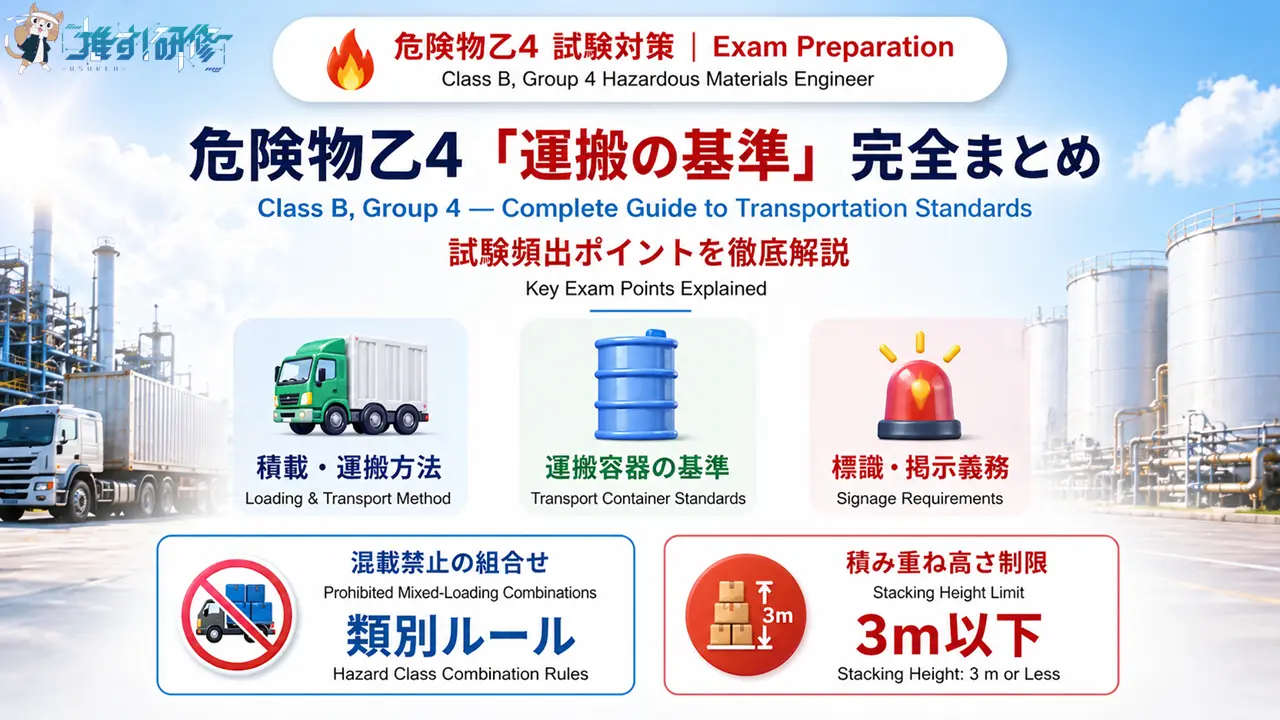
危険物乙4の試験では、「運搬の基準」から毎回複数問が出題されます。運搬容器・積載方法・混載の可否・運搬方法の4つの柱を整理して覚えることが、合格への近道です。本記事では試験頻出ポイントを中心にわかりやすく解説します。
In the Class B, Group 4 Hazardous Materials Engineer exam, multiple questions on transport standards appear on every exam. The key to passing is to organize and memorize the four pillars: transport containers, loading methods, mixed-loading rules, and transportation methods. This article provides a clear explanation focused on the most frequently tested points.
目次
運搬の基準とは?基本をおさえよう What Are Transportation Standards? Understanding the Basics
「運搬」とは、ドラム缶や一斗缶などに詰められた危険物をトラック等の車両によって運ぶことをいいます。
“Transportation” (運搬) refers to the transport of hazardous materials packed in containers such as drums or cans by truck or similar vehicle.
運搬の基準には、次の2つの重要な特徴があります。
Transportation standards have the following two important characteristics.
- 指定数量未満の危険物にも適用される
- 届出や許可の義務はない
- They apply even to hazardous materials below the designated quantity
- No notification or permit is required
危険物を「運搬」するだけであれば、指定数量に関係なく危険物取扱者の同乗は不要です。
For the purpose of transportation alone, a Hazardous Materials Engineer is not required to accompany the vehicle, regardless of the designated quantity.
運搬容器の基準 Transport Container Standards
材質・構造の要件 Material and Structural Requirements
危険物は必ず運搬容器に収納して運搬しなければなりません。運搬容器の材質は、鋼板・アルミニウム板・ブリキ板・ガラスなどが定められています。容器は堅固で危険物が漏れるおそれがなく、かつその口から収納した危険物が漏れるおそれがないものでなければなりません。
Hazardous materials must always be stored in transport containers before being transported. Approved materials for transport containers include steel plate, aluminum plate, tin plate, and glass. Containers must be sturdy, with no risk of hazardous materials leaking, including from the opening.
危険等級(Ⅰ・Ⅱ・Ⅲ) Hazard Grades (I, II, III)
危険物は危険性の程度に応じて危険等級Ⅰ・Ⅱ・Ⅲに区分されます。容器の構造および最大容積は、容器の区分に応じて細かく定められています。
Hazardous materials are classified into Hazard Grades I, II, and III according to their level of danger. The structure and maximum capacity of containers are specified in detail according to the container classification.
積載方法の基準 Loading Method Standards
容器への収納方法 How to Store Hazardous Materials in Containers
- 危険物は原則として運搬容器に収納して積載すること
- 温度変化等により危険物が漏れないよう運搬容器を密封して収納すること
- 収納する危険物と危険な反応を起こさない材質の運搬容器に収納すること
- 固体の危険物は、容器の内容積の95%以下の収納率で収納すること
- 液体の危険物は、容器の内容積の98%以下の収納率で、かつ55℃の温度において漏れないよう十分な空間容積を有して収納すること
- ひとつの外装容器には、原則として類を異にする危険物を収納してはならない
- As a general rule, hazardous materials must be stored in transport containers before loading
- Containers must be sealed so that hazardous materials do not leak due to temperature changes or other factors
- Containers must be made of a material that does not cause a dangerous reaction with the hazardous materials stored inside
- Solid hazardous materials must be stored at a fill rate of 95% or less of the container’s internal volume
- Liquid hazardous materials must be stored at a fill rate of 98% or less of the container’s internal volume, with sufficient headspace to prevent leakage at 55°C
- As a general rule, hazardous materials of different groups must not be stored in the same outer container
容器表示の6項目【試験頻出】 Six Required Container Markings [Frequently Tested]
危険物の運搬容器の外部には、以下の6項目を表示して積載しなければなりません。
Transport containers for hazardous materials must display the following six items on the outside.
- 危険物の品名
- 危険等級
- 化学名
- 第4類のうち水溶性のものは「水溶性」の表示
- 危険物の数量
- 収納する危険物に応じた注意事項
- Name of the hazardous material
- Hazard grade
- Chemical name
- For water-soluble materials in Group 4, the label “Water-Soluble” (水溶性)
- Quantity of the hazardous material
- Precautionary statements appropriate to the hazardous material stored
注意事項の内容は類別によって異なります。特に試験に出やすいものを以下の表にまとめます。
The content of precautionary statements varies by group. The table below summarizes those most likely to appear on the exam.
| 類別等 Group | 品名 Substance | 注意事項 Precautionary Statements |
|---|---|---|
| 第1類 酸化性固体 Group 1 — Oxidizing Solids | アルカリ金属の過酸化物、これらの含有品 Alkali metal peroxides and products containing them | 【火気・衝撃注意】【禁水】【可燃物接触注意】 [Keep Away from Fire and Shock] [Keep Away from Water] [Avoid Contact with Combustibles] |
| その他のもの All others | 【火気・衝撃注意】【可燃物接触注意】 [Keep Away from Fire and Shock] [Avoid Contact with Combustibles] | |
| 第2類 可燃性固体 Group 2 — Flammable Solids | 鉄粉、金属粉、マグネシウム、これらの含有品 Iron powder, metal powder, magnesium, and products containing them | 【火気注意】【禁水】 [Flammable — Handle with Care] [Keep Away from Water] |
| 引火性固体 Flammable solids | 【火気厳禁】 [Keep Away from Open Flames] | |
| その他のもの All others | 【火気注意】 [Flammable — Handle with Care] | |
| 第3類 自然発火性物品 Group 3 — Spontaneously Ignitable Substances | すべて All | 【空気接触厳禁】【火気厳禁】 [Avoid Contact with Air] [Keep Away from Open Flames] |
| 第3類 禁水性物品 Group 3 — Water-Reactive Substances | すべて All | 【禁水】 [Keep Away from Water] |
| 第4類 引火性液体 Group 4 — Flammable Liquids | すべて All | 【火気厳禁】 [Keep Away from Open Flames] |
| 第5類 自己反応性物質 Group 5 — Self-Reactive Substances | すべて All | 【火気厳禁】【衝撃注意】 [Keep Away from Open Flames] [Caution: Impact] |
| 第6類 酸化性液体 Group 6 — Oxidizing Liquids | すべて All | 【可燃物接触注意】 [Avoid Contact with Combustibles] |
その他の積載注意事項 Other Loading Precautions
- 危険物が転落・転倒・破損しないよう積載すること
- 運搬容器は収納口を上に向けて積載すること
- 遮光性の被覆が必要な危険物(日光の直射を避けるため):第1類・第3類(自然発火性)・第4類(特殊引火物)・第5類・第6類
- 防水性の被覆が必要な危険物(雨水の浸透を防ぐため):第1類のうちアルカリ金属の過酸化物等、第2類のうち鉄粉・金属粉・マグネシウム等、第3類の禁水性物品
- 保冷コンテナによる温度管理が必要な危険物:第5類のうち55℃以下の温度で分解するおそれのあるもの
- 危険物と高圧ガスは混載してはならない(ただし、内容積120L未満の容器に充てんされたアセチレンガスまたは酸素ガスを、第4類第3石油類または第4石油類と混載する場合はこの限りでない)
- 運搬容器を積み重ねる場合は、高さ3m以下で積載すること
- Hazardous materials must be loaded so that they do not fall, tip over, or break
- Transport containers must be loaded with the opening facing upward
- Hazardous materials requiring light-blocking covers (to avoid direct sunlight): Groups 1, 3 (spontaneously ignitable), 4 (special flammable substances), 5, and 6
- Hazardous materials requiring waterproof covers (to prevent rainwater penetration): alkali metal peroxides in Group 1; iron powder, metal powder, and magnesium in Group 2; water-reactive substances in Group 3
- Hazardous materials requiring temperature control in refrigerated containers: Group 5 substances that may decompose at temperatures of 55°C or below
- Hazardous materials and high-pressure gases must not be loaded together (except when acetylene gas or oxygen gas filled in containers with an internal volume of less than 120 L is loaded together with Group 4, Class 3 petroleum or Class 4 petroleum)
- When stacking transport containers, the total height must not exceed 3 m
混載の可否一覧表【試験頻出】 Mixed-Loading Rules [Frequently Tested]
同一車両において類を異にする危険物を運搬するとき(混載)、混載してはならない組み合わせがあります。
When transporting hazardous materials of different groups on the same vehicle (mixed loading), certain combinations are prohibited.
| 項目 | 第1類 Group 1 | 第2類 Group 2 | 第3類 Group 3 | 第4類 Group 4 | 第5類 Group 5 | 第6類 Group 6 |
|---|---|---|---|---|---|---|
| 第1類 Group 1 | ― | × | × | × | × | ○ |
| 第2類 Group 2 | × | ― | × | ○ | ○ | × |
| 第3類 Group 3 | × | × | ― | ○ | × | × |
| 第4類 Group 4 | × | ○ | ○ | ― | ○ | × |
| 第5類 Group 5 | × | ○ | × | ○ | ― | × |
| 第6類 Group 6 | ○ | × | × | × | × | ― |
※この表は、指定数量の1/10以下の危険物については適用しません。
Note: This table does not apply to hazardous materials in quantities of 1/10 or less of the designated quantity.
覚え方のポイント:混載できる(○)組み合わせは5パターンだけです。「第1類は第6類とのみ混載可」「第4類は第2類・第3類・第5類と混載可」と整理して覚えましょう。
Memory tip: There are only 5 permitted (○) mixed-loading combinations. Remember: “Group 1 can only be mixed with Group 6” and “Group 4 can be mixed with Groups 2, 3, and 5.”
運搬方法の基準 Transportation Method Standards
標識の掲示要件 Signage Requirements
指定数量以上の危険物を車両で運搬する場合、車両の前後の見やすい箇所に標識を掲げなければなりません。
When transporting hazardous materials in quantities at or above the designated quantity by vehicle, a sign must be displayed in a clearly visible location at the front and rear of the vehicle.
- 大きさ:0.3m平方
- 色:黒色の板に黄色の反射塗料またはその他反射性を有する材料
- 表示:「危」
- Size: 0.3 m square
- Color: Yellow reflective paint or other reflective material on a black plate
- Display: The character “危” (Hazardous)
指定数量以上の運搬時のルール Rules When Transporting at or Above the Designated Quantity
- 積替え・休憩・故障等のため車両を一時停止させるときは、安全な場所を選び、かつ運搬する危険物の保安に注意すること
- 危険物または危険物を収納した運搬容器が著しく摩擦または動揺を起こさないよう運搬すること
- 危険物が著しく漏れる等、災害が発生するおそれがある場合は、応急措置を講じるとともに最寄りの消防機関その他の関係機関に通報すること
- 危険物の運搬に適応する消火設備を備えること
- When stopping the vehicle temporarily for reloading, rest, breakdown, or similar reasons, choose a safe location and take care to ensure the safety of the hazardous materials being transported
- Transport hazardous materials and transport containers in a manner that prevents significant friction or shaking
- If there is a risk of disaster such as significant leakage of hazardous materials, take emergency measures and notify the nearest fire department and other relevant authorities
- Equip the vehicle with fire-extinguishing equipment appropriate for transporting hazardous materials
「運搬」と「移送」の違い【試験頻出】 Difference Between “Transportation” and “Transfer” [Frequently Tested]
| 項目 Item | 運搬 Transportation | 移送 Transfer |
|---|---|---|
| 方法 Method | 容器に詰めてトラック等で運ぶ Transport in containers by truck or similar vehicle | タンクローリー(移動タンク貯蔵所)やパイプラインで運ぶ Transport by tank lorry (mobile tank storage) or pipeline |
| 取扱者の同乗 Engineer on Board | 不要(積み卸し時は立会い必要) Not required (attendance required during loading/unloading) | 危険物取扱者が乗車し、免状を携帯しなければならない A Hazardous Materials Engineer must ride on board and carry their license |
| 運転要員 Driving Personnel | 規定なし No specific requirement | 長時間移送(連続運転4時間超または1日9時間超)の場合は2名以上の運転要員を確保 For long-distance transfer (continuous driving over 4 hours or over 9 hours per day), 2 or more drivers must be secured |
| 指定数量との関係 Relation to Designated Quantity | 指定数量未満にも基準が適用される Standards apply even below the designated quantity | 移送する危険物を取り扱える資格が必要 Qualification to handle the hazardous materials being transferred is required |
試験対策まとめ|よく出る問題パターン Exam Preparation Summary | Common Question Patterns
- 運搬の基準は指定数量未満にも適用される → ○
- 運搬するだけなら危険物取扱者の同乗は不要 → ○
- 液体危険物の収納率は容器内容積の98%以下、かつ55℃で漏れないこと → ○
- 固体危険物の収納率は容器内容積の95%以下 → ○
- 第2類と第4類は混載できる → ○
- 第1類と第4類は混載できない → ○(第1類と混載できるのは第6類のみ)
- 標識は0.3m平方の黒色の板に黄色で「危」と表示 → ○
- 容器表示の注意事項で第4類はすべて「火気厳禁」 → ○
- Transportation standards apply even to hazardous materials below the designated quantity → ○
- For transportation only, a Hazardous Materials Engineer is not required to accompany the vehicle → ○
- Liquid hazardous materials must be stored at 98% or less of container volume and must not leak at 55°C → ○
- Solid hazardous materials must be stored at 95% or less of container volume → ○
- Group 2 and Group 4 can be loaded together → ○
- Group 1 and Group 4 cannot be loaded together → ○ (Group 1 can only be mixed with Group 6)
- The sign must be 0.3 m square, black board with “危” in yellow → ○
- The precautionary statement for all Group 4 substances is “Keep Away from Open Flames” → ○
運搬の基準は暗記項目が多いですが、混載の可否(5パターン)と容器表示の6項目は必ず得点できるよう繰り返し確認しておきましょう。
Transportation standards involve a large number of items to memorize, but make sure you can reliably score points on the five permitted mixed-loading combinations and the six required container markings by reviewing them repeatedly.
練習問題 運搬の基準の理解を確認しよう Practice Questions | Test Your Understanding of Transportation Standards
ここまで学んだ内容を確認するため、試験形式の練習問題に挑戦してみましょう。解答は各問題の下に記載しています。
To review what you have learned, try the following exam-style practice questions. The answer to each question is provided below it.
問題1 Question 1
危険物の運搬容器の外部に表示しなければならない事項として、誤っているものはどれか。
Which of the following is incorrect as a required marking on the exterior of a hazardous materials transport container?
- 危険物の品名および危険等級
Name of the hazardous material and hazard grade - 化学名および危険物の数量
Chemical name and quantity of the hazardous material - 収納する危険物に応じた注意事項
Precautionary statements appropriate to the hazardous material stored - 危険物取扱者の氏名および免状番号
Name and license number of the Hazardous Materials Engineer
解答:4 Answer: 4
運搬容器の外部に表示すべき6項目は、①危険物の品名、②危険等級、③化学名、④第4類のうち水溶性のものは「水溶性」の表示、⑤危険物の数量、⑥収納する危険物に応じた注意事項です。危険物取扱者の氏名や免状番号は表示事項に含まれません。この6項目は試験頻出のため確実に覚えておきましょう。
The six required exterior markings on transport containers are: ① name of the hazardous material, ② hazard grade, ③ chemical name, ④ “Water-Soluble” for water-soluble Group 4 substances, ⑤ quantity of the hazardous material, and ⑥ precautionary statements appropriate to the hazardous material stored. The name and license number of the Hazardous Materials Engineer are not included. These six items are frequently tested, so be sure to memorize them.
問題2 Question 2
同一車両に危険物を混載する場合に関する次の記述のうち、正しいものはどれか。
Which of the following statements about mixed loading of hazardous materials on the same vehicle is correct?
- 第1類と第4類は混載することができる。
Group 1 and Group 4 can be loaded together. - 第2類と第4類は混載することができる。
Group 2 and Group 4 can be loaded together. - 第3類と第5類は混載することができる。
Group 3 and Group 5 can be loaded together. - 第6類と第4類は混載することができる。
Group 6 and Group 4 can be loaded together.
解答:2 Answer: 2
第2類(可燃性固体)と第4類(引火性液体)は混載することができます。混載できる組み合わせは5パターンのみです。第1類と混載できるのは第6類のみ(選択肢1・4は誤り)。第4類は第2類・第3類・第5類と混載可能です。第3類と第5類の混載は不可(選択肢3は誤り)。「第4類は第2・3・5類と混載可」という組み合わせを優先して覚えておきましょう。
Group 2 (flammable solids) and Group 4 (flammable liquids) can be loaded together. There are only five permitted mixed-loading combinations. Group 1 can only be mixed with Group 6 (options 1 and 4 are incorrect). Group 4 can be mixed with Groups 2, 3, and 5. Group 3 and Group 5 cannot be mixed (option 3 is incorrect). Prioritize memorizing the rule that “Group 4 can be mixed with Groups 2, 3, and 5.”
問題3 Question 3
危険物の「運搬」と「移送」の違いに関する次の記述のうち、正しいものはどれか。
Which of the following statements about the difference between “transportation” (運搬) and “transfer” (移送) of hazardous materials is correct?
- 運搬とは、タンクローリーで危険物を運ぶことをいい、危険物取扱者の同乗は不要である。
“Transportation” refers to transporting hazardous materials by tank lorry, and a Hazardous Materials Engineer is not required to accompany the vehicle. - 移送とは、容器に詰めた危険物をトラックで運ぶことをいう。
“Transfer” refers to transporting hazardous materials packed in containers by truck. - 運搬の基準は、指定数量未満の危険物には適用されない。
Transportation standards do not apply to hazardous materials below the designated quantity. - 移送の場合、危険物取扱者が乗車し、免状を携帯しなければならない。
In the case of transfer, a Hazardous Materials Engineer must ride on board and carry their license.
解答:4 Answer: 4
移送(タンクローリーやパイプラインによる運搬)では、危険物取扱者が乗車し、免状を携帯しなければなりません。また連続運転4時間超または1日9時間超の長時間移送の場合は、2名以上の運転要員が必要です。選択肢1は誤りで、タンクローリーで運ぶのは「移送」であり、危険物取扱者の乗車が必要です。選択肢2は「運搬」の説明が「移送」として記述されており誤りです。選択肢3は誤りで、運搬の基準は指定数量未満の危険物にも適用されます。「運搬=容器に入れてトラック」「移送=タンクローリー・パイプライン」という違いを確実に覚えておきましょう。
In transfer (transporting by tank lorry or pipeline), a Hazardous Materials Engineer must ride on board and carry their license. For long-distance transfer (continuous driving over 4 hours or over 9 hours per day), 2 or more drivers must be secured. Option 1 is incorrect: transporting by tank lorry is “transfer,” which requires a Hazardous Materials Engineer on board. Option 2 is incorrect: it describes “transportation” but labels it as “transfer.” Option 3 is incorrect: transportation standards apply even to hazardous materials below the designated quantity. Be sure to memorize the distinction: “transportation = containers by truck” and “transfer = tank lorry or pipeline.”
- QC3|QC7つ道具(2) ヒストグラム・散布図・チェックシート・グラフの使い方 QC3 | The 7 QC Tools (Part 2): How to Use Histograms, Scatter Diagrams, Check Sheets, and Graphs
- 食品衛生責任者とは?コンビニで働く外国人スタッフのための完全取得ガイド What Is a Food Sanitation Manager? A Complete Guide to Certification for Foreign Workers in Convenience Stores
この記事を書いた人

関連記事
-
 危険物乙4|アルコール類の性状を徹底解説【メタノール・エタノール・n-プロピルアルコール・イソプロピルアルコール】 Class B, Group 4 Hazardous Materials Engineer | Properties of Alcohols: Methanol, Ethanol, n-Propyl Alcohol, and Isopropyl Alcohol Explained
 -
危険物乙4|第一石油類の性状を徹底解説【ガソリン・ベンゼン・トルエン・アセトンほか】 Class B, Group 4 Hazardous Materials Engineer | Properties of Category 1 Petroleum: Gasoline, Benzene, Toluene, Acetone, and More Explained
-
危険物乙4|特殊引火物の性状を徹底解説【ジエチルエーテル・二硫化炭素・アセトアルデヒド・酸化プロピレン】 Class B, Group 4 Hazardous Materials Engineer | Properties of Special Flammable Liquids: Diethyl Ether, Carbon Disulfide, Acetaldehyde, and Propylene Oxide Explained
-
危険物乙4|酸と塩基・酸化と還元・金属腐食の基礎知識 Class B, Group 4 Hazardous Materials Engineer | Acids and Bases, Oxidation and Reduction, and Metal Corrosion
-
危険物乙4|単体・化合物・混合物と状態変化の基礎知識 Class B, Group 4 Hazardous Materials Engineer | Simple Substances, Compounds, Mixtures, and Changes of State
-
危険物乙4|保安距離と保有空地の対象施設・数値基準をわかりやすく解説 Class B Group 4 Hazardous Materials Engineer | Safety Distances and Open Space Requirements Explained
-
危険物乙4|免状の交付・書換え・再交付の申請先と手続きをわかりやすく解説 Class B Group 4 Hazardous Materials Engineer | License Issuance, Amendment, Reissuance, and Surrender: Application Authorities and Procedures Explained
-
危険物乙4|熱の移動の基礎知識 伝導・対流・放射 Class B, Group 4 Hazardous Materials Engineer | Heat Transfer Fundamentals: Conduction, Convection, and Radiation