
食品衛生責任者とは?コンビニで働く外国人スタッフのための完全取得ガイド What Is a Food Sanitation Manager? A Complete Guide to Certification for Foreign Workers in Convenience Stores
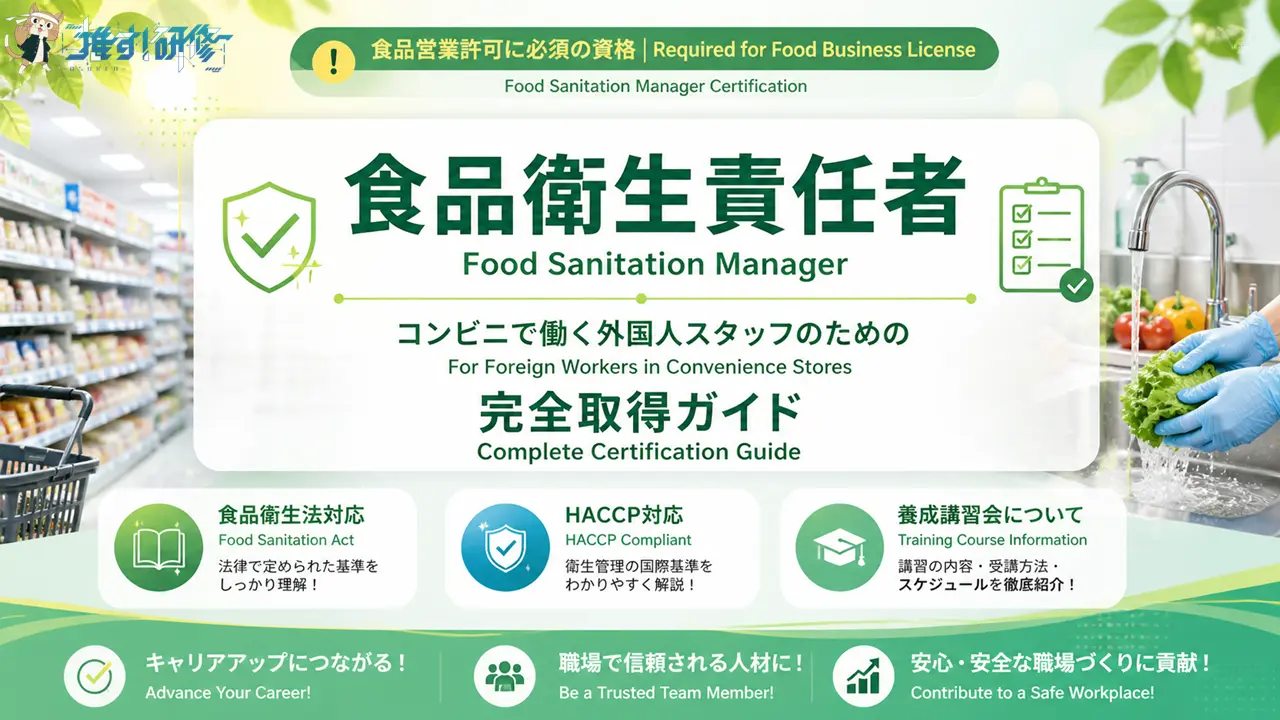
「食品衛生責任者って何?」「うちで働いてもらっているスタッフでも取れるの?」——コンビニで働く外国人スタッフや、外国人スタッフに資格を取得させたい店舗オーナーから、こうした疑問をよく耳にします。
“What exactly is a Food Sanitation Manager?” “Can the staff working at our store get this qualification?” — These are questions we often hear from foreign workers at convenience stores and from store owners looking to have their foreign staff obtain this certification.
食品衛生責任者は1日の講習会で取得できるシンプルな資格です。しかし、講習はすべて日本語で行われるため、日本語に不安がある外国人スタッフにとっては「何をどう準備すればよいか」が分かりにくいのが現実です。
The Food Sanitation Manager qualification is a straightforward certification that can be obtained through a single day of training. However, because all training is conducted entirely in Japanese, foreign workers with limited Japanese proficiency often find it difficult to know what to prepare and how to go about it.
本記事では、食品衛生責任者の法令上の位置づけから、養成講習会の具体的な中身、外国人スタッフが受講するための条件と注意点、店舗側のサポートのポイントまでを、法令に基づいて正確に、かつわかりやすく解説します。
This article provides a clear and accurate explanation based on applicable law — covering the legal status of the Food Sanitation Manager, the specific content of the certification training course, the requirements and key considerations for foreign workers, and the support measures store owners can take.
目次
食品衛生責任者とは?法令上の位置づけ What Is a Food Sanitation Manager? Legal Framework
食品衛生責任者とは、飲食店や食品販売店など食品を取り扱う施設において、衛生管理を担う責任者のことです。食品衛生法施行規則に基づき、令和3年6月1日の改正施行以降、営業許可または営業届出の対象となる原則すべての施設において、食品衛生責任者を1名定めることが義務付けられています。
A Food Sanitation Manager is the person responsible for managing hygiene at facilities that handle food, such as restaurants and food retailers. Under the Enforcement Regulations of the Food Sanitation Act, as of June 1, 2021, when the revised regulations took effect, virtually all facilities subject to business licensing or business notification are required to designate one Food Sanitation Manager.
コンビニエンスストアは惣菜・弁当・調理パンなど加熱・調理を伴う食品を扱うため、営業許可の対象施設に該当します。したがって、コンビニの各店舗には必ず食品衛生責任者を設置しなければなりません。また、食品衛生責任者の氏名は施設内の見やすい場所に掲示することも法令上定められています。
Convenience stores handle foods that involve heating and cooking — such as prepared side dishes, boxed meals, and baked goods — and therefore fall under the category of facilities requiring a business license. Accordingly, every convenience store location is legally required to have a designated Food Sanitation Manager. The law also stipulates that the name of the Food Sanitation Manager must be displayed in a clearly visible location within the facility.
食品衛生責任者の主な役割 Key Responsibilities of a Food Sanitation Manager
食品衛生責任者には、主に以下の役割が求められます。
The Food Sanitation Manager is expected to fulfill the following primary responsibilities.
- 施設のHACCPに沿った衛生管理の実施・維持
- 食品衛生に関する最新の知見を習得するための講習会の定期受講
- 営業者に対する衛生管理上の意見具申
- Implementing and maintaining HACCP-based sanitation management at the facility
- Regularly attending training sessions to stay current with the latest knowledge on food hygiene
- Providing sanitation-related recommendations to the business operator
HACCPとの関係 Relationship with HACCP
平成30年の食品衛生法改正により、令和3年6月1日からHACCPに沿った衛生管理がすべての食品等事業者に義務付けられました。HACCPとは、原材料の入荷から製品の出荷に至るすべての工程で食中毒菌汚染や異物混入などの危害要因を管理する衛生管理手法です。食品衛生責任者はこの衛生管理を店舗内で実践・維持するための中核人材であり、その役割の重要性は年々高まっています。
Following the 2018 revision of the Food Sanitation Act, HACCP-based sanitation management became mandatory for all food businesses as of June 1, 2021. HACCP is a sanitation management approach that controls hazards — such as contamination by foodborne pathogens and foreign object intrusion — at every stage from receiving raw materials through to product shipment. The Food Sanitation Manager is the central person responsible for implementing and maintaining this sanitation management in-store, and the importance of this role continues to grow each year.
食品衛生責任者と食品衛生管理者の違い Difference Between Food Sanitation Manager and Food Sanitation Supervisor
似た名前の資格として「食品衛生管理者」があります。混同しやすいので整理しておきましょう。
There is a similarly named qualification called “Food Sanitation Supervisor” (食品衛生管理者). Since the two are easily confused, the table below clarifies the distinction.
| 項目 Item | 食品衛生責任者 Food Sanitation Manager | 食品衛生管理者 Food Sanitation Supervisor |
|---|---|---|
| 対象施設 Applicable Facilities | 飲食店・コンビニ・食品販売店など食品を取り扱う原則すべての施設 Virtually all facilities handling food, including restaurants, convenience stores, and food retailers | 食肉製品・食用油脂・添加物など特定の食品を製造・加工する工場 Factories manufacturing or processing specific foods such as meat products, edible oils, and food additives |
| 資格取得方法 How to Qualify | 1日の養成講習会を受講修了 Complete a one-day certification training course | 医師・獣医師・薬剤師等の国家資格、または大学での特定課程修了等 Hold a national qualification such as physician, veterinarian, or pharmacist; or complete a designated university program |
| 難易度 Difficulty | 低い(1日で取得可能) Low (obtainable in one day) | 高い(国家資格・学歴要件あり) High (requires national qualification or educational background) |
コンビニで必要なのは「食品衛生責任者」です。「食品衛生管理者」はより高度な国家資格で、コンビニには設置義務はありません。
What convenience stores require is the “Food Sanitation Manager.” The “Food Sanitation Supervisor” is a higher-level national qualification, and convenience stores are not required to have one on staff.
資格取得の方法|養成講習会の中身を詳しく解説 How to Obtain the Qualification | A Detailed Look at the Training Course
食品衛生責任者になるには、以下のいずれかの要件を満たす必要があります。
To become a Food Sanitation Manager, a person must meet one of the following requirements.
- 既定の資格保有者:調理師・製菓衛生師・栄養士・管理栄養士・船舶料理士など、食品衛生に関する一定の知識を有すると認められる資格の保有者は、講習会を受けずに食品衛生責任者になることができます。
- 養成講習会の受講修了者:都道府県知事等が行う、または都道府県知事等が適正と認める食品衛生責任者養成講習会を受講・修了した者。
- Holders of Specified Qualifications: Individuals who hold a qualification recognized as demonstrating sufficient food hygiene knowledge — such as a licensed cook, confectionery hygiene specialist, dietitian, registered dietitian, or ship’s cook — may become a Food Sanitation Manager without attending a training course.
- Completers of a Certification Training Course: Individuals who have attended and completed a Food Sanitation Manager certification training course conducted or approved as appropriate by a prefectural governor or equivalent authority.
コンビニで働く外国人スタッフの多くは②の経路で取得することになります。
Most foreign workers at convenience stores will obtain the qualification through route ②.
養成講習会の概要(東京都の例) Overview of the Training Course (Tokyo Example)
講習会の内容や実施方法は都道府県によって異なりますが、東京都の場合は以下の通りです。
The content and format of the training course vary by prefecture. The following details apply to Tokyo.
| 項目 Item | 内容 Details |
|---|---|
| 受講時間 Course Hours | 午前9:45〜午後4:30(約6時間、テスト含む) 9:45 AM – 4:30 PM (approx. 6 hours, including test) |
| 講習科目 Subjects | 食品衛生学(2時間30分)、公衆衛生学(30分)、食品衛生法(3時間) Food Sanitation Science (2 hrs 30 min), Public Health (30 min), Food Sanitation Act (3 hrs) |
| 受講料 Course Fee | 12,000円程度(東京都の例)※受講料・支払い方法はともに都道府県・実施団体により異なります。当日現金払いのほか、事前銀行振込・コンビニ払い等の場合があります。詳細は受講する地域の食品衛生協会にご確認ください。 Approximately ¥12,000 (Tokyo example). Note: Fee and payment method vary by prefecture and organizer. Options may include cash on the day, advance bank transfer, or convenience store payment. Please confirm details with the food sanitation association in your area. |
| 受講資格 Eligibility | おおむね15〜17歳以上(都道府県により異なる)、経歴・学歴不問 Generally age 15–17 or older (varies by prefecture); no work history or educational background required |
| 有効期限 Validity | なし(取得後の更新不要) No expiry (no renewal required after obtaining the qualification) |
| 実施形式 Format | 会場集合型またはeラーニング(都道府県により異なる) In-person at a venue or e-learning (varies by prefecture) |
なお、平成9年4月1日以降に取得した修了証書は全国共通で有効です。
Please note that certificates of completion obtained on or after April 1, 1997 are valid nationwide.
講習内容の詳細 Details of Course Content
養成講習会では6時間にわたって以下のような内容を学習します。試験は講習内容をきちんと聞いていたかを確認するもので、択一式・30分程度です。
The training course covers the following content over approximately 6 hours. The test at the end is designed to confirm that participants have followed the course content; it is multiple-choice and takes approximately 30 minutes.
① 食品衛生学(2時間30分) Food Sanitation Science (2 hrs 30 min)
- 食中毒の種類・原因菌・症状(サルモネラ属菌、腸管出血性大腸菌O157、ノロウイルスなど)
- 食品の変質・腐敗のメカニズム
- 食品添加物の種類と安全基準
- HACCPの考え方と実践方法
- Types of foodborne illness, causative pathogens, and symptoms (Salmonella, enterohemorrhagic E. coli O157, Norovirus, etc.)
- Mechanisms of food deterioration and spoilage
- Types of food additives and safety standards
- HACCP concepts and practical application
② 公衆衛生学(30分) Public Health (30 min)
- 感染症の基礎知識と予防
- 環境衛生・労働衛生の基本
- Basic knowledge of infectious diseases and prevention
- Fundamentals of environmental hygiene and occupational health
③ 食品衛生法(3時間) Food Sanitation Act (3 hrs)
- 食品衛生法の目的と基本的な仕組み
- 営業許可・届出制度の概要
- 食品衛生責任者の役割と義務
- 食品表示に関するルール
- Purpose and basic structure of the Food Sanitation Act
- Overview of the business licensing and notification system
- Roles and obligations of the Food Sanitation Manager
- Rules on food labeling
食品衛生法の条文解釈やHACCPの概念など、専門的な日本語が多用される内容であることが、外国人スタッフにとっての最大のハードルとなっています。
The course makes extensive use of technical Japanese — including statutory interpretation of the Food Sanitation Act and HACCP concepts — and this heavy reliance on specialized Japanese language represents the single biggest hurdle for foreign workers.
外国人スタッフが受講するための条件と注意点 Requirements and Considerations for Foreign Workers
受講に必要な条件 Eligibility Requirements
外国人スタッフが養成講習会を受講するには、以下の条件を満たす必要があります。
Foreign workers must meet the following conditions in order to attend the certification training course.
- 在留カードまたは特別永住者証明書を所持していること
- 日本語で「読み・書き・会話」ができること
- Hold a valid Residence Card or Special Permanent Resident Certificate
- Be able to read, write, and converse in Japanese
短期滞在ビザでは受講できません。コンビニでアルバイト勤務している留学生(資格外活動許可取得者)や、永住者・定住者・日本人の配偶者等の在留資格を持つ方は、上記条件を満たせば受講可能です。
Individuals on a short-term stay visa are not eligible to attend. International students working part-time at convenience stores (those holding permission to engage in activities outside their visa status), as well as those with permanent resident, long-term resident, or spouse-of-Japanese-national status, are eligible to attend provided they meet the above conditions.
日本語レベルと講習内容のギャップという現実 The Reality: Gap Between Japanese Proficiency and Course Content
ここに重要な課題があります。コンビニで働く外国人アルバイトスタッフの日本語能力はJLPT(日本語能力試験)でN3〜N4レベルが中心とされています。
This is a key challenge. The Japanese proficiency level of foreign part-time workers at convenience stores is generally centered around JLPT (Japanese Language Proficiency Test) N3–N4.
一方、食品衛生責任者の養成講習会では、食品衛生法の条文解釈、HACCPの概念、食中毒原因菌の種類と特性といった専門的な内容を日本語で6時間学習します。これらを正確に理解するためにはN2以上の読解力が求められると考えられ、N3〜N4レベルのスタッフにとって、予習なしに講習内容を完全に理解することは容易ではありません。
The certification training course, on the other hand, requires six hours of Japanese-language study covering specialized content — including statutory interpretation of the Food Sanitation Act, HACCP concepts, and the types and characteristics of foodborne pathogens. Accurately understanding this material is considered to require at least N2-level reading comprehension, meaning that for workers at the N3–N4 level, fully understanding the course content without any prior preparation is far from straightforward.
受講条件の「日本語で読み・書き・会話ができること」はあくまで最低限の要件であり、講習内容の完全な理解を保証するものではない点に注意が必要です。
It is important to note that the eligibility condition of “being able to read, write, and converse in Japanese” represents only a minimum threshold, and does not guarantee full comprehension of the course content.
講習会の予約について Booking the Training Course
養成講習会は予約制で実施されており、都市部でも数日〜数週間先まで満席になるケースが多くなっています。取得が必要になってから申し込むのでは間に合わない場合があるため、早めの予約が重要です。eラーニング形式が選択できる都道府県では、随時受講できるため比較的予約しやすい場合があります。
The training course operates on a reservation basis, and sessions — even in urban areas — frequently fill up days or even weeks in advance. Booking ahead is essential, as waiting until the need arises may mean missing the required timing. In prefectures where an e-learning option is available, participants can register at any time, making it comparatively easier to secure a spot.
店舗オーナー・研修担当者が押さえるべきサポートのポイント Key Support Points for Store Owners and Training Coordinators
外国人スタッフの食品衛生責任者取得を支援する際には、以下の4点を意識したサポートが効果的です。
When supporting foreign workers in obtaining the Food Sanitation Manager qualification, the following four areas of support are particularly effective.
- 在留資格の事前確認:在留カードまたは特別永住者証明書の所持が必須。短期滞在ビザでは受講不可のため、在留資格の種類を事前に確認する。
- 早めの予約サポート:講習会は予約が混み合うため、取得の必要性が決まった時点で速やかに申し込む。eラーニングの活用も検討する。
- 事前学習の環境整備:食品衛生学・公衆衛生学・食品衛生法の内容を、可能であれば母国語で予習できる環境を整える。理解度と定着率の向上が期待できる。
- 受講料の補助:受講料(約12,000円)の会社負担または補助を検討する。資格取得への動機付けと従業員定着の両面で効果的。
- Check Residence Status in Advance: Holding a Residence Card or Special Permanent Resident Certificate is mandatory. Since individuals on a short-term stay visa are ineligible, confirm the type of residence status beforehand.
- Support Early Booking: Training sessions fill up quickly, so submit the application as soon as the need for the qualification is confirmed. Consider the e-learning option where available.
- Create an Environment for Prior Study: Where possible, arrange for workers to study the course content — Food Sanitation Science, Public Health, and the Food Sanitation Act — in their native language beforehand. This can be expected to improve both comprehension and knowledge retention.
- Subsidize the Course Fee: Consider covering or partially subsidizing the course fee (approximately ¥12,000). This is effective both as a motivator for qualification attainment and as a measure to improve employee retention.
まとめ Summary
食品衛生責任者に関する重要ポイントを整理します。
The key points regarding the Food Sanitation Manager are summarized below.
- 食品衛生法施行規則に基づき、コンビニを含む食品営業施設では食品衛生責任者の設置が義務(令和3年6月1日施行)
- 1日・約6時間の養成講習会(食品衛生学・公衆衛生学・食品衛生法)を受講・修了することで取得可能。有効期限なし
- 外国人スタッフが受講するには在留カードまたは特別永住者証明書の所持と日本語能力が必要。短期滞在ビザは不可
- コンビニで働く外国人スタッフの日本語レベル(N3〜N4中心)と講習内容の難易度の間にはギャップがあり、母国語での事前学習が重要
- 店舗側は在留資格の確認・予約サポート・事前学習支援・受講料補助を組み合わせてフォローすることが定着率向上につながる
- Under the Enforcement Regulations of the Food Sanitation Act, designating a Food Sanitation Manager is mandatory for food business facilities including convenience stores (effective June 1, 2021)
- The qualification can be obtained by completing a one-day, approximately six-hour training course covering Food Sanitation Science, Public Health, and the Food Sanitation Act. There is no expiry date
- Foreign workers must hold a Residence Card or Special Permanent Resident Certificate and demonstrate Japanese language ability. Short-term stay visas are not eligible
- There is a gap between the Japanese proficiency level of foreign workers at convenience stores (generally N3–N4) and the difficulty of the course content; prior study in one’s native language is therefore important
- Store-side support combining residence status verification, booking assistance, pre-study support, and course fee subsidies contributes to improved staff retention
オスケン株式会社では、日本で働く外国人労働者の皆さまが母国語で安心して資格取得に取り組めるよう、多言語対応の学習教材の開発・提供に取り組んでいます。詳細は、どうぞお気軽にお問い合わせください。
At Osuken Inc., we are committed to developing and providing multilingual learning materials so that foreign workers in Japan can pursue qualification attainment with confidence in their native language. Please feel free to contact us for more information.
講習会テスト対策 確認問題に挑戦しよう Test Preparation | Practice Questions for the Training Course Exam
養成講習会の最後には、講習内容の理解を確認するための択一式テスト(約30分)があります。講習をしっかり聞いていれば問題なく通過できる内容ですが、事前に予習しておくことで当日の理解度がさらに高まります。以下の問題で講習内容の要点を確認しましょう。
At the end of the training course, there is a multiple-choice test (approximately 30 minutes) to confirm understanding of the course content. Participants who have followed the course carefully will have no difficulty passing, but preparing in advance will further improve comprehension on the day. Use the practice questions below to review the key points of the course.
問題1(食品衛生学) Question 1 (Food Sanitation Science)
食中毒の原因に関する次の記述のうち、正しいものはどれか。
Which of the following statements about the causes of foodborne illness is correct?
- ノロウイルスによる食中毒は、十分に加熱調理された食品を食べることで予防できる。
- 腸管出血性大腸菌(O157)は、75℃・1分以上の加熱では死滅しない。
- 食中毒の三大原因は「菌をつけない・増やさない・やっつける」であり、これを食中毒予防の三原則という。
- サルモネラ属菌による食中毒は、水が原因となることが多い。
- Foodborne illness caused by Norovirus can be prevented by eating food that has been thoroughly cooked.
- Enterohemorrhagic E. coli (O157) cannot be killed by heating at 75°C for one minute or more.
- The three key principles of foodborne illness prevention are “do not attach bacteria, do not allow bacteria to multiply, and eliminate bacteria,” known as the Three Principles of Foodborne Illness Prevention.
- Foodborne illness caused by Salmonella is most often linked to contaminated water.
解答:3 Answer: 3
「菌をつけない(清潔)・増やさない(迅速・冷却)・やっつける(加熱・消毒)」は食中毒予防の三原則として養成講習会でも必ず取り上げられる重要事項です。選択肢1は誤りで、ノロウイルスは85〜90℃・90秒以上の加熱が有効とされています。選択肢2は誤りで、O157を含む腸管出血性大腸菌は75℃・1分以上の加熱で死滅します。選択肢4は誤りで、サルモネラ属菌は鶏卵や食肉が主な感染源です。
“Do not attach bacteria (cleanliness), do not allow bacteria to multiply (promptness and cooling), and eliminate bacteria (heating and disinfection)” are the Three Principles of Foodborne Illness Prevention — a topic covered without fail in the certification training course. Option 1 is incorrect: Norovirus requires heating at 85–90°C for 90 seconds or more to be inactivated. Option 2 is incorrect: enterohemorrhagic E. coli, including O157, is killed by heating at 75°C for one minute or more. Option 4 is incorrect: the primary sources of Salmonella infection are eggs and meat.
問題2(食品衛生法) Question 2 (Food Sanitation Act)
HACCPに関する次の記述のうち、正しいものはどれか。
Which of the following statements about HACCP is correct?
- HACCPへの対応が義務付けられているのは、大規模な食品製造工場のみである。
- HACCPとは、原材料の入荷から製品の出荷に至るすべての工程で危害要因を管理する衛生管理手法である。
- コンビニエンスストアは小規模営業者に該当するため、HACCPへの対応は不要である。
- HACCPの導入は任意であり、法律による義務はない。
- HACCP compliance is required only for large-scale food manufacturing plants.
- HACCP is a sanitation management approach that controls hazards at every stage from receiving raw materials through to product shipment.
- Convenience stores qualify as small-scale businesses and are therefore exempt from HACCP requirements.
- The adoption of HACCP is voluntary, and there is no legal obligation.
解答:2 Answer: 2
HACCPとは食品等事業者自らが危害要因(ハザード)をあらかじめ把握し、原材料の入荷から出荷までのすべての工程で管理する衛生管理手法です。平成30年の食品衛生法改正により、令和3年6月1日から規模や業種を問わずすべての食品等事業者にHACCPに沿った衛生管理が義務付けられています。コンビニも対象であり、選択肢1・3・4はいずれも誤りです。小規模事業者は「HACCPの考え方を取り入れた衛生管理」という簡略化した形での対応が認められています。
HACCP is a sanitation management approach in which food businesses themselves identify hazards in advance and control them at every stage from receiving raw materials through to shipment. Following the 2018 revision of the Food Sanitation Act, HACCP-based sanitation management has been mandatory for all food businesses regardless of scale or industry since June 1, 2021. Convenience stores are included, and options 1, 3, and 4 are all incorrect. Small-scale businesses are permitted to comply in a simplified form, known as “sanitation management incorporating the HACCP approach.”
問題3(公衆衛生学) Question 3 (Public Health)
食品取扱者の衛生管理に関する次の記述のうち、誤っているものはどれか。
Which of the following statements about the hygiene management of food handlers is incorrect?
- 手洗いは食品を取り扱う前や、トイレの後、生肉・生魚を触った後などに行う必要がある。
- 下痢・嘔吐・発熱などの症状がある場合は、食品を直接取り扱う作業を避けなければならない。
- 手に傷がある場合でも、手袋を着用すれば食品を直接取り扱う作業を行ってよい。
- 衛生的な手洗いでは、石けんを使い、指の間・爪の間・手首まで洗うことが重要である。
- Handwashing is required before handling food, after using the toilet, after touching raw meat or raw fish, and at other such times.
- If a person has symptoms such as diarrhea, vomiting, or fever, they must avoid tasks that involve directly handling food.
- Even if a person has a wound on their hand, they may directly handle food as long as they wear gloves.
- Proper handwashing requires using soap and thoroughly washing between the fingers, under the fingernails, and up to the wrists.
解答:3 Answer: 3
手に傷がある場合は、手袋を着用していても化膿菌(黄色ブドウ球菌など)による食中毒リスクが残るため、食品を直接取り扱う作業は原則として避けるべきとされています。選択肢1・2・4はいずれも正しい衛生管理の基本として講習でも繰り返し強調される内容です。特に手洗いのタイミングと方法は講習テストでも頻出のポイントです。
Even when gloves are worn, a wound on the hand still carries the risk of foodborne illness caused by pyogenic bacteria such as Staphylococcus aureus; therefore, tasks involving direct food handling should as a general rule be avoided. Options 1, 2, and 4 are all correct and represent hygiene management fundamentals that are repeatedly emphasized throughout the course. In particular, the timing and method of handwashing are frequently tested topics in the training course exam.
