危険物乙4|アルコール類の性状を徹底解説【メタノール・エタノール・n-プロピルアルコール・イソプロピルアルコール】 Class B, Group 4 Hazardous Materials Engineer | Properties of Alcohols: Methanol, Ethanol, n-Propyl Alcohol, and Isopropyl Alcohol Explained
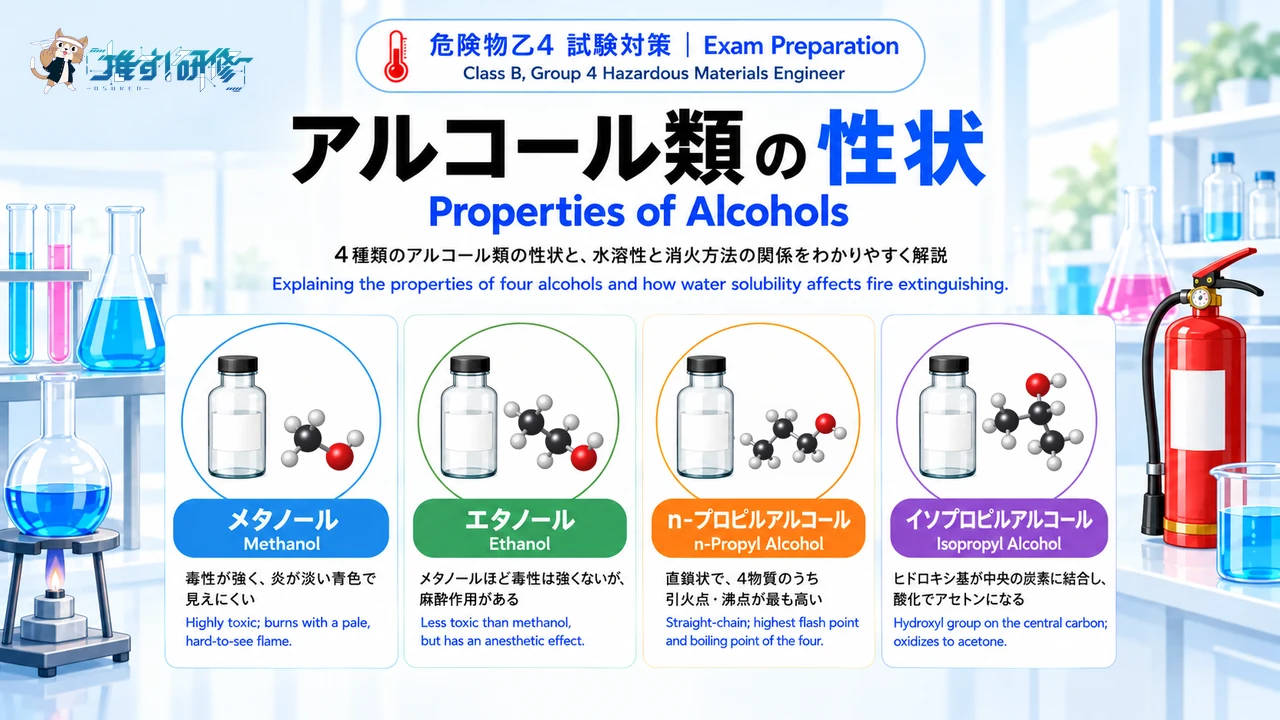
危険物乙4の第4類危険物のうち、法令上の品名「アルコール類」は、メタノールやエタノールなど、炭素原子の数が1〜3個の飽和1価アルコールが対象です。指定数量は400Lで、水に溶ける性質をもつことから消火剤の選択に注意が必要なため、試験対策で押さえておきたい分野です。本記事では、アルコール類の定義と共通する危険性を整理したうえで、代表的な4物質(メタノール・エタノール・n-プロピルアルコール・イソプロピルアルコール)それぞれの性状を、試験対策の観点からわかりやすく解説します。なお、ここで扱うのは法令上の品名としてのアルコール類であり、飲料としての酒類の解説ではありません。
Among the Group 4 hazardous materials covered by the Class B, Group 4 exam, the item named “alcohols” under the Fire Service Act covers saturated monohydric alcohols with one to three carbon atoms, such as methanol and ethanol. Their designated quantity is 400 liters, and because they dissolve in water, the choice of extinguishing agent is an important point to master for the exam. This article organizes the definition and shared hazards of alcohols, then explains the properties of four representative substances — methanol, ethanol, n-propyl alcohol, and isopropyl alcohol — with a focus on exam preparation. Note that this article deals with alcohols as a legal classification of hazardous materials, not with alcoholic beverages.
目次
アルコール類とは What Are “Alcohols” Under the Fire Service Act?
消防法の別表第一では、第4類(引火性液体)の品名の一つとして「アルコール類」が定められています。アルコール類とは、1分子を構成する炭素の原子の数が1個から3個までの飽和1価アルコール(変性アルコールを含む)をいいます。飽和1価アルコールとは、ヒドロキシ基(-OH)を1つもち、炭素どうしが単結合だけでつながったアルコールのことです。この定義に当てはまるのは、炭素数1のメタノール、炭素数2のエタノール、炭素数3のプロパノール(n-プロピルアルコールとイソプロピルアルコールの2種類)です。炭素数が4以上のアルコールは、アルコール類の定義には含まれません(例:1-ブタノールは第二石油類に分類されます)。
Appended Table 1 of the Fire Service Act lists “alcohols” as one of the items of Group 4 (flammable liquids). Alcohols are defined as saturated monohydric alcohols with one to three carbon atoms per molecule (including denatured alcohol). A saturated monohydric alcohol has a single hydroxyl group (-OH), with its carbon atoms joined only by single bonds. The definition of alcohols covers methanol (one carbon), ethanol (two carbons), and propanol (three carbons, in two forms: n-propyl alcohol and isopropyl alcohol). Alcohols with four or more carbon atoms fall outside the definition (for example, 1-butanol is classified as Category 2 Petroleum).
ただし、総務省令(危険物の規制に関する規則)により、飽和1価アルコールの含有量が60重量%未満の水溶液は、アルコール類から除かれます。水で薄められた低濃度のものは、この品名には当たらないということです。水で薄めると、引火点は高くなります。このほかにも、組成と引火点・燃焼点にもとづく除外の定めが同規則にあります。
However, under an Order of the Ministry of Internal Affairs and Communications (the Regulations for the Control of Hazardous Materials), aqueous solutions containing less than 60% by weight of a saturated monohydric alcohol are excluded from alcohols. In other words, a dilute, low-concentration solution does not fall under alcohols. Diluting with water raises the flash point. The same Regulations also set out further exclusions based on composition, flash point, and fire point.
この60%は重量パーセント(質量による割合)であり、容量パーセント(体積による割合)ではありません。
This 60% is percent by weight (a mass-based proportion), not percent by volume.
指定数量は、水溶性・非水溶性の区別がなく一律400Lです。これは、第一石油類の水溶性液体(アセトンなど)と同じ数量です。危険等級はⅡで、第一石油類と同じ危険等級です。
The designated quantity is a uniform 400 liters, with no distinction between water-soluble and non-water-soluble substances. This is the same quantity as for water-soluble liquids in Category 1 Petroleum, such as acetone. The hazard grade is II, the same grade as Category 1 Petroleum.
アルコール類に共通する危険性 Common Hazards Across Alcohols
アルコール類の4物質には、いくつかの共通した性質があります。第一に、引火点がおよそ11〜15℃と低く、常温に近い温度でも、発生した蒸気が空気と混ざって燃焼範囲に入ると、火源があれば引火する危険があります。第二に、蒸気比重がいずれも1より大きく、蒸気は空気より重いため低い場所に滞留しやすくなります。第三に、いずれも水によく溶ける水溶性の液体であり、この性質が泡消火剤の選択に直結します。第四に、強い酸化剤と接触・混合すると、発火や爆発のおそれがあります。また、ナトリウムなどの金属と反応して水素を発生します。これらの性質から、火気を避け、換気のよい場所で、容器を密栓して取り扱うことが基本になります。
The four alcohols share several properties. First, their flash points are low, roughly 11–15°C, so they can ignite even near room temperature if the vapor mixes with air to reach its flammable range and an ignition source is present. Second, their vapor densities are all greater than 1, so the vapor is heavier than air and tends to accumulate in low-lying areas. Third, all of them dissolve readily in water, and this property directly determines which foam extinguishing agent is appropriate. Fourth, contact with or mixing with strong oxidizers can cause ignition or explosion, and they react with metals such as sodium to release hydrogen. For these reasons, the basic rule is to keep them away from open flames, handle them in well-ventilated places, and keep containers tightly sealed.
メタノールの性状 Properties of Methanol
メタノール(CH3OH)は、アルコール類の中で最も単純な構造をもち、毒性が強い物質です。引火点は約11℃、沸点は約64℃、比重は約0.8、蒸気比重は約1.1で、水によく溶けます。誤って飲み込むと失明や死亡に至るおそれがあるほど毒性が強く、この点でエタノールとは大きく異なります。また、燃えるときの炎は淡い青色で見えにくく、明るい場所では火災に気づきにくいことがあります。酸化されるとホルムアルデヒドを経てギ酸になります。
Methanol (CH3OH) is the alcohol with the simplest structure, and a highly toxic substance. Its flash point is about 11°C, its boiling point about 64°C, its specific gravity about 0.8, and its vapor density about 1.1; it dissolves readily in water. It is toxic enough that swallowing it by mistake can cause blindness or death, which sets it clearly apart from ethanol. It also burns with a pale blue flame that is hard to see, so a fire can go unnoticed in a bright place. When oxidized, it becomes formaldehyde and then formic acid.
メタノールは、化学製品をつくる際の原料や、塗料の溶剤などに使われています。毒性が強いため、エタノールの代わりに飲用や消毒に使ってはいけません。
Methanol is used as a raw material for producing chemical products and as a paint solvent, among other uses. Because it is so toxic, it must not be used in place of ethanol for drinking or disinfection.
エタノールの性状 Properties of Ethanol
エタノール(C2H5OH)は、引火点が13℃、沸点が約78℃、比重が約0.8、蒸気比重が約1.6で、水によく溶け、メタノールのような強い毒性はありませんが、麻酔作用をもつ物質です。酸化されるとアセトアルデヒドを経て酢酸になります。また、変性アルコール(工業用アルコールを変性したもの)も、法令上はアルコール類に含まれます。
Ethanol (C2H5OH) has a flash point of 13°C, a boiling point of about 78°C, a specific gravity of about 0.8, and a vapor density of about 1.6. It dissolves readily in water and is not as strongly toxic as methanol, but it has an anesthetic effect. When oxidized, it becomes acetaldehyde and then acetic acid. In addition, “denatured alcohol” — industrial alcohol that has been denatured — is also included in alcohols under the law.
エタノールは、手指や物品の消毒、溶剤などに使われています。第4類危険物であるため、消毒用として大量に保管する場合などは、指定数量を意識した管理が必要になります。ただし、エタノールも無害ではなく、大量に飲んだり蒸気を多く吸い込んだりすると健康を害します。
Ethanol is used to disinfect hands and objects and as a solvent, among other uses. Because it is a Group 4 hazardous material, storing it in large quantities, for example for disinfection, requires management with the designated quantity in mind. Note that ethanol is not harmless either: drinking a large amount or inhaling a lot of its vapor can harm your health.
n-プロピルアルコールの性状 Properties of n-Propyl Alcohol
n-プロピルアルコール(1-プロパノール、C3H7OH)は、炭素原子が3個の直鎖状のプロパノールで、引火点が15℃、沸点が約97℃、比重が約0.8、蒸気比重が約2.1です。無色透明の液体で、水・エタノール・ジエチルエーテルによく溶けます。4物質の中では、引火点が最も高く、沸点も最も高い物質です。
n-Propyl alcohol (1-propanol, C3H7OH) is the straight-chain propanol, with three carbon atoms, a flash point of 15°C, a boiling point of about 97°C, a specific gravity of about 0.8, and a vapor density of about 2.1. It is a colorless, transparent liquid that dissolves readily in water, ethanol, and diethyl ether. Among the four substances, it has the highest flash point and the highest boiling point.
n-プロピルアルコールは、主に溶剤として使われます。炭素数が増えるほど沸点が高くなるという一般的な傾向を、メタノール・エタノール・n-プロピルアルコールの並びで確認しておくとよいでしょう。
n-Propyl alcohol is used mainly as a solvent. It is worth confirming the general trend that boiling points rise as the number of carbon atoms increases, by looking at the sequence of methanol, ethanol, and n-propyl alcohol.
イソプロピルアルコールの性状 Properties of Isopropyl Alcohol
イソプロピルアルコール(2-プロパノール、(CH3)2CHOH)は、n-プロピルアルコールと同じ炭素数3の異性体で、ヒドロキシ基が中央の炭素原子に結合しているのが特徴です。引火点は12℃、沸点は約82℃、比重は約0.8、蒸気比重は約2.1で、水によく溶けます。酸化されるとアセトンになります。
Isopropyl alcohol (2-propanol, (CH3)2CHOH) is an isomer of n-propyl alcohol with the same three carbon atoms, and its hydroxyl group is attached to the central carbon atom. Its flash point is 12°C, its boiling point about 82°C, its specific gravity about 0.8, and its vapor density about 2.1; it dissolves readily in water. When oxidized, it becomes acetone.
イソプロピルアルコールは、溶剤や消毒用などに使われています。同じ炭素数3でも、n-プロピルアルコールより沸点が低い点に注目してください。
Isopropyl alcohol is used as a solvent and for disinfection, among other uses. Note that, even with the same three carbon atoms, its boiling point is lower than that of n-propyl alcohol.
4物質の性状比較表 Comparison Table of the Four Substances
スクロールできます
| 物質名 / Substance | 化学式 / Formula | 炭素数 / Carbon atoms | 引火点 / Flash point | 沸点 / Boiling point | 蒸気比重 / Vapor density | 水溶性 / Water solubility | 特徴 / Notes |
|---|---|---|---|---|---|---|---|
| メタノール Methanol | CH3OH | 1 | 約11℃ | 約64℃ | 約1.1 | 水溶性 / Soluble | 毒性が強い/炎が見えにくい Highly toxic; flame hard to see |
| エタノール Ethanol | C2H5OH | 2 | 13℃ | 約78℃ | 約1.6 | 水溶性 / Soluble | 変性アルコールも含む Includes denatured alcohol |
| n-プロピルアルコール n-Propyl alcohol | C3H7OH | 3 | 15℃ | 約97℃ | 約2.1 | 水溶性 / Soluble | 直鎖状のプロパノール Straight-chain propanol |
| イソプロピルアルコール Isopropyl alcohol | (CH3)2CHOH | 3 | 12℃ | 約82℃ | 約2.1 | 水溶性 / Soluble | 酸化でアセトンになる Oxidizes to acetone |
※引火点は測定方法や資料により数℃程度の差が見られ、沸点も資料により多少異なります。本記事では代表的な値を示しています。4物質すべてが「引火点が低い・蒸気比重が1より大きい・水に溶ける」という共通点をもつことを、あわせて押さえておきましょう。
Note: Flash points differ by a few degrees Celsius depending on the measurement method and the source, and boiling points also vary slightly depending on the source. Representative values are shown in this article. Be sure to also remember what all four substances have in common: low flash points, vapor densities greater than 1, and solubility in water.
消火方法の使い分け Choosing the Right Fire Extinguishing Method
アルコール類の消火で特に重要なのは、水溶性であることです。アルコール類は水に溶けるため、一般の泡消火剤を使うと泡が溶かされて消えてしまい、窒息効果が得られません。このため、泡消火剤を使う場合は、水溶性液体用の泡消火剤(耐アルコール泡)を使用します。二酸化炭素・ハロゲン化物・一部の粉末の消火剤も、窒息効果や燃焼の抑制効果によって有効です。一方、危険物の規制に関する政令の別表第五では、棒状の水を放射する消火器、霧状の水を放射する消火器、棒状の強化液を放射する消火器は、第4類の危険物には適応しないとされています。ただし、水を使う設備がすべて不適というわけではなく、同じ別表第五で、水噴霧消火設備は第4類の危険物に適応します。消火器と消火設備は区別して覚えておきましょう。
A key point in extinguishing alcohol fires is that alcohols are water-soluble. Because alcohols dissolve in water, ordinary foam extinguishing agents are dissolved and broken down, failing to achieve a smothering effect; if foam is used, it must be foam designed for water-soluble liquids (alcohol-resistant foam). Carbon dioxide, halogenated, and certain powder extinguishing agents are also effective, through their smothering and combustion-suppressing effects. On the other hand, Appended Table 5 of the Cabinet Order for the Control of Hazardous Materials states that extinguishers discharging a straight stream of water, extinguishers discharging a fine water spray, and extinguishers discharging a straight stream of strengthened liquid are not suitable for Group 4 hazardous materials. However, this does not mean that every water-based system is unsuitable: in the same table, water spray extinguishing systems are suitable for Group 4 hazardous materials. Be sure to distinguish extinguishers from extinguishing systems.
試験対策のポイント Key Points for Exam Preparation
アルコール類では、定義・指定数量・水溶性と消火の組み合わせを、セットで整理しておくことが得点への近道です。炭素数1〜3の飽和1価アルコールが対象で、含有量60重量%未満の水溶液は除かれる。指定数量は一律400Lで、危険等級はⅡ。4物質はいずれも水溶性のため、泡消火剤は水溶性液体用のものを用いる。このほか、メタノールは毒性が強く、エタノールは毒性が強くないこと、酸化の経路(メタノール→ホルムアルデヒド→ギ酸、エタノール→アセトアルデヒド→酢酸、イソプロピルアルコール→アセトン)、蒸気比重がいずれも1より大きいこと、メタノールの炎が見えにくいことも、あわせて整理しておきたい論点です。
For alcohols, the most direct path to scoring points is to organize the definition, designated quantity, and the link between water solubility and extinguishing as a set. The definition covers saturated monohydric alcohols with one to three carbon atoms, excluding aqueous solutions below 60% by weight. The designated quantity is a uniform 400 liters and the hazard grade is II. All four substances are water-soluble, so if foam is used, it must be foam designed for water-soluble liquids. Also worth organizing are the following points: methanol is highly toxic while ethanol is not strongly toxic; the oxidation pathways (methanol → formaldehyde → formic acid, ethanol → acetaldehyde → acetic acid, isopropyl alcohol → acetone); the vapor densities of all four are greater than 1; and the flame of methanol is hard to see.
まとめ Summary
アルコール類は、定義が明確で、4物質の共通点が多い品名です。水溶性という一つの性質から、泡消火剤の選択までを一本の線でつなげて理解しておくと、試験本番でも落ち着いて判断できます。
Alcohols have a clear definition, and the four substances share many properties. By connecting water solubility to the choice of foam extinguishing agent as one chain of reasoning, you can stay calm and decide confidently on exam day.
練習問題 理解を確認しよう Practice Questions: Test Your Understanding
ここまでの内容を、試験と同じ五肢択一の形式で、3問を確認してみましょう。
Let’s check what you have learned with three five-option multiple-choice questions in the same format as the exam.
問題1 Question 1
アルコール類に関する記述として、正しいものはどれか。
ア 1分子を構成する炭素の原子の数が1個から5個までの飽和1価アルコールをいう。
イ 飽和1価アルコールの含有量が40重量%の水溶液も、アルコール類として扱われる。
ウ 指定数量は400Lで、危険等級はⅡである。
エ 指定数量は、水溶性か非水溶性かによって、200Lと400Lに分かれる。
オ 変性アルコールは、アルコール類に含まれない。
Which of the following statements about alcohols is correct?
A. They are saturated monohydric alcohols with one to five carbon atoms per molecule.
B. An aqueous solution containing 40% by weight of a saturated monohydric alcohol is also treated as an alcohol.
C. The designated quantity is 400 liters, and the hazard grade is II.
D. The designated quantity is either 200 liters or 400 liters, depending on water solubility.
E. Denatured alcohol is not included in alcohols.
解答:ウ
解説:アルコール類は、炭素数1〜3の飽和1価アルコール(変性アルコールを含む)で、含有量60重量%未満の水溶液は除かれる。指定数量は水溶性・非水溶性の区別なく一律400Lで、危険等級はⅡである。
Answer: C
Explanation: Alcohols are saturated monohydric alcohols with one to three carbon atoms (including denatured alcohol), and aqueous solutions below 60% by weight are excluded. The designated quantity is a uniform 400 liters regardless of water solubility, and the hazard grade is II.
問題2 Question 2
アルコール類の性状に関する記述として、誤っているものはどれか。
ア メタノールは毒性が強く、誤って飲み込むと失明のおそれがある。
イ エタノールの蒸気比重は1より大きい。
ウ 水で薄めると、引火点は高くなる。
エ イソプロピルアルコールは、水によく溶ける。
オ n-プロピルアルコールは、水に溶けにくい。
Which of the following statements about the properties of alcohols is incorrect?
A. Methanol is highly toxic, and swallowing it by mistake can cause blindness.
B. The vapor density of ethanol is greater than 1.
C. Diluting an alcohol with water raises its flash point.
D. Isopropyl alcohol dissolves readily in water.
E. n-Propyl alcohol dissolves poorly in water.
解答:オ
解説:n-プロピルアルコールも、他のアルコール類と同様に水によく溶ける。法令上のアルコール類は、いずれも水溶性の液体であり、この点は泡消火剤の選択に直結する。
Answer: E
Explanation: Like the other alcohols, n-propyl alcohol dissolves readily in water. All substances classified as alcohols under the Fire Service Act are water-soluble liquids, a point that directly determines the choice of foam extinguishing agent.
問題3 Question 3
アルコール類の火災の消火に関する記述として、正しいものはどれか。
ア 棒状の水を放射する消火器が、最も適している。
イ 水溶性液体用の泡消火剤は、アルコールに泡が溶けにくいため、使用できる。
ウ 一般の泡消火剤は、アルコールに泡が溶けないため、有効である。
エ 水溶性であるため、どのような泡消火剤も使用できない。
オ 水より比重が大きいので、液面を水で覆って消火する。
Which of the following statements about extinguishing alcohol fires is correct?
A. An extinguisher discharging a straight stream of water is the most suitable.
B. Foam designed for water-soluble liquids can be used because the foam is not easily dissolved by the alcohol.
C. Ordinary foam extinguishing agents are effective because the foam does not dissolve in alcohol.
D. Because alcohols are water-soluble, no type of foam extinguishing agent can be used.
E. Because alcohols are heavier than water, the liquid surface is covered with water to extinguish the fire.
解答:イ
解説:アルコール類は水溶性のため、一般の泡消火剤では泡が溶かされて消えてしまう。泡が溶けにくい水溶性液体用の泡消火剤(耐アルコール泡)であれば使用できる。なお、棒状の水を放射する消火器は第4類の危険物には適応しない。また、アルコール類の比重は約0.8で水より小さく、しかも水によく溶けるため、液面を水で覆っても空気を遮断できず、この方法は用いない。
Answer: B
Explanation: Alcohols are water-soluble, so ordinary foam is dissolved and broken down by them. Foam designed for water-soluble liquids (alcohol-resistant foam), whose foam does not dissolve easily, can be used. Note that extinguishers discharging a straight stream of water are not suitable for Group 4 hazardous materials. Also, the specific gravity of alcohols is about 0.8, lower than that of water, and because they dissolve readily in water, covering the surface with water cannot cut off the air, so this method is not used.
この記事を書いた人

関連記事
-
 危険物乙4|第一石油類の性状を徹底解説【ガソリン・ベンゼン・トルエン・アセトンほか】 Class B, Group 4 Hazardous Materials Engineer | Properties of Category 1 Petroleum: Gasoline, Benzene, Toluene, Acetone, and More Explained
-
危険物乙4|特殊引火物の性状を徹底解説【ジエチルエーテル・二硫化炭素・アセトアルデヒド・酸化プロピレン】 Class B, Group 4 Hazardous Materials Engineer | Properties of Special Flammable Liquids: Diethyl Ether, Carbon Disulfide, Acetaldehyde, and Propylene Oxide Explained
-
危険物乙4|酸と塩基・酸化と還元・金属腐食の基礎知識 Class B, Group 4 Hazardous Materials Engineer | Acids and Bases, Oxidation and Reduction, and Metal Corrosion
-
危険物乙4|単体・化合物・混合物と状態変化の基礎知識 Class B, Group 4 Hazardous Materials Engineer | Simple Substances, Compounds, Mixtures, and Changes of State
-
危険物乙4|保安距離と保有空地の対象施設・数値基準をわかりやすく解説 Class B Group 4 Hazardous Materials Engineer | Safety Distances and Open Space Requirements Explained
-
危険物乙4|免状の交付・書換え・再交付の申請先と手続きをわかりやすく解説 Class B Group 4 Hazardous Materials Engineer | License Issuance, Amendment, Reissuance, and Surrender: Application Authorities and Procedures Explained
-
危険物乙4|熱の移動の基礎知識 伝導・対流・放射 Class B, Group 4 Hazardous Materials Engineer | Heat Transfer Fundamentals: Conduction, Convection, and Radiation
-
危険物乙4|静電気の基礎知識と防止対策 Class B, Group 4 Hazardous Materials Engineer | Static Electricity: Fundamentals and Prevention Measures