ITパスポート試験|プロジェクトマネジメントの基礎知識と計算問題 IT Passport Exam | Project Management: Fundamentals and Calculation Problems
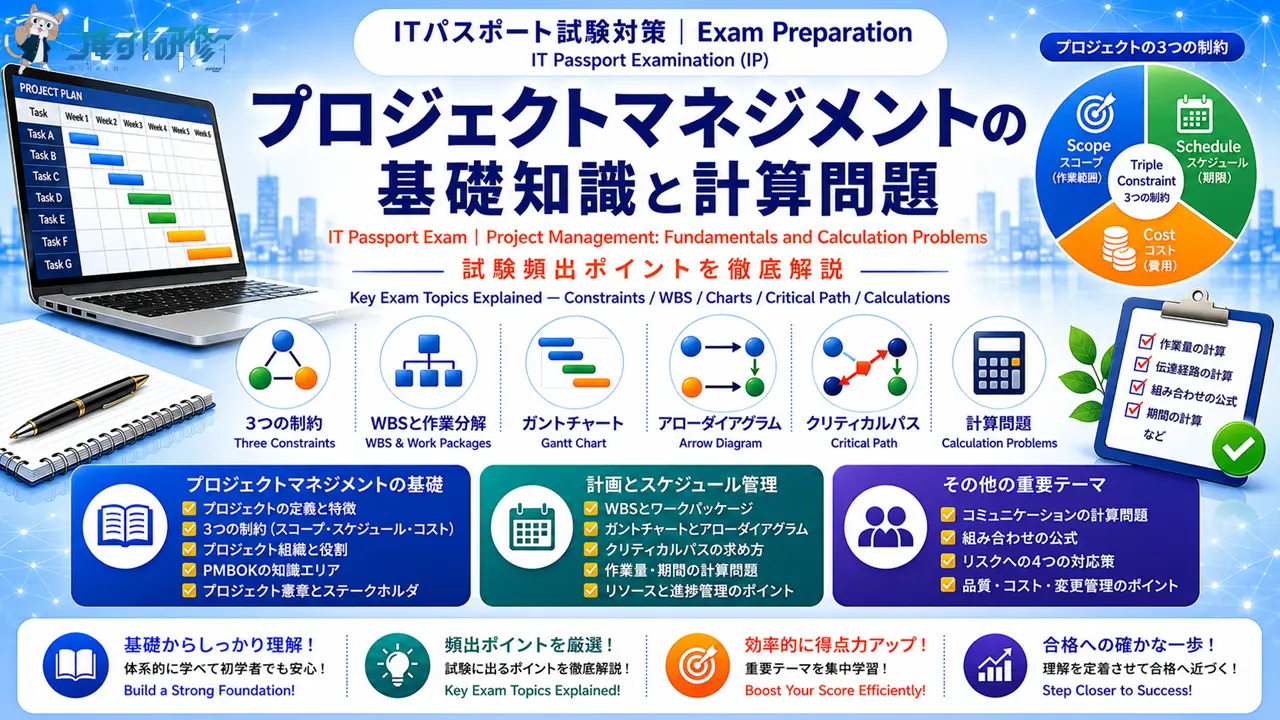
ITパスポート試験の「プロジェクトマネジメント」分野は、マネジメント系の中でも計算問題と用語の定義・比較が繰り返し問われる出題範囲です。プロジェクトの3つの制約・PMBOKの知識エリア・WBS・ガントチャートとアローダイアグラム・クリティカルパスの計算・リスクへの4つの対応策など、扱うテーマは多岐にわたりますが、出題パターンは一定の範囲に絞られています。本記事では、試験頻出ポイントに絞り、日英併記でわかりやすく解説します。
The “Project Management” domain of the IT Passport exam is an area within the management systems section where calculation problems and definitions and comparisons of key terms appear repeatedly. Topics range widely — the three project constraints, the PMBOK knowledge areas, WBS, Gantt charts and arrow diagrams, critical path calculations, and four risk response strategies — but exam question patterns follow a consistent set of themes. This article provides a clear, bilingual explanation focused specifically on the most frequently tested points.
この記事で学べること:プロジェクトの定義と特徴・3つの制約・プロジェクト組織・プロジェクトマネジメントの主な管理対象・プロジェクト憲章・WBSとワークパッケージ・ステークホルダ・ガントチャートとアローダイアグラムの違い・クリティカルパスの求め方・作業量の計算・コミュニケーション伝達経路の計算・組み合わせの公式・リスクへの4つの対応策。公開問題やシラバスで確認できる重要テーマを中心に、試験対策で押さえておきたいポイントを整理しています。
What you’ll learn: the definition and characteristics of a project; the three project constraints; project organizations; key areas of project management; the project charter; WBS and work packages; stakeholders; the differences between Gantt charts and arrow diagrams; how to find the critical path; work-volume calculations; communication channel calculations; the combination formula; and four risk response strategies. This article focuses on key topics confirmed in the official syllabus and published past questions, organizing the points you should understand for exam preparation.
目次
プロジェクトとは What Is a Project?
プロジェクトとは、決められた期限の中で、唯一無二の成果物やサービスを生み出すために行われる一時的な業務のことです。PMBOKでは「独自のプロダクト、サービス、所産を創造するために実施される有期的な業務」と定義されています。ITパスポート試験では、プロジェクトは主にシステム開発の文脈で登場します。
A project is a temporary endeavor undertaken to produce a unique deliverable or service within a defined timeframe. PMBOK defines it as “a temporary endeavor undertaken to create a unique product, service, or result.” In the IT Passport exam, projects most commonly appear in the context of system development.
プロジェクトには次の2つの本質的な特徴があります。
A project has two essential characteristics.
| 特徴 / Characteristic | 説明 / Description |
|---|---|
| 有期性 Temporary nature | 明確な開始日と終了日があり、期限が定められている Has a defined start and end date; operates within a set timeframe |
| 独自性 Uniqueness | 成果物は毎回異なる、一度限りの業務である Each output is different; the work is performed only once |
この2つの特徴を持たない業務はプロジェクトではありません。たとえば、毎年度末に行う会計処理や、毎日繰り返される製品の生産ライン作業は日常業務(定型業務)であり、プロジェクトには該当しません。試験では「これはプロジェクトか、日常業務か」という判断を問う問題が繰り返し出題されます。
Work that lacks these two characteristics is not a project. For example, year-end accounting processes performed every fiscal year, or daily production line operations, are routine (recurring) tasks and do not qualify as projects. The exam repeatedly tests the ability to judge whether a given activity is a project or a routine task.
プロジェクトマネージャとプロジェクト組織 Project Manager and Project Organization
プロジェクトマネージャ(プロマネ)とは、プロジェクト全体の管理を担う責任者です。プロジェクトマネージャが行う仕事をプロジェクトマネジメントといいます。プロジェクトマネジメントの目的は、作業範囲・期限・費用の3つをバランスよく管理しながら、プロジェクトの目的を達成することです。
The project manager is the person responsible for overseeing the entire project. The work performed by a project manager is called project management, whose purpose is to achieve the project’s objectives by managing scope, schedule, and cost in a balanced way.
プロジェクト組織とは、特定の目標を達成するために複数の部署から専門家を集めて一時的に編成された組織のことです。プロジェクトの完了と同時に解散するため、期限のある組織です。プロジェクトマネージャとプロジェクトメンバーをあわせてプロジェクトチームと呼びます。
A project organization is a temporary organizational unit assembled by bringing together specialists from multiple departments to achieve a specific goal. It is dissolved upon project completion and therefore has a defined lifespan. The project manager together with the project members form the project team.
3つの制約 The Three Project Constraints
プロジェクトには、目的を達成するうえで常に意識しなければならない3つの制約があります。
Every project involves three constraints that must be kept in mind throughout the effort to achieve its objectives.
| 制約 / Constraint | 内容 / Description |
|---|---|
| スコープ(作業範囲) Scope (work coverage) | プロジェクトで実施すべき作業と成果物の全体的な範囲 The overall range of work and deliverables to be carried out in the project |
| スケジュール(期限) Schedule (deadline) | プロジェクトの開始から完了までの期間 The timeframe from project start to completion |
| コスト(費用) Cost (budget) | プロジェクト全体にかかる費用・予算 The total expenditure and budget for the project |
この3つの制約は相互に密接に関係しており、一つを変えると他の制約にも影響が及びます。たとえば、顧客からの追加要求によってスコープが拡大した場合、スケジュールを延ばすか、投入人員を増やしてコストを上げるか、いずれかの対応が必要になります。試験では誤答選択肢として「リスク」が紛れ込むことがあるため、3つの制約はスコープ・スケジュール・コストであることをしっかり覚えておきましょう。
These three constraints are closely interrelated: a change to one will affect the others. For example, if scope expands due to a customer’s additional request, the team must either extend the schedule or increase staffing — raising cost. Note that “risk” sometimes appears as a misleading option in exam questions, so be sure to remember that the three constraints are specifically scope, schedule, and cost.
プロジェクトマネジメントの主な管理対象 Key Areas of Project Management
PMBOKの従来の整理では、プロジェクトマネジメントの知識は複数の管理領域(知識エリア)に分類されています。ITパスポート試験では、10の知識エリアの名称を細かく暗記するよりも、各管理対象の役割と代表的な用語を押さえることが重要です。
In the traditional PMBOK framework, project management knowledge is organized into multiple knowledge areas. For the IT Passport exam, it is more important to understand the role of each management area and its key terms than to memorize all ten knowledge area names precisely.
プロジェクト憲章 Project Charter
プロジェクト憲章とは、プロジェクトの目的・目標・スコープ・責任者などを公式に記載した文書です。プロジェクトのスポンサーや発起人が作成し、この文書によってプロジェクトマネージャに公式な権限が与えられます。権限が与えられて初めてプロジェクトマネージャはプロジェクトを正式に管理・運営できるようになります。
In PMBOK, the first step in launching a project is to create a project charter. The project charter is a formal document that records the project’s purpose, objectives, scope, and accountable parties. It is created by the project sponsor or initiator, and it is through this document that the project manager is granted official authority. Only after receiving this authority can the project manager formally manage and direct the project.
PMBOKの主な知識エリア Key PMBOK Knowledge Areas
試験で特に出題頻度が高い知識エリアを以下に整理します。名称と対応する管理内容をセットで覚えておきましょう。
The following knowledge areas are most frequently tested. Memorize each name together with what it manages.
| 知識エリア / Knowledge Area | 主な内容 / Key Focus |
|---|---|
| プロジェクト統合マネジメント Integration Management | 立上げ・計画・実行・監視・終結の5プロセスを統括して管理する Oversees and coordinates the five process groups: initiating, planning, executing, monitoring and controlling, and closing |
| プロジェクトスコープマネジメント Scope Management | プロジェクトで実施すべき作業範囲を明確に定義し管理する Defines and controls what work is and is not included in the project |
| プロジェクトスケジュールマネジメント Schedule Management | プロジェクトが期限内に完了するよう進捗を管理する Manages the timeline to ensure the project is completed on schedule |
| プロジェクトコストマネジメント Cost Management | 費用が予算の範囲内に収まるよう管理する Manages expenditure to keep costs within the approved budget |
| プロジェクト品質マネジメント Quality Management | 成果物が求められる品質基準を満たすことを確認する。品質評価の指標としてテストカバー率などが用いられる Confirms that deliverables meet required quality standards; metrics such as test coverage rate are used for quality evaluation |
| プロジェクト資源マネジメント Resource Management | プロジェクトに必要な人的・物的資源を調達・管理する Acquires and manages the human and physical resources needed for the project |
| プロジェクトコミュニケーションマネジメント Communications Management | 誰が、誰に、いつ、どのような手段で、何を伝えるかを計画・管理する Plans and manages who communicates what to whom, when, and by what means |
| プロジェクトリスクマネジメント Risk Management | リスクを識別・評価し、対応策を計画・実施する Identifies and evaluates risks, and plans and implements response strategies |
| プロジェクト調達マネジメント Procurement Management | プロジェクト遂行に必要な外部からの物品・サービスの購買・契約を管理する Manages purchasing and contracting for goods and services needed from outside the project |
| プロジェクトステークホルダマネジメント Stakeholder Management | プロジェクトの利害関係者を特定し、効果的に関与できるよう調整する Identifies stakeholders and ensures they can engage with the project effectively |
WBSとステークホルダ WBS and Stakeholders
WBSは、作業を見積もり・管理できる単位まで階層的に分解したものです。最小単位をワークパッケージといいます。実務上は1人または少人数で管理しやすい大きさに分けることが多く、8〜80時間程度を目安とする考え方もあります。
A WBS breaks down work into units that can be reliably estimated and managed. The smallest unit is called a work package. In practice, work packages are often sized so that one person or a small team can manage them comfortably; one common guideline is roughly 8 to 80 hours.
ステークホルダ(利害関係者)とは、プロジェクトの進行や結果によって何らかの利益または損害を受ける可能性のある、すべての個人・組織のことです。プロジェクトチームの内外を問わず、また関与が間接的であっても利害関係があればステークホルダに含まれます。経営者・チームメンバー・取引先・株主・地域住民などが代表例です。
Stakeholders are all individuals and organizations that may experience some benefit or harm as a result of the project’s progress or outcomes. Stakeholders include those inside and outside the project team, and even those with only indirect involvement are considered stakeholders if they have an interest in the project. Typical examples include executives, team members, business partners, shareholders, and local community members.
スケジュールマネジメントの2つの図 Two Key Tools for Schedule Management
プロジェクトスケジュールマネジメントでは、進捗状況を定量的に把握・管理するために次の2種類の図が使われます。試験ではそれぞれの特徴と使い分けが問われます。
In project schedule management, two types of diagrams are used to quantitatively monitor and control progress. The exam tests the characteristics of each and how to choose between them.
| 図の種類 / Diagram Type | 特徴 / Characteristics | 主な用途 / Primary Use |
|---|---|---|
| ガントチャート Gantt chart | 横軸に時間、縦軸にタスクを置き、各タスクの所要期間を横棒で表す。予定と実績を並べて記入できる Time on the horizontal axis, tasks on the vertical axis; duration shown as horizontal bars. Planned and actual progress can be recorded side by side | 進捗状況の視覚的な把握・報告 Visual monitoring and reporting of progress |
| アローダイアグラム Arrow diagram | 作業の流れを矢印と結合点で表したネットワーク図。作業間の依存関係を表現でき、最長経路(クリティカルパス)を特定できる A network diagram showing workflow using arrows and nodes. Can represent dependencies between tasks and identify the longest path (critical path) | 作業の依存関係の整理とクリティカルパスの特定 Organizing task dependencies and identifying the critical path |
アローダイアグラムを使ったプロジェクトの分析手法をPERT(Program Evaluation and Review Technique)と呼びます。アローダイアグラムでは矢印の上に作業名、下に所要日数を記載します。また、所要日数がゼロの仮想の作業をダミー作業といい、作業間の依存関係を表すために点線の矢印で示します。
The project analysis technique that uses arrow diagrams is called PERT (Program Evaluation and Review Technique). In an arrow diagram, the task name is written above the arrow and the required duration below it. A virtual task with zero duration is called a dummy activity and is shown as a dashed arrow to express dependency relationships between tasks.
クリティカルパスの求め方 How to Find the Critical Path
クリティカルパスとは、アローダイアグラム上で開始から終了までの経路のうち、合計所要時間が最も長い経路のことです。計算上は、余裕時間(フロート)がゼロとなる作業をつないで確認します。
The critical path is the path from start to finish in an arrow diagram that has the longest total duration. In calculation, it is confirmed by connecting the tasks whose float (slack) is zero. Any delay in a task on the critical path will delay the entire project. The exam includes calculation questions asking you to identify the critical path and determine the float at each node.
クリティカルパスを求める手順は以下のとおりです。
The procedure for finding the critical path is as follows.
- 各結合点への最早到達時間を求める:始点から順に、その結合点に到達できる最も早い時刻を計算する。複数の経路がある場合は最大値を採用する
Calculate the earliest arrival time at each node: Working forward from the start, calculate the earliest time each node can be reached. When multiple paths converge, take the maximum value - プロジェクト全体の最短完了日数を確認する:終点の最早到達時間がプロジェクト全体の最短完了日数となる
Confirm the shortest completion time for the project: The earliest arrival time at the end node equals the minimum project duration - クリティカルパスを特定する:開始から終了までの経路のうち、合計所要時間が最も長い経路を確認する。必要に応じて、余裕時間がゼロとなる作業をつないで確認する
Identify the critical path: Identify the path from start to finish with the longest total duration; if needed, confirm it by connecting tasks whose float is zero
資源マネジメントとコミュニケーションマネジメント Resource Management and Communications Management
作業量の計算 Calculating Work Volume
プロジェクト資源マネジメントでは、試験で作業量・作業日数・必要人数を計算する問題が出題されます。計算の基本単位は人日(にんにち)で、「1人が1日かけて行う作業量」を表します。重要な注意点は、メンバーによって作業効率が異なる場合、効率の差を考慮して計算する必要があることです。
In project resource management, the exam includes questions that require calculating work volume, working days, or required headcount. The basic unit is the person-day, representing the amount of work one person can complete in one day. An important point to remember is that when team members have different levels of productivity, the calculation must account for those differences.
伝達経路の計算と組み合わせの公式 Calculating Communication Channels and the Combination Formula
プロジェクトコミュニケーションマネジメントでは、1対1の情報伝達を行う場合の伝達経路の数を求める計算問題が出題されます。メンバーが増えると伝達経路が急増し、コミュニケーション効率が下がることを示すために出題されます。
In project communications management, the exam includes calculations asking for the number of one-to-one communication channels. These questions illustrate how rapidly channels multiply as team size grows, reducing communication efficiency.
伝達経路の数は、n人のメンバーから2人を選び出す組み合わせの数と同じです。組み合わせの公式を使って求めます。
The number of communication channels equals the number of ways to choose 2 people from n members — calculated using the combination formula.
組み合わせの公式 / Combination Formula:
nCr = n! ÷ {r! × (n-r)!}
例:メンバーが5人の場合の伝達経路の数
Example: Number of communication channels for 5 members
5C2 = 5! ÷ {2! × (5-2)!} = (5×4×3×2×1) ÷ {(2×1) × (3×2×1)} = 120 ÷ 12 = 10通り / 10 channels
| メンバー数 / Members | 伝達経路の数 / Channels |
|---|---|
| 2人 | 1 |
| 3人 | 3 |
| 4人 | 6 |
| 5人 | 10 |
| 6人 | 15 |
| 7人 | 21 |
なお、伝達経路の数は次の簡略式でも素早く求められます。
The number of communication channels can also be calculated quickly using this simplified formula.
伝達経路の数 = n × (n − 1) ÷ 2
Number of channels = n × (n − 1) ÷ 2
例:5人の場合 → 5 × 4 ÷ 2 = 10 / Example: 5 members → 5 × 4 ÷ 2 = 10
組み合わせでは選び出す順番を区別しません(AさんとBさん=BさんとAさん)。なお、階乗(n!)とは、1からnまでの整数をすべて掛け合わせた値です(例:5!=5×4×3×2×1=120)。
Combinations do not distinguish order (A and B is the same as B and A). Factorial (n!) is the product of all integers from 1 to n (e.g., 5! = 5×4×3×2×1 = 120).
リスクマネジメントの4つの対応策 Four Risk Response Strategies
プロジェクトリスクマネジメントでは、識別したリスクに対して事前に対応策を計画します。対応策は次の4種類に分類されます。試験では各対応策の名称と定義の対応が問われます。
In project risk management, response strategies are planned in advance for identified risks. Responses fall into the following four categories. The exam tests matching the name of each strategy with its definition.
| 対応策 / Strategy | 内容 / Description | 一言表現 / In Short |
|---|---|---|
| リスク回避 Risk avoidance | リスクを引き起こす可能性のある作業自体を取りやめ、リスクが発生する状況を根本から排除する Eliminates the risk entirely by discontinuing the activity that could cause it | リスクを取らない Don’t take the risk |
| リスク転嫁 Risk transfer | 保険の加入や業務の外部委託などにより、リスクの影響を自社から他者へ移す Shifts the impact of the risk to another party through insurance or outsourcing | 他者にリスクを移す Transfer the risk |
| リスク軽減 Risk mitigation | リスクが発生する確率を下げる、または発生した際の損害を小さくするための対策を講じる Takes measures to reduce the likelihood of the risk occurring or to minimize the damage if it does | リスクを小さくする Reduce the risk |
| リスク受容 Risk acceptance | リスクに対して積極的な対策を講じず、発生した場合はその影響をそのまま受け入れる。対策コストが想定損害額を上回る場合に選択されることがある Takes no active countermeasure and accepts any impact if the risk occurs; may be chosen when the cost of mitigation exceeds the expected loss | 影響を受け入れる Accept the impact |
試験直前チェック Key Points to Remember
プロジェクトマネジメント分野の重要ポイントをまとめます。
Here is a summary of the key points for the Project Management domain.
- プロジェクトの2つの特徴 有期性(期限がある)と独自性(一回限りの成果物)。定型業務・繰り返し業務はプロジェクトではない
Two characteristics of a project — Temporary nature (defined timeframe) and uniqueness (one-time deliverable). Routine or recurring work is not a project - 3つの制約はスコープ・スケジュール・コスト 「リスク」は3つの制約ではない。3つは相互に影響し合う
The three constraints are scope, schedule, and cost — “Risk” is not one of the three constraints. All three influence each other - PMBOKは10の知識エリア 特に出題頻度が高いのはスコープ・スケジュール・コスト・品質・資源・コミュニケーション・リスク・ステークホルダの各マネジメント
PMBOK has ten knowledge areas — The most frequently tested are scope, schedule, cost, quality, resource, communications, risk, and stakeholder management - WBSの最小単位はワークパッケージ 8〜80時間程度で完了できる作業の大きさが目安
The smallest WBS unit is the work package — Sized to be completable in roughly 8 to 80 hours - ガントチャートとアローダイアグラムの違い ガントチャート=進捗の視覚化(依存関係の表現は不向き)、アローダイアグラム=作業の依存関係とクリティカルパスの特定
Gantt chart vs. arrow diagram — Gantt chart: visualizes progress (not suited for expressing dependencies); arrow diagram: shows task dependencies and identifies the critical path - クリティカルパスは最も時間のかかる経路 この経路上の遅れはプロジェクト全体の遅延に直結する
The critical path is the longest path — Delays on this path directly delay the entire project - 伝達経路の数はnC2で求める 5人→10経路、6人→15経路。組み合わせでは順番を区別しない
Communication channels = nC2 — 5 members → 10 channels; 6 members → 15 channels. Combinations do not distinguish order - リスクへの4つの対応策 回避(取らない)・転嫁(移す)・軽減(小さくする)・受容(影響を受け入れる)
Four risk response strategies — Avoidance (don’t take it), transfer (shift it), mitigation (reduce it), acceptance (accept the impact)
練習問題で理解を確認しよう Practice Questions
ここまでの内容を試験形式で確認しましょう。解答と解説は各問題の直下に記載しています。
Let’s test what you’ve learned with some exam-style practice questions. The answer and explanation for each question appear directly below it.
本練習問題3問は、独立行政法人情報処理推進機構(IPA)公開 ITパスポート試験 公式公開過去問題(プロジェクトマネジメント分野)より引用しています(第1問=令和6年度 問36、第2問=令和6年度 問41、第3問=令和6年度 問52)。
All three practice questions are taken from the IT Passport Examination — Official Published Past Questions, Project Management Domain, published by the Information-technology Promotion Agency, Japan (IPA) (Question 1 = Reiwa 6 (2024) Item 36, Question 2 = Reiwa 6 (2024) Item 41, Question 3 = Reiwa 6 (2024) Item 52).
第1問(令和6年度 問36) Question 1 (Reiwa 6, Item 36)
プロジェクトに該当する事例として、適切なものだけを全て挙げたものはどれか。
Which of the following correctly lists all examples that qualify as a project?
- a 会社合併に伴う新組織への移行
Transitioning to a new organizational structure following a company merger - b 社内システムの問合せや不具合を受け付けるサービスデスクの運用
Operating a service desk that handles inquiries and issues related to internal systems - c 新規の経理システム導入に向けたプログラム開発
Developing a program for the introduction of a new accounting system - d 毎年度末に実施する会計処理
Accounting processing conducted at the end of every fiscal year
- ア a, c
- イ b, c
- ウ b, d
- エ c
解答:ア(a, c) / Answer: ア (a, c)
プロジェクトの判断基準は「有期性(期限がある)」と「独自性(一回限りの業務)」の2点です。aの会社合併に伴う新組織への移行は、合併という一度限りのイベントに際して複数部署の専門家が協力して行う有期的な業務であり、プロジェクトに該当します。cの新規経理システム導入に向けたプログラム開発は、その企業固有のシステムを一から構築する独自性の高い業務であり、完了とともに終了する有期性もあるためプロジェクトに該当します。一方、bのサービスデスクの運用は毎日継続的に発生する日常業務であり、プロジェクトには該当しません。dの毎年度末の会計処理は毎年同じ内容を繰り返す定型業務であり、独自性がないためプロジェクトには該当しません。したがって正解はア(a, c)です。
The criteria for classifying something as a project are two: temporary nature (a defined timeframe) and uniqueness (performed only once). Event a — transitioning to a new organizational structure following a merger — is a time-limited activity requiring specialists from multiple departments to collaborate for a once-only corporate event, and qualifies as a project. Event c — developing a program for a new accounting system — involves building a system unique to the company from scratch and ends upon completion; it satisfies both criteria. Event b — operating a service desk — is an ongoing daily task with no defined end, so it is not a project. Event d — year-end accounting processing — is a recurring routine task performed the same way every year and lacks uniqueness, so it is also not a project. The correct answer is therefore ア (a, c).
第2問(令和6年度 問41) Question 2 (Reiwa 6, Item 41)
あるプロジェクトの作業間の関係と所要時間がアローダイアグラムで示されている。このアローダイアグラムのBからEの四つの結合点のうち、工程全体の完了時間に影響を与えることなく、その結合点から始まる全ての作業の開始を最も遅らせることができるものはどれか。ここで、各結合点から始まる作業はその結合点に至る作業が全て完了するまで開始できず、作業から次の作業への段取り時間は考えないものとする。
An arrow diagram shows the relationships and durations of tasks in a project. Of the four nodes B through E in this arrow diagram, which node allows the greatest delay in the start of all tasks beginning at that node without affecting the overall project completion time? Each task cannot begin until all tasks leading to its starting node are complete, and no setup time between tasks is considered.
【アローダイアグラムの作業関係表 / Arrow Diagram Task Relationship Table】
| 作業 / Task | 所要時間(日)/ Duration (days) |
|---|---|
| A → B | 15 |
| A → C | 10 |
| B → D | 10 |
| B → E(直接)/ B → E (direct) | 25 |
| C → E | 15 |
| D → E | 10 |
| D → F | 20 |
| E → F | 15 |
- ア B
- イ C
- ウ D
- エ E
解答:イ(C) / Answer: イ (C)
まず各結合点への最早到達時間を求めます。AはAから0日。BはAから15日後で15日。CはAから10日後で10日。DはBから10日後で15+10=25日。Eには3つの経路(D経由:25+10=35日、B経由:15+25=40日、C経由:10+15=25日)があり、最大の40日が最早到達時間。Fには2つの経路(D経由:25+20=45日、E経由:40+15=55日)があり、最大の55日が最早到達時間です。よってプロジェクトは最短55日で完了します。クリティカルパスはA→B→E→Fで、B・Eには余裕がありません。各結合点の余裕を求めると、Cへの最遅到達時間はEへの最遅到達時間(40日)からC→Eの15日を引いた25日であり、最早到達時間10日との差は15日の余裕があります。Dへの最遅到達時間はFへの完了時間55日からD→Fの20日を引いた35日であり、最早到達時間25日との差は10日の余裕です。最も余裕が大きいのはCの15日なので、正解はイ(C)です。
First, calculate the earliest arrival time at each node. A = 0. B = 0 + 15 = 15. C = 0 + 10 = 10. D = 15 + 10 = 25. E has three incoming paths (via D: 25+10=35; via B: 15+25=40; via C: 10+15=25), so the earliest arrival is the maximum: 40. F has two paths (via D: 25+20=45; via E: 40+15=55), so the earliest arrival is 55. The project therefore completes in a minimum of 55 days. The critical path is A→B→E→F, leaving no float at B or E. For C: the latest arrival time is the latest arrival at E (40) minus C→E (15) = 25; float = 25 − 10 = 15 days. For D: the latest arrival time is 55 − 20 = 35; float = 35 − 25 = 10 days. C has the greatest float (15 days), so the answer is イ (C).
第3問(令和6年度 問52) Question 3 (Reiwa 6, Item 52)
システム開発プロジェクトにおいて、新機能の追加要求が変更管理委員会で認可された後にプロジェクトスコープマネジメントで実施する活動として、適切なものはどれか。
In a system development project, after an additional feature request has been approved by the change control board, which of the following is an appropriate activity to carry out within project scope management?
- ア 新機能を追加で開発するためにWBSを変更し、コストの詳細な見積りをするための情報として提供する。
Revise the WBS to accommodate additional development of the new feature and provide it as information for detailed cost estimation. - イ 新機能を追加で開発するためのWBSのアクティビティの実行に必要なスキルを確認し、必要に応じてプロジェクトチームの能力向上を図る。
Identify the skills needed to execute the WBS activities for the additional feature development and, if necessary, enhance the capabilities of the project team. - ウ 変更されたWBSに基づいてスケジュールを作成し、完了時期の見通しを提示する。
Create a schedule based on the revised WBS and present an outlook for the project completion date. - エ 変更されたWBSに基づいて要員の充足度を確認し、必要な場合は作業の外注を検討する。
Assess staffing adequacy based on the revised WBS and, if necessary, consider outsourcing some of the work.
解答:ア / Answer: ア
プロジェクトスコープマネジメントとは、プロジェクトで実施すべき作業範囲(スコープ)を定義・管理するための活動領域です。新機能の追加が認可された場合にスコープマネジメントの観点でまず行うべきことは、変更内容を反映するためにWBSを更新し、作業の範囲を明確に再定義することです。その更新されたWBSを、コスト見積もりなど他の管理活動の入力情報として提供する流れが正しい手順です。したがって正解はアです。選択肢イは、WBSのアクティビティ実行に必要なスキル確認と人材育成を行う活動であり、スコープマネジメントではなくプロジェクト資源マネジメントの活動です。選択肢ウは、WBSに基づいてスケジュールを作成し完了見通しを示す活動であり、プロジェクトスケジュールマネジメントの活動です。選択肢エは、WBSを基に要員充足度を確認して外注を検討する活動であり、プロジェクト資源マネジメントまたはプロジェクト調達マネジメントの活動です。
Project scope management is the knowledge area focused on defining and controlling the scope — the range of work to be performed in the project. When additional features are approved, the first action under scope management is to update the WBS to reflect the change and clearly redefine the work scope. The revised WBS is then provided as input to other management activities such as cost estimation. The correct answer is therefore ア. Option イ — identifying the skills needed for WBS activities and developing team capabilities — is an activity under project resource management, not scope management. Option ウ — creating a schedule based on the WBS and presenting a completion outlook — is an activity under project schedule management. Option エ — assessing staffing adequacy based on the WBS and considering outsourcing — falls under project resource management or project procurement management.
- QC3|プロセス保証・方針管理・日常管理の基礎知識をわかりやすく解説 QC3 | Process Assurance, Policy Management, and Daily Management Explained
- 日商簿記検定3級|貸付金・借入金の仕訳と利息計算 Nissho Bookkeeping Level 3 | Loans Receivable and Loans Payable: Journal Entries and Interest Calculations
この記事を書いた人

関連記事
-
 ITパスポート試験の難易度は?合格率・合格基準・勉強時間を徹底解説 IT Passport Exam Difficulty: Pass Rates, Passing Criteria, and Study Time Explained
 -
ITパスポート試験|データベースの基礎知識と頻出問題 IT Passport Exam | Database: Fundamentals and Frequently Tested Topics
-
ITパスポート試験|法務の基礎知識 IT Passport Exam | Legal Affairs: Fundamentals and Key Concepts
-
ITパスポート試験|サービスマネジメントの基礎知識 IT Passport Exam | Service Management: Fundamentals and Key Concepts
-
ITパスポート試験|開発技術の基礎知識とソフトウェア開発モデル IT Passport Exam | Development Technology: Fundamentals and Software Development Models
-
ITパスポート試験|情報セキュリティの基礎知識と対策 IT Passport Exam | Information Security: Fundamentals and Security Measures