ITパスポート試験|法務の基礎知識 IT Passport Exam | Legal Affairs: Fundamentals and Key Concepts
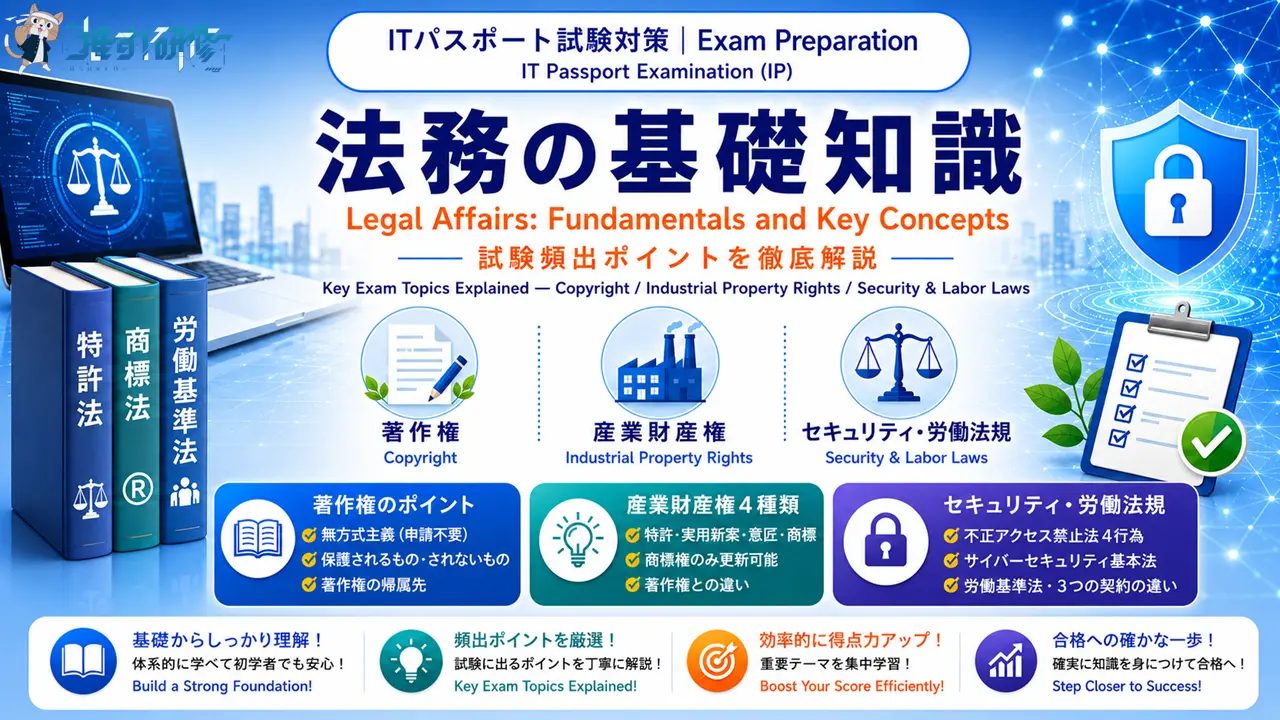
ITパスポート試験の「法務」分野は、著作権・産業財産権・セキュリティ関連法規・労働関連法規など、幅広い法律の知識が問われる出題範囲です。扱うテーマは多岐にわたりますが、試験で繰り返し問われるのはキーワードの定義と概念の比較に絞られています。各テーマを体系的に整理すれば、確実に得点できる分野です。本記事では、ITパスポート試験の法務分野に必要な知識を試験頻出ポイントに絞り、日英併記でわかりやすく解説します。
The “Legal Affairs” domain of the IT Passport exam covers a broad range of legal knowledge, including copyright, industrial property rights, security-related legislation, and labor-related legislation. Despite the wide scope, the exam repeatedly focuses on definitions of key terms and comparisons between related concepts. Organize each topic systematically and this becomes a domain where you can score reliably. This article provides a clear, bilingual explanation of the Legal Affairs domain, focused specifically on the points most frequently tested.
この記事で学べること:知的財産権の3分類・著作権の定義と無方式主義・著作権で保護されるもの・されないもの・産業財産権4種類の比較・著作権と産業財産権の違い・営業秘密と不正競争防止法・サイバーセキュリティ基本法・不正アクセス禁止法の対象行為・労働基準法・3つの契約の違い・著作権の帰属先。すべて試験頻出ポイントに絞っています。
What you’ll learn: the three categories of intellectual property rights; the definition of copyright and the no-formality principle; what copyright does and does not protect; a comparison of the four types of industrial property rights; the differences between copyright and industrial property rights; trade secrets and the Unfair Competition Prevention Act; the Cybersecurity Basic Act; the acts prohibited by the Unauthorized Computer Access Act; the Labor Standards Act; the differences among the three types of contract; and where copyright ownership resides. Every point is selected specifically because it appears on the exam.
目次
知的財産権の全体像 Overview of Intellectual Property Rights
知的財産とは、人の知的活動によって生み出された発明・デザイン・著作物などの創造物のことです。こうした形のない財産を法律によって保護する権利が知的財産権です。知的財産権は大きく①著作権・②産業財産権・③その他の権利の3つに分類されます。試験では「どの権利がどの分類に属するか」を問う問題が出題されるため、この3分類の構造を正確に把握しておくことが重要です。
Intellectual property refers to creations produced through human intellectual activity — inventions, designs, works of authorship, and the like. The legal rights that protect these intangible assets are known as intellectual property rights. These rights are broadly divided into three categories: ① copyright, ② industrial property rights, and ③ other rights. The exam tests which rights belong to which category, so it is important to understand this three-part structure accurately.
著作権とは What Is Copyright?
著作権とは、著作物を創作した者(著作者)に与えられる権利です。著作権の最大の特徴は無方式主義であり、役所や特許庁への申請・登録を一切行わなくても、著作物を創作した瞬間に自動的に権利が発生する点です。試験では「著作権はいつ発生するか」という問いに対し、「著作物を創作した時点で発生する」が正解となります。
Copyright is the right granted to the person who creates a work (the author). The defining feature of copyright is the no-formality principle: rights arise automatically at the moment of creation, with no application or registration at any government office or patent office required. On the exam, the question “when does copyright arise?” is correctly answered with “at the moment the work is created.”
著作権で保護されるもの・されないもの What Copyright Protects and What It Does Not
著作権法によって保護される著作物は多岐にわたります。試験頻出の保護対象は以下の8つです。なお、プログラム・データベース・取扱説明書も著作権の保護対象であることは特に注意が必要です。ITに関わる創作物にも著作権が及ぶ点が、試験で繰り返し問われます。
Copyright protects a wide range of works. The following eight types are the most frequently tested. Of particular note is that programs, databases, and instruction manuals are also protected by copyright. The fact that copyright extends to IT-related creations is a point the exam tests repeatedly.
| 著作権の保護対象 / Works Protected by Copyright |
|---|
| プログラム(コンピュータソフトウェア) Programs (computer software) |
| データベース Databases |
| 取扱説明書・マニュアル類 Instruction manuals and other documentation |
| 本・小説・論文などの言語著作物 Books, novels, papers, and other literary works |
| 音楽(楽曲・歌詞) Music (compositions and lyrics) |
| 写真・映像 Photographs and video |
| 絵画・彫刻などの美術作品 Artworks including paintings and sculptures |
| 建築物(建築の著作物) Buildings and architectural works |
一方、以下の3つは著作権法によって保護されません。試験では「著作権で保護されないもの」として選択肢に登場するため、確実に覚えておく必要があります。
The following three items, on the other hand, are not protected by copyright law. They appear as answer choices in questions about “what is not protected by copyright,” so it is essential to memorize them.
| 著作権で保護されないもの / Not Protected by Copyright | 説明 / Description |
|---|---|
| アルゴリズム Algorithms | ある問題を解くための処理手順・論理的なステップの組み合わせ A logical sequence of steps for solving a given problem |
| プロトコル Protocols | コンピュータ間の通信を成立させるための規格・取り決め Standardized rules and conventions that enable communication between computers |
| プログラム言語 Programming languages | コンピュータへの命令を記述するために用いる言語体系そのもの The language system itself used to write instructions for a computer |
アルゴリズム・プロトコル・プログラム言語はあくまでも「論理・規格・道具」であり、それ自体は著作権で保護されません。一方、これらを用いて実際に作成されたプログラム(コンピュータソフトウェア)は著作物として保護されます。試験では「プログラム言語は保護されないが、プログラムは保護される」という対比が問われる場合があります。
Algorithms, protocols, and programming languages are merely logical procedures, standards, and tools — they themselves receive no copyright protection. By contrast, the actual programs (computer software) created using them are protected as works of authorship. The exam may test the contrast that “programming languages are not protected, but programs themselves are.”
産業財産権の4種類 Four Types of Industrial Property Rights
産業財産権とは、発明・デザイン・ブランドなどを保護し、産業の発展を促進するための権利です。著作権とは異なり、特許庁への申請と審査・登録が必要です。産業財産権には以下の4種類があります。
Industrial property rights are rights that protect inventions, designs, and brands in order to promote industrial development. Unlike copyright, they require an application to and examination and registration by the Japan Patent Office (JPO). There are four types of industrial property rights.
| 種類 / Type | 保護対象 / What It Protects | 特記事項 / Key Notes |
|---|---|---|
| 商標権 Trademark right | 商品・サービスを識別するマーク・ブランド名 Marks and brand names that identify goods or services | 唯一、更新手続きにより有効期限を延長できる The only industrial property right whose term can be extended by renewal |
| 特許権 Patent right | 高度な発明(技術的アイデア) Highly advanced inventions (technical ideas) | 高度な発明のみ対象。審査が厳格 Only highly advanced inventions qualify; examination is strict |
| 意匠権 Design right | 物品の外観デザイン The external design/appearance of a product | 機能ではなく見た目(デザイン)を保護 Protects appearance, not function |
| 実用新案権 Utility model right | 物品の形状・構造・組み合わせに関する考案 Ideas relating to the shape, structure, or combination of a product | 実体審査なしで登録。特許より取得しやすい Registered without substantive examination; easier to obtain than patents |
商標権のみが有効期限を更新できる点は試験頻出事項です。他の産業財産権は一定の有効期限があり、期限が切れると誰でも利用できるようになります。商標権が更新可能とされているのは、消費者が長期にわたり商品名やマークを頼りに購買判断を行う実態があり、その信頼関係を継続的に保護する必要があるためです。
The fact that only trademark rights can be renewed is a frequently tested point. Other industrial property rights have fixed terms, after which the protected subject matter may be freely used by anyone. Trademark rights are renewable because consumers rely on brand names and marks over long periods when making purchasing decisions, creating a need for ongoing protection of that trust relationship.
著作権と産業財産権の違い Key Differences Between Copyright and Industrial Property Rights
試験では著作権と産業財産権の違いが問われます。特に申請の要否と主な対象者の違いを正確に把握しておくことが重要です。
The exam tests the differences between copyright and industrial property rights. It is particularly important to understand whether registration is required and who the primary rights holders are.
| 比較項目 / Comparison | 著作権 / Copyright | 産業財産権 / Industrial Property Rights |
|---|---|---|
| 申請の要否 / Registration | 不要(無方式主義) Not required (no-formality principle) | 必要 Required |
| 権利の発生 / When rights arise | 創作した時点で自動発生 Automatically upon creation | 申請・審査・登録後 After application, examination, and registration |
| 主な対象者 / Primary holders | 主に個人(文化・芸術分野) Primarily individuals (culture and the arts) | 主に企業(産業・ビジネス分野) Primarily companies (industry and business) |
| 管轄 / Administering body | 文化庁 Agency for Cultural Affairs | 特許庁 Japan Patent Office |
その他の権利と不正競争防止法 Other Rights and the Unfair Competition Prevention Act
営業秘密と不正競争防止法 Trade Secrets and the Unfair Competition Prevention Act
知的財産権の中には著作権・産業財産権に分類されないものもあります。その代表が営業秘密です。営業秘密とは、企業が秘密として管理している、ビジネス上で有用な情報のことです。営業秘密として認められるためには、以下の3つの条件をすべて満たす必要があります。
Some intellectual property does not fall under copyright or industrial property rights. The most notable example is trade secrets. A trade secret is information managed as confidential by a company that has business utility. For information to qualify as a trade secret, all three of the following conditions must be met.
| 条件 / Condition | 内容 / Description |
|---|---|
| 有用性 Utility | 事業活動において実際に役立てられる情報であること Information that is genuinely useful in business operations |
| 非公知性 Non-public nature | 社外に広く知られておらず、容易に入手できない情報であること Information not widely known outside the organization and not readily obtainable |
| 秘密管理性 Confidentiality management | 社内規程や機密保持契約などによって、秘密として適切に管理されていること Appropriately managed as confidential through internal rules or non-disclosure agreements |
こうした営業秘密を守るための法律が不正競争防止法です。不正競争防止法は、事業者間の公正な競争秩序を維持し、不正な競業行為を規制するための法律です。試験では、不正競争防止法によって禁止されている行為として、競合他社の営業秘密の無断取得・複製防止技術を回避する手段の提供・他の事業者の商品等表示と類似するドメイン名の不正登録などが出題されます。なお、違法行為に関する記録(脱税や不正取引の情報など)は、法律上保護すべき正当な事業活動に基づくものではないため有用性の要件を満たさず、営業秘密とは認められません。
The law that protects trade secrets is the Unfair Competition Prevention Act, which is designed to maintain fair competition among businesses and regulate unfair competitive practices. Exam questions on acts prohibited by this law include: unauthorized acquisition of a competitor’s trade secrets, provision of tools that circumvent copy-protection technology, and fraudulent registration of domain names resembling other businesses’ product names or identifiers. Note that records relating to illegal acts (such as tax evasion or fraudulent transactions) do not constitute trade secrets, because they are not based on legitimate business activities and therefore fail to satisfy the utility condition.
限定提供データ Limited-Disclosure Data
不正競争防止法では、営業秘密とは別に限定提供データという概念も規定しています。限定提供データとは、企業が特定の相手に継続的に提供するデータを不正利用から保護するために設けられた法的概念です。限定提供データとは、業として特定の者に提供する情報として電磁的方法(電子的・磁気的その他の方法)によって相当量蓄積され管理されている技術上または営業上の情報のうち、秘密として管理されているものを除いたものです。試験では営業秘密との違いが問われます。最大の違いは、営業秘密=秘密として管理されているもの、限定提供データ=秘密ではないが電磁的方法で蓄積・管理されているものという点です。また、限定提供データは物理的な管理(金庫への保管など)ではなく、電磁的方法による管理が要件となります。
In addition to trade secrets, the Unfair Competition Prevention Act also defines a separate concept: limited-disclosure data. In simple terms, limited-disclosure data is a legal concept established to protect data that a company continuously provides to specific parties from unauthorized use. More precisely, limited-disclosure data refers to technical or business information that is accumulated in substantial quantities and managed using electromagnetic methods (electronic, magnetic, or other methods) as information to be provided to specific parties in the course of business — excluding information managed as a trade secret. The exam tests the distinction between limited-disclosure data and trade secrets. The key difference is that trade secrets are managed as confidential, whereas limited-disclosure data are not managed as secret but are accumulated and managed using electromagnetic methods. Additionally, limited-disclosure data requires electromagnetic management — physical management such as storage in a safe does not qualify.
その他の重要な用語 Other Important Terms
試験では以下の用語も出題されます。定義を正確に覚えておきましょう。
The following terms also appear on the exam. Memorize each definition accurately.
| 用語 / Term | 説明 / Description |
|---|---|
| パブリシティ権 Right of publicity | タレント・アーティスト・スポーツ選手など知名度の高い人物の氏名・肖像が持つ商業的価値を、本人のみが独占的に管理・活用できる権利。著名人の氏名や顔写真を本人の許可なく商品の宣伝や販売に利用する行為はこの権利の侵害にあたる The right of celebrities, artists, and athletes to exclusively control and exploit the commercial value of their name and likeness. Using a celebrity’s name or image without permission in product promotion or sales constitutes an infringement of this right |
| クロスライセンス Cross-license | 複数の事業者がそれぞれ保有する知的財産権について、双方向で使用を認め合う契約上の取り決め A contractual arrangement in which multiple parties each grant the other(s) permission to use their respective intellectual property rights on a reciprocal basis |
| オープンソースソフトウェア Open-source software | プログラムの設計情報(ソースコード)が広く公開され、誰でも自由に利用・改変・再配布できるソフトウェア。公開されていても著作権そのものは存在し続ける点に注意が必要 Software whose source code is publicly available, allowing anyone to freely use, modify, and redistribute it. It is important to note that copyright continues to exist even though the code is publicly accessible |
| 肖像権 Portrait rights | 本人の同意なく、自己の外見・表情・姿を無断で撮影・公開されない権利 The right not to have one’s appearance, facial expression, or figure photographed or published without one’s consent |
セキュリティ関連法規 Security-Related Legislation
サイバーセキュリティ基本法 Cybersecurity Basic Act
サイバーセキュリティ基本法とは、インターネット上のサイバー攻撃・サイバー犯罪に対し、国全体として取り組むための基本方針と考え方を定めた法律です。試験で最も重要なポイントはこの法律の対象者です。対象者は国・地方公共団体・重要社会基盤事業者・サイバー関連事業者・その他事業者・教育研究機関・国民と幅広く、一言で表すと「社会全体が対象」です。試験では「対象者は国と地方公共団体のみか」という引っかけに注意し、一般市民を含む社会全体が対象であることを覚えておきましょう。
The Cybersecurity Basic Act is a law that establishes the fundamental policy direction and principles for addressing cyberattacks and cybercrime as a whole-of-society effort. The most important exam point is who this law applies to. The subjects covered include the national government, local governments, critical infrastructure operators, cybersecurity-related businesses, other businesses, educational and research institutions, and private citizens — in short, “the whole of society.” Be careful of misleading exam options suggesting the law applies only to central and local governments — it covers all citizens as well.
不正アクセス禁止法 Unauthorized Computer Access Act
不正アクセス禁止法とは、権限のない者がコンピュータシステムやネットワークに侵入する行為を禁じた法律です。重要な前提として、この法律の規制対象はネットワーク経由でのアクセスに限られます。同じ場所にある端末を直接操作する行為は、ネットワークを介さないため本法の適用外となります。試験では以下の4つの行為が禁止対象として問われます。
The Unauthorized Computer Access Act is a law that prohibits unauthorized individuals from accessing computer systems or networks without permission. An important premise is that this law applies only to access conducted via a network. Directly operating a terminal in the same location without going through a network falls outside the scope of this law. The exam tests the following four prohibited acts.
| 禁止される行為 / Prohibited Act | 説明 / Description |
|---|---|
| セキュリティホールを悪用したアクセス Security hole exploitation | システムのセキュリティ上の弱点(セキュリティホール)を利用したアクセス Accessing a system by exploiting a security vulnerability (security hole) |
| なりすましによるアクセス Impersonation-based access | 他人のIDとパスワードを無断で使用してコンピュータにアクセスすること Accessing a computer by using another person’s ID and password without authorization |
| 他人のIDとパスワードの無断提供 Unauthorized disclosure of credentials | 本人の許可なく、他人のIDとパスワードを第三者に教えること Providing another person’s ID and password to a third party without the owner’s consent |
| 他人のIDとパスワードの不正取得 Unauthorized acquisition of credentials | 不正アクセスに使用する目的で他人のIDとパスワードを入手すること Obtaining another person’s ID and password for the purpose of unauthorized access |
また、コンピュータウイルスの作成・配布・取得・保管といった行為を取り締まる法律は、不正アクセス禁止法ではなく「不正指令電磁的記録に関する罪(いわゆるウイルス作成罪)」です。この2つを混同しないよう注意が必要です。試験では「コンピュータウイルスを作成した場合にどの法律で罰せられるか」が出題されます。
The law that governs the creation, distribution, acquisition, and storage of computer viruses is not the Unauthorized Computer Access Act but the offense of creating electromagnetic records for unauthorized commands (commonly known as the “virus creation offense”). It is important not to confuse these two. The exam tests which law applies when someone creates a computer virus.
労働関連法規 Labor-Related Legislation
労働基準法 Labor Standards Act
労働基準法とは、賃金・労働時間・休息・安全衛生など、使用者が遵守しなければならない労働条件の下限を法律として規定したものです。試験では「労働基準法とは何か」という問いに対し、「労働条件の最低基準を定めた法律」というキーワードが正解の選択肢に含まれます。企業はこの基準を下回る条件で従業員を雇用することはできません。
The Labor Standards Act is a law that sets the legally required minimum standards for working conditions — including wages, working hours, rest periods, and occupational health and safety — that employers must observe. On the exam, questions about “what is the Labor Standards Act?” are answered correctly by options containing the phrase “a law that establishes minimum standards for working conditions.” Companies may not employ workers under conditions that fall below these standards.
3つの契約 Three Types of Contract
労働に関わる契約には大きく3種類があります。試験では指示・命令権がどこにあるか・雇用主がどこか・完成責任の有無の3点で各契約を区別する問題が出題されます。
There are three main types of work-related contracts. The exam tests how to distinguish among them based on three key points: where the authority to give instructions lies, who the employer is, and whether a completion obligation exists.
| 契約の種類 / Contract Type | 指示・命令権 / Authority to Instruct | 雇用主 / Employer | 完成責任 / Completion Obligation |
|---|---|---|---|
| 請負契約 Subcontracting agreement | 請負会社(発注者からの直接指示は不可) The contractor (client cannot instruct workers directly) | 請負会社 The contractor | あり Yes |
| 労働者派遣契約 Worker dispatch contract | 派遣先 The client company (dispatch destination) | 派遣元 The dispatch agency (dispatch source) | なし None |
| 雇用契約 Employment contract | 会社(雇用主) The company (employer) | 会社 The company | なし None |
試験では特に労働者派遣契約と請負契約の違いが頻出です。労働者派遣契約では、指示は派遣先から出されますが、雇用関係は派遣元との間にあります。請負契約では、発注者(ユーザー)は労働者に直接指示を出すことができません。また、請負契約には完成責任と契約不適合責任が生じます。
The distinction most frequently tested is the difference between worker dispatch contracts and subcontracting agreements. Under a worker dispatch contract, instructions come from the client company, but the employment relationship is with the dispatch agency. Under a subcontracting agreement, the client (user) cannot give instructions directly to the workers. Subcontracting agreements also give rise to a completion obligation and liability for non-conforming performance.
著作権の帰属先 Copyright Ownership by Contract Type
プログラムやシステムの開発において、著作権がどこに帰属するかは、契約形態によって異なります。試験では「この契約形態で作成されたプログラムの著作権はどこに帰属するか」という問題が出題されます。
When developing programs or systems, where copyright ownership resides depends on the type of contract. The exam tests questions such as “under this type of contract, who owns the copyright to the program created?”
| 状況 / Situation | 著作権の帰属先 / Copyright Owner |
|---|---|
| 雇用契約のもとで業務としてプログラムを作成した場合 A program created as part of work duties under an employment contract | 雇用主(会社) The employer (company) |
| 請負契約のもとで請負会社の社員がプログラムを作成した場合 A program created by a contractor’s employee under a subcontracting agreement | 請負会社 The contractor |
| 労働者派遣契約のもとで派遣先でプログラムを作成した場合 A program created at the client company under a worker dispatch contract | 派遣先 The client company (dispatch destination) |
| 個人が趣味でプログラムを作成した場合 A program created by an individual as a personal hobby | 個人本人 The individual themselves |
試験直前チェック Key Points to Remember
法務分野の重要ポイントをまとめます。
Here is a summary of the key points for the Legal Affairs domain.
- 知的財産権の3分類 ①著作権(文化・芸術)②産業財産権(産業・ビジネス)③その他の権利(営業秘密など)
Three categories of intellectual property rights — ① Copyright (culture and the arts) ② Industrial property rights (industry and business) ③ Other rights (trade secrets, etc.) - 著作権の無方式主義 申請・登録不要。著作物を創作した時点で自動的に発生
No-formality principle of copyright — No application or registration required. Rights arise automatically at the moment of creation - 著作権で保護されないもの3つ アルゴリズム・プロトコル・プログラム言語(プログラムそのものは保護される)
Three things NOT protected by copyright — Algorithms, protocols, and programming languages (programs themselves are protected) - 商標権のみ更新可能 産業財産権の中で有効期限を更新できるのは商標権だけ
Only trademarks can be renewed — Among industrial property rights, only trademark rights can have their term extended by renewal - 著作権と産業財産権の最大の違い 著作権=申請不要(無方式主義)・文化庁管轄、産業財産権=特許庁への申請が必要
The key difference between copyright and industrial property rights — Copyright: no application required (no-formality principle), administered by the Agency for Cultural Affairs. Industrial property rights: application to the Japan Patent Office required - サイバーセキュリティ基本法の対象者 社会全体(国・地方公共団体・事業者・国民まで広く適用される)
Who the Cybersecurity Basic Act applies to — The whole of society (broadly applicable to the national government, local governments, businesses, and private citizens) - 不正アクセス禁止法の4つの対象行為 セキュリティホール悪用・なりすまし・ID・パスワードの無断提供・ID・パスワードの不正取得。ウイルス作成はウイルス作成罪(不正指令電磁的記録に関する罪)で別途処罰
Four acts prohibited by the Unauthorized Computer Access Act — Security hole exploitation, impersonation, unauthorized disclosure of credentials, unauthorized acquisition of credentials. Virus creation is punishable under a separate offense (unauthorized electromagnetic records) - 労働者派遣契約と請負契約の違い 派遣:指示は派遣先・雇用は派遣元。請負:発注者から直接指示不可・完成責任あり
Dispatch vs. subcontracting — Dispatch: instructions from client, employment with agency. Subcontracting: client cannot instruct workers directly; completion obligation exists - 著作権の帰属先 雇用契約=雇用主・請負契約=請負会社・労働者派遣契約=派遣先・個人の趣味=個人本人
Copyright ownership — Employment contract: employer. Subcontracting: contractor. Worker dispatch: client company. Personal hobby: the individual themselves
練習問題で理解を確認しよう Practice Questions
ここまでの内容を試験形式で確認しましょう。解答と解説は各問題の直下に記載しています。
Let’s test what you’ve learned with some exam-style practice questions. The answer and explanation for each question appear directly below it.
本練習問題3問は、独立行政法人情報処理推進機構(IPA)公開 ITパスポート試験 公式公開過去問題(法務分野)より引用しています(第1問=令和6年度 問2、第2問=令和6年度 問10、第3問=令和6年度 問35)。
All three practice questions are taken from the IT Passport Examination — Official Published Past Questions, Legal Affairs Domain, published by the Information-technology Promotion Agency, Japan (IPA) (Question 1 = Reiwa 6 (2024) Item 2, Question 2 = Reiwa 6 (2024) Item 10, Question 3 = Reiwa 6 (2024) Item 35).
第1問 Question 1
情報システムに不正に侵入し、サービスを停止させて社会的混乱を生じさせるような行為に対して、国全体で体系的に防御施策を講じるための基本理念を定め、国の責務などを明らかにした法律はどれか。
Which of the following laws establishes the fundamental principles for implementing systematic defensive measures on a national scale against acts such as unauthorized intrusion into information systems that halt services and cause social disruption, while clarifying the responsibilities of the state?
- ア 公益通報者保護法
Whistleblower Protection Act - イ 不正アクセス禁止法
Unauthorized Computer Access Act - ウ サイバーセキュリティ基本法
Cybersecurity Basic Act - エ プロバイダ責任制限法
Provider Liability Limitation Act
解答:ウ / Answer: ウ
サイバーセキュリティ基本法は、情報システムへの不正侵入やサービス妨害などに対して、国全体で体系的に取り組むための基本方針と、国・地方公共団体・事業者・国民それぞれの責務を定めた法律です。問題文の「国全体で体系的に防御施策を講じるための基本理念を定め、国の責務などを明らかにした」という記述と合致するため、正解はウです。選択肢アの公益通報者保護法は、法令違反行為について事業者内部や行政機関等へ通報した者が、それを理由に解雇などの不利益な取り扱いを受けないよう保護することを目的とした法律です。選択肢イの不正アクセス禁止法は、ネットワーク経由での不正なアクセス行為を個別に禁止する法律であり、国全体としての防御体制や基本理念を定めるものではありません。選択肢エのプロバイダ責任制限法は、インターネット上の権利侵害情報(名誉毀損・プライバシー侵害など)に対して、プロバイダ等が負う損害賠償責任の範囲と発信者情報の開示請求について定めた法律です。
The Cybersecurity Basic Act establishes the fundamental policy direction for addressing cyberattacks and service disruptions on a whole-of-society basis, and clarifies the responsibilities of the national government, local governments, businesses, and citizens respectively. The question’s description — “establishing fundamental principles for implementing systematic defensive measures on a national scale and clarifying the responsibilities of the state” — aligns with this law, making ウ the correct answer. Option ア, the Whistleblower Protection Act, is a law designed to protect those who report legal violations internally or to regulatory authorities from retaliation such as dismissal. Option イ, the Unauthorized Computer Access Act, prohibits specific instances of unauthorized network-based access and does not establish national-level defensive frameworks or overarching principles. Option エ, the Provider Liability Limitation Act, addresses the scope of liability for internet service providers in cases of rights-infringing content online (such as defamation or privacy violations) and governs requests for disclosure of sender information.
第2問 Question 2
不正競争防止法で規定されている限定提供データに関する記述として、最も適切なものはどれか。
Which of the following statements about “limited-disclosure data” as defined under the Unfair Competition Prevention Act is most appropriate?
- ア 特定の第三者に対し、1回に限定して提供する前提で保管されている技術上又は営業上の情報は限定提供データである。
Technical or business information stored with the premise of being provided to a specific third party on only one occasion constitutes limited-disclosure data. - イ 特定の第三者に提供する情報として電磁的方法によって相当量蓄積され管理されている技術上又は営業上の情報(秘密として管理されているものを除く)は限定提供データである。
Technical or business information accumulated in substantial quantities and managed using electromagnetic methods as information to be provided to specific third parties — excluding information managed as a trade secret — constitutes limited-disclosure data. - ウ 特定の第三者に提供するために、金庫などで物理的に管理されている技術上又は営業上の情報は限定提供データである。
Technical or business information managed physically (such as in a safe) for the purpose of providing it to specific third parties constitutes limited-disclosure data. - エ 不正競争防止法に定めのある営業秘密は限定提供データである。
Trade secrets as defined under the Unfair Competition Prevention Act constitute limited-disclosure data.
解答:イ / Answer: イ
限定提供データは、不正競争防止法において「業として特定の者に提供する情報として電磁的方法により相当量蓄積され管理されている技術上または営業上の情報(秘密として管理されているものを除く)」と定義されています。選択肢イはこの定義に合致するため正解です。選択肢アは誤りです。限定提供データは「1回限りの提供」を要件としておらず、継続的に特定の者へ提供されることを想定しています。選択肢ウは誤りです。限定提供データの要件は電磁的方法(電子的・磁気的な方法)による管理であり、金庫など物理的な手段による管理は該当しません。選択肢エは誤りです。営業秘密は「秘密として管理されているもの」を指しますが、限定提供データの定義には「秘密として管理されているものを除く」という明示的な除外規定があるため、営業秘密は限定提供データとはなりません。
Limited-disclosure data is defined under the Unfair Competition Prevention Act as technical or business information accumulated in substantial quantities and managed using electromagnetic methods as information to be provided to specific parties in the course of business, excluding information managed as a trade secret. Option イ aligns with this definition and is therefore correct. Option ア is incorrect: limited-disclosure data does not require a single-provision premise — it is intended to be provided to specific parties on a continuing basis. Option ウ is incorrect: the requirement for limited-disclosure data is management using electromagnetic methods (electronic or magnetic means), and physical management such as storage in a safe does not qualify. Option エ is incorrect: trade secrets are information managed as confidential, but the definition of limited-disclosure data explicitly excludes “information managed as a trade secret,” meaning trade secrets cannot simultaneously be limited-disclosure data.
第3問 Question 3
実用新案に関する記述として、最も適切なものはどれか。
Which of the following statements about utility models is most appropriate?
- ア 今までにない製造方法は、実用新案の対象となる。
A manufacturing method that has never existed before is eligible for a utility model. - イ 自然法則を利用した技術的思想の創作で高度なものだけが、実用新案の対象となる。
Only creations of a technical concept utilizing natural laws that are of a high level are eligible for a utility model. - ウ 新規性の審査に合格したものだけが実用新案として登録される。
Only those that pass a novelty examination are registered as utility models. - エ 複数の物品を組み合わせて考案した新たな製品は、実用新案の対象となる。
A new product conceived by combining multiple items is eligible for a utility model.
解答:エ / Answer: エ
実用新案権は、物品の形状・構造・組み合わせに係る考案を保護する産業財産権です。複数の物品を組み合わせて考案した新たな製品はこの「組み合わせ」に係る考案に該当するため、エが正解です。選択肢アは誤りです。「製造方法」は物品の形状・構造・組み合わせには該当せず、自然法則を利用した高度な技術的思想の創作(発明)として特許権の保護対象となります。選択肢イは誤りです。「自然法則を利用した技術的思想の創作で高度なもの」は特許権の定義です。実用新案は特許とは異なり高度性を要件とせず、物品の形状・構造・組み合わせに限定した考案を保護します。選択肢ウは誤りです。実用新案は出願・登録に際して方式審査(書類の形式確認)は行いますが、新規性・進歩性などの実体審査は行わずに登録されます。したがって「新規性の審査に合格したものだけが登録される」という記述は誤りです。
A utility model right is an industrial property right that protects ideas relating to the shape, structure, or combination of items. A new product conceived by combining multiple items falls under the “combination” category, making エ the correct answer. Option ア is incorrect: a “manufacturing method” does not relate to the shape, structure, or combination of items, and instead qualifies as a highly advanced creative concept using natural laws (an invention), which is the subject of patent protection. Option イ is incorrect: “creations of a technical concept utilizing natural laws that are of a high level” is the definition of a patent. Unlike patents, utility models do not require a high level of advancement — they protect ideas specifically related to the shape, structure, or combination of items. Option ウ is incorrect: utility model registration involves a formality examination (checking document format), but does not require substantive examination of novelty or inventive step before registration. The statement that “only those passing a novelty examination are registered” is therefore incorrect.
- QC3|相関係数の計算方法・性質・使用上の注意点をわかりやすく解説 QC Level 3 | Correlation Coefficient: Calculation, Properties, and Key Cautions Explained
- 日商簿記3級|小口現金の仕訳 Nissho Bookkeeping Level 3 | Petty Cash Journal Entries
この記事を書いた人

関連記事
-
 ITパスポート試験の難易度は?合格率・合格基準・勉強時間を徹底解説 IT Passport Exam Difficulty: Pass Rates, Passing Criteria, and Study Time Explained
 -
ITパスポート試験|データベースの基礎知識と頻出問題 IT Passport Exam | Database: Fundamentals and Frequently Tested Topics
-
ITパスポート試験|プロジェクトマネジメントの基礎知識と計算問題 IT Passport Exam | Project Management: Fundamentals and Calculation Problems
-
ITパスポート試験|サービスマネジメントの基礎知識 IT Passport Exam | Service Management: Fundamentals and Key Concepts
-
ITパスポート試験|開発技術の基礎知識とソフトウェア開発モデル IT Passport Exam | Development Technology: Fundamentals and Software Development Models
-
ITパスポート試験|情報セキュリティの基礎知識と対策 IT Passport Exam | Information Security: Fundamentals and Security Measures