危険物乙4|特殊引火物の性状を徹底解説【ジエチルエーテル・二硫化炭素・アセトアルデヒド・酸化プロピレン】 Class B, Group 4 Hazardous Materials Engineer | Properties of Special Flammable Liquids: Diethyl Ether, Carbon Disulfide, Acetaldehyde, and Propylene Oxide Explained
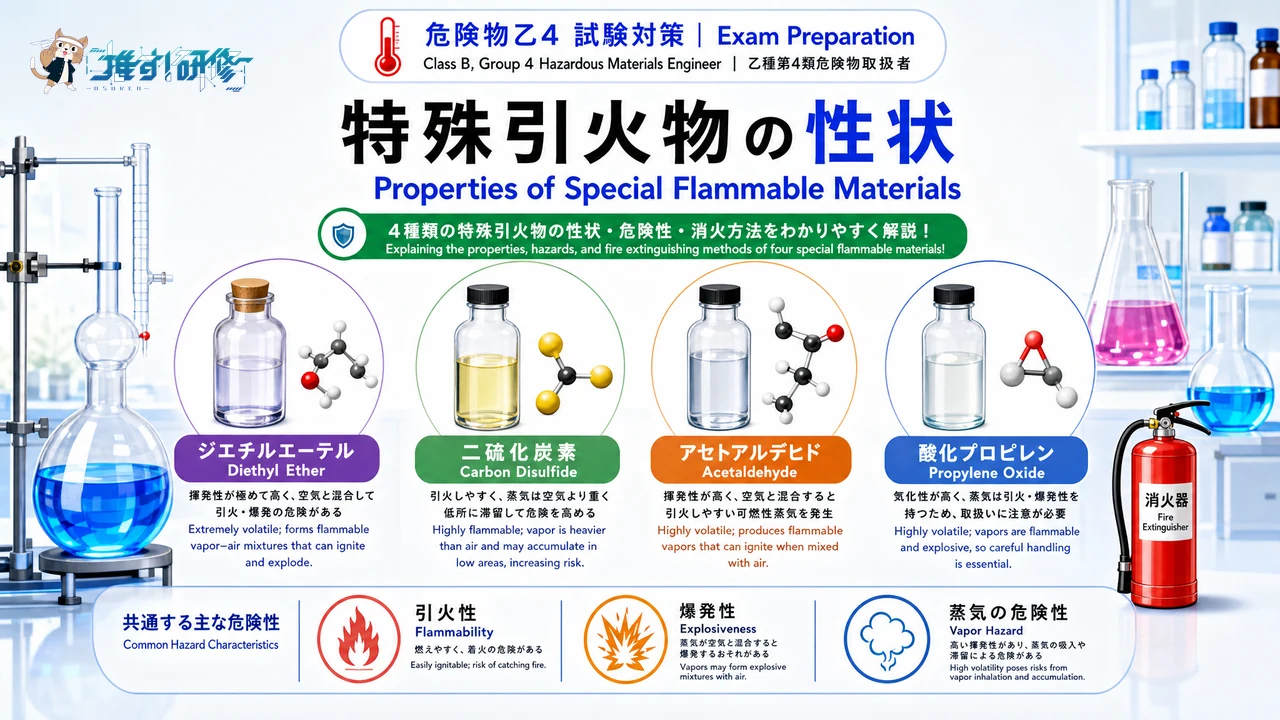
危険物乙4の第4類危険物の中で、最も危険性が高いとされているのが「特殊引火物」です。指定数量はわずか50Lと、第4類の中で最も少なく設定されており、試験でも頻出のテーマとなっています。本記事では、特殊引火物の定義と共通する危険性を整理したうえで、代表的な4物質(ジエチルエーテル・二硫化炭素・アセトアルデヒド・酸化プロピレン)それぞれの性状を、試験対策の観点からわかりやすく解説します。
Among Group 4 hazardous materials in the Class B, Group 4 exam, special flammable liquids are considered the most hazardous category. Their designated quantity is just 50 liters — the smallest of any Group 4 subcategory — and this topic appears frequently on the exam. This article organizes the definition and shared hazards of special flammable liquids, then explains the properties of the four representative substances — diethyl ether, carbon disulfide, acetaldehyde, and propylene oxide — with a focus on what matters for exam preparation.
目次
特殊引火物とは What Are Special Flammable Liquids?
特殊引火物とは、1気圧において発火点が100℃以下のもの、または引火点が-20℃以下かつ沸点が40℃以下のものをいいます。この定義は「発火点」と「引火点・沸点」という2種類の基準のどちらかを満たせば特殊引火物に該当する、という点に注意が必要です。指定数量は、水溶性・非水溶性を問わず一律50Lです。第1石油類や第2石油類のように水溶性と非水溶性で指定数量が異なる区分もあるため、この点は試験でのひっかけになりやすいポイントです。
A special flammable liquid is defined as a substance with an ignition point at or below 100°C at 1 atmosphere, or a flash point at or below -20°C combined with a boiling point at or below 40°C. Note that a substance qualifies as a special flammable liquid if it meets either of these two criteria — not both. The designated quantity is a uniform 50 liters regardless of water solubility. Since some categories, such as Category 1 and Category 2 petroleum, set different designated quantities for water-soluble and non-water-soluble substances, this uniformity is a common point of confusion tested on the exam.
特殊引火物に共通する危険性 Common Hazards Across Special Flammable Liquids
特殊引火物に分類される物質には、いくつかの共通した危険性があります。第一に、引火点や発火点が極めて低いため、常温でも容易に引火・発火する危険があります。第二に、沸点が低く揮発性が高いため、密栓せずに保管すると蒸気が大量に発生しやすくなります。第三に、燃焼範囲が広く、蒸気が空気と混ざったときに燃焼に至る濃度の幅が大きいことも共通する特徴です。加えて、いずれの物質も蒸気比重が1より大きく、発生した蒸気は空気より重いため低い場所に滞留しやすく、換気が不十分な場所では火災の危険が高まります。これらの性質から、特殊引火物は冷暗所での貯蔵と容器の密栓が徹底されます。
Substances classified as special flammable liquids share several common hazards. First, their flash and ignition points are extremely low, meaning they can ignite easily even at room temperature. Second, their low boiling points and high volatility mean that large amounts of vapor can be generated quickly if containers are not tightly sealed. Third, they have wide combustion ranges — a broad span of vapor-to-air concentrations at which combustion can occur. In addition, every one of these substances has a vapor density greater than 1, so the vapor they generate is heavier than air and tends to accumulate in low-lying areas, increasing fire risk in poorly ventilated spaces. Because of these properties, special flammable liquids must always be stored in cool, dark locations with containers kept tightly sealed.
ジエチルエーテルの性状 Properties of Diethyl Ether
ジエチルエーテルは、引火点-45℃と第4類危険物の中で最も低い引火点を持つ物質です。沸点は35℃、発火点は160℃、比重は0.7と水より軽く、水にはわずかしか溶けないため消防法上は非水溶性に区分されます。無色の液体で甘い刺激臭をもち、蒸気には麻酔性があることでも知られています。電気の不導体であるため静電気が蓄積しやすく、それが着火源となる危険があることから、取扱いの際は静電気対策が欠かせません。また、空気との接触や日光にさらされることで酸化され、爆発性の高い過酸化物を生成することがあるため、定期的な点検が必要です。
Diethyl ether has a flash point of -45°C, the lowest of any Group 4 hazardous material. Its boiling point is 35°C and its ignition point 160°C; with a specific gravity of 0.7 it is lighter than water, and because it dissolves only slightly in water it is classified as non-water-soluble under the Fire Service Act. It is a colorless liquid with a sweet, pungent odor, and its vapor is known for its anesthetic effect. Since it does not conduct electricity, it readily accumulates static charge, which can act as an ignition source — making static electricity precautions essential when handling it. Contact with air or exposure to sunlight can also oxidize it into highly explosive peroxides, so periodic inspection is required.
ジエチルエーテルは、かつては手術の際の全身麻酔薬として医療現場で広く使われていた歴史を持ちます。現在では、より安全性の高い麻酔薬に置き換わっていますが、医学史上重要な役割を果たした物質です。また、有機化学の実験室では、物質を抽出する溶媒として、あるいはグリニャール反応と呼ばれる合成反応の溶剤として、現在も日常的に使用されています。
Diethyl ether has a notable place in medical history: it was once widely used as a general anesthetic during surgery. While it has since been replaced by safer anesthetics, it played a significant role in the history of medicine. In organic chemistry laboratories, it also remains in everyday use today as an extraction solvent and as the solvent of choice for Grignard reactions, a fundamental class of synthesis reactions.
二硫化炭素の性状 Properties of Carbon Disulfide
二硫化炭素は、発火点90℃と、第4類危険物の中で唯一発火点が100℃を下回る物質です。比重は1.3で水より重く、水に溶けにくい性質を利用して、容器やタンクでは液面上に水を張り、屋外貯蔵タンクではタンク自体を水槽に水没させる貯蔵方法がとられます。これは可燃性蒸気の発生を抑えることを目的とした特殊な保管方法です。蒸気には特に強い毒性があり、燃焼すると二酸化炭素とともに有毒な二酸化硫黄(亜硫酸ガス)を発生させるため、取扱いには注意が必要です。
Carbon disulfide has an ignition point of 90°C — the only Group 4 hazardous material with an ignition point below 100°C. With a specific gravity of 1.3, it is heavier than water and barely soluble in it, a property exploited in its storage method: a layer of water is maintained above the liquid surface in containers and tanks, and outdoor storage tanks are themselves submerged in a water basin. This special storage method serves to suppress the generation of flammable vapor. Its vapor is particularly toxic, and combustion produces carbon dioxide along with toxic sulfur dioxide gas, so careful handling is required.
二硫化炭素は、衣料品の原料となるレーヨン(人絹)やセロハンを製造する工程で、溶剤として使われてきました。また、優れた溶解力を活かし、ゴム製品の加硫(ゴムに弾力性を与える処理)を促進する薬剤や、農業用の土壌燻蒸剤(害虫や線虫を駆除する薬剤)としても利用されてきた歴史があります。
Carbon disulfide has long been used as a solvent in the manufacturing of rayon and cellophane, materials used in clothing and packaging. Thanks to its strong dissolving power, it has also historically been used as an accelerant in rubber vulcanization (the process that gives rubber its elasticity) and as a soil fumigant in agriculture to control pests and nematodes.
アセトアルデヒドの性状 Properties of Acetaldehyde
アセトアルデヒドは、沸点が21℃と第4類危険物の中で最も低く、常温に近い温度で沸騰するため、極めて揮発しやすい物質です。燃焼範囲も4.0〜60%と第4類の中で最も広く、引火・爆発の危険性が高い物質といえます。無色の液体で刺激臭があり、水によく溶けるほか有機溶剤にも溶けます。還元性が強く、酸化されると酢酸に変化します。また、空気と長時間接触したり、接触した状態で加圧されたりすると爆発性の過酸化物を生成するおそれがあります。貯蔵し、または取り扱う設備には、銅・マグネシウム・銀・水銀、またはこれらを成分とする合金を使用できません。アセトアルデヒドがこれらの金属と反応し、爆発性化合物を生成するおそれがあるためです。容器やタンクの材質には鋼製のものを用います。
Acetaldehyde has a boiling point of 21°C, the lowest among Group 4 hazardous materials, meaning it boils at a temperature close to room temperature, making it extremely volatile. Its combustion range of 4.0–60% is also the widest of any Group 4 substance, making it particularly prone to ignition and explosion. It is a colorless liquid with a pungent odor, highly soluble in water and also soluble in organic solvents. Its strong reducing properties mean it converts to acetic acid when oxidized. Prolonged contact with air — or pressurization while in contact with air — can also produce explosive peroxides. Equipment used to store or handle acetaldehyde must not be made of copper, magnesium, silver, or mercury, nor of any alloy containing them. Acetaldehyde can react with these metals to form explosive compounds. Steel is the material used for its containers and tanks.
アセトアルデヒドは、酢酸や酢酸エチルなど、さまざまな化学製品の原料として工業的に重要な物質です。また、身近な例として、お酒(エタノール)を飲んだ際に体内で生成される中間代謝物でもあります。飲酒後に顔が赤くなったり、頭痛や吐き気(いわゆる二日酔い)が起きたりするのは、体内で分解しきれずに蓄積したアセトアルデヒドが原因の一つとされています。
Acetaldehyde is industrially important as a raw material for a range of chemical products, including acetic acid and ethyl acetate. It also has a familiar connection to everyday life: it is an intermediate metabolite produced in the body when alcohol (ethanol) is consumed. The facial flushing, headache, and nausea associated with a hangover are, in part, attributed to acetaldehyde accumulating in the body faster than it can be broken down.
酸化プロピレンの性状 Properties of Propylene Oxide
酸化プロピレンは、発火点449℃と、特殊引火物の中では際立って高い数値を示す点が特徴です。無色の液体でエーテル臭があり、水によく溶けるほか、エタノールやジエチルエーテルにも溶けます。容器等に貯蔵する場合は、窒素などの不活性ガスを封入します。また、アセトアルデヒドと同様に、貯蔵し、または取り扱う設備には、銅・マグネシウム・銀・水銀、またはこれらを成分とする合金を使用できません。酸化プロピレンがこれらの金属と反応し、爆発性化合物を生成するおそれがあるためです。さらに、重合する性質があり、重合の際に発熱するため火災・爆発の原因となります(特にアルカリが存在する条件下では重合が進行します)。貯蔵時には重合を防止する措置が求められます。
Propylene oxide is notable for its ignition point of 449°C, exceptionally high compared to other special flammable liquids. It is a colorless liquid with an ether-like odor, readily soluble in water as well as in ethanol and diethyl ether. When stored in containers, an inert gas such as nitrogen is sealed in. As with acetaldehyde, equipment used to store or handle propylene oxide must not be made of copper, magnesium, silver, or mercury, nor of any alloy containing them, since propylene oxide can react with these metals to form explosive compounds. It also undergoes polymerization, and because polymerization generates heat, it can cause fire or explosion — a reaction that proceeds especially readily in the presence of alkali. Measures to prevent polymerization are therefore required during storage.
酸化プロピレンは、クッション材や断熱材として住宅や自動車に幅広く使われているポリウレタンフォームの原料(ポリエーテルポリオール)を作るために使われています。また、不凍液や化粧品、食品添加物、医薬品の基剤などに使われるプロピレングリコールの原料としても、私たちの生活を支える身近な工業製品の裏側で活躍している物質です。
Propylene oxide is used to produce polyether polyols, the raw material for polyurethane foam — a material widely used as cushioning and insulation in homes and automobiles. It also serves as the raw material for propylene glycol, which is used in antifreeze, cosmetics, food additives, and pharmaceutical bases. In these ways, propylene oxide plays a role, often unseen, in many everyday industrial products that support our daily lives.
4物質の性状比較表 Comparison Table of the Four Substances
| 物質名 / Substance | 引火点 / Flash point | 発火点 / Ignition point | 沸点 / Boiling point | 比重 / Specific gravity | 燃焼範囲 / Combustion range | 水溶性 / Water solubility |
|---|---|---|---|---|---|---|
| ジエチルエーテル Diethyl ether | -45℃ | 160℃ | 35℃ | 0.7 | 1.9〜36vol% | 非水溶性 / Non-soluble |
| 二硫化炭素 Carbon disulfide | -30℃以下 | 90℃ | 46℃ | 1.3 | 1.3〜50vol% | 非水溶性 / Non-soluble |
| アセトアルデヒド Acetaldehyde | -39℃ | 175℃ | 21℃ | 0.8 | 4.0〜60vol% | 水溶性 / Soluble |
| 酸化プロピレン Propylene oxide | -37℃ | 449℃ | 35℃ | 0.8 | 2.1〜39vol% | 水溶性 / Soluble |
消火方法の使い分け Choosing the Right Extinguishing Method
特殊引火物の消火では、一般の泡消火剤が適さない場面が多い点を押さえておく必要があります。アセトアルデヒドや酸化プロピレンのような水溶性の物質には、一般の泡消火剤は不適当であり、耐アルコール泡(水溶性液体用泡消火剤)やハロゲン化物等の消火剤を使用します。通常の泡消火剤では、水溶性の液体に泡が溶け込んでしまい、窒息効果が得られないためです。ジエチルエーテルも水にわずかに溶けるため、二酸化炭素や耐アルコール泡を用いた窒息消火が有効とされます。二硫化炭素については、水より重く水に溶けにくいという性質から、液面を水で覆って蒸気の発生を抑える方法がとられます。
A key point about extinguishing special flammable liquid fires is that ordinary foam is often unsuitable. For water-soluble substances such as acetaldehyde and propylene oxide, ordinary foam extinguishing agents are inappropriate; alcohol-resistant foam (foam designed for water-soluble liquids) or halogenated agents should be used instead. Ordinary foam dissolves into water-soluble liquids, failing to achieve the smothering effect needed to suppress the fire. Diethyl ether is also slightly soluble in water, so smothering with carbon dioxide or alcohol-resistant foam is the effective approach. For carbon disulfide, its combination of being heavier than water and barely soluble in it allows the liquid surface to be covered with water to suppress vapor generation.
試験対策のポイント Key Points for Exam Preparation
特殊引火物の出題では、「最も○○な物質はどれか」という形式の問題が頻出です。引火点が最も低いのはジエチルエーテル(-45℃)、発火点が最も低いのは二硫化炭素(90℃)、沸点が最も低いのはアセトアルデヒド(21℃)、燃焼範囲が最も広いのもアセトアルデヒド(4.0〜60%)と、それぞれ異なる物質が該当する点をしっかり区別して覚えることが得点への近道です。また、指定数量が水溶性・非水溶性を問わず一律50Lである点、比重が1を超えるのは4物質のうち二硫化炭素(1.3)のみであり、これが水中貯蔵という特殊な保管方法の根拠になっている点、アセトアルデヒドと酸化プロピレンが銅・マグネシウム・水銀・銀を含む容器を使用できない点も、あわせて整理しておきたい重要な論点です。
Exam questions on special flammable liquids frequently take the form “which substance has the lowest/highest…?” Diethyl ether has the lowest flash point (-45°C), carbon disulfide has the lowest ignition point (90°C), acetaldehyde has the lowest boiling point (21°C), and acetaldehyde also has the widest combustion range (4.0–60%) — clearly distinguishing which substance corresponds to which property is the most direct path to scoring points. It is also worth organizing together the facts that the designated quantity is a uniform 50 liters regardless of water solubility, that carbon disulfide (1.3) is the only one of the four substances with a specific gravity above 1 — the basis for its distinctive underwater storage method — and that acetaldehyde and propylene oxide cannot be stored in containers made of copper, magnesium, mercury, or silver.
まとめ Summary
特殊引火物は、指定数量の少なさが示すとおり、第4類危険物の中でも特に慎重な取扱いが求められる物質群です。4物質それぞれの性状の違いを、比較表を使って整理しながら覚えることで、試験本番でも落ち着いて判断できるようになります。
As their small designated quantity suggests, special flammable liquids demand especially careful handling among Group 4 hazardous materials. By organizing the differences in properties among the four substances using the comparison table, you can build the kind of clear understanding that will help you stay calm and answer confidently on exam day.
練習問題 理解を確認しよう Practice Questions: Test Your Understanding
ここまでの内容を、実際の試験形式の問題で確認してみましょう。
Let’s test your understanding with some exam-style practice questions.
問題1 Question 1
特殊引火物の定義に関する記述として、正しいものはどれか。
ア 1気圧において、引火点が0℃以下のものをいう。
イ 1気圧において、発火点が100℃以下のもの、または引火点が-20℃以下かつ沸点が40℃以下のものをいう。
ウ 水溶性のものだけが該当し、非水溶性のものは第1石油類に分類される。
エ 指定数量は、他の第4類危険物と同様に、水溶性か非水溶性かによって異なる。
オ 第4類危険物の中で、指定数量が最も多く設定されている。
Which of the following correctly describes the definition of special flammable liquids?
A. A substance with a flash point at or below 0°C at 1 atmosphere.
B. A substance with an ignition point at or below 100°C, or a flash point at or below -20°C combined with a boiling point at or below 40°C, at 1 atmosphere.
C. Only water-soluble substances qualify; non-water-soluble substances fall under Category 1 petroleum.
D. The designated quantity varies by water solubility, as with other Group 4 materials.
E. It has the largest designated quantity among Group 4 hazardous materials.
解答:イ
解説:特殊引火物は「発火点100℃以下」または「引火点-20℃以下かつ沸点40℃以下」のいずれかを満たす物質と定義される。指定数量は水溶性・非水溶性を問わず一律50Lであり、第4類の中で最も少ない数量である。
Answer: B
Explanation: A special flammable liquid is defined as a substance meeting either of two criteria — an ignition point at or below 100°C, or a flash point at or below -20°C combined with a boiling point at or below 40°C. The designated quantity is a uniform 50 liters regardless of water solubility, the smallest of any Group 4 category.
問題2 Question 2
特殊引火物の性状に関する記述として、誤っているものはどれか。
ア ジエチルエーテルは、第4類危険物の中で最も引火点が低い。
イ 二硫化炭素は、第4類危険物の中で唯一発火点が100℃を下回る。
ウ アセトアルデヒドは、第4類危険物の中で最も沸点が低い。
エ 酸化プロピレンは、水に溶けにくい非水溶性の物質である。
オ 二硫化炭素は、水より比重が大きいため、水中で貯蔵することができる。
Which of the following statements about the properties of special flammable liquids is incorrect?
A. Diethyl ether has the lowest flash point among Group 4 hazardous materials.
B. Carbon disulfide is the only Group 4 material with an ignition point below 100°C.
C. Acetaldehyde has the lowest boiling point among Group 4 hazardous materials.
D. Propylene oxide is a non-water-soluble substance that dissolves poorly in water.
E. Carbon disulfide, having a specific gravity greater than water, can be stored underwater.
解答:エ
解説:酸化プロピレンはアセトアルデヒドと同様に水溶性の物質である。非水溶性なのはジエチルエーテルと二硫化炭素であり、この点は消火方法の選択にも直結する。
Answer: D
Explanation: Propylene oxide is water-soluble, like acetaldehyde. It is diethyl ether and carbon disulfide that are non-water-soluble — a distinction that directly determines the appropriate extinguishing method.
問題3 Question 3
特殊引火物の貯蔵・消火に関する記述として、正しいものはどれか。
ア アセトアルデヒド及び酸化プロピレンは、鉄製の容器であれば問題なく貯蔵できる。
イ アセトアルデヒド及び酸化プロピレンは、銅、マグネシウム、銀、水銀又はこれらを成分とする合金でできた設備を使用してはならない。
ウ 二硫化炭素は、乾燥した場所で容器を密栓して貯蔵するのが原則である。
エ 水溶性の特殊引火物の消火には、通常の(耐アルコール性でない)泡消火剤が最も有効である。
オ ジエチルエーテルの消火には、水による棒状注水が最も適している。
Which of the following statements about the storage and firefighting of special flammable liquids is correct?
A. Acetaldehyde and propylene oxide can be safely stored in iron containers with no restrictions.
B. Acetaldehyde and propylene oxide must not be stored using equipment made of copper, magnesium, silver, mercury, or alloys containing these metals.
C. Carbon disulfide should, in principle, be stored in a dry location with the container tightly sealed.
D. Ordinary (non-alcohol-resistant) foam is the most effective extinguishing agent for water-soluble special flammable liquids.
E. A straight stream of water is the most suitable method for extinguishing a diethyl ether fire.
解答:イ
解説:アセトアルデヒドと酸化プロピレンは、銅・マグネシウム・銀・水銀等と反応して爆発性の化合物を生成するおそれがあるため、これらの金属を使用した設備を用いてはならない。二硫化炭素は水中貯蔵が原則であり、水溶性の物質の消火には耐アルコール泡を用いる必要がある。
Answer: B
Explanation: Acetaldehyde and propylene oxide can react with copper, magnesium, silver, mercury, and related alloys to form explosive compounds, so equipment made from these materials must never be used. Carbon disulfide is, in principle, stored underwater, and alcohol-resistant foam is required to extinguish fires involving water-soluble substances.
- 研修は内製化すべきか、外注すべきか|企業規模を問わず使える判断基準 Build or Buy? A Practical Decision Framework for Corporate Training Coordinators
- ITパスポート試験の難易度は?合格率・合格基準・勉強時間を徹底解説 IT Passport Exam Difficulty: Pass Rates, Passing Criteria, and Study Time Explained
この記事を書いた人

関連記事
-
 危険物乙4|第一石油類の性状を徹底解説【ガソリン・ベンゼン・トルエン・アセトンほか】 Class B, Group 4 Hazardous Materials Engineer | Properties of Category 1 Petroleum: Gasoline, Benzene, Toluene, Acetone, and More Explained
 -
危険物乙4|酸と塩基・酸化と還元・金属腐食の基礎知識 Class B, Group 4 Hazardous Materials Engineer | Acids and Bases, Oxidation and Reduction, and Metal Corrosion
-
危険物乙4|単体・化合物・混合物と状態変化の基礎知識 Class B, Group 4 Hazardous Materials Engineer | Simple Substances, Compounds, Mixtures, and Changes of State
-
危険物乙4|保安距離と保有空地の対象施設・数値基準をわかりやすく解説 Class B Group 4 Hazardous Materials Engineer | Safety Distances and Open Space Requirements Explained
-
危険物乙4|免状の交付・書換え・再交付の申請先と手続きをわかりやすく解説 Class B Group 4 Hazardous Materials Engineer | License Issuance, Amendment, Reissuance, and Surrender: Application Authorities and Procedures Explained
-
危険物乙4|熱の移動の基礎知識 伝導・対流・放射 Class B, Group 4 Hazardous Materials Engineer | Heat Transfer Fundamentals: Conduction, Convection, and Radiation
-
危険物乙4|静電気の基礎知識と防止対策 Class B, Group 4 Hazardous Materials Engineer | Static Electricity: Fundamentals and Prevention Measures
-
危険物乙4「運搬の基準」完全まとめ|試験頻出ポイントを徹底解説 Class B, Group 4 — Complete Guide to Hazardous Materials Transportation Standards | Key Exam Points Explained