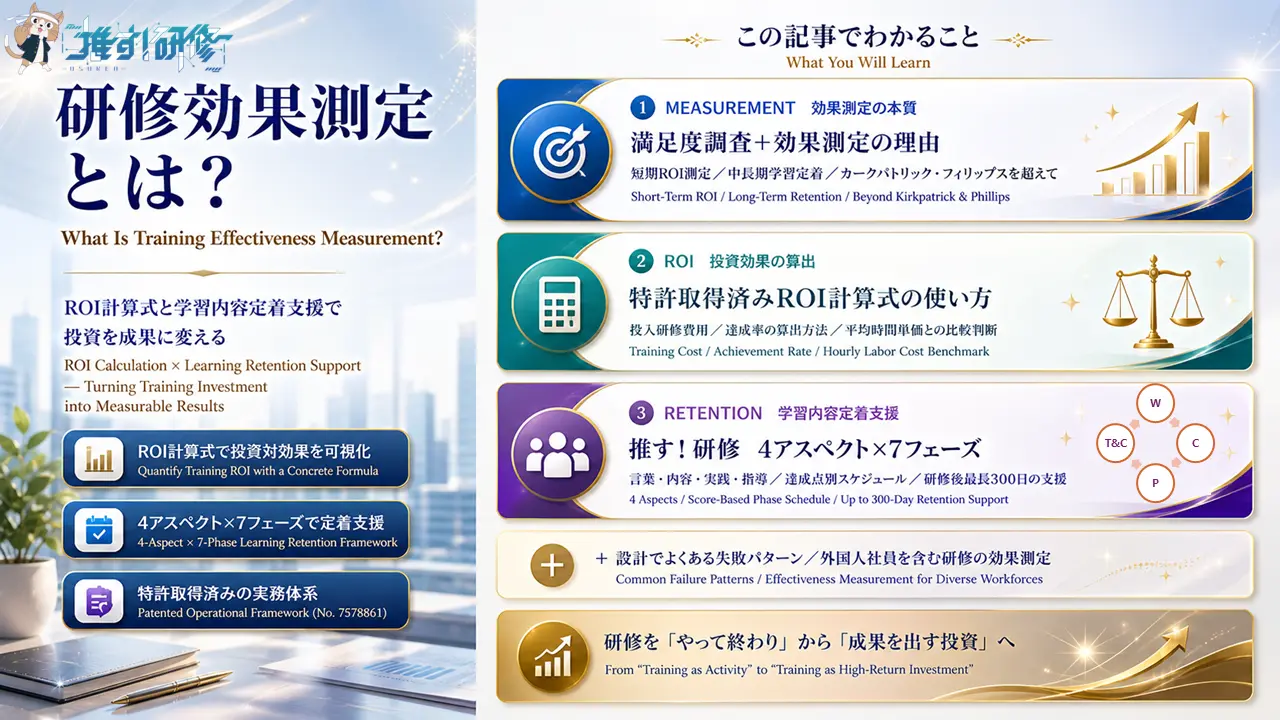
研修効果測定とは?——ROI計算式と学習内容定着支援で投資を成果に変える What Is Training Effectiveness Measurement? — How ROI Calculation and Learning Retention Support Turn Training Investment into Measurable Results
「毎年研修を実施しているが、本当に効果が出ているのかわからない」「経営層から研修の投資対効果を問われるたびに、明確な答えが出せない」「研修を受講した社員が、しばらくすると学んだ内容を忘れてしまっている」——そのような課題を感じている人事教育担当者・経営者の方は少なくありません。
“We run training every year, but we have no idea whether it’s actually working.” “Every time senior management asks about the ROI of our training, we can’t give a clear answer.” “Employees seem to forget what they learned not long after the session ends.” These are concerns that resonate with many HR professionals and business leaders across Japan.
これらの課題の根本には、研修を「実施すること」が目的化してしまい、「測定すること」「定着させること」の設計が後回しになっているという構造的な問題があります。研修は実施した瞬間に価値が生まれるのではなく、測定・定着・改善のサイクルが機能して初めて、組織への真の投資として機能します。
At the root of these challenges lies a structural problem: organizations have come to treat training delivery as the end goal, while the design of “measuring outcomes” and “ensuring retention” has been consistently deprioritized. Training does not generate value at the moment it is delivered. It functions as a genuine organizational investment only when the cycle of measurement, retention, and improvement is working.
本記事では、人事教育担当者・経営者・経営層の方を対象に、研修効果測定の本質的な目的・短期的な投資対効果の計算方法・中長期的な学習内容定着の仕組みを、実務に直結する視点から解説します。
This article is written for HR professionals, managers, and executives. It covers the essential purpose, short-term ROI calculation methodology, and medium-to-long-term learning retention framework of training effectiveness measurement — all from a perspective grounded in practical application.
目次
研修効果測定とは——「やった証拠」ではなく「価値の証明」 Training Effectiveness Measurement: Proving Value, Not Just Documenting Activity
研修効果測定とは、実施した研修教育プログラムが、参加者の能力向上と組織の業績にどれだけ貢献したかを、客観的な指標で把握・評価するプロセスです。単に「満足度アンケートを取ること」ではありません。
Training effectiveness measurement is the process of objectively assessing the extent to which a training program has contributed to participant development and organizational performance. It is not simply about collecting satisfaction surveys.
研修効果の測定を経営管理の観点から検討するとき、私たちは次の2つを混同しがちです。一つは「投入した研修費用は採算が合ったか、正しく回収されたか」という予算執行の観点(短期的な測定)、もう一つは「学習した内容は受講者に本当に定着したか、行動変容は起きたか」という学習内容定着の観点(中長期的な測定)です。この2つは性質が異なる問いであり、それぞれに対応した測定の設計が必要です。
When examining training effectiveness from a management perspective, there are two questions we tend to conflate. The first is “did the training budget deliver an adequate return — was the cost justified?” — a budget execution question and a short-term measurement. The second is “did participants genuinely retain what they learned, and did it produce behavior change?” — a learning retention question and a medium-to-long-term measurement. These are fundamentally different questions, and each requires its own measurement design.
多くの組織では、研修終了後のアンケートで「満足度」を測定することをもって、効果測定が完了したと見なしています。しかし、満足度が高かったことと、研修に投資した価値があったこととは、まったく別の問いです。「面白かった」「ためになった」という感想が、行動変容・業務成果・組織への貢献につながっていなければ、その研修への投資は正当化できません。
In most organizations, measuring satisfaction through a post-session survey is treated as the completion of effectiveness measurement. Yet high satisfaction scores and a worthwhile return on training investment are entirely different questions. If positive impressions do not translate into behavior change, improved performance, and organizational contribution, the investment in that training cannot be justified.
なお、研修効果測定の文脈では、カークパトリックの4段階評価モデルやフィリップスのROI手法が引用されることが少なくありません。これらは測定の概念的な枠組みとして参照価値があります。ただし、多くの社内研修・教育実務の解説では、それらモデルの紹介にとどまっており、実際にどのような計算式で投資対効果を算出するか、そして研修後の学習内容をどのように職場に定着させるかという実務設計には踏み込んでいません。本記事が紹介するROI計算式と学習内容定着支援(推す!研修)は、概念の整理にとどまらず、実務の現場で機能する具体的な体系として構築されています。
It is worth noting that Kirkpatrick’s four-level evaluation model and Phillips’ ROI methodology are frequently cited in discussions of training effectiveness measurement. These frameworks offer genuine value as conceptual organizers of what to measure. However, many practical guides to in-house training and corporate education stop at introducing the model itself, without addressing the practical questions of how to calculate ROI in practice, or how to systematically embed learning content in the workplace after training ends. The ROI formula and learning retention support system (Osu! Kenshu) introduced in this article are not conceptual frameworks — they are fully operational systems designed to function on the ground.
【特許取得済|短期的な測定】研修の投資対効果(ROI)計算式 Short-Term Measurement: The Training ROI Formula (Patented)
研修の投資対効果を測定するための計算式として、以下のアプローチを活用します。
The following approach is used to calculate the return on investment of a training program.
(投入研修費用 × 研修目的達成率)÷(研修時間 × 研修参加者数)≥ 自社社員の平均時間単価
( Training Cost × Achievement Rate ) ÷ ( Training Hours × Number of Participants ) ≥ Average Hourly Labor Cost per Employee
この計算式の意義は、自社の社員を1時間拘束するだけの価値が、その研修プログラムにあったかどうかを、金額ベースで判断することにあります。左辺が右辺(自社社員の平均時間単価)以上であれば、投資価値ありと判断します。
The significance of this formula lies in making a monetary judgment about whether the training program was worth the value of employees’ time for the hours it required. If the left side equals or exceeds the right side — the organization’s average hourly labor cost per employee — the training is judged to have delivered a return on investment.
投入研修費用の計算 Calculating Training Cost
「投入研修費用」とは、ある研修プログラムを実施する際に生じる費用です。社外の研修会社(コンテンツベンダー)を活用する場合は、講師料・プログラム提供料・講師交通費などが該当します。社内講師を活用する場合は、「社内講師の月収 ÷ 月間総勤務時間 × 研修時間数」で算出します。なお接待費など、受講者の学習効果と直接関連しない費用は含めません。
“Training cost” refers to all expenses incurred in delivering a specific training program. For programs using external providers, this includes instructor fees, program delivery costs, and instructor travel expenses. For in-house instructors, the cost is calculated as “instructor’s monthly salary ÷ total monthly working hours × number of training hours.” Expenses with no direct relationship to participant learning outcomes are excluded.
研修目的達成率の算出 Calculating the Training Objective Achievement Rate
「研修目的達成率」は、研修参加者のうち所定の方法で100点満点の達成点を測定し、60点以上を獲得した者の割合です。達成点の測定には、①講師による研修中パフォーマンス評価(40点)、②事前・事後課題(40点)、③匿名性360度相互評価(10点)、④理解度の自己評価(10点)の4つの評価方法を組み合わせます。例えば20名中18名が60点以上の場合、達成率は90%(0.9)です。
The “training objective achievement rate” is the proportion of participants who score 60 points or above when their achievement is measured on a 100-point scale. Achievement scores are measured using a combination of four evaluation methods: ① instructor evaluation of in-session performance (40 points), ② pre- and post-assignments (40 points), ③ anonymous 360-degree peer evaluation (10 points), and ④ self-assessed comprehension (10 points). For example, if 18 out of 20 participants score 60 or above, the achievement rate is 90% (0.9).
自社社員の平均時間単価の計算 Calculating Average Hourly Labor Cost
右辺の「自社社員の平均時間単価」は、「社員の平均年収 ÷ 年間総勤務時間(例:8時間 × 5日 × 4週 × 12か月 = 1,920時間)」で算出します。例えば平均年収600万円の場合、時間単価は3,125円となります。この数値が、研修の投資価値を判断するベンチマークです。左辺がこの数値を下回る場合、研修の投資対効果がなかったものとして判断し、次期プログラムの設計見直しを行います。
The “average hourly labor cost per employee” on the right side is calculated as “average annual employee salary ÷ total annual working hours (e.g., 8 hrs × 5 days × 4 weeks × 12 months = 1,920 hours).” With an average annual salary of 6 million yen, the hourly rate is 3,125 yen. When the left side of the formula falls below this benchmark, the training is judged to have delivered no return on investment, and the program design should be revised for the next cycle.
計算例:研修実施価値があったシナリオ Calculation Example: A Case Where Training Delivered Value
以下の条件で、ROI計算式を実際に適用します。投入研修費用:600,000円(外部講師料・プログラム提供料を含む)/研修目的達成率:75%(0.75)——20名中15名が60点以上を獲得/研修時間:6時間(全日研修)/研修参加者数:20名/自社社員の平均時間単価:3,125円(平均年収600万円 ÷ 1,920時間)。
The following parameters are applied to the ROI formula. Training cost: ¥600,000 (including external instructor fees and program delivery costs) / Training objective achievement rate: 75% (0.75) — 15 out of 20 participants scored 60 or above / Training hours: 6 hours (full-day session) / Number of participants: 20 / Average hourly labor cost per employee: ¥3,125 (average annual salary of ¥6 million ÷ 1,920 hours).
(600,000 × 0.75)÷(6 × 20)= 450,000 ÷ 120 = 3,750円
( ¥600,000 × 0.75 ) ÷ ( 6 × 20 ) = ¥450,000 ÷ 120 = ¥3,750
判定:3,750円 ≥ 3,125円(平均時間単価)→ 投資価値あり ✓ 左辺(3,750円)が右辺(3,125円)を1時間あたり625円上回っており、この研修プログラムへの投資は正当化されます。参加者20名・6時間の研修全体では、ベンチマークを75,000円(625円 × 20名 × 6時間)上回る価値を創出したことになります。
Result: ¥3,750 ≥ ¥3,125 (average hourly labor cost) → Training delivered a return on investment ✓ The left side (¥3,750) exceeds the right side (¥3,125) by ¥625 per participant-hour, confirming that this training program justified its investment. Across all 20 participants over 6 hours, the program generated ¥75,000 in value above the benchmark (¥625 × 20 × 6).
【特許取得済|中長期的な測定】学習内容定着の仕組み——『推す!研修』 Medium-to-Long-Term Measurement: The Learning Retention Framework — “Osu! Kenshu” (Patented)
ROIの計算は短期的な投資回収の判断を可能にしますが、それだけでは研修の真の価値を測ることはできません。研修後に学習内容が職場で実践され、行動変容として定着しているかどうかを、中長期的に追跡・支援する仕組みが不可欠です。
ROI calculation enables short-term investment recovery judgments — but it cannot measure the full value of training on its own. A system for tracking and supporting whether learning is being applied in the workplace and taking root as behavior change — over the medium to long term — is indispensable.
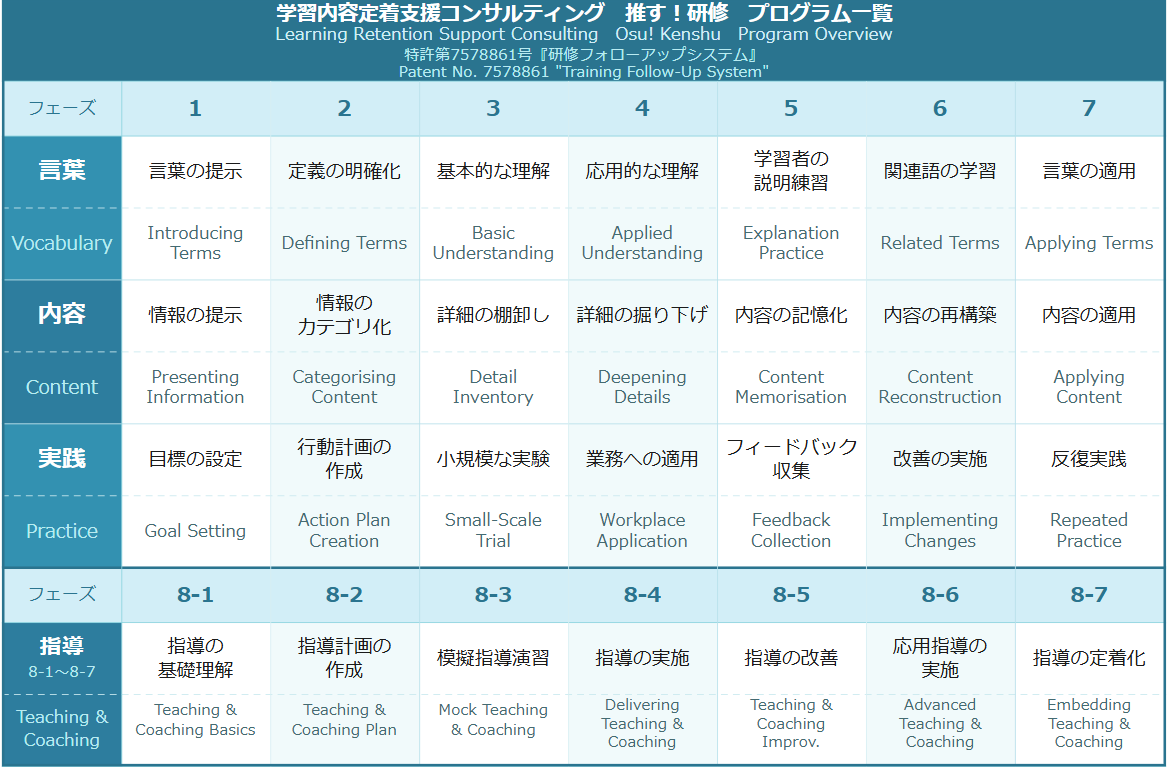
オスケン株式会社が提供する『推す!研修』は、前章で解説したROI計算式を含む研修効果測定の仕組み全体と、研修後の学習内容定着支援を一体として設計した独自プログラムです(特許第7578861号『研修フォローアップシステム』)。「言葉」「内容」「実践」「指導」の4つのアスペクトを軸に、各7フェーズで構成されており、研修受講後、概ね6〜10か月の期間をかけて学習内容の定着を段階的に実現します。
Osuken Inc.’s “Osu! Kenshu” (推す!研修) is a proprietary program that integrates the ROI measurement framework introduced in the previous section — including the calculation formula — with a systematic post-training learning retention support system (Patent No. 7578861: “Training Follow-Up System”). Built around four aspects — Words, Content, Practice, and Teaching & Coaching — each structured across seven phases, the program delivers staged learning retention over a period of approximately six to ten months following training completion.
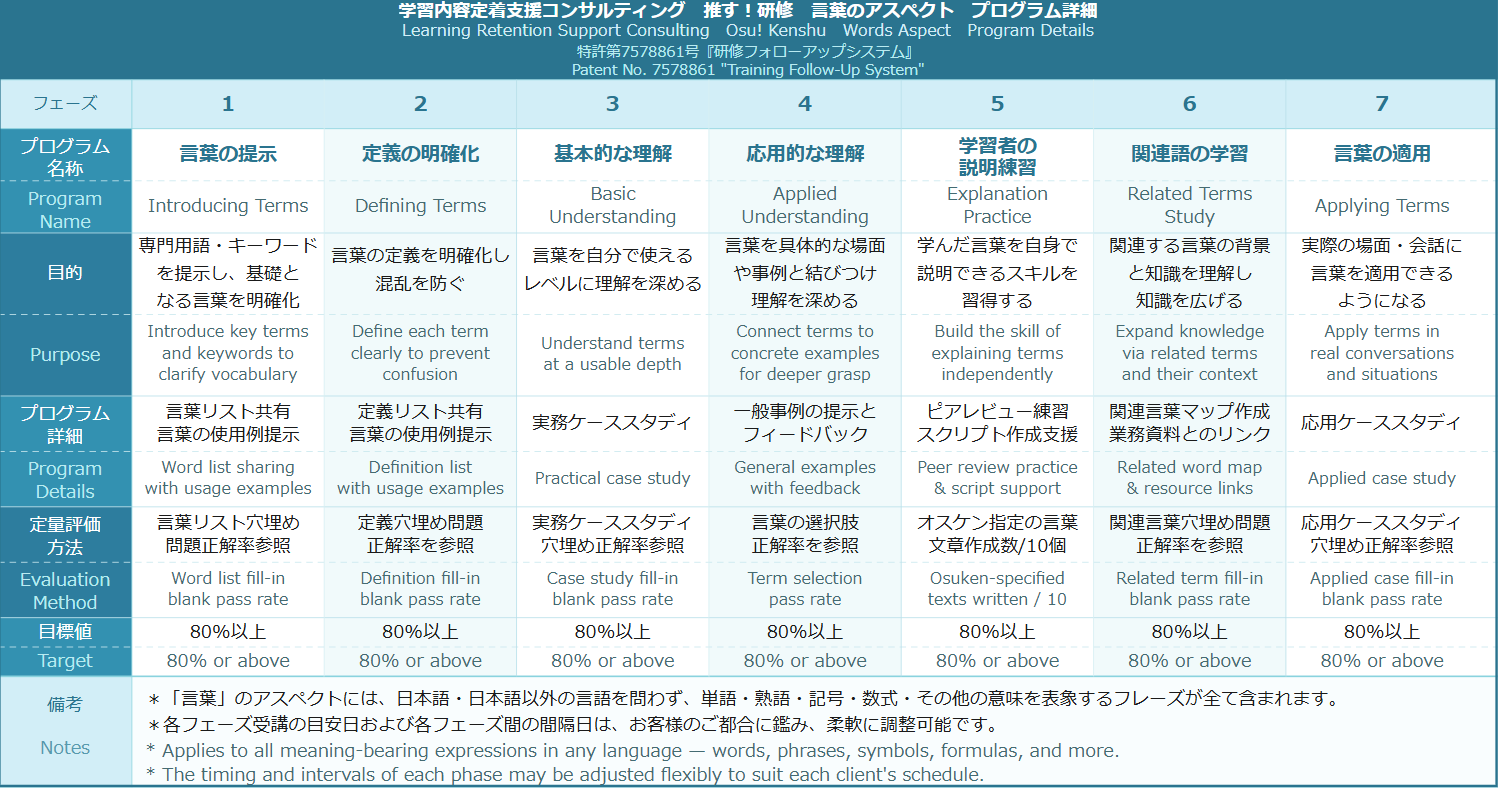
アスペクト①:言葉 Aspect 1 — Words
「言葉のアスペクト」は、研修で使用された専門用語やキーワードについて、言葉の提示→定義の明確化→基本的な理解→応用的な理解→学習者の説明練習→関連語の学習→言葉の適用という7フェーズを通じて、言葉の表面的な暗記にとどまらない「活用できる理解」を養います。日本語・日本語以外の言語の別を問わず、単語・熟語・記号・数式など、意味を表象するフレーズすべてが対象です。
The Words aspect develops not surface-level memorization but genuine, applicable understanding of the specialist terms and keywords used in training — progressing through seven phases: presentation of terms → clarification of definitions → foundational understanding → applied understanding → explanation practice → learning of related terms → application of vocabulary. The scope covers all meaning-bearing expressions — words, phrases, symbols, and formulas — in Japanese and other languages alike.
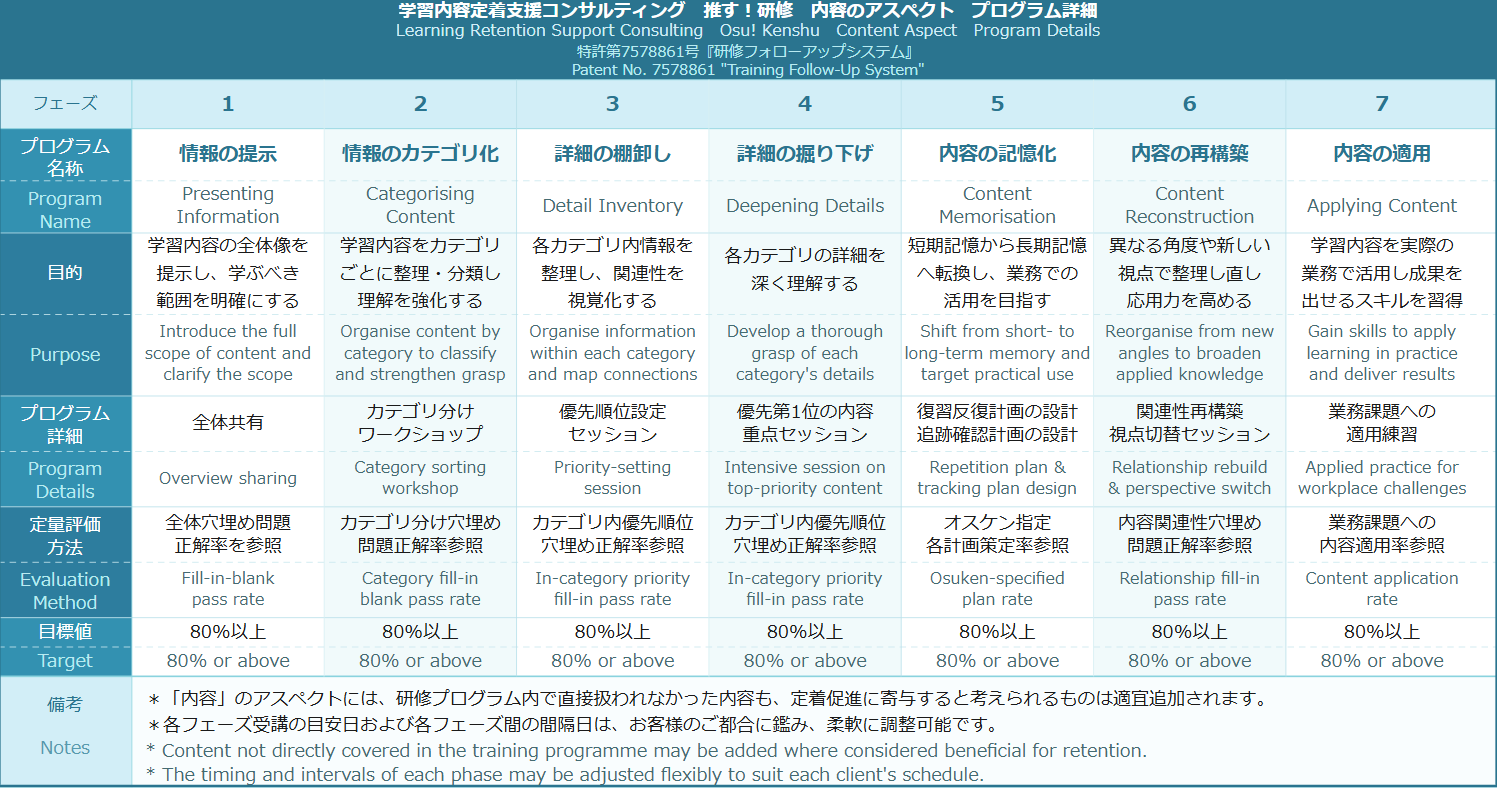
アスペクト②:内容 Aspect 2 — Content
「内容のアスペクト」は、研修で学んだ知識の全体像を整理し、業務に適用できる力を養います。情報の提示→情報のカテゴリ化→詳細の棚卸し→詳細の掘り下げ→内容の記憶化→内容の再構築→内容の適用という7フェーズを通じて、短期記憶から長期記憶への転換と、業務への実践的応用を段階的に実現します。なお研修プログラム内で直接扱われなかった内容でも、定着促進に寄与すると考えられるものは対象として加えることができます。
The Content aspect develops the ability to organize and apply the knowledge acquired in training, through seven phases: presentation of information → categorization → detailed inventory → deep-dive → memorization → reconstruction → application. This staged process supports the conversion of short-term to long-term memory and the practical application of knowledge to work tasks. Content not directly covered in the training program may also be incorporated if it is judged to contribute to retention.
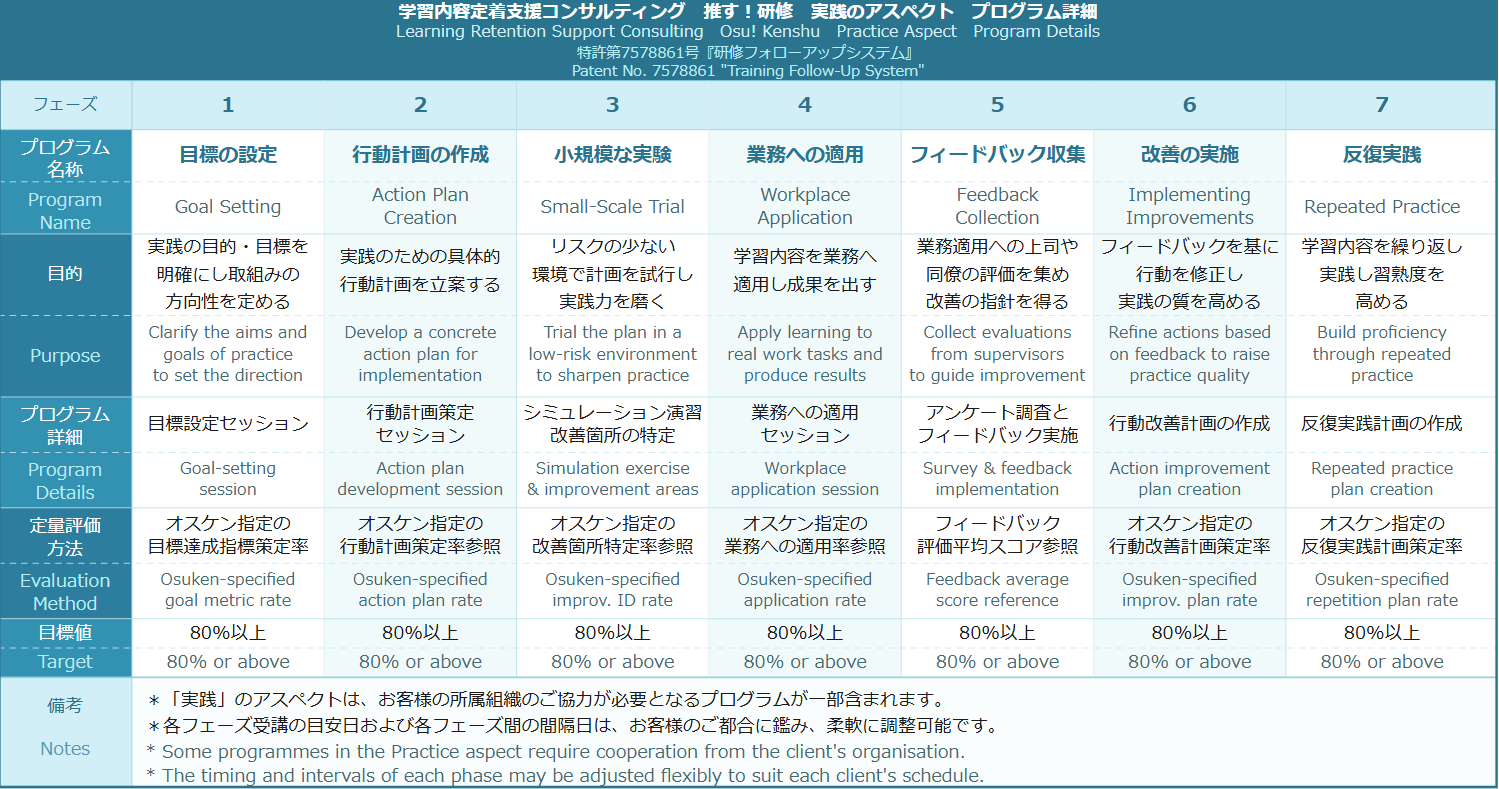
アスペクト③:実践 Aspect 3 — Practice
「実践のアスペクト」は、学習内容を実際の職場成果に結びつける力を養います。目標の設定→行動計画の作成→小規模な実験→業務への適用→フィードバック収集→改善の実施→反復実践という7フェーズを通じて、「知っている」から「やっている」へ、さらに「習慣化されている」への移行を支援します。一部のフェーズでは、参加者の所属組織のご協力が必要になります。
The Practice aspect develops the ability to connect learning to real workplace results, through seven phases: goal setting → action planning → small-scale experimentation → on-the-job application → feedback collection → implementing improvements → repeated practice. This supports the transition from “knowing” to “doing” and ultimately to “habitual execution.” Some phases require the cooperation of the participant’s organization.
アスペクト④:指導 Aspect 4 — Teaching & Coaching
「指導のアスペクト」は、学習分野に関する知見を他者や組織に還元する力を養います。指導の基礎理解→指導計画の作成→模擬指導演習→指導の実施→指導の改善→応用指導の実施→指導の定着化という7フェーズ(フェーズ8-1〜8-7)で構成されます。学習内容を自ら「教えられる」水準まで高めることは、最も深い定着の証明であり、組織の知識継承にも直結します。このアスペクトはすべて、参加者の所属組織のご協力が必要になります。
The Teaching & Coaching aspect develops the ability to share knowledge and expertise in the learning domain with others and with the organization — progressing through seven phases (8-1 through 8-7): foundational understanding of teaching → development of a teaching plan → simulated teaching practice → delivery of teaching → improvement of teaching → application of advanced teaching → embedding teaching as a habit. Reaching the level at which one can teach what has been learned is the deepest proof of retention, and connects directly to organizational knowledge transfer. This aspect requires the cooperation of the participant’s organization throughout.
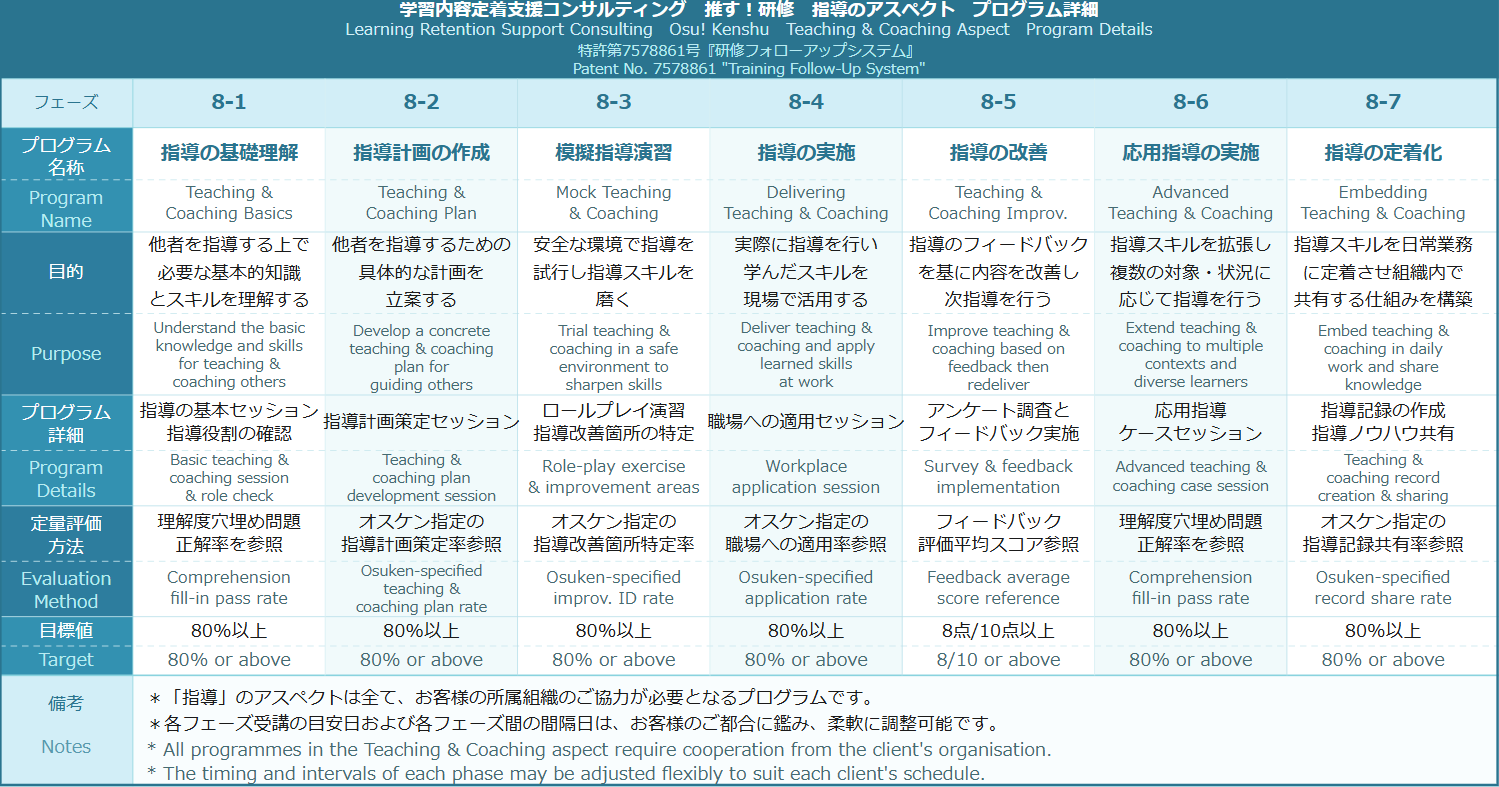
4つのアスペクトは同一の受講者に対して連続して進行します。言葉のアスペクトで「記憶する」、内容のアスペクトで「理解する」、実践のアスペクトで「行動に移す」、指導のアスペクトで「他者に伝える」——研修内容定着の4条件をそれぞれのアスペクトが担うことで、研修投資が確実に成果へと結びつく設計です。
The four aspects progress in sequence for the same participant. The Words aspect addresses “memorizing,” the Content aspect “understanding,” the Practice aspect “applying,” and the Teaching & Coaching aspect “teaching others” — each aspect covering one of the four conditions for learning retention, ensuring that the training investment translates reliably into measurable results.
研修目的達成水準と定着支援のタイミング Achievement Tiers and the Timing of Retention Support
各アスペクトの定着支援は、研修目的達成点に基づき、4アスペクト×各7フェーズのスケジュールを個別に設定します。60点未満の参加者は研修後2日目から開始し、言葉・内容・実践・指導の順に各7フェーズを実施(最終フェーズは128日後、約4か月)。60〜70点未満は3日目から開始し最終フェーズは189日後(約6か月)。70〜80点未満は4日目から開始し最終フェーズは250日後(約8か月)。80点以上は5日目から開始し最終フェーズは299日後(約10か月)に実施します。達成点が低い参加者ほど支援開始を早め、フェーズ間隔を短く設定することで、初期の記憶定着の差異に対応した科学的根拠に基づくアプローチを実現しています。
The timing of all seven phases per aspect is set individually based on each participant’s training objective achievement score. The four aspects — vocabulary, content, practice, and instruction — are addressed sequentially, each comprising seven phases. Participants scoring below 60 begin Phase 1 on day 2 post-training and complete the final phase on day 128 (approx. 4 months); those scoring 60–70 begin on day 3 with a final phase on day 189 (approx. 6 months); 70–80 begin on day 4 with a final phase on day 250 (approx. 8 months); and 80 and above begin on day 5 with a final phase on day 299 (approx. 10 months). Earlier start dates and shorter phase intervals for lower-scoring participants reflect a scientifically grounded approach to the differences in initial memory consolidation.
言葉 / Vocabulary
内容 / Content
実践 / Practice
指導 / Instruction
許容誤差 / Tolerance
実施可能範囲 / Acceptable Range
| アスペクト/区間Aspect / Interval | Ph.1 | Ph.2 | Ph.3 | Ph.4 | Ph.5 | Ph.6 | Ph.7 |
|---|---|---|---|---|---|---|---|
| 言葉Vocabulary (Day from Training) | 2d | 4d | 7d | 11d | 17d | 24d | 32d |
| フェーズ間隔Phase Interval | — | +2d | +3d | +4d | +6d | +7d | +8d |
| 許容誤差Tolerance | — | ±1d | ±1d | ±1d | ±2d | ±2d | ±2d |
| 実施可能範囲Acceptable Range | — | 3〜5d | 6〜8d | 10〜12d | 15〜19d | 22〜26d | 30〜34d |
| 内容Content (Day from Training) | 34d | 36d | 39d | 43d | 49d | 56d | 64d |
| フェーズ間隔Phase Interval | — | +2d | +3d | +4d | +6d | +7d | +8d |
| 許容誤差Tolerance | — | ±1d | ±1d | ±1d | ±2d | ±2d | ±2d |
| 実施可能範囲Acceptable Range | — | 35〜37d | 38〜40d | 42〜44d | 47〜51d | 54〜58d | 62〜66d |
| 実践Practice (Day from Training) | 66d | 68d | 71d | 75d | 81d | 88d | 96d |
| フェーズ間隔Phase Interval | — | +2d | +3d | +4d | +6d | +7d | +8d |
| 許容誤差Tolerance | — | ±1d | ±1d | ±1d | ±2d | ±2d | ±2d |
| 実施可能範囲Acceptable Range | — | 67〜69d | 70〜72d | 74〜76d | 79〜83d | 86〜90d | 94〜98d |
| 指導Instruction (Day from Training) | 98d | 100d | 103d | 107d | 113d | 120d | 128d |
| フェーズ間隔Phase Interval | — | +2d | +3d | +4d | +6d | +7d | +8d |
| 許容誤差Tolerance | — | ±1d | ±1d | ±1d | ±2d | ±2d | ±2d |
| 実施可能範囲Acceptable Range | — | 99〜101d | 102〜104d | 106〜108d | 111〜115d | 118〜122d | 126〜130d |
※ Day 0 = 研修実施日 / Training date ※ 数値はすべて「研修後○日」/ All values = days post-training
※ アスペクト間移行:前アスペクト Ph.7 完了の2日後に次アスペクト Ph.1 を開始 / Next aspect’s Ph.1 begins 2 days after previous aspect’s Ph.7
※ 許容誤差(比例方式)/ Proportional tolerance: 1–5d → ±1d / 6–14d → ±2d / 15–30d → ±3d / 31d+ → ±7d
※ アスペクト間移行:前アスペクト Ph.7 完了の2日後に次アスペクト Ph.1 を開始 / Next aspect’s Ph.1 begins 2 days after previous aspect’s Ph.7
※ 許容誤差(比例方式)/ Proportional tolerance: 1–5d → ±1d / 6–14d → ±2d / 15–30d → ±3d / 31d+ → ±7d
言葉 / Vocabulary
内容 / Content
実践 / Practice
指導 / Instruction
許容誤差 / Tolerance
実施可能範囲 / Acceptable Range
| アスペクト/区間Aspect / Interval | Ph.1 | Ph.2 | Ph.3 | Ph.4 | Ph.5 | Ph.6 | Ph.7 |
|---|---|---|---|---|---|---|---|
| 言葉Vocabulary (Day from Training) | 3d | 6d | 10d | 16d | 24d | 35d | 48d |
| フェーズ間隔Phase Interval | — | +3d | +4d | +6d | +8d | +11d | +13d |
| 許容誤差Tolerance | — | ±1d | ±1d | ±2d | ±2d | ±2d | ±2d |
| 実施可能範囲Acceptable Range | — | 5〜7d | 9〜11d | 14〜18d | 22〜26d | 33〜37d | 46〜50d |
| 内容Content (Day from Training) | 50d | 53d | 57d | 63d | 71d | 82d | 95d |
| フェーズ間隔Phase Interval | — | +3d | +4d | +6d | +8d | +11d | +13d |
| 許容誤差Tolerance | — | ±1d | ±1d | ±2d | ±2d | ±2d | ±2d |
| 実施可能範囲Acceptable Range | — | 52〜54d | 56〜58d | 61〜65d | 69〜73d | 80〜84d | 93〜97d |
| 実践Practice (Day from Training) | 97d | 100d | 104d | 110d | 118d | 129d | 142d |
| フェーズ間隔Phase Interval | — | +3d | +4d | +6d | +8d | +11d | +13d |
| 許容誤差Tolerance | — | ±1d | ±1d | ±2d | ±2d | ±2d | ±2d |
| 実施可能範囲Acceptable Range | — | 99〜101d | 103〜105d | 108〜112d | 116〜120d | 127〜131d | 140〜144d |
| 指導Instruction (Day from Training) | 144d | 147d | 151d | 157d | 165d | 176d | 189d |
| フェーズ間隔Phase Interval | — | +3d | +4d | +6d | +8d | +11d | +13d |
| 許容誤差Tolerance | — | ±1d | ±1d | ±2d | ±2d | ±2d | ±2d |
| 実施可能範囲Acceptable Range | — | 146〜148d | 150〜152d | 155〜159d | 163〜167d | 174〜178d | 187〜191d |
※ Day 0 = 研修実施日 / Training date ※ 数値はすべて「研修後○日」/ All values = days post-training
※ アスペクト間移行:前アスペクト Ph.7 完了の2日後に次アスペクト Ph.1 を開始 / Next aspect’s Ph.1 begins 2 days after previous aspect’s Ph.7
※ 許容誤差(比例方式)/ Proportional tolerance: 1–5d → ±1d / 6–14d → ±2d / 15–30d → ±3d / 31d+ → ±7d
※ アスペクト間移行:前アスペクト Ph.7 完了の2日後に次アスペクト Ph.1 を開始 / Next aspect’s Ph.1 begins 2 days after previous aspect’s Ph.7
※ 許容誤差(比例方式)/ Proportional tolerance: 1–5d → ±1d / 6–14d → ±2d / 15–30d → ±3d / 31d+ → ±7d
言葉 / Vocabulary
内容 / Content
実践 / Practice
指導 / Instruction
許容誤差 / Tolerance
実施可能範囲 / Acceptable Range
| アスペクト/区間Aspect / Interval | Ph.1 | Ph.2 | Ph.3 | Ph.4 | Ph.5 | Ph.6 | Ph.7 |
|---|---|---|---|---|---|---|---|
| 言葉Vocabulary (Day from Training) | 4d | 8d | 13d | 21d | 32d | 47d | 64d |
| フェーズ間隔Phase Interval | — | +4d | +5d | +8d | +11d | +15d | +17d |
| 許容誤差Tolerance | — | ±1d | ±1d | ±2d | ±2d | ±3d | ±3d |
| 実施可能範囲Acceptable Range | — | 7〜9d | 12〜14d | 19〜23d | 30〜34d | 44〜50d | 61〜67d |
| 内容Content (Day from Training) | 66d | 70d | 75d | 83d | 94d | 109d | 126d |
| フェーズ間隔Phase Interval | — | +4d | +5d | +8d | +11d | +15d | +17d |
| 許容誤差Tolerance | — | ±1d | ±1d | ±2d | ±2d | ±3d | ±3d |
| 実施可能範囲Acceptable Range | — | 69〜71d | 74〜76d | 81〜85d | 92〜96d | 106〜112d | 123〜129d |
| 実践Practice (Day from Training) | 128d | 132d | 137d | 145d | 156d | 171d | 188d |
| フェーズ間隔Phase Interval | — | +4d | +5d | +8d | +11d | +15d | +17d |
| 許容誤差Tolerance | — | ±1d | ±1d | ±2d | ±2d | ±3d | ±3d |
| 実施可能範囲Acceptable Range | — | 131〜133d | 136〜138d | 143〜147d | 154〜158d | 168〜174d | 185〜191d |
| 指導Instruction (Day from Training) | 190d | 194d | 199d | 207d | 218d | 233d | 250d |
| フェーズ間隔Phase Interval | — | +4d | +5d | +8d | +11d | +15d | +17d |
| 許容誤差Tolerance | — | ±1d | ±1d | ±2d | ±2d | ±3d | ±3d |
| 実施可能範囲Acceptable Range | — | 193〜195d | 198〜200d | 205〜209d | 216〜220d | 230〜236d | 247〜253d |
※ Day 0 = 研修実施日 / Training date ※ 数値はすべて「研修後○日」/ All values = days post-training
※ アスペクト間移行:前アスペクト Ph.7 完了の2日後に次アスペクト Ph.1 を開始 / Next aspect’s Ph.1 begins 2 days after previous aspect’s Ph.7
※ 許容誤差(比例方式)/ Proportional tolerance: 1–5d → ±1d / 6–14d → ±2d / 15–30d → ±3d / 31d+ → ±7d
※ アスペクト間移行:前アスペクト Ph.7 完了の2日後に次アスペクト Ph.1 を開始 / Next aspect’s Ph.1 begins 2 days after previous aspect’s Ph.7
※ 許容誤差(比例方式)/ Proportional tolerance: 1–5d → ±1d / 6–14d → ±2d / 15–30d → ±3d / 31d+ → ±7d
言葉 / Vocabulary
内容 / Content
実践 / Practice
指導 / Instruction
許容誤差 / Tolerance
実施可能範囲 / Acceptable Range
| アスペクト/区間Aspect / Interval | Ph.1 | Ph.2 | Ph.3 | Ph.4 | Ph.5 | Ph.6 | Ph.7 |
|---|---|---|---|---|---|---|---|
| 言葉Vocabulary (Day from Training) | 5d | 10d | 16d | 25d | 38d | 57d | 77d |
| フェーズ間隔Phase Interval | — | +5d | +6d | +9d | +13d | +19d | +20d |
| 許容誤差Tolerance | — | ±1d | ±2d | ±2d | ±2d | ±3d | ±3d |
| 実施可能範囲Acceptable Range | — | 9〜11d | 14〜18d | 23〜27d | 36〜40d | 54〜60d | 74〜80d |
| 内容Content (Day from Training) | 79d | 84d | 90d | 99d | 112d | 131d | 151d |
| フェーズ間隔Phase Interval | — | +5d | +6d | +9d | +13d | +19d | +20d |
| 許容誤差Tolerance | — | ±1d | ±2d | ±2d | ±2d | ±3d | ±3d |
| 実施可能範囲Acceptable Range | — | 83〜85d | 88〜92d | 97〜101d | 110〜114d | 128〜134d | 148〜154d |
| 実践Practice (Day from Training) | 153d | 158d | 164d | 173d | 186d | 205d | 225d |
| フェーズ間隔Phase Interval | — | +5d | +6d | +9d | +13d | +19d | +20d |
| 許容誤差Tolerance | — | ±1d | ±2d | ±2d | ±2d | ±3d | ±3d |
| 実施可能範囲Acceptable Range | — | 157〜159d | 162〜166d | 171〜175d | 184〜188d | 202〜208d | 222〜228d |
| 指導Instruction (Day from Training) | 227d | 232d | 238d | 247d | 260d | 279d | 299d |
| フェーズ間隔Phase Interval | — | +5d | +6d | +9d | +13d | +19d | +20d |
| 許容誤差Tolerance | — | ±1d | ±2d | ±2d | ±2d | ±3d | ±3d |
| 実施可能範囲Acceptable Range | — | 231〜233d | 236〜240d | 245〜249d | 258〜262d | 276〜282d | 296〜302d |
※ Day 0 = 研修実施日 / Training date ※ 数値はすべて「研修後○日」/ All values = days post-training
※ アスペクト間移行:前アスペクト Ph.7 完了の2日後に次アスペクト Ph.1 を開始 / Next aspect’s Ph.1 begins 2 days after previous aspect’s Ph.7
※ 許容誤差(比例方式)/ Proportional tolerance: 1–5d → ±1d / 6–14d → ±2d / 15–30d → ±3d / 31d+ → ±7d
※ アスペクト間移行:前アスペクト Ph.7 完了の2日後に次アスペクト Ph.1 を開始 / Next aspect’s Ph.1 begins 2 days after previous aspect’s Ph.7
※ 許容誤差(比例方式)/ Proportional tolerance: 1–5d → ±1d / 6–14d → ±2d / 15–30d → ±3d / 31d+ → ±7d
なお重要な原則として、研修目的の未達成者(60点未満)に対する学習内容定着支援は、達成者と同様に実施します。未達成者を支援の対象から外すことは、研修への投資対効果をさらに悪化させるだけでなく、当該社員の成長機会を組織が奪うことにもなります。
An important principle: learning retention support for participants who did not achieve the training objective (below 60 points) is conducted in exactly the same way as for those who did. Excluding non-achievers from support not only further worsens the ROI of the training investment — it also means the organization is actively removing a growth opportunity from those employees.
研修効果測定の設計でよくある失敗パターン Common Failure Patterns in Training Effectiveness Measurement Design
実務上よく見られる失敗パターンを知っておくことが、担当者として測定体系の品質を高める出発点です。
Understanding the most common failure patterns in practice is the starting point for HR professionals committed to building a high-quality measurement system.
「満足度=効果」と見なしている。研修の満足度が高いことは、参加者が研修を「楽しい・良かった」と感じたことを示すに過ぎず、行動変容・業務成果への影響とは別次元の指標です。満足度調査はあくまでもプログラム改善のための参考データとして位置づけ、効果測定の主指標としては使用しないことが原則です。
Treating satisfaction as a proxy for effectiveness. High training satisfaction simply indicates that participants found the program enjoyable or worthwhile — it is a fundamentally different metric from behavior change and business impact. Satisfaction surveys should be positioned as reference data for program improvement only, and should not be used as the primary measure of training effectiveness.
短期的なROI測定だけで終わり、中長期的な定着支援を設計していない。ROIの計算結果が良好であっても、学習内容が職場で実践・定着されていなければ、研修の本質的な価値は生まれません。短期測定と中長期的な定着支援を一体の設計として組み込むことが、研修投資の価値を最大化する唯一の方法です。
Stopping at short-term ROI measurement without designing medium-to-long-term retention support. Even if ROI calculations look favorable, training generates no real value if learning content is not being applied and embedded in the workplace. Integrating short-term measurement and medium-to-long-term retention support as a unified design is the only way to maximize the return on training investment.
測定を研修終了後に考え始めている。測定と定着支援の設計は、研修の企画段階から組み込む必要があります。「研修目的」「達成水準」「評価方法」「参加者数」「定着支援スケジュール」の設計が研修実施前に完了していて初めて、正確な投資対効果の算出と体系的な定着支援が可能になります。
Beginning to think about measurement only after training has ended. The design of both measurement and retention support must be embedded from the program planning stage. Only when the design of training objectives, achievement standards, evaluation methods, participant count, and retention support schedule is complete before delivery does accurate ROI calculation and systematic retention support become possible.
外国人社員を含む研修の効果測定 Effectiveness Measurement for Training That Includes Foreign National Employees
技能実習制度の廃止と育成就労制度への移行(2027年施行予定)、および特定技能制度の拡充を背景に、外国籍社員が増加しています。外国人社員を含む研修の効果測定では、日本語能力の差異が「研修目的達成点」に与える影響を設計段階で考慮しておくことが不可欠です。事前・事後課題のバイリンガル化、評価基準の多言語対訳表の整備、発言内容評価における言語的ハンディキャップを考慮した加点設計などが有効な対応策です。
Against the backdrop of the abolition of the Technical Intern Training Program and the transition to the Ikusei Shuro system scheduled for April 2027, and the expansion of the Specified Skilled Worker program, the number of foreign national employees continues to grow. For training effectiveness measurement in programs that include foreign national employees, it is essential to account at the design stage for the impact that differences in Japanese language proficiency may have on training objective achievement scores. Practical measures include bilingual pre- and post-assignments, multilingual competency reference guides, and adjusted scoring mechanisms that account for language-related disadvantage in contribution evaluation.
オスケン株式会社では、製造業・食品業・物流業などの職場で働く外国人労働者・外国籍社員向けに、多言語対応研修を提供しています。日本人・外国人社員を問わず、研修効果測定の設計・『推す!研修』による学習内容定着支援の運営管理全般についてもお気軽にご相談ください。
Osuken Inc. provides multilingual training programs for foreign national employees working in manufacturing, food service, logistics, and related industries. We also support the design of training effectiveness measurement frameworks and the operational management of learning retention support through “Osu! Kenshu” — for all employees, regardless of nationality. Please do not hesitate to reach out.
まとめ——研修効果測定は「管理業務」ではなく「経営判断の基盤」をつくる施策 Summary: Training Effectiveness Measurement as a Foundation for Strategic Decision-Making
研修効果測定は、短期的なROI測定と中長期的な学習内容定着支援の両輪が機能して初めて、組織の人材育成投資を正当化し、継続的に改善する力を持ちます。人事教育担当者・経営者にとって重要なのは、「測定をやっているか」ではなく、「研修への投資が正しく回収されているか。そして社員の学びが確実に行動として定着し、組織の成果に変わっているか」を問い続けることです。
Training effectiveness measurement only justifies and continuously improves an organization’s people development investment when both wheels are turning: short-term ROI measurement and medium-to-long-term learning retention support. For HR professionals and executives, what matters is not “are we doing measurement?” but the discipline of continuously asking: “Is our training investment being properly recovered? And is our employees’ learning genuinely taking root as behavior that produces organizational results?”
研修は「実施して終わり」ではありません。短期的な投資回収の確認と、中長期的な学習内容定着支援を一体の設計として組織に根づかせることが、研修を真の「人材育成投資」として機能させる道です。
Training does not end when the session closes. Embedding short-term investment recovery measurement and medium-to-long-term learning retention support as a unified design into the organization is what transforms training into a genuine, high-return investment in your people.
- マネジメント研修とは?人事担当者・経営者が押さえるべき目的・研修内容・設計の要点を徹底解説 What Is Management Training? Purpose, Core Content, and Design Principles for HR and Business Leaders
- 危険物乙4|免状の交付・書換え・再交付の申請先と手続きをわかりやすく解説 Class B Group 4 Hazardous Materials Engineer | License Issuance, Amendment, Reissuance, and Surrender: Application Authorities and Procedures Explained
この記事を書いた人

関連記事
-
 研修は内製化すべきか、外注すべきか|企業規模を問わず使える判断基準 Build or Buy? A Practical Decision Framework for Corporate Training Coordinators
 -
生成AI×OJT|社員の「使い方」を現場で育てる育成設計の考え方 Generative AI and OJT: How to Build AI Competency Through On-the-Job Learning
-
生成AI研修、導入して終わりにしないために|設計・事例・定着の実務ガイド Generative AI Training That Sticks: A Practical Guide to Design, Case Studies, and Retention
-
マネジメント研修の講師に学位は必要か|研修担当者が本当に問うべき選定基準 Management Training Facilitators: The Selection Criteria That Matter More Than Degrees
-
夏目漱石『こころ』に学ぶ——職場で「打ち明けられる関係と信頼」を育てる文学研修 Learning from Natsume Sōseki’s Kokoro: Literature-Based Training for Building Trust and Creating Space for Openness at Work
-
芥川龍之介『藪の中』に学ぶ——職場で「事実と解釈を見分ける力」を育てる文学研修 Learning from Akutagawa Ryūnosuke’s Yabu no Naka: Literature-Based Training for Distinguishing Facts from Interpretations at Work
-
森鷗外『最後の一句』に学ぶ——職場で「言うべきことを言える人」を育てる文学研修 Learning from Mori Ōgai’s Saigo no Ikku: A Literary Approach to Developing People Who Speak Up at Work
-
新入社員フォローアップ研修とは? What Is New Employee Follow-Up Training? Purpose, Themes, and Design for HR Professionals