危険物乙4|熱の移動の基礎知識 伝導・対流・放射 Class B, Group 4 Hazardous Materials Engineer | Heat Transfer Fundamentals: Conduction, Convection, and Radiation
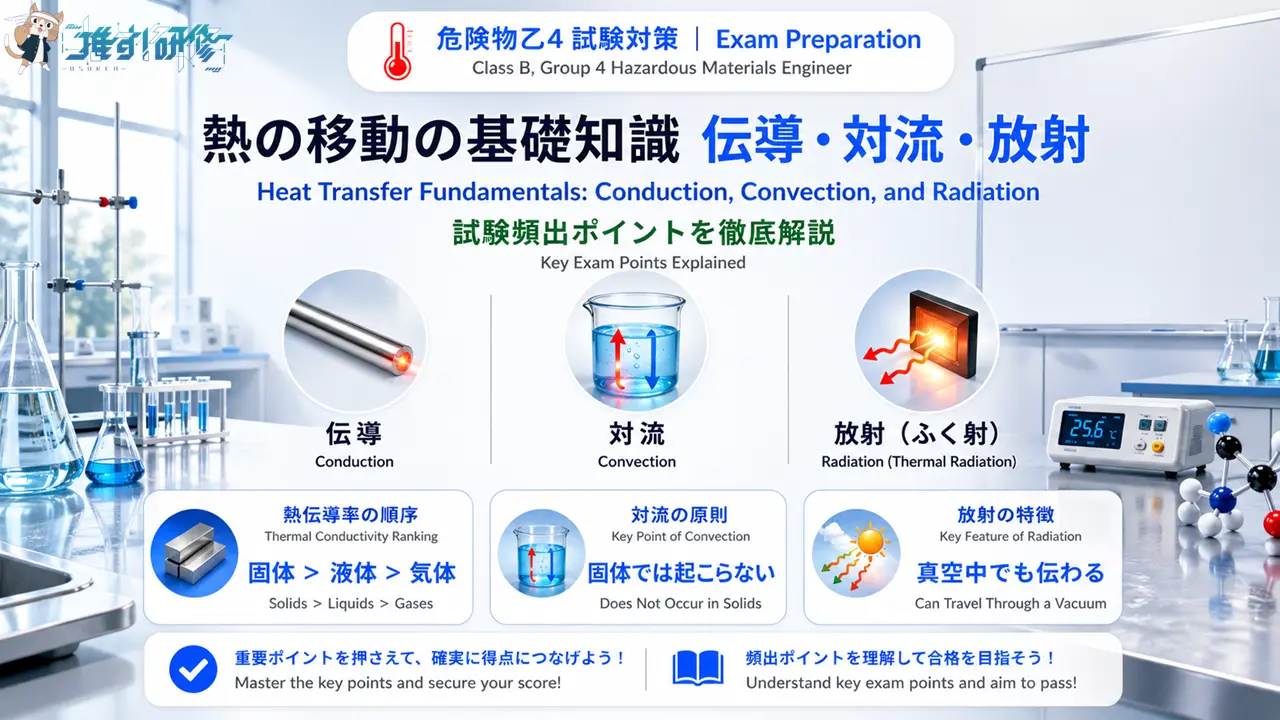
危険物乙4の試験では、「熱の移動」は燃焼・火災のしくみを理解するうえで欠かせない基礎テーマです。「熱が伝わる」という現象は日常生活の中でも身近なものですが、試験では「どのような仕組みで、どのような条件のもとで熱が移動するのか」を正確に区別することが求められます。
In the Class B, Group 4 Hazardous Materials Engineer exam, “heat transfer” is a fundamental topic essential to understanding combustion and fire. While heat transfer is something we experience every day, the exam requires you to accurately distinguish between the different mechanisms — how heat moves and under what conditions.
本記事では、伝導・対流・放射(ふく射)という熱の移動の3つの方法について、物理や化学が苦手な方でもイメージしやすいよう、身近な例を使いながらやさしく解説します。
This article explains the three methods of heat transfer — conduction, convection, and radiation (thermal radiation) — using familiar, everyday examples so that even readers who find physics or chemistry challenging can build a clear mental picture.
目次
熱の移動とは / What Is Heat Transfer?
熱は「温度が高いところから低いところへ」移動する性質があります。この熱の移動には、伝導・対流・放射(ふく射)の3種類があります。それぞれ「どの媒体を通して」「どのように」熱が移動するかが異なります。試験では3種類の名前と、それぞれがどんな場面で起こるかを区別することが重要です。
Heat naturally flows from higher-temperature areas to lower-temperature areas. There are three types of heat transfer: conduction, convection, and radiation (thermal radiation). Each differs in the medium through which heat travels and the way it moves. The exam requires you to know the name of each type and distinguish the situations in which each occurs.
伝導 / Conduction
伝導とは、熱が物質の中を直接伝わって移動する現象です。熱は物質の内部を通じて、温度が高い側から低い側へと伝わっていきます。金属製のスプーンをみそ汁に入れておくと、しばらくして柄の部分まで熱くなってくるのが、伝導の典型的な例です。
Conduction is the process by which heat travels directly through a material. Heat is transferred through the interior of a substance from the hotter side toward the cooler side. A typical example is placing a metal spoon in miso soup — after a short time, even the handle becomes hot as heat conducts through the metal.
熱伝導率 / Thermal Conductivity
物質によって「熱の伝わりやすさ」には大きな差があります。この伝わりやすさを数値で表したものを熱伝導率と呼びます。熱伝導率の値が大きいほど、熱を伝えやすい素材です。
Different materials conduct heat at very different rates. The numerical measure of a material’s ability to conduct heat is called its thermal conductivity. The higher the thermal conductivity value, the more easily the material conducts heat.
熱伝導率を物質の状態で比較すると、固体が最も大きく、液体がその次で、気体が最も小さいという順になります。また、素材の種類で比べると、金属は非金属よりも熱伝導率が高いという特徴があります。さらに、すべての金属の中で、銀(Ag)の熱伝導率が最も大きいことも試験で問われるポイントです。
Comparing thermal conductivity by state of matter, the order is: solids have the highest thermal conductivity, followed by liquids, with gases having the lowest. In terms of material type, metals have higher thermal conductivity than non-metals. It is also a frequently tested point that among all metals, silver (Ag) has the highest thermal conductivity.
日常的なイメージとして、冬に金属製のドアノブはすぐ冷たく感じるのに、木製の椅子は比較的温かく感じます。これは金属の熱伝導率が高く、手の熱をすばやく奪うためです。気体(空気)の熱伝導率の低さは、二重窓の断熱性能の根拠にもなっています。
In everyday terms, a metal door handle feels cold instantly in winter, while a wooden chair feels comparatively warm. This is because metal’s high thermal conductivity quickly draws heat away from your hand. The low thermal conductivity of gases (such as air) is also the principle behind the insulating performance of double-pane windows.
対流 / Convection
対流とは、液体または気体が実際に移動することで熱を運ぶ現象です。温められた液体や気体は軽くなって上昇し、その後冷えて重くなると下降します。この循環する動きが「対流」です。
Convection is the process by which heat is carried by the physical movement of a liquid or gas. When a liquid or gas is heated, it becomes less dense and rises; as it cools, it becomes denser and sinks. This continuous circulation is called convection.
身近な例として、①エアコンの暖房運転では吹き出し口を下向きに設定するのが効果的です。これは温かい空気が上昇しやすいため、下から送ることで部屋全体に対流を起こしやすくするためです。②なべでみそ汁を温めると、底から温められた液体が上昇し、冷たい液体と入れ替わる対流が生じて全体が均一に温まります。
Familiar examples include: ① setting an air conditioner’s heating vent to face downward is effective because warm air tends to rise — blowing it downward creates a convection current that distributes warmth throughout the room; ② when heating miso soup in a pot, the liquid at the bottom is warmed first, rises, and exchanges places with cooler liquid above, creating convection that heats the entire pot evenly.
対流は液体と気体にのみ起こります。固体の中では対流は起こりません。これは固体の中では粒子が自由に動けないためです。試験ではこの点が誤りの選択肢として登場することがあります。
Convection occurs only in liquids and gases — it does not occur in solids. This is because the particles in a solid cannot move freely. This distinction sometimes appears as an incorrect answer option on the exam.
放射(ふく射) / Radiation (Thermal Radiation)
放射(ふく射)とは、熱せられた物体が熱を電磁波(放射線)の形で空間へ放出し、他の物体がそれを吸収することで熱が伝わる現象です。伝導や対流とは違い、物質がなくても熱が伝わるのが最大の特徴です。
Radiation (thermal radiation) is the process by which a heated object emits heat in the form of electromagnetic waves, which are then absorbed by other objects. Unlike conduction and convection, its most important characteristic is that heat can be transferred even without any medium — including through a vacuum.
放射熱は真空中でも伝わり、直進します。また、物体にあたると吸収されたり、反射したりします。太陽の熱が宇宙空間(真空)を越えて地球に届くのは、この放射によるものです。屋外で日当たりのよい場所に立つと顔や腕が温かく感じるのも、太陽から直進してくる放射熱が皮膚に吸収されるためです。
Thermal radiation travels in a straight line and can pass through a vacuum. When it strikes an object, it is either absorbed or reflected. The sun’s heat reaching Earth across the vacuum of space is an example of radiation. Standing outdoors in a sunny spot and feeling warmth on your face and arms is also due to radiant heat from the sun traveling in a straight line and being absorbed by your skin.
3種類の熱移動の比較 / Comparison of the Three Types of Heat Transfer
3つの熱移動の違いを整理しておきましょう。
Let’s summarize the key differences among the three types of heat transfer.
| 種類 / Type | 媒体 / Medium | 真空中 / In a Vacuum | 対象 / Applies to |
|---|---|---|---|
| 伝導 / Conduction | 物質内部を伝わる / Through material | 不可 / No | 主に固体 / Mainly solids |
| 対流 / Convection | 液体・気体が移動 / Fluid movement | 不可 / No | 液体・気体のみ / Liquids and gases only |
| 放射 / Radiation | 電磁波 / Electromagnetic waves | 可 / Yes | すべて / All |
重要ポイント / Key Point
「真空中でも熱が伝わる」のは放射だけです。伝導と対流は、熱を伝えるための物質(媒体)が必ず必要です。この点は試験で繰り返し問われます。
Radiation is the only form of heat transfer that works in a vacuum. Both conduction and convection require a material medium to transfer heat. This distinction is tested repeatedly on the exam.
まとめ / Summary
危険物乙4における熱の移動の重要ポイントをまとめます。
Here is a summary of the key points on heat transfer for the Class B, Group 4 exam.
- 熱の移動は3種類 伝導・対流・放射(ふく射)。それぞれ仕組みと起こる条件が異なる
Three types of heat transfer — Conduction, convection, and radiation; each has a different mechanism and set of conditions - 熱伝導率の順序 固体>液体>気体、金属>非金属、銀がすべての金属の中で最大
Thermal conductivity order — Solids > liquids > gases; metals > non-metals; silver has the highest of all metals - 対流は固体では起こらない 液体と気体にのみ発生する(試験頻出の誤り選択肢)
Convection does not occur in solids — It occurs only in liquids and gases (a frequently tested incorrect option) - 放射は真空中でも伝わる 電磁波として直進し、物質がなくても熱が移動する
Radiation travels through a vacuum — It moves in straight lines as electromagnetic waves and requires no medium - 太陽の熱は放射 宇宙空間(真空)を越えて熱が届くのは放射だけが可能(試験頻出)
Solar heat arrives by radiation — Only radiation can travel across the vacuum of space (frequently tested)
練習問題 熱の移動の理解を確認しよう / Practice Questions: Test Your Understanding
ここまでの内容を試験形式で確認しましょう。解答と解説は各問題の直下に記載しています。
Let’s test what you’ve learned with some exam-style practice questions. The answer and explanation for each question appear directly below it.
問題1 / Question 1
熱の移動の種類とその説明の組み合わせとして、誤っているものはどれか。
Which of the following combinations of heat transfer type and its description is not correct?
- 伝導 ― 物質の内部を通じて、温度の高い側から低い側へ熱が伝わる。
Conduction — Heat travels through the interior of a material from the hotter side to the cooler side. - 対流 ― 温められた液体や気体が移動することで熱が運ばれる。
Convection — Heat is carried by the physical movement of a heated liquid or gas. - 放射 ― 熱を伝えるために空気などの媒体が必ず必要であり、真空中では熱は伝わらない。
Radiation — A medium such as air is always required to transfer heat; heat cannot travel through a vacuum. - 対流 ― 固体の中では起こらず、液体と気体にのみ生じる。
Convection — Does not occur in solids; occurs only in liquids and gases.
解答:3 / Answer: 3
選択肢3が誤りです。放射(ふく射)は電磁波の形で熱を伝えるため、空気などの媒体がなくても、真空中でも熱が伝わります。太陽の熱が真空の宇宙空間を越えて地球に届くのがその証拠です。選択肢1は伝導の正しい説明です。選択肢2は対流の正しい説明です。選択肢4は対流の重要な特徴を正しく述べており、固体では粒子が自由に動けないため対流は発生しません。
Option 3 is incorrect. Radiation transfers heat in the form of electromagnetic waves, which means it does not require any medium such as air — it can travel through a vacuum. The fact that the sun’s heat reaches Earth across the vacuum of space is proof of this. Option 1 correctly describes conduction. Option 2 correctly describes convection. Option 4 correctly states an important characteristic of convection: since particles in a solid cannot move freely, convection does not occur in solids.
問題2 / Question 2
熱伝導率に関する記述として、誤っているものはどれか。
Which of the following statements about thermal conductivity is not correct?
- 一般に、固体は液体よりも熱伝導率が大きい。
In general, solids have higher thermal conductivity than liquids. - 気体は固体や液体と比べて熱伝導率が小さく、熱を伝えにくい。
Gases have lower thermal conductivity than solids or liquids and conduct heat poorly. - 金属は非金属に比べて熱伝導率が大きい。
Metals have higher thermal conductivity than non-metals. - 熱伝導率が大きい物質ほど、断熱材として優れた性能を発揮する。
Materials with higher thermal conductivity perform better as thermal insulators.
解答:4 / Answer: 4
選択肢4が誤りです。熱伝導率が大きい素材ほど熱を伝えやすく、断熱性は低くなります。断熱材として優れているのは、熱伝導率が小さい素材です。空気の熱伝導率が非常に小さいことを利用した二重窓などがその例です。選択肢1・2・3はいずれも正しい記述です。固体>液体>気体の順、金属>非金属の関係は、試験で頻出の重要知識です。
Option 4 is incorrect. Materials with higher thermal conductivity transfer heat more easily — they are poor thermal insulators. Good thermal insulation requires materials with low thermal conductivity. Double-pane windows, which make use of the very low thermal conductivity of air, are a practical example. Options 1, 2, and 3 are all correct. The order solids > liquids > gases, and the relationship metals > non-metals, are important and frequently tested facts.
問題3 / Question 3
次の現象のうち、主として放射(ふく射)によるものはどれか。
Which of the following phenomena is primarily caused by radiation (thermal radiation)?
- 熱した鉄板に手を触れると、手が熱くなった。
Touching a heated iron plate caused the hand to become hot. - 冷房をかけた部屋で、しばらくすると室内全体の温度が下がった。
In a room with air conditioning running, the temperature of the entire room dropped after a while. - 炎の近くに手をかざすと、炎に向いた側の手のひらが温かくなった。
Holding a hand near a flame caused the palm facing the flame to feel warm. - 熱湯の入ったカップを持つと、カップの外側も熱くなった。
Holding a cup filled with hot water caused the outside of the cup to become hot.
解答:3 / Answer: 3
選択肢3が正解です。炎(熱せられた物体)から放射熱が直進して手のひらに届き、吸収されるため温かくなります。手と炎の間に空気はありますが、放射は空気がなくても伝わる性質があり、炎に向いた面だけが選択的に温まるのが放射の特徴です。選択肢1は熱した鉄板に直接触れているため「伝導」です。選択肢2は冷やされた空気が循環して室内全体を冷やしているため「対流」です。選択肢4はお湯からカップへ熱が物質内部を伝わっているため「伝導」です。
Option 3 is correct. Radiant heat travels in a straight line from the flame (a heated object) to the palm and is absorbed, making it feel warm. Although air is present between the hand and the flame, radiation does not require a medium — and the fact that only the side facing the flame becomes warm is a characteristic feature of radiation. Option 1 involves direct contact with a heated iron plate — this is conduction. Option 2 involves cooled air circulating to lower the room temperature — this is convection. Option 4 involves heat passing through the material of the cup from the hot water inside — this is conduction.
- 危険物乙4|静電気の基礎知識と防止対策 Class B, Group 4 Hazardous Materials Engineer | Static Electricity: Fundamentals and Prevention Measures
- QC3|工程能力指数 Cp・Cpkの計算方法と評価基準 QC3 | Process Capability Index: Cp and Cpk Calculation and Evaluation Criteria
この記事を書いた人

関連記事
-
 危険物乙4|アルコール類の性状を徹底解説【メタノール・エタノール・n-プロピルアルコール・イソプロピルアルコール】 Class B, Group 4 Hazardous Materials Engineer | Properties of Alcohols: Methanol, Ethanol, n-Propyl Alcohol, and Isopropyl Alcohol Explained
 -
危険物乙4|第一石油類の性状を徹底解説【ガソリン・ベンゼン・トルエン・アセトンほか】 Class B, Group 4 Hazardous Materials Engineer | Properties of Category 1 Petroleum: Gasoline, Benzene, Toluene, Acetone, and More Explained
-
危険物乙4|特殊引火物の性状を徹底解説【ジエチルエーテル・二硫化炭素・アセトアルデヒド・酸化プロピレン】 Class B, Group 4 Hazardous Materials Engineer | Properties of Special Flammable Liquids: Diethyl Ether, Carbon Disulfide, Acetaldehyde, and Propylene Oxide Explained
-
危険物乙4|酸と塩基・酸化と還元・金属腐食の基礎知識 Class B, Group 4 Hazardous Materials Engineer | Acids and Bases, Oxidation and Reduction, and Metal Corrosion
-
危険物乙4|単体・化合物・混合物と状態変化の基礎知識 Class B, Group 4 Hazardous Materials Engineer | Simple Substances, Compounds, Mixtures, and Changes of State
-
危険物乙4|保安距離と保有空地の対象施設・数値基準をわかりやすく解説 Class B Group 4 Hazardous Materials Engineer | Safety Distances and Open Space Requirements Explained
-
危険物乙4|免状の交付・書換え・再交付の申請先と手続きをわかりやすく解説 Class B Group 4 Hazardous Materials Engineer | License Issuance, Amendment, Reissuance, and Surrender: Application Authorities and Procedures Explained
-
危険物乙4|静電気の基礎知識と防止対策 Class B, Group 4 Hazardous Materials Engineer | Static Electricity: Fundamentals and Prevention Measures