第4類危険物の分類と引火点をわかりやすく解説 Class B, Group 4 Hazardous Materials Engineer | Classifications and Flash Points: A Complete Guide
危険物乙4の試験では、第4類危険物の分類に関する問題が頻繁に出題されます。第4類危険物は「引火性液体」と呼ばれ、ガソリンや灯油など私たちの身近にある物質が多く含まれています。本記事では、第4類危険物の7つの分類について、引火点の数値や代表的な物質を整理しながらわかりやすく解説します。水溶性と非水溶性の違いについても触れていますので、試験対策の参考にしてください。
Questions about the classification of Group 4 hazardous materials appear frequently in the Class B, Group 4 Hazardous Materials Engineer exam. Group 4 hazardous materials are known as “flammable liquids” and include many substances familiar in daily life, such as gasoline and kerosene. This article explains the seven classifications of Group 4 hazardous materials in a clear and organized manner, covering flash point values and representative substances for each category. The difference between water-soluble and non-water-soluble substances is also addressed, so please use this article as a reference for your exam preparation.
目次
第4類危険物とは?引火性液体の基礎知識 What Are Group 4 Hazardous Materials? Basic Knowledge of Flammable Liquids
まずは第4類危険物の基本的な定義と特徴を押さえましょう。なぜ「引火点」という概念が重要なのかを理解することで、分類の意味がより明確になります。
Let us start by understanding the basic definition and characteristics of Group 4 hazardous materials. Understanding why the concept of the “flash point” is important will make the meaning of each classification much clearer.
第4類危険物の定義と特徴 Definition and Characteristics of Group 4 Hazardous Materials
第4類危険物は「引火性液体」と定義されています。引火性液体とは、液体であって引火の危険性があるものを指します。消防法では、引火点が250℃未満の液体、または引火点が250℃以上で燃焼点が引火点から10℃以内の液体を第4類危険物として規定しています。
Group 4 hazardous materials are defined as “flammable liquids.” Flammable liquids refer to liquids that pose a risk of ignition. Under the Fire Services Act, liquids with a flash point below 250°C, or liquids with a flash point of 250°C or above where the fire point is within 10°C of the flash point, are classified as Group 4 hazardous materials.
第4類危険物に共通する特徴として、以下の点が挙げられます。液体であること、蒸気が空気より重いこと、水より軽いものが多いこと、そして静電気が発生しやすいことです。これらの特徴は、貯蔵や取扱いの際の注意点にも関係してきます。
Common characteristics shared by Group 4 hazardous materials include the following: they are liquid; their vapors are heavier than air; many are lighter than water; and they tend to generate static electricity. These characteristics are also directly related to the precautions required during storage and handling.
なぜ「引火点」が重要なのか Why Is the “Flash Point” Important?
引火点とは、液体が点火源によって引火するのに十分な濃度の蒸気を発生する最低の温度のことです。引火点が低いほど、常温でも引火しやすく危険性が高いということになります。
The flash point is the lowest temperature at which a liquid produces a sufficient concentration of vapor to ignite when exposed to an ignition source. The lower the flash point, the more easily the substance ignites at room temperature and the more hazardous it is.
第4類危険物の分類は、主にこの引火点の数値によって区分されています。引火点が低い物質ほど厳しく管理する必要があるため、指定数量も少なく設定されています。試験では引火点の数値を正確に覚えることが求められますので、各分類の境界となる温度をしっかり押さえておきましょう。
The classification of Group 4 hazardous materials is primarily based on these flash point values. Substances with lower flash points require stricter management, and therefore their designated quantities are set lower. The exam requires you to accurately memorize flash point values, so make sure to firmly grasp the boundary temperatures that define each classification.
第4類危険物の分類一覧|7つの品名を覚えよう Classifications of Group 4 Hazardous Materials | Learn the 7 Categories
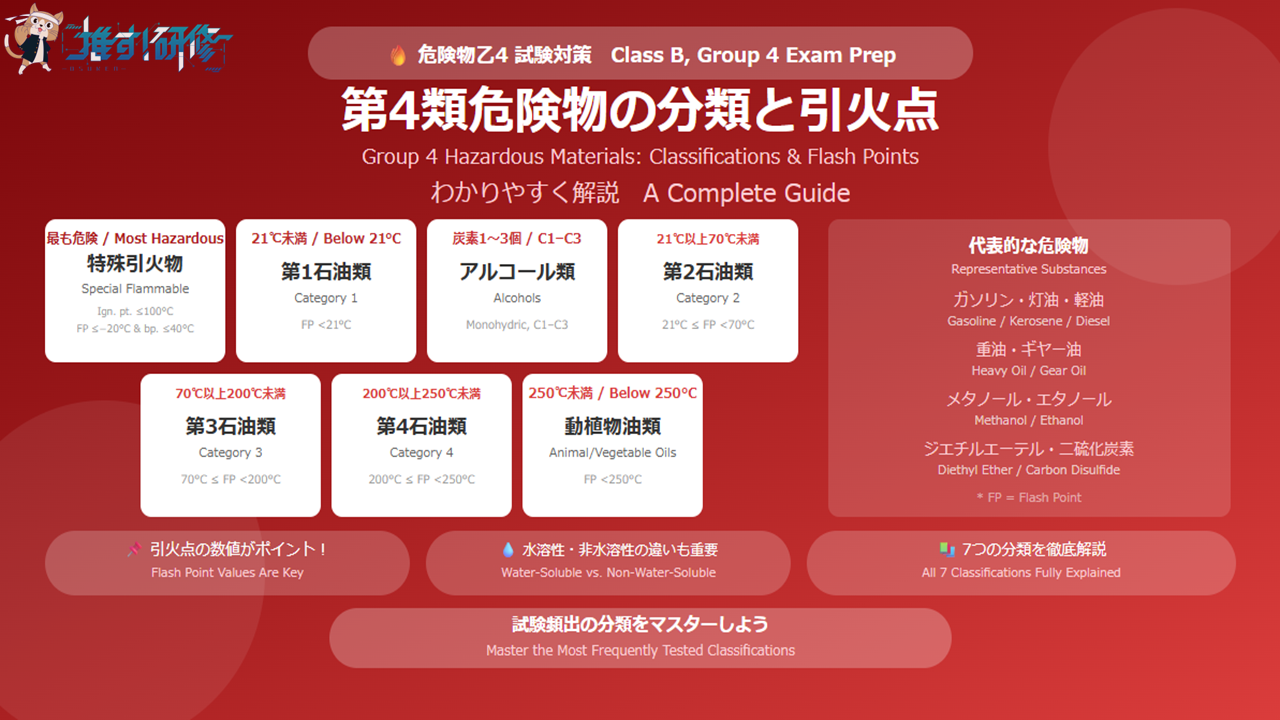
第4類危険物は、引火点や性質によって7つの品名に分類されています。それぞれの定義と代表的な物質を順番に見ていきましょう。
Group 4 hazardous materials are classified into seven categories based on flash point and physical properties. Let us go through the definition and representative substances for each category in order.
特殊引火物|最も危険性が高い Special Flammable Substances | The Most Hazardous
特殊引火物は、第4類危険物の中で最も危険性が高い物質です。定義は「1気圧において発火点が100℃以下のもの、または引火点が−20℃以下で沸点が40℃以下のもの」とされています。
Special flammable substances are the most hazardous among Group 4 hazardous materials. They are defined as “substances with an ignition point of 100°C or below at 1 atm, or substances with a flash point of −20°C or below and a boiling point of 40°C or below.”
代表的な物質には、ジエチルエーテル、二硫化炭素、アセトアルデヒド、酸化プロピレンがあります。これらは常温でも非常に引火しやすく、取扱いには細心の注意が必要です。指定数量は50Lと、第4類危険物の中で最も少なく設定されています。
Representative substances include diethyl ether, carbon disulfide, acetaldehyde, and propylene oxide. These substances are extremely flammable even at room temperature and require the utmost care during handling. The designated quantity is 50 L, the lowest among all Group 4 hazardous materials.
第1石油類|ガソリンが代表例 Category 1 Petroleum Products | Gasoline as a Representative Example
第1石油類は「1気圧において引火点が21℃未満のもの」と定義されています。21℃未満ということは、夏場の常温でも引火する可能性があることを意味します。
Category 1 petroleum products are defined as “substances with a flash point below 21°C at 1 atm.” A flash point below 21°C means there is a risk of ignition even at typical room temperature during summer.
第1石油類は水溶性と非水溶性に分かれます。非水溶性の代表例はガソリン、ベンゼン、トルエン、酢酸エチル、エチルメチルケトンです。水溶性の代表例はアセトン、ピリジンです。非水溶性の指定数量は200L、水溶性の指定数量は400Lとなっています。
Category 1 petroleum products are divided into non-water-soluble and water-soluble types. Representative non-water-soluble substances include gasoline, benzene, toluene, ethyl acetate, and ethyl methyl ketone. Representative water-soluble substances include acetone and pyridine. The designated quantity for non-water-soluble is 200 L, and for water-soluble is 400 L.
アルコール類|炭素数がポイント Alcohols | Carbon Count Is the Key
アルコール類は、他の分類とは異なり、引火点ではなく分子構造によって定義されています。「1分子を構成する炭素の原子の数が1個から3個までの飽和1価アルコール」がアルコール類に該当します。ただし、この飽和1価アルコールの含有量が60%未満の水溶液は除かれます。
Unlike the other classifications, alcohols are defined not by flash point but by molecular structure. “Saturated monohydric alcohols with 1 to 3 carbon atoms per molecule” are classified as alcohols. However, aqueous solutions containing less than 60% of such saturated monohydric alcohols are excluded from this classification.
代表的な物質は、メチルアルコール(メタノール)とエチルアルコール(エタノール)です。これらは消毒用アルコールや燃料として広く使用されています。指定数量は400Lです。
Representative substances are methyl alcohol (methanol) and ethyl alcohol (ethanol). These are widely used as disinfectant alcohol and fuel. The designated quantity is 400 L.
第2石油類|灯油、軽油が該当 Category 2 Petroleum Products | Kerosene and Light Oil
第2石油類は「1気圧において引火点が21℃以上70℃未満のもの」と定義されています。第1石油類よりは引火点が高く、常温での危険性はやや低くなります。
Category 2 petroleum products are defined as “substances with a flash point of 21°C or above and below 70°C at 1 atm.” Their flash points are higher than those of Category 1 petroleum products, making them slightly less hazardous at room temperature.
非水溶性の代表例は灯油、軽油、キシレン、スチレン、クロロベンゼンです。水溶性の代表例は酢酸、プロピオン酸、アクリル酸です。非水溶性の指定数量は1,000L、水溶性の指定数量は2,000Lです。灯油や軽油は家庭や自動車で日常的に使用されている物質です。
Representative non-water-soluble substances include kerosene, light oil (diesel), xylene, styrene, and chlorobenzene. Representative water-soluble substances include acetic acid, propionic acid, and acrylic acid. The designated quantity for non-water-soluble is 1,000 L, and for water-soluble is 2,000 L. Kerosene and light oil are substances used routinely in homes and vehicles.
第3石油類|重油が代表例 Category 3 Petroleum Products | Heavy Oil as a Representative Example
第3石油類は「1気圧において引火点が70℃以上200℃未満のもの」と定義されています。引火点が70℃以上あるため、常温では引火しにくい物質です。
Category 3 petroleum products are defined as “substances with a flash point of 70°C or above and below 200°C at 1 atm.” With a flash point of 70°C or above, these substances are unlikely to ignite under normal room temperature conditions.
非水溶性の代表例は重油、クレオソート油、アニリン、ニトロベンゼンです。水溶性の代表例はグリセリン、エチレングリコールです。非水溶性の指定数量は2,000L、水溶性の指定数量は4,000Lです。重油は船舶や工場のボイラー燃料として使用されています。
Representative non-water-soluble substances include heavy oil, creosote oil, aniline, and nitrobenzene. Representative water-soluble substances include glycerin and ethylene glycol. The designated quantity for non-water-soluble is 2,000 L, and for water-soluble is 4,000 L. Heavy oil is used as fuel for ships and factory boilers.
第4石油類|潤滑油、ギヤー油など Category 4 Petroleum Products | Lubricating Oils, Gear Oil, and More
第4石油類は「1気圧において引火点が200℃以上250℃未満のもの」と定義されています。また、「潤滑油・可塑剤などで、1気圧で20℃で液状であり、引火点が200℃以上250℃未満のもの」という条件もあります。
Category 4 petroleum products are defined as “substances with a flash point of 200°C or above and below 250°C at 1 atm.” An additional condition states that they must be lubricating oils or plasticizers that are liquid at 20°C under 1 atm and have a flash point of 200°C or above and below 250°C.
代表的な物質は、ギヤー油、シリンダー油、タービン油、モーター油、マシン油、可塑剤です。これらは機械の潤滑や工業製品の製造に使用されています。指定数量は6,000Lで、第4類危険物の中では比較的多く設定されています。なお、第4石油類には水溶性と非水溶性の区別はありません。
Representative substances include gear oil, cylinder oil, turbine oil, motor oil, machine oil, and plasticizers. These are used for machine lubrication and the manufacturing of industrial products. The designated quantity is 6,000 L, which is relatively high among Group 4 hazardous materials. Note that Category 4 petroleum products have no distinction between water-soluble and non-water-soluble.
動植物油類|引火点250℃未満 Animal and Vegetable Oils | Flash Point Below 250°C
動植物油類は「動物の脂肉または植物の種子等から抽出した油で、1気圧において引火点が250℃未満のもの」と定義されています。
Animal and vegetable oils are defined as “oils extracted from animal fat or plant seeds, with a flash point below 250°C at 1 atm.”
代表的な物質は、ナタネ油、ヤシ油、オリーブ油、ニシン油、アマニ油です。これらは食用油や工業原料として使用されています。指定数量は10,000Lで、第4類危険物の中で最も多く設定されています。動植物油類も水溶性・非水溶性の区別はありません。
Representative substances include rapeseed oil, coconut oil, olive oil, herring oil, and linseed oil. These are used as edible oils and industrial raw materials. The designated quantity is 10,000 L, the highest among all Group 4 hazardous materials. Animal and vegetable oils also have no distinction between water-soluble and non-water-soluble.
水溶性と非水溶性の違い|指定数量に影響する Water-Soluble vs. Non-Water-Soluble | Impact on Designated Quantities
第1石油類から第3石油類までは、水溶性と非水溶性に区分されています。この区分は指定数量に影響する重要なポイントです。
From Category 1 to Category 3 petroleum products, substances are divided into water-soluble and non-water-soluble types. This distinction is an important point that directly affects designated quantities.
水溶性液体とは What Are Water-Soluble Liquids?
水溶性液体とは、水に溶ける性質を持つ液体のことです。アセトン、メタノール、エタノール、酢酸、グリセリンなどが該当します。これらは水と混ざり合うため、火災時に水で薄めることで消火効果が期待できる場合があります。
Water-soluble liquids are liquids that dissolve in water. Examples include acetone, methanol, ethanol, acetic acid, and glycerin. Because these substances mix with water, diluting them with water during a fire may provide some extinguishing effect in certain situations.
非水溶性液体とは What Are Non-Water-Soluble Liquids?
非水溶性液体とは、水に溶けない性質を持つ液体のことです。ガソリン、灯油、軽油、重油などが該当します。これらは水より軽いため、水をかけると油が水の上に浮いて火災が拡大する危険があります。
Non-water-soluble liquids are liquids that do not dissolve in water. Examples include gasoline, kerosene, light oil, and heavy oil. Because these substances are lighter than water, applying water to a fire involving them can cause the oil to float on the water’s surface, risking further spread of the fire.
なぜ水溶性と非水溶性の区別が重要なのか Why Is the Distinction Between Water-Soluble and Non-Water-Soluble Important?
水溶性と非水溶性の区別が重要な理由は、主に2つあります。
There are mainly two reasons why the distinction between water-soluble and non-water-soluble is important.
1つ目は指定数量の違いです。同じ石油類でも、水溶性の方が非水溶性の2倍の指定数量が設定されています。これは、水溶性液体の方が消火しやすいと考えられているためです。
The first is the difference in designated quantities. Even within the same petroleum category, the designated quantity for water-soluble substances is set at twice that of non-water-soluble substances. This is because water-soluble liquids are generally considered easier to extinguish.
2つ目は消火方法の違いです。非水溶性液体の火災には、泡消火剤や二酸化炭素消火剤が有効です。一方、水溶性液体の火災には、耐アルコール泡消火剤を使用する必要があります。通常の泡消火剤では泡が溶けてしまうためです。
The second is the difference in extinguishing methods. For fires involving non-water-soluble liquids, foam extinguishing agents or carbon dioxide extinguishing agents are effective. For fires involving water-soluble liquids, however, alcohol-resistant foam extinguishing agents must be used. This is because ordinary foam agents break down when they come into contact with water-soluble liquids.
試験で狙われるポイント|引火点の数値を整理 Key Exam Topics | Organizing Flash Point Values
ここまで学んだ内容を試験対策の観点から整理しましょう。引火点の数値と代表的な物質は、確実に暗記しておく必要があります。
Let us now organize what we have covered so far from an exam preparation perspective. Flash point values and representative substances must be memorized with certainty.
引火点の覚え方|数値の境界線を意識する How to Memorize Flash Points | Focus on the Boundary Values
第4類危険物の引火点は、以下の境界線を覚えることがポイントです。
The key to memorizing flash points for Group 4 hazardous materials is to learn the following boundary values.
特殊引火物は発火点100℃以下、または引火点−20℃以下かつ沸点40℃以下です。第1石油類は引火点21℃未満、第2石油類は21℃以上70℃未満、第3石油類は70℃以上200℃未満、第4石油類は200℃以上250℃未満、動植物油類は250℃未満です。
Special flammable substances: ignition point of 100°C or below, or flash point of −20°C or below and boiling point of 40°C or below. Category 1 petroleum products: flash point below 21°C. Category 2: 21°C or above and below 70°C. Category 3: 70°C or above and below 200°C. Category 4: 200°C or above and below 250°C. Animal and vegetable oils: below 250°C.
覚え方のコツとして、「21、70、200、250」という数字の並びを意識してください。21℃を境に第1石油類と第2石油類が分かれ、70℃を境に第2石油類と第3石油類が分かれます。200℃を境に第3石油類と第4石油類が分かれ、250℃が第4石油類と動植物油類の上限となります。
As a memory tip, be conscious of the number sequence “21, 70, 200, 250.” The boundary at 21°C separates Category 1 and Category 2 petroleum products; 70°C separates Category 2 and Category 3; 200°C separates Category 3 and Category 4; and 250°C is the upper limit for both Category 4 petroleum products and animal and vegetable oils.
頻出の代表的な危険物を押さえる Master the Frequently Tested Representative Substances
試験では、物質名を見てどの分類に該当するかを判断する問題が出題されます。以下の物質は必ず覚えておきましょう。
The exam includes questions that ask you to identify which classification a substance belongs to based on its name. Be sure to memorize the following substances.
特殊引火物はジエチルエーテル、二硫化炭素です。第1石油類(非水溶性)はガソリン、ベンゼン、トルエンです。第1石油類(水溶性)はアセトン、ピリジンです。アルコール類はメタノール、エタノールです。第2石油類(非水溶性)は灯油、軽油です。第3石油類(非水溶性)は重油です。第4石油類はギヤー油、シリンダー油です。動植物油類はアマニ油、ナタネ油です。
Special flammable substances: diethyl ether, carbon disulfide. Category 1 petroleum products (non-water-soluble): gasoline, benzene, toluene. Category 1 petroleum products (water-soluble): acetone, pyridine. Alcohols: methanol, ethanol. Category 2 petroleum products (non-water-soluble): kerosene, light oil. Category 3 petroleum products (non-water-soluble): heavy oil. Category 4 petroleum products: gear oil, cylinder oil. Animal and vegetable oils: linseed oil, rapeseed oil.
まとめ|第4類危険物の分類を得点源にしよう Summary | Make Group 4 Classifications Your Scoring Strength
本記事では、第4類危険物の7つの分類について解説しました。最後に、試験対策として押さえておきたいポイントを整理します。
This article has explained the seven classifications of Group 4 hazardous materials. Finally, let us organize the key points to keep in mind for exam preparation.
第4類危険物は引火性液体であり、引火点の数値によって7つに分類されます。引火点の境界線は「21℃、70℃、200℃、250℃」を意識して覚えましょう。アルコール類だけは引火点ではなく、炭素数1〜3個の飽和1価アルコールという定義で分類されています。
Group 4 hazardous materials are flammable liquids, classified into seven categories based on flash point values. Remember the flash point boundaries by being conscious of “21°C, 70°C, 200°C, and 250°C.” Alcohols are the only classification defined not by flash point but by the molecular structure of saturated monohydric alcohols with 1 to 3 carbon atoms.
水溶性と非水溶性の区別も重要です。第1石油類から第3石油類までは水溶性と非水溶性に分かれており、水溶性の方が指定数量は2倍に設定されています。消火方法も異なるため、この違いを理解しておくことが大切です。
The distinction between water-soluble and non-water-soluble is also important. From Category 1 to Category 3 petroleum products, substances are divided into these two types, with the designated quantity for water-soluble substances set at twice that of non-water-soluble substances. The extinguishing methods also differ, so understanding this distinction is essential.
代表的な物質として、ガソリン(第1石油類)、灯油と軽油(第2石油類)、重油(第3石油類)は日常生活でも馴染みがあり、覚えやすいでしょう。特殊引火物のジエチルエーテルや二硫化炭素は、最も危険性が高い物質として必ず覚えておいてください。
Among representative substances, gasoline (Category 1), kerosene and light oil (Category 2), and heavy oil (Category 3) are familiar from everyday life and easy to remember. Diethyl ether and carbon disulfide, as special flammable substances, are among the most hazardous materials in Group 4 and must be memorized without fail.
第4類危険物の分類は、危険物乙4の試験で繰り返し出題されるテーマです。本記事の内容をしっかり復習し、確実に得点できる分野にしていきましょう。
The classification of Group 4 hazardous materials is a theme that appears repeatedly throughout the Class B, Group 4 Hazardous Materials Engineer exam. Review the content of this article thoroughly and make this a topic on which you can score with confidence.
練習問題 第4類危険物の分類を確認しよう Practice Questions: Check Your Understanding of Group 4 Classifications
ここまで学んだ内容を確認するため、試験形式の練習問題に挑戦してみましょう。解答は各問題の下に記載しています。
To check your understanding of what you have learned, let us try some practice questions in exam format. Answers are provided below each question.
問題1 Question 1
第4類危険物の分類と引火点の組み合わせとして、正しいものはどれか。
Which of the following is the correct combination of Group 4 hazardous materials classification and flash point?
- 第1石油類 ― 引火点70℃以上200℃未満 / Category 1 Petroleum Products ― Flash point 70°C or above and below 200°C
- 第2石油類 ― 引火点21℃以上70℃未満 / Category 2 Petroleum Products ― Flash point 21°C or above and below 70°C
- 第3石油類 ― 引火点21℃未満 / Category 3 Petroleum Products ― Flash point below 21°C
- 第4石油類 ― 引火点100℃以上150℃未満 / Category 4 Petroleum Products ― Flash point 100°C or above and below 150°C
解答:2 / Answer: 2
第2石油類の引火点は「21℃以上70℃未満」が正しい定義です。選択肢1は第3石油類の引火点(70℃以上200℃未満)、選択肢3は第1石油類の引火点(21℃未満)、選択肢4は第4石油類の正しい範囲(200℃以上250℃未満)ではありません。引火点の境界線「21・70・200・250」を繰り返し確認しておきましょう。
The correct definition for Category 2 Petroleum Products is a flash point of “21°C or above and below 70°C.” Option 1 describes the flash point of Category 3 Petroleum Products (70°C or above and below 200°C). Option 3 describes the flash point of Category 1 Petroleum Products (below 21°C). Option 4 does not match the correct range for Category 4 Petroleum Products (200°C or above and below 250°C). Review the flash point boundaries “21, 70, 200, 250” repeatedly until they are firmly memorized.
問題2 Question 2
次の物質のうち、特殊引火物に該当するものはどれか。
Which of the following substances falls under the category of Special Flammable Substances?
- ガソリン / Gasoline
- アセトン / Acetone
- 二硫化炭素 / Carbon disulfide
- 灯油 / Kerosene
解答:3 / Answer: 3
二硫化炭素は特殊引火物の代表例です。発火点が低く(約90℃)、引火点も非常に低い(約−30℃)ため、第4類危険物の中で最も危険性が高い物質の1つです。選択肢1のガソリンは第1石油類(非水溶性)、選択肢2のアセトンは第1石油類(水溶性)、選択肢4の灯油は第2石油類(非水溶性)に分類されます。
Carbon disulfide is a representative example of special flammable substances. It has a low ignition point (approx. 90°C) and a very low flash point (approx. −30°C), making it one of the most hazardous substances among all Group 4 hazardous materials. Option 1, gasoline, is classified as Category 1 Petroleum Products (non-water-soluble); Option 2, acetone, as Category 1 Petroleum Products (water-soluble); and Option 4, kerosene, as Category 2 Petroleum Products (non-water-soluble).
問題3 Question 3
水溶性と非水溶性の区別に関する次の記述のうち、正しいものはどれか。
Which of the following statements regarding the distinction between water-soluble and non-water-soluble substances is correct?
- 水溶性液体の指定数量は、同じ分類の非水溶性液体の半分に設定されている。 / The designated quantity for water-soluble liquids is set at half that of non-water-soluble liquids in the same classification.
- 第4石油類と動植物油類には、水溶性と非水溶性の区別がある。 / Category 4 Petroleum Products and animal and vegetable oils have a distinction between water-soluble and non-water-soluble.
- 水溶性液体の火災には、通常の泡消火剤が最も有効である。 / Ordinary foam extinguishing agents are most effective for fires involving water-soluble liquids.
- 水溶性液体の指定数量は、同じ分類の非水溶性液体の2倍に設定されている。 / The designated quantity for water-soluble liquids is set at twice that of non-water-soluble liquids in the same classification.
解答:4 / Answer: 4
水溶性液体の指定数量は、同じ分類の非水溶性液体の2倍に設定されています(例:第1石油類の非水溶性200L、水溶性400L)。これは水溶性液体の方が消火しやすいと考えられているためです。選択肢1は逆で2倍が正しい。選択肢2は誤りで、第4石油類と動植物油類には水溶性・非水溶性の区別はありません。選択肢3は誤りで、水溶性液体の火災には耐アルコール泡消火剤が必要です。
The designated quantity for water-soluble liquids is set at twice that of non-water-soluble liquids in the same classification (e.g., Category 1 Petroleum Products: non-water-soluble 200 L, water-soluble 400 L). This is because water-soluble liquids are considered easier to extinguish. Option 1 is reversed — twice, not half, is correct. Option 2 is incorrect — Category 4 Petroleum Products and animal and vegetable oils have no water-soluble/non-water-soluble distinction. Option 3 is incorrect — alcohol-resistant foam extinguishing agents are required for fires involving water-soluble liquids.
- QC3|データの種類とサンプリングをわかりやすく解説
- 研修後のフォローアップ完全ガイド|効果を最大化する6つの施策とチェックリスト The Complete Guide to Post-Training Follow-Up | 6 Initiatives and a Checklist to Maximize Training Effectiveness
この記事を書いた人

関連記事
-
 危険物乙4「運搬の基準」完全まとめ|試験頻出ポイントを徹底解説
 -
危険物乙4の難易度は?合格率・勉強時間・他の資格との比較で徹底解説 How Difficult Is the Class B, Group 4 Hazardous Materials Engineer Exam? Pass Rates, Study Time, and Comparison with Other Certifications
-
危険物乙4|製造所・貯蔵所・取扱所の区分と覚え方|試験頻出ポイントを解説
-
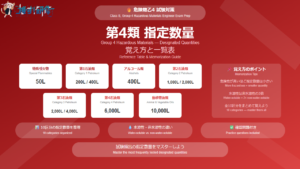
危険物乙4|指定数量の覚え方と一覧表 Class B, Group 4 Hazardous Materials Engineer | Designated Quantities: Reference Table & Memorization Guide
-
危険物乙4で覚えるべき「類別」とは?第1類〜第6類の特徴をわかりやすく解説