危険物乙4|指定数量の覚え方と一覧表 Class B, Group 4 Hazardous Materials Engineer | Designated Quantities: Reference Table & Memorization Guide
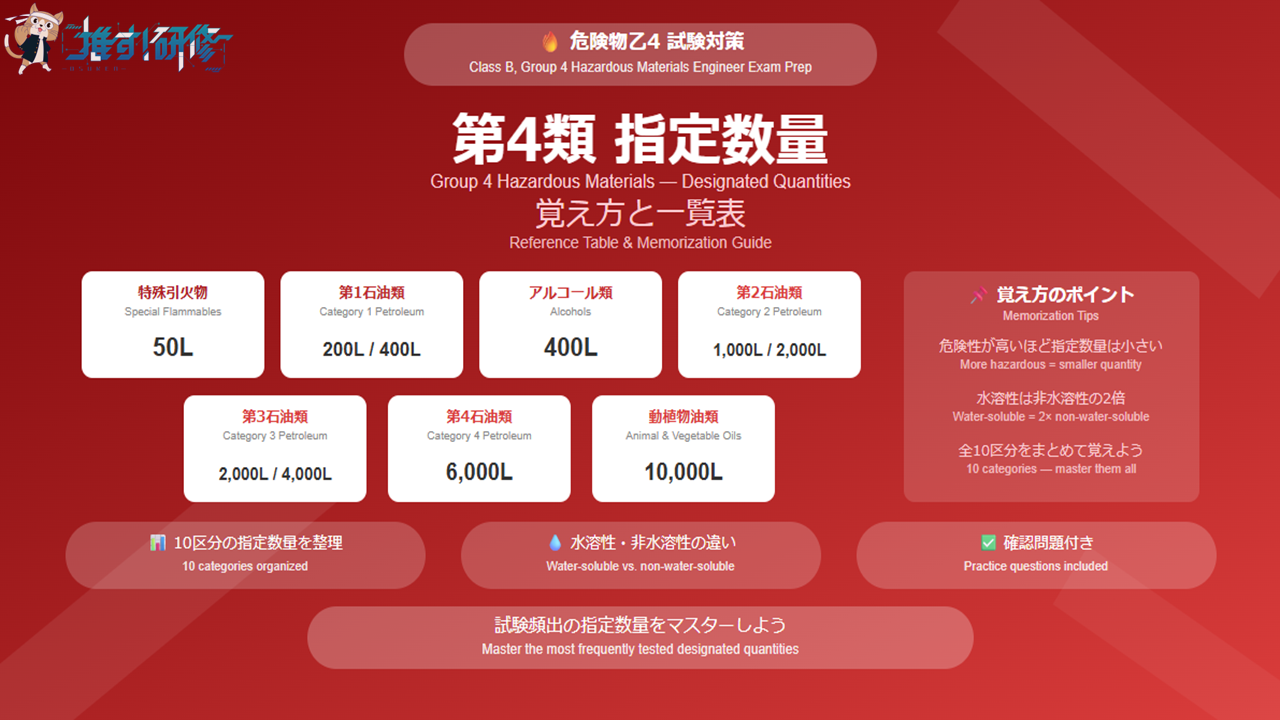
危険物乙4の試験において、「指定数量」は避けて通れない重要テーマです。第4類危険物だけでも10種類以上の数値を覚える必要があり、多くの受験者が苦戦するポイントでもあります。
In the Class B, Group 4 Hazardous Materials Engineer exam, “designated quantities” is one of the most critical topics you simply cannot skip. With more than ten different values to memorize for Group 4 hazardous materials alone, it’s a section that trips up a lot of test-takers.
本記事では、指定数量の一覧表を整理したうえで、効率的な暗記法を紹介します。「数字が覚えられない」という方は、ぜひ最後までお読みください。
This article provides a comprehensive reference table of designated quantities along with practical memorization strategies. If you’ve been struggling to remember all the numbers, read on to the end.
目次
はじめに / Introduction
指定数量とは、消防法で定められた危険物の貯蔵・取扱いの基準となる数量です。この数量以上の危険物を扱う場合、危険物取扱者の資格が必要になります。
A designated quantity is the threshold amount established by Japan’s Fire Services Act that governs the storage and handling of hazardous materials. Once you handle an amount at or above this threshold, a licensed hazardous materials handler is legally required.
試験では、各物品の指定数量を問う問題だけでなく、複数の危険物を貯蔵する場合の「指定数量の倍数計算」も出題されます。まずは一覧表で全体像を把握しましょう。
The exam tests not only your knowledge of individual designated quantities, but also your ability to calculate the “multiple of designated quantities” when storing two or more hazardous materials together. Start by reviewing the full reference table below to get the big picture.
第4類 指定数量一覧表 / Group 4 Hazardous Materials — Designated Quantities Reference Table
第4類危険物(引火性液体)は、品名ごとに指定数量が定められています。さらに、水溶性と非水溶性で数量が異なる品名もあるため、合計10区分を覚える必要があります。以下の一覧表で全体を確認しましょう。
Group 4 hazardous materials (flammable liquids) each have their own designated quantity. Some categories are further split into water-soluble and non-water-soluble subcategories with different values, bringing the total number of entries to memorize to ten. Use the table below to review all of them at once.
| 品名 / Category | 性質 / Solubility | 指定数量 / Designated Qty. | 代表的な物品名 / Key Examples |
|---|---|---|---|
| 特殊引火物 / Special Flammables | ― | 50L | ジエチルエーテル、二硫化炭素、アセトアルデヒド、酸化プロピレン / Diethyl ether, Carbon disulfide, Acetaldehyde, Propylene oxide |
| 第1石油類 / Category 1 Petroleum | 非水溶性 / Non-water-soluble | 200L | ガソリン、ベンゼン、トルエン、酢酸エチル、エチルメチルケトン / Gasoline, Benzene, Toluene, Ethyl acetate, Ethyl methyl ketone |
| 第1石油類 / Category 1 Petroleum | 水溶性 / Water-soluble | 400L | アセトン、ピリジン / Acetone, Pyridine |
| アルコール類 / Alcohols | ― | 400L | メタノール、エタノール / Methanol, Ethanol |
| 第2石油類 / Category 2 Petroleum | 非水溶性 / Non-water-soluble | 1,000L | 灯油、軽油、キシレン、スチレン、1-ブタノール、クロロベンゼン / Kerosene, Diesel, Xylene, Styrene, 1-Butanol, Chlorobenzene |
| 第2石油類 / Category 2 Petroleum | 水溶性 / Water-soluble | 2,000L | 酢酸、アクリル酸、プロピオン酸 / Acetic acid, Acrylic acid, Propionic acid |
| 第3石油類 / Category 3 Petroleum | 非水溶性 / Non-water-soluble | 2,000L | 重油、クレオソート油、アニリン、ニトロベンゼン / Heavy fuel oil, Creosote oil, Aniline, Nitrobenzene |
| 第3石油類 / Category 3 Petroleum | 水溶性 / Water-soluble | 4,000L | グリセリン、エチレングリコール / Glycerin, Ethylene glycol |
| 第4石油類 / Category 4 Petroleum | ― | 6,000L | ギヤー油、シリンダー油、タービン油、モーター油、マシン油 / Gear oil, Cylinder oil, Turbine oil, Motor oil, Machine oil |
| 動植物油類 / Animal & Vegetable Oils | ― | 10,000L | アマニ油、イワシ油、ナタネ油、ヤシ油、オリーブ油、ニシン油 / Linseed oil, Sardine oil, Canola oil, Coconut oil, Olive oil, Herring oil |
品名別の詳細解説 / Detailed Breakdown by Category
一覧表で全体像を把握したところで、各品名の特徴と代表的な物品名を詳しく見ていきましょう。試験では、物品名から品名を判断する問題や、各品名の定義を問う問題が頻出です。それぞれの引火点の範囲や代表例をしっかり押さえておくことが合格への近道です。
Now that you have the full picture from the table, let’s take a closer look at the characteristics and representative substances for each category. The exam frequently tests whether you can identify a category from a substance name, and whether you know the definition of each category. Mastering the flash point ranges and key examples for each is the most direct path to passing.
特殊引火物(50L) / Special Flammables (50 L)
第4類の中で最も危険性が高く、指定数量も最少です。
This is the most hazardous subcategory within Group 4, and accordingly has the smallest designated quantity.
特徴 / Characteristics
発火点が100℃以下、または引火点が-20℃以下で沸点が40℃以下という条件を満たす物質です。常温でも容易に引火し、揮発性が極めて高いため、取扱いには細心の注意が必要です。
These substances either have an ignition point at or below 100°C, or a flash point at or below -20°C combined with a boiling point at or below 40°C. They ignite easily at room temperature and are highly volatile, demanding extreme caution when handled.
代表例と特性 / Key Examples and Properties
ジエチルエーテルは麻酔作用があり、静電気で引火しやすい性質を持ちます。二硫化炭素は発火点が約90℃と非常に低く、水より重いという特徴があります。アセトアルデヒドは刺激臭があり、酸化されると酢酸になります。
Diethyl ether has anesthetic properties and is particularly prone to ignition from static electricity. Carbon disulfide has an extremely low ignition point of around 90°C and is denser than water. Acetaldehyde has a pungent odor and oxidizes into acetic acid.
第1石油類(非水溶性200L/水溶性400L) / Category 1 Petroleum (Non-water-soluble: 200 L / Water-soluble: 400 L)
日常生活で最も身近な危険物が含まれる分類です。引火点が21℃未満の液体が該当します。
This category includes some of the most familiar hazardous materials in everyday life. It covers liquids with a flash point below 21°C.
非水溶性(200L)の代表例 / Non-water-soluble (200 L) — Key Examples
ガソリンは自動車燃料として広く使用され、引火点は-40℃以下です。ベンゼンは発がん性があり特有の芳香を持ちます。トルエンは塗料の溶剤として使用されます。
Gasoline is widely used as automotive fuel and has a flash point at or below -40°C. Benzene is a known carcinogen with a distinctive aromatic odor. Toluene is commonly used as a solvent in paints and coatings.
水溶性(400L)の代表例 / Water-soluble (400 L) — Key Examples
アセトンはマニキュア除光液の主成分として知られています。ピリジンは不快な臭気が特徴です。
Acetone is best known as the main ingredient in nail polish remover. Pyridine is characterized by its distinctly unpleasant odor.
アルコール類(400L) / Alcohols (400 L)
炭素数1〜3の飽和一価アルコールが該当します。変性アルコールも含まれます。
This category covers saturated monohydric alcohols with one to three carbon atoms, including denatured alcohol.
代表例 / Key Examples
メタノール(メチルアルコール)は燃料用として使用されますが、有毒で誤飲すると失明の危険があります。エタノール(エチルアルコール)は消毒用や酒類の主成分として広く使われています。
Methanol (methyl alcohol) is used as a fuel but is highly toxic — ingesting even a small amount can cause permanent blindness. Ethanol (ethyl alcohol) is widely used as a disinfectant and is the active ingredient in alcoholic beverages.
注意点 / Important Note
炭素数4以上のアルコール(1-ブタノールなど)はアルコール類ではなく、第2石油類に分類されます。試験でよく問われるポイントです。
Alcohols with four or more carbon atoms — such as 1-butanol — are not classified under Alcohols but under Category 2 Petroleum. This distinction is a frequently tested point on the exam.
第2石油類(非水溶性1,000L/水溶性2,000L) / Category 2 Petroleum (Non-water-soluble: 1,000 L / Water-soluble: 2,000 L)
暖房器具の燃料として広く使われる油類です。引火点が21℃以上70℃未満の液体が該当します。
This category includes oils commonly used as heating fuel. It covers liquids with a flash point of 21°C or higher but below 70°C.
非水溶性(1,000L)の代表例 / Non-water-soluble (1,000 L) — Key Examples
灯油は家庭用暖房器具の燃料として一般的です。軽油はディーゼルエンジンの燃料として使用されます。キシレンは塗料や接着剤の溶剤として用いられます。
Kerosene is the standard fuel for residential heating appliances. Diesel fuel powers diesel engines. Xylene is used as a solvent in paints and adhesives.
水溶性(2,000L)の代表例 / Water-soluble (2,000 L) — Key Examples
酢酸は食酢の主成分で、刺激臭があります。
Acetic acid is the main component of vinegar and has a sharp, pungent odor.
第3石油類(非水溶性2,000L/水溶性4,000L) / Category 3 Petroleum (Non-water-soluble: 2,000 L / Water-soluble: 4,000 L)
常温では引火しにくいものの、加熱時には注意が必要な油類です。引火点が70℃以上200℃未満の液体が該当します。
These oils are unlikely to ignite at room temperature, but require caution when heated. The category covers liquids with a flash point of 70°C or higher but below 200°C.
非水溶性(2,000L)の代表例 / Non-water-soluble (2,000 L) — Key Examples
重油はボイラーや船舶の燃料として使用されます。クレオソート油は木材の防腐剤として用いられます。アニリンは染料の原料で、有毒です。
Heavy fuel oil is used in boilers and marine vessels. Creosote oil is used as a wood preservative. Aniline is a raw material for dyes and is toxic.
水溶性(4,000L)の代表例 / Water-soluble (4,000 L) — Key Examples
グリセリンは化粧品や医薬品に使用されます。エチレングリコールは不凍液の主成分として知られています。
Glycerin is used in cosmetics and pharmaceuticals. Ethylene glycol is best known as the primary ingredient in antifreeze.
第4石油類(6,000L) / Category 4 Petroleum (6,000 L)
潤滑油など、引火点が高く比較的安全な油類です。引火点が200℃以上250℃未満の液体が該当します。
This category includes lubricating oils and other relatively safe oils with high flash points. It covers liquids with a flash point of 200°C or higher but below 250°C.
代表例 / Key Examples
ギヤー油、シリンダー油、タービン油は機械の潤滑油として使用されます。モーター油、マシン油はエンジンオイル等に用いられます。
Gear oil, cylinder oil, and turbine oil are all used as machine lubricants. Motor oil and machine oil are used in engines and other mechanical equipment.
動植物油類(10,000L) / Animal and Vegetable Oils (10,000 L)
第4類の中で指定数量が最大ですが、自然発火に注意が必要です。動物の脂肉や植物の種子、果肉から抽出した油が該当します。
This subcategory has the largest designated quantity within Group 4, but spontaneous ignition is a serious concern. It includes oils extracted from animal fat, plant seeds, and fruit pulp.
代表例 / Key Examples
乾性油(ヨウ素価130以上)にはアマニ油、イワシ油があり、自然発火しやすい性質があります。半乾性油(ヨウ素価100〜130)にはナタネ油、ゴマ油があります。不乾性油(ヨウ素価100未満)にはオリーブ油、ヤシ油があります。
Drying oils (iodine value of 130 or above) include linseed oil and sardine oil, both of which are prone to spontaneous ignition. Semi-drying oils (iodine value of 100–130) include canola oil and sesame oil. Non-drying oils (iodine value below 100) include olive oil and coconut oil.
重要ポイント / Key Point
布に染み込んだ乾性油は、酸化熱の蓄積により自然発火することがあります。ウエスの管理には十分注意してください。
Rags or cloths soaked in drying oils can spontaneously combust due to the buildup of heat from oxidation. Always store and dispose of oily rags with extreme care.
指定数量の覚え方 / How to Memorize Designated Quantities
10区分もの数値を丸暗記するのは大変ですが、ある法則を知っておくと効率的に覚えられます。ここでは、水溶性、非水溶性の関係を利用した覚え方を紹介します。
Memorizing all ten values by brute force is a tough ask, but knowing a few underlying patterns makes it much more manageable. Here we’ll focus on using the relationship between water-soluble and non-water-soluble categories as a memorization shortcut.
水溶性は非水溶性の2倍 / Water-soluble = 2× Non-water-soluble
水溶性の指定数量は、非水溶性の2倍という法則があります。
There is a consistent rule: the designated quantity for a water-soluble subcategory is always double that of its non-water-soluble counterpart.
- 第1石油類 非水溶性200L → 水溶性400L(2倍)/ Category 1 Petroleum: Non-water-soluble 200 L → Water-soluble 400 L (×2)
- 第2石油類 非水溶性1,000L → 水溶性2,000L(2倍)/ Category 2 Petroleum: Non-water-soluble 1,000 L → Water-soluble 2,000 L (×2)
- 第3石油類 非水溶性2,000L → 水溶性4,000L(2倍)/ Category 3 Petroleum: Non-water-soluble 2,000 L → Water-soluble 4,000 L (×2)
水に溶けるものは危険性が低いため、指定数量が大きくなると覚えておきましょう。
The logic is straightforward: water-soluble substances are considered less hazardous because water can be used to dilute them, so their designated quantities are set higher.
危険性と指定数量の関係 / The Relationship Between Hazard Level and Designated Quantity
指定数量は危険性に反比例します。危険性が高いほど指定数量は小さく、危険性が低いほど指定数量は大きくなります。
Designated quantities are inversely proportional to hazard level — the more dangerous the substance, the smaller its designated quantity; the less dangerous, the larger.
- 最も危険な特殊引火物 50L(最少)/ Most hazardous — Special Flammables: 50 L (smallest)
- 最も安全な動植物油類 10,000L(最大)/ Least hazardous — Animal and Vegetable Oils: 10,000 L (largest)
この原則を理解しておくと、数値の大小関係を判断しやすくなります。
Keeping this principle in mind makes it much easier to reason through relative quantity values, even on questions you haven’t seen before.
まとめ / Summary
第4類危険物の指定数量を整理すると、以下のポイントが重要です。
To wrap up, here are the key takeaways for Group 4 hazardous materials designated quantities.
- 危険性と指定数量の関係 危険性が高いほど指定数量は小さい/ Hazard level vs. designated quantity — the more hazardous, the smaller the quantity
- 水溶性の法則 水溶性は非水溶性の2倍/ The water-soluble rule — water-soluble quantities are always double non-water-soluble
- 代表的な物品名 各分類の代表例を押さえておく/ Representative substances — know the key examples for each category
指定数量は計算問題でも頻出です。まずは一覧表を暗記し、その後で計算問題に取り組むと効率的に学習できます。
Designated quantities also appear frequently in calculation problems. The most efficient study approach is to memorize the reference table first, then move on to tackling calculation questions.
練習問題 指定数量の理解を確認しよう / Practice Questions: Test Your Understanding
ここまで学んだ内容を確認するため、試験形式の練習問題に挑戦してみましょう。解答は各問題の下に記載しています。
Let’s put what you’ve learned to the test with some exam-style practice questions. The answer and explanation for each question are provided directly below it.
問題1 / Question 1
ガソリンの指定数量として、正しいものはどれか。
Which of the following is the correct designated quantity for gasoline?
- 50L
- 200L
- 400L
- 1,000L
解答:2 / Answer: 2
ガソリンは第1石油類(非水溶性)に該当し、指定数量は200Lです。選択肢1の50Lは特殊引火物、選択肢3の400Lは第1石油類(水溶性)またはアルコール類、選択肢4の1,000Lは第2石油類(非水溶性)の指定数量です。「ガソリン=第1石油類(非水溶性)=200L」は試験頻出のセットとして覚えておきましょう。
Gasoline is classified as Category 1 Petroleum (non-water-soluble) with a designated quantity of 200 L. Choice 1 (50 L) applies to Special Flammables, Choice 3 (400 L) applies to Category 1 Petroleum (water-soluble) or Alcohols, and Choice 4 (1,000 L) applies to Category 2 Petroleum (non-water-soluble). Commit “Gasoline = Category 1 Petroleum (non-water-soluble) = 200 L” to memory as a frequently tested combination.
問題2 / Question 2
次の危険物のうち、指定数量が最も大きいものはどれか。
Which of the following hazardous materials has the largest designated quantity?
- 灯油 / Kerosene
- 重油 / Heavy fuel oil
- ギヤー油 / Gear oil
- グリセリン / Glycerin
解答:3 / Answer: 3
ギヤー油は第4石油類で指定数量6,000Lです。灯油は第2石油類(非水溶性)で1,000L、重油は第3石油類(非水溶性)で2,000L、グリセリンは第3石油類(水溶性)で4,000Lです。危険性が低いほど指定数量が大きくなるという原則から、引火点が最も高い第4石油類が最大となります。
Gear oil is classified under Category 4 Petroleum with a designated quantity of 6,000 L. Kerosene (Category 2 Petroleum, non-water-soluble) is 1,000 L, heavy fuel oil (Category 3 Petroleum, non-water-soluble) is 2,000 L, and glycerin (Category 3 Petroleum, water-soluble) is 4,000 L. Applying the principle that lower hazard means higher designated quantity, Category 4 Petroleum — which has the highest flash points — comes out on top.
問題3 / Question 3
エタノール400Lと灯油1,000Lを同一場所で貯蔵する場合の指定数量の倍数として、正しいものはどれか。
When 400 L of ethanol and 1,000 L of kerosene are stored at the same location, what is the correct multiple of the designated quantities?
- 0.5倍 / 0.5
- 1倍 / 1
- 2倍 / 2
- 4倍 / 4
解答:3 / Answer: 3
複数の危険物を貯蔵する場合の指定数量の倍数は、それぞれの倍数を合計して求めます。エタノール(アルコール類・指定数量400L)の倍数は400L÷400L=1倍、灯油(第2石油類・非水溶性・指定数量1,000L)の倍数は1,000L÷1,000L=1倍です。合計1+1=2倍となります。この倍数計算は試験頻出の問題形式ですので、計算手順をしっかり覚えておきましょう。
When multiple hazardous materials are stored together, the combined multiple is calculated by adding the individual multiples for each substance. Ethanol (Alcohols, designated quantity 400 L): 400 L ÷ 400 L = 1. Kerosene (Category 2 Petroleum, non-water-soluble, designated quantity 1,000 L): 1,000 L ÷ 1,000 L = 1. Total: 1 + 1 = 2. This type of multiple calculation is a staple of the exam, so make sure you have the calculation process down cold.
この記事を書いた人

関連記事
-
 危険物乙4「運搬の基準」完全まとめ|試験頻出ポイントを徹底解説
 -
危険物乙4の難易度は?合格率・勉強時間・他の資格との比較で徹底解説 How Difficult Is the Class B, Group 4 Hazardous Materials Engineer Exam? Pass Rates, Study Time, and Comparison with Other Certifications
-
危険物乙4|製造所・貯蔵所・取扱所の区分と覚え方|試験頻出ポイントを解説
-
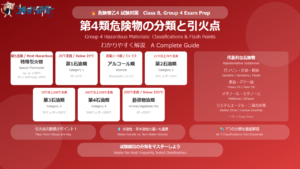
第4類危険物の分類と引火点をわかりやすく解説 Class B, Group 4 Hazardous Materials Engineer | Classifications and Flash Points: A Complete Guide
-
危険物乙4で覚えるべき「類別」とは?第1類〜第6類の特徴をわかりやすく解説