危険物乙4|製造所・貯蔵所・取扱所の区分と覚え方|試験頻出ポイントを解説 Class B, Group 4 Hazardous Materials Engineer | Classifications of Manufacturing, Storage, and Handling Facilities with Memory Tips | Key Exam Points
目次
はじめに Introduction
危険物乙4の試験で必ず出題される「製造所等の区分」。製造所・貯蔵所・取扱所という3つの大きな分類と、その中でもさらに細かく分けられた施設の種類を正確に理解することが合格への近道です。この記事では、法令科目で頻出する製造所等の区分について、それぞれの定義・特徴・覚え方のコツを分かりやすく解説します。
The classification of hazardous material facilities (製造所等) is a topic that is guaranteed to appear in the Class B, Group 4 Hazardous Materials Engineer exam. Understanding the three broad categories — manufacturing facilities, storage facilities, and handling facilities — as well as the more detailed subtypes within each, is the most direct path to passing. This article clearly explains the definition, characteristics, and memorization tips for each type, focusing on the facility classification topic that appears so frequently in the Fire Service Act subject.
製造所等の3つの区分 The Three Categories of Hazardous Material Facilities
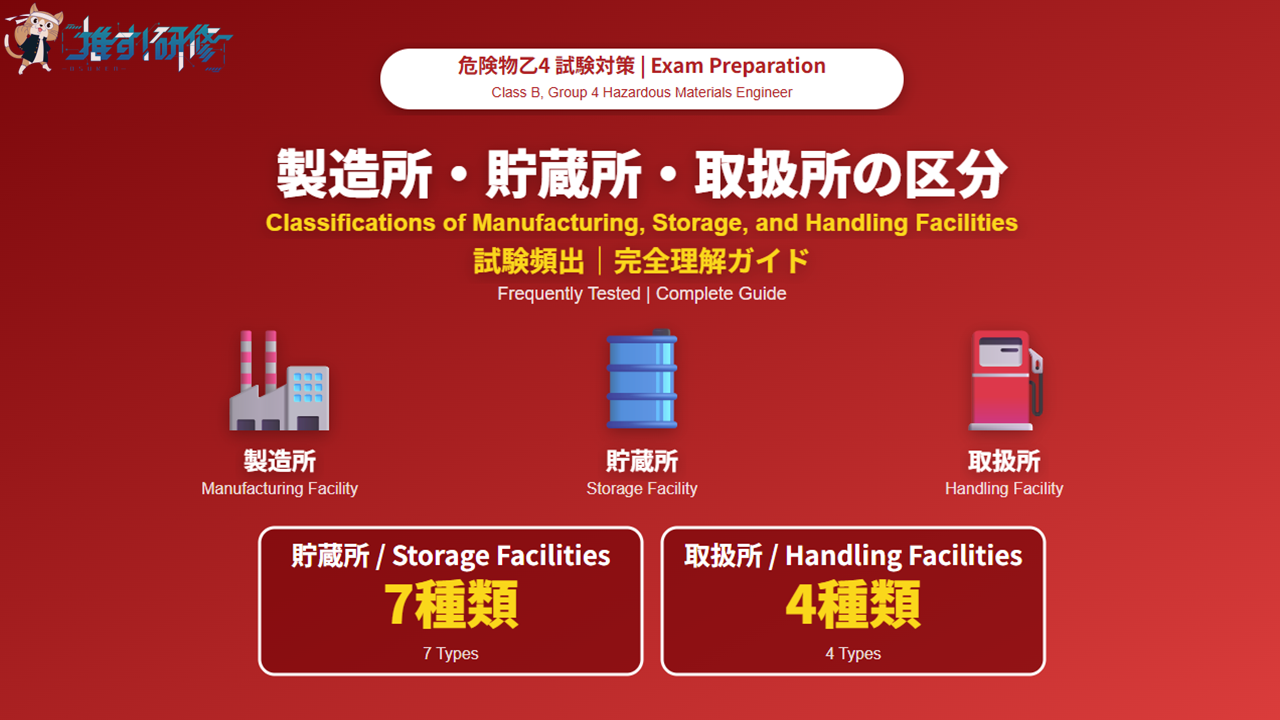
危険物を貯蔵し、または取り扱う施設は、消防法で「製造所等」と呼ばれ、以下の3種類に区分されます。
Facilities that store or handle hazardous materials are referred to under the Fire Service Act as “hazardous material facilities” (製造所等) and are divided into the following three categories.
| 区分 / Category | 定義 / Definition |
|---|---|
| 製造所 / Manufacturing Facility | 危険物を製造(合成・分解)する施設 A facility that manufactures (synthesizes or decomposes) hazardous materials |
| 貯蔵所 / Storage Facility | 危険物をタンクやドラム缶などに入れて貯蔵する施設 A facility that stores hazardous materials in tanks, drums, or other containers |
| 取扱所 / Handling Facility | 製造目的以外で、危険物を取り扱う(給油、販売、移送などのため、他の容器に移し替える)施設 A facility that handles hazardous materials for purposes other than manufacturing (such as fueling, sales, transfer, or decanting into other containers) |
法令上、これら3つの施設をまとめて「製造所等」といいます。
Under the law, these three types of facilities are collectively referred to as “hazardous material facilities” (製造所等).
貯蔵所の種類と特徴 Types and Characteristics of Storage Facilities
貯蔵所は、危険物をタンクやドラム缶などに入れて貯蔵する施設で、全部で7種類に分類されます。
Storage facilities store hazardous materials in tanks, drums, or other containers and are classified into seven types in total.
| 種類 / Type | 定義 / Definition | 特徴 / Characteristics |
|---|---|---|
| 屋内貯蔵所 Indoor Storage Facility | 屋内の場所において、容器(ドラム缶等)入りの危険物を貯蔵し、または取り扱う貯蔵所 A facility that stores or handles hazardous materials in containers (drums, etc.) at an indoor location | 建物の中にドラム缶などを保管する施設。工場や倉庫内の保管スペースが該当 A facility that stores drums and similar containers inside a building. Includes storage spaces within factories and warehouses. |
| 屋外タンク貯蔵所 Outdoor Tank Storage Facility | 屋外にあるタンク(地下タンク貯蔵所、簡易タンク貯蔵所、移動タンク貯蔵所を除く)において危険物を貯蔵し、または取り扱う貯蔵所 A facility that stores or handles hazardous materials in an outdoor tank (excluding underground tank, simple tank, and mobile tank storage facilities) | 工場敷地内にある大型タンク。地下タンク、簡易タンク、移動タンクは除外される Large tanks located on factory premises. Underground tanks, simple tanks, and mobile tanks are excluded. |
| 屋内タンク貯蔵所 Indoor Tank Storage Facility | 屋内にあるタンク(地下タンク貯蔵所、簡易タンク貯蔵所、移動タンク貯蔵所を除く)において危険物を貯蔵し、または取り扱う貯蔵所 A facility that stores or handles hazardous materials in an indoor tank (excluding underground tank, simple tank, and mobile tank storage facilities) | 建物内に設置されたタンク。屋外タンクとの違いは設置場所(屋内か屋外か) A tank installed inside a building. The difference from an outdoor tank facility is the installation location (indoors vs. outdoors). |
| 地下タンク貯蔵所 Underground Tank Storage Facility | 地盤面下に埋没されているタンク(簡易タンク貯蔵所を除く)において危険物を貯蔵し、または取り扱う貯蔵所 A facility that stores or handles hazardous materials in a tank buried below ground level (excluding simple tank storage facilities) | 地中に埋められたタンク。ガソリンスタンドの地下タンクが代表例 A tank buried underground. The underground tanks at gas stations are the most representative example. |
| 簡易タンク貯蔵所 Simple Tank Storage Facility | 簡易タンク(600L以下)において危険物を貯蔵し、または取り扱う貯蔵所 A facility that stores or handles hazardous materials in a simple tank (600L or less) | 容量が600L以下の小型タンク。簡易的な貯蔵設備 A small tank with a capacity of 600L or less. A simple storage installation. |
| 移動タンク貯蔵所 Mobile Tank Storage Facility | 車両に固定されたタンクにおいて危険物を貯蔵し、または取り扱う貯蔵所。タンクローリーが該当 A facility that stores or handles hazardous materials in a tank fixed to a vehicle. Tank trucks (tanker lorries) fall under this category. | タンクローリー(危険物運搬車両)。移動しながら危険物を貯蔵・運搬 Tank trucks (hazardous material transport vehicles). Stores and transports hazardous materials while in motion. |
| 屋外貯蔵所 Outdoor Storage Facility | 屋外の場所(タンクを除く)において第2類の危険物のうち硫黄もしくは硫黄のみを含有するもの(引火点が0℃以上のものに限る)、アルコール類、第4類の危険物のうち第1石油類(引火点が0℃以上のものに限る)、第2石油類、第3石油類、第4石油類、動植物油類を貯蔵し、または取り扱う貯蔵所 A facility that stores or handles, at an outdoor location (excluding tanks), certain hazardous materials including: sulfur and sulfur-containing Group 2 substances (FP ≥ 0°C), alcohols, and Group 4 substances including Category 1 petroleum (FP ≥ 0°C), Category 2 petroleum, Category 3 petroleum, Category 4 petroleum, and animal and vegetable oils | 屋外で容器入りの危険物を貯蔵。貯蔵できる危険物の種類が限定されている。引火点が高い(比較的安全な)危険物のみ Stores hazardous materials in containers outdoors. The types of hazardous materials that can be stored are limited — only those with higher flash points (relatively safer substances). |
取扱所の種類と特徴 Types and Characteristics of Handling Facilities
取扱所は、製造目的以外で危険物を取り扱う施設で、全部で4種類に分類されます。
Handling facilities handle hazardous materials for purposes other than manufacturing and are classified into four types in total.
| 種類 / Type | 定義 / Definition | 特徴 / Characteristics |
|---|---|---|
| 給油取扱所 Fueling Facility | 専ら給油設備によって自動車等の燃料タンクに直接給油するため危険物を取り扱う取扱所、及び給油設備によって自動車等の燃料タンクに直接給油するため危険物を取り扱うほか、灯油若しくは軽油を容器に詰め替え、又は車両に固定された容量4,000L以下のタンク(※)に注入する作業等を行う取扱所 (※)容量2,000Lを超えるタンクにあっては、その内部を2,000L以下ごとに仕切ったものに限る A facility that handles hazardous materials exclusively for the purpose of directly fueling the fuel tanks of vehicles using fueling equipment, as well as facilities that additionally decant kerosene or diesel into containers or inject them into vehicle-fixed tanks of 4,000L or less (※) (※) For tanks exceeding 2,000L, only those with internal partitions dividing the capacity into sections of 2,000L or less | 一般的なガソリンスタンド。自動車への給油が主な業務。容量制限あり(4,000L以下のタンクへの注入) Standard gas stations. The primary operation is fueling vehicles. Capacity restrictions apply (injection into tanks of 4,000L or less). |
| 販売取扱所 Sales Facility | 店舗において容器入りのまま販売するため危険物を取り扱う取扱所 A facility that handles hazardous materials in a store for the purpose of selling them in their original containers | ホームセンターや塗料店など。容器入りのまま販売(小分けしない)。指定数量の倍数で第一種(15以下)・第二種(15を超え40以下)に分かれる Home improvement stores, paint shops, etc. Sold in original containers (not subdivided). Divided into Type 1 (multiple of designated quantity ≤ 15) and Type 2 (multiple > 15 and ≤ 40) |
| 移送取扱所 Transfer Facility | 配管及びポンプ並びにこれらに付属する設備によって危険物の移送の取り扱いを行う取扱所。地下に埋め込んであるパイプ、地上に配置してあるパイプ及びそのポンプなどが該当 A facility that handles the transfer of hazardous materials via piping, pumps, and associated equipment. Underground pipelines, above-ground pipelines, and their associated pumps fall under this category. | パイプラインとポンプによる危険物の移送。石油コンビナート等で使用。移送は他の場所へ送ること(無集積) Transfer of hazardous materials via pipelines and pumps. Used in petrochemical complexes and similar installations. Transfer refers to conveying to another location (without accumulation). |
| 一般取扱所 General Handling Facility | 給油取扱所、販売取扱所、移送取扱所以外で危険物の取り扱いをする取扱所。燃料に大量の重油等を使用するボイラー施設などが該当 A facility that handles hazardous materials other than fueling, sales, and transfer facilities. Boiler facilities that use large quantities of heavy oil as fuel are a representative example. | 上記3つの取扱所に該当しないもの全て。ボイラー施設、洗浄施設、焼入れ施設など。最も幅広い分類 All facilities not falling under the above three types. Includes boiler facilities, cleaning facilities, quenching facilities, etc. The broadest classification. |
販売取扱所の区分 Classification of Sales Facilities
| 区分 / Type | 指定数量の倍数 / Multiple of Designated Quantity | 該当施設例 / Example Facilities |
|---|---|---|
| 第一種 / Type 1 | 15以下 / ≤ 15 | 塗料やシンナーを取り扱う塗料小売店等 Paint retail stores handling paints and thinners |
| 第二種 / Type 2 | 15を超え40以下 / > 15 and ≤ 40 | 大型のホームセンター等 Large home improvement stores |
覚え方のコツ Memorization Tips
貯蔵所の覚え方 How to Memorize the Storage Facility Types
貯蔵所7種類を覚える語呂合わせ:
A mnemonic for memorizing the 7 types of storage facilities:
「屋内・屋外(タンク)、屋内(タンク)、地下、簡易、移動、屋外」
“Indoor storage / Outdoor tank / Indoor tank / Underground tank / Simple tank / Mobile tank / Outdoor storage”
または、タンクの有無で分類:
Alternatively, classify by whether a tank is used:
| 分類 / Category | 貯蔵所の種類 / Storage Facility Types |
|---|---|
| タンク系 / Tank-based | 屋外タンク、屋内タンク、地下タンク、簡易タンク、移動タンク Outdoor tank, Indoor tank, Underground tank, Simple tank, Mobile tank |
| 非タンク系 / Non-tank-based | 屋内貯蔵所(ドラム缶等)、屋外貯蔵所(容器入り) Indoor storage facility (drums, etc.), Outdoor storage facility (containers) |
取扱所の覚え方 How to Memorize the Handling Facility Types
取扱所4種類の頭文字:
The initial characters of the four handling facility types:
「給・販・移・一」(きゅう・はん・い・いち)
“Fueling / Sales / Transfer / General” (Kyū / Han / I / Ichi)
| 頭文字 / Initial | 種類 / Type | 代表例 / Representative Example |
|---|---|---|
| 給 / F | 給油取扱所 / Fueling Facility | ガソリンスタンド / Gas station |
| 販 / S | 販売取扱所 / Sales Facility | ホームセンター等 / Home improvement store, etc. |
| 移 / T | 移送取扱所 / Transfer Facility | パイプライン / Pipeline |
| 一 / G | 一般取扱所 / General Handling Facility | ボイラー施設等 / Boiler facility, etc. |
試験本番での解き方|得点力を上げるコツ Exam Strategies | Tips for Scoring Higher
コツ1:キーワードを見つける Tip 1: Identify the Keywords
問題文の中から、以下のキーワードを探してください:
Look for the following keywords in the question text:
- 「600L」→ 簡易タンク貯蔵所
“600L” → Simple Tank Storage Facility - 「4,000L」→ 給油取扱所
“4,000L” → Fueling Facility - 「車両に固定」→ 移動タンク貯蔵所
“Fixed to a vehicle” → Mobile Tank Storage Facility - 「配管とポンプ」→ 移送取扱所
“Piping and pumps” → Transfer Facility - 「容器入りのまま販売」→ 販売取扱所
“Sold in original containers” → Sales Facility - 「引火点0℃以上」→ 屋外貯蔵所
“Flash point ≥ 0°C” → Outdoor Storage Facility
コツ2:消去法を使う Tip 2: Use Process of Elimination
特に一般取扱所の問題では、「給油・販売・移送のどれにも該当しない」という消去法が有効です。
For questions about general handling facilities in particular, the process of elimination — ruling out fueling, sales, and transfer facilities one by one — is an effective strategy.
コツ3:数字は確実に覚える Tip 3: Memorize the Key Numbers
以下の数字は必ず暗記してください:
The following figures must be committed to memory:
- 簡易タンク:600L以下
Simple tank: 600L or less - 給油取扱所:4,000L以下(2,000L超は仕切り必要)
Fueling facility: 4,000L or less (partitioning required for tanks exceeding 2,000L) - 販売取扱所:第一種15以下、第二種15超〜40以下
Sales facility: Type 1 ≤ 15, Type 2 > 15 and ≤ 40
まとめ Summary
危険物乙4の法令科目では、製造所等の区分が頻出です。
The classification of hazardous material facilities is a frequently tested topic in the Fire Service Act subject of the Class B, Group 4 exam.
- 製造所等は「製造所」「貯蔵所」「取扱所」の3つに区分
Hazardous material facilities are divided into three categories: manufacturing facilities, storage facilities, and handling facilities. - 貯蔵所は7種類(屋内貯蔵所、屋外タンク、屋内タンク、地下タンク、簡易タンク、移動タンク、屋外貯蔵所)
Storage facilities are classified into 7 types: indoor storage, outdoor tank, indoor tank, underground tank, simple tank, mobile tank, and outdoor storage. - 取扱所は4種類(給油、販売、移送、一般)
Handling facilities are classified into 4 types: fueling, sales, transfer, and general. - 容量制限や設置場所の違いに注意
Pay attention to capacity restrictions and differences in installation location.
製造所等の区分を理解したら、次は「位置・構造・設備の基準」を学習しましょう。各施設にどのような安全基準が定められているのか、試験によく出るポイントを押さえることで、さらに得点力が上がります!
Once you have mastered the classification of hazardous material facilities, move on to studying the standards for location, structure, and equipment. Understanding what safety standards apply to each type of facility and securing the key exam points will boost your score even further.
練習問題 製造所等の区分の理解を確認しよう Practice Questions | Test Your Understanding of Facility Classification
ここまで学んだ内容を確認するため、試験形式の練習問題に挑戦してみましょう。解答は各問題の下に記載しています。
To consolidate what you have learned, try the following exam-style practice questions. The answers are provided below each question.
問題1 Question 1
簡易タンク貯蔵所のタンク容量の上限として、正しいものはどれか。
Which of the following is the correct maximum tank capacity for a simple tank storage facility?
- 200L以下 / 200L or less
- 400L以下 / 400L or less
- 600L以下 / 600L or less
- 1,000L以下 / 1,000L or less
解答:3 / Answer: 3
簡易タンク貯蔵所のタンク容量の上限は600L以下です。この数字は試験頻出のため確実に覚えておきましょう。選択肢1・2・4はいずれも誤りです。「簡易タンク=600L以下」というキーワードをセットで暗記してください。
The maximum tank capacity for a simple tank storage facility is 600L or less. This figure appears frequently in the exam, so make sure to memorize it. Options 1, 2, and 4 are all incorrect. Memorize the keyword combination “simple tank = 600L or less.”
問題2 Question 2
屋外貯蔵所で貯蔵できない危険物として、正しいものはどれか。
Which of the following hazardous materials cannot be stored in an outdoor storage facility?
- 軽油 / Diesel
- ガソリン / Gasoline
- 重油 / Heavy oil
- 灯油 / Kerosene
解答:2 / Answer: 2
屋外貯蔵所で貯蔵できるのは、第1石油類のうち引火点が0℃以上のものに限られます。ガソリンの引火点は-40℃以下であるため、屋外貯蔵所では貯蔵できません。軽油・重油・灯油はいずれも引火点が0℃以上のため貯蔵可能です。「引火点0℃以上」というキーワードが屋外貯蔵所を判断するポイントです。
Outdoor storage facilities may only store Category 1 petroleum products with a flash point of 0°C or above. Gasoline has a flash point of −40°C or below and therefore cannot be stored in an outdoor storage facility. Diesel, heavy oil, and kerosene all have flash points of 0°C or above and can be stored. The keyword “flash point ≥ 0°C” is the key to identifying what can be stored in an outdoor storage facility.
問題3 Question 3
次の施設のうち、一般取扱所に該当するものはどれか。
Which of the following facilities falls under the category of a general handling facility?
- ガソリンスタンド / Gas station
- ホームセンターの灯油売場 / Kerosene section of a home improvement store
- 重油を使用するボイラー施設 / A boiler facility that uses heavy oil
- 石油コンビナートのパイプライン / A pipeline at a petrochemical complex
解答:3 / Answer: 3
一般取扱所とは、給油取扱所・販売取扱所・移送取扱所のいずれにも該当しない取扱所のことです。選択肢1のガソリンスタンドは給油取扱所、選択肢2のホームセンターの灯油売場は販売取扱所、選択肢4の石油コンビナートのパイプラインは移送取扱所に該当します。重油を燃料とするボイラー施設はこれら3つのどれにも当てはまらないため、一般取扱所となります。消去法で解くのが有効です。
A general handling facility is one that does not fall under any of the three other categories — fueling, sales, or transfer. Option 1 (gas station) is a fueling facility, option 2 (kerosene section of a home improvement store) is a sales facility, and option 4 (pipeline at a petrochemical complex) is a transfer facility. A boiler facility that uses heavy oil as fuel does not match any of these three categories and therefore qualifies as a general handling facility. The process of elimination is an effective approach here.
- QC3|正規分布と二項分布、確率の求め方を例題で解説 QC3 | Normal & Binomial Distributions: How to Calculate Probabilities with Examples
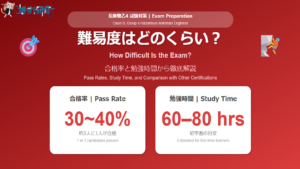
- 危険物乙4の難易度は?合格率・勉強時間・他の資格との比較で徹底解説 How Difficult Is the Class B, Group 4 Hazardous Materials Engineer Exam? Pass Rates, Study Time, and Comparison with Other Certifications
この記事を書いた人

関連記事
-
 危険物乙4|熱の移動の基礎知識 伝導・対流・放射 Class B, Group 4 Hazardous Materials Engineer | Heat Transfer Fundamentals: Conduction, Convection, and Radiation
 -
危険物乙4|静電気の基礎知識と防止対策 Class B, Group 4 Hazardous Materials Engineer | Static Electricity: Fundamentals and Prevention Measures
-
危険物乙4「運搬の基準」完全まとめ|試験頻出ポイントを徹底解説 Class B, Group 4 — Complete Guide to Hazardous Materials Transportation Standards | Key Exam Points Explained
-
危険物乙4の難易度は?合格率・勉強時間・他の資格との比較で徹底解説 How Difficult Is the Class B, Group 4 Hazardous Materials Engineer Exam? Pass Rates, Study Time, and Comparison with Other Certifications
-
危険物乙4|指定数量の覚え方と一覧表 Class B, Group 4 Hazardous Materials Engineer | Designated Quantities: Reference Table & Memorization Guide
-
第4類危険物の分類と引火点をわかりやすく解説 Class B, Group 4 Hazardous Materials Engineer | Classifications and Flash Points: A Complete Guide
-
危険物乙4で覚えるべき「類別」とは?第1類〜第6類の特徴をわかりやすく解説 Hazardous Material Classification for the Class B Exam: Key Characteristics of Groups 1–6 Explained