日商簿記検定3級|未払金・未収入金・前払金・前受金・仮払金・仮受金の仕訳を解説 Nissho Bookkeeping Level 3 | Six Key Receivable and Payable Accounts Explained
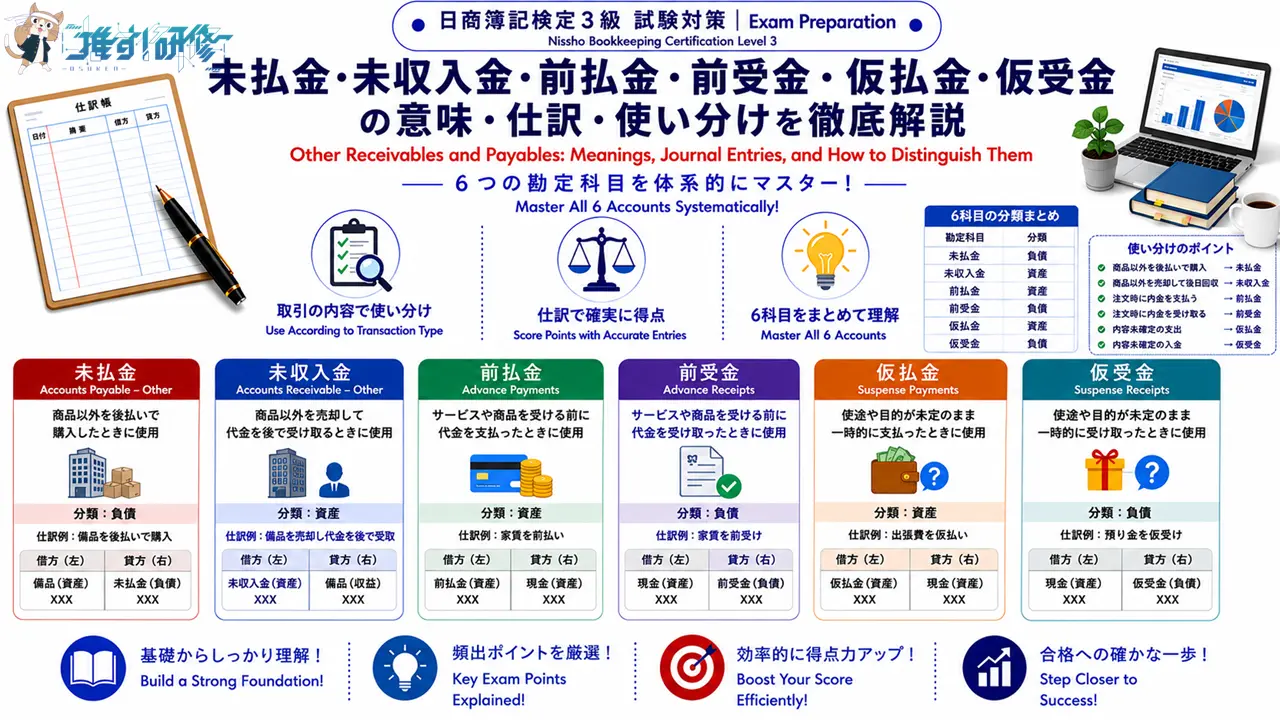
日商簿記検定3級の学習において、「未払金・未収入金」「前払金・前受金」「仮払金・仮受金」は、いずれも似た状況で登場しながら性質の異なる勘定科目です。混同しやすいだけに試験でも繰り返し出題されます。本記事では、未払金・未収入金・前払金・前受金・仮払金・仮受金の6つの勘定科目について、それぞれの意味・分類・仕訳を体系的に整理します。
In the Nissho Bookkeeping Level 3 exam, “accounts payable – other,” “accounts receivable – other,” “advance payments,” “advance receipts,” “suspense payments,” and “suspense receipts” are six accounts that appear in similar situations yet have distinct characteristics. Precisely because they are easy to confuse, they are tested repeatedly. This article systematically explains the meaning, classification, and journal entries for each of these six accounts, which fall under the category of “other receivables and payables.”
この記事で学べること:未払金・未収入金の意味と仕訳/前払金・前受金の意味と仕訳/仮払金・仮受金の意味と仕訳/6つの勘定科目の使い分けポイント/試験直前チェックと練習問題。
What you will learn: the meaning and journal entries for accounts payable – other and accounts receivable – other; the meaning and journal entries for advance payments and advance receipts; the meaning and journal entries for suspense payments and suspense receipts; key points for distinguishing among all six accounts; and a final review with practice questions.
目次
未払金と未収入金 Accounts Payable – Other and Accounts Receivable – Other
勘定科目の意味 What These Accounts Mean
企業が建物・備品・車両など商品以外のものを後払いで購入したとき、後日代金を支払わなければならない義務が生まれます。この義務を未払金(負債)として記録します。逆に、商品以外のものを売却してその代金をあとで受け取る契約にしたとき、後日代金を受け取ることができる権利が生まれます。この権利を未収入金(資産)として記録します。
When a company purchases something other than merchandise — such as a building, equipment, or vehicle — on deferred payment terms, an obligation to pay at a later date arises. This obligation is recorded as accounts payable – other (liability). Conversely, when non-merchandise is sold under an arrangement where payment will be received at a future date, a right to collect that payment arises. This right is recorded as accounts receivable – other (asset).
試験で最も問われる判断ポイントは「商品かどうか」です。商品を後払いで仕入れた場合は買掛金、商品を売って後で代金を受け取る場合は売掛金ですが、取引の対象が商品以外であれば、それぞれ未払金・未収入金に切り替えます。この区別が得点の分かれ目になります。
The single most important judgment in exam questions is whether the item involved is merchandise or not. Merchandise purchased on credit uses accounts payable (買掛金); merchandise sold on credit uses accounts receivable (売掛金). Switch to accounts payable – other or accounts receivable – other whenever the transaction involves anything other than merchandise. Mastering this distinction is the key to scoring marks in this area.
| 取引の内容 / Transaction | 勘定科目 / Account | 分類 / Classification |
|---|---|---|
| 商品を後払いで仕入れた Purchased merchandise on credit | 買掛金 / Accounts Payable | 負債 / Liability |
| 商品以外を後払いで購入した Purchased non-merchandise on deferred terms | 未払金 / Accounts Payable – Other | 負債 / Liability |
| 商品を売って後で代金を受け取る Sold merchandise; payment deferred | 売掛金 / Accounts Receivable | 資産 / Asset |
| 商品以外を売って後で代金を受け取る Sold non-merchandise; payment deferred | 未収入金 / Accounts Receivable – Other | 資産 / Asset |
①商品以外のものを後払いで購入したときの仕訳 Journal Entry: Non-Merchandise Purchased on Deferred Terms
商品以外の資産(備品など)を後払いで購入すると、取得した資産が計上される一方、支払義務として未払金(負債)が発生します。未払金は負債ですので、発生したときは貸方(右)に記録します。
When a non-merchandise asset (such as equipment) is purchased on deferred payment terms, the acquired asset is recognised and, at the same time, accounts payable – other (liability) arises. As a liability, it is recorded on the credit (right) side when it arises.
例 / Example 松風商事は、業務用の複合機を750円で購入し、代金は翌月末に支払うこととした。
Matsukaze Trading purchased a multifunction printer for business use for ¥750, with payment due at the end of the following month.
| 借方(左)/ Debit | 貸方(右)/ Credit |
|---|---|
| 備品(資産)750 Equipment (Asset) ¥750 | 未払金(負債)750 Accounts Payable – Other (Liability) ¥750 |
翌月末に現金で代金を支払ったとき、未払金(負債)の支払義務が消滅するため、借方(左)に記録して負債を減少させます。
When the payment is made in cash at the end of the following month, the obligation is extinguished; accounts payable – other (liability) is therefore recorded on the debit (left) side to reflect the decrease.
| 借方(左)/ Debit | 貸方(右)/ Credit |
|---|---|
| 未払金(負債)750 Accounts Payable – Other (Liability) ¥750 | 現金(資産)750 Cash (Asset) ¥750 |
②商品以外のものを売却して代金をあとで受け取るときの仕訳 Journal Entry: Non-Merchandise Sold with Deferred Payment
建物・車両・備品などを売却して代金をあとで受け取る場合、売却した資産が減少する一方、代金を受け取る権利として未収入金(資産)が発生します。未収入金は資産ですので、発生したときは借方(左)に記録します。
When a building, vehicle, or piece of equipment is sold and payment will be collected at a later date, the sold asset decreases and, at the same time, accounts receivable – other (asset) arises as the right to receive payment. As an asset, it is recorded on the debit (left) side when it arises.
例 / Example 竹林物産は、使用していたトラックを380円で売却し、代金は来月受け取ることとした。
Takebayashi Bussan sold a truck it had been using for ¥380, with payment to be received next month.
※ここでは、売却額と帳簿価額が同額(380円)であり、固定資産売却損益は発生しないものとして扱います。固定資産の売却額と帳簿価額が異なる場合は、固定資産売却益または固定資産売却損が生じます。
※ In this example, the selling price equals the book value (¥380), so no gain or loss on disposal arises. When the selling price and book value differ, a gain or loss on disposal of fixed assets must be recognised.
| 借方(左)/ Debit | 貸方(右)/ Credit |
|---|---|
| 未収入金(資産)380 Accounts Receivable – Other (Asset) ¥380 | 車両運搬具(資産)380 Vehicles (Asset) ¥380 |
来月に現金を受け取ったとき、代金回収の権利が消滅するため、貸方(右)に記録して資産を減少させます。
When cash is collected next month, the right to receive payment is extinguished; accounts receivable – other (asset) is therefore recorded on the credit (right) side to reflect the decrease.
| 借方(左)/ Debit | 貸方(右)/ Credit |
|---|---|
| 現金(資産)380 Cash (Asset) ¥380 | 未収入金(資産)380 Accounts Receivable – Other (Asset) ¥380 |
前払金と前受金 Advance Payments and Advance Receipts
勘定科目の意味 What These Accounts Mean
商品を注文する際、代金の一部を手付金・内金として前もって支払うことがあります。支払った側にとって、この前払いは「のちに商品を受け取ることができる権利」に相当するため、前払金(資産)として処理します。受け取った側にとっては「のちに商品を引き渡さなければならない義務」が生まれるため、前受金(負債)として処理します。
When ordering merchandise, a portion of the payment is sometimes made in advance as a deposit. For the paying party, this advance represents the right to receive merchandise in the future and is therefore recorded as advance payments (asset). For the receiving party, it creates an obligation to deliver merchandise in the future and is therefore recorded as advance receipts (liability).
| 勘定科目 / Account | 分類 / Classification | 立場 / Perspective | 内容 / Meaning |
|---|---|---|---|
| 前払金 Advance Payments | 資産 / Asset | 購入者側 / Buyer | のちに商品を受け取る権利 Right to receive merchandise later |
| 前受金 Advance Receipts | 負債 / Liability | 販売者側 / Seller | のちに商品を渡す義務 Obligation to deliver merchandise later |
③注文時に内金を支払ったときの仕訳(購入者側) Journal Entry: Advance Payment Made on Order (Buyer)
例 / Example 梅香商会は、蘭花産業に商品400円を注文し、内金60円を現金で支払った。
Baika Shokai ordered ¥400 worth of merchandise from Ranka Industries and paid ¥60 in cash as a deposit.
| 借方(左)/ Debit | 貸方(右)/ Credit |
|---|---|
| 前払金(資産)60 Advance Payments (Asset) ¥60 | 現金(資産)60 Cash (Asset) ¥60 |
後日、商品400円を受け取ったとき(仕入時)は、前払金(資産)が充当されて消滅し、残額は買掛金(負債)として処理します。
When the ¥400 worth of merchandise is received later, the advance payment is applied and eliminated, and the remaining balance is recorded as accounts payable (liability).
| 借方(左)/ Debit | 貸方(右)/ Credit |
|---|---|
| 仕入(費用)400 Purchases (Expense) ¥400 | 前払金(資産)60 Advance Payments (Asset) ¥60 |
| 買掛金(負債)340 Accounts Payable (Liability) ¥340 |
④注文時に内金を受け取ったときの仕訳(販売者側) Journal Entry: Advance Receipt Collected on Order (Seller)
例 / Example 蘭花産業は、梅香商会から商品400円の注文を受け、内金60円を現金で受け取った。
Ranka Industries received an order for ¥400 worth of merchandise from Baika Shokai and collected ¥60 in cash as a deposit.
| 借方(左)/ Debit | 貸方(右)/ Credit |
|---|---|
| 現金(資産)60 Cash (Asset) ¥60 | 前受金(負債)60 Advance Receipts (Liability) ¥60 |
後日、商品400円を引き渡したとき(売上時)は、前受金(負債)が充当されて消滅し、残額は売掛金(資産)として処理します。
When the ¥400 worth of merchandise is delivered later, the advance receipt is applied and eliminated, and the remaining balance is recorded as accounts receivable (asset).
| 借方(左)/ Debit | 貸方(右)/ Credit |
|---|---|
| 前受金(負債)60 Advance Receipts (Liability) ¥60 | 売上(収益)400 Sales (Revenue) ¥400 |
| 売掛金(資産)340 Accounts Receivable (Asset) ¥340 |
仮払金と仮受金 Suspense Payments and Suspense Receipts
勘定科目の意味 What These Accounts Mean
支出や入金が発生しているものの、その内容や金額がまだ確定していないケースでは、正式な勘定科目への記録を保留し、一時的に仮の勘定科目を使います。支出の場合は仮払金(資産)、入金の場合は仮受金(負債)を用います。内容が判明したら、速やかに正しい勘定科目へ振り替えます。
When a payment or receipt has occurred but its nature or amount has not yet been confirmed, recording it under a formal account is deferred, and a temporary account is used instead. Suspense payments (asset) are used for outgoing amounts; suspense receipts (liability) are used for incoming amounts. Once the details are confirmed, the balance is promptly reclassified to the correct account.
| 勘定科目 / Account | 分類 / Classification | 使う場面 / When Used |
|---|---|---|
| 仮払金 Suspense Payments | 資産 / Asset | 支出の内容・金額が未確定のとき When the nature or amount of a payment is unconfirmed |
| 仮受金 Suspense Receipts | 負債 / Liability | 入金の内容・金額が未確定のとき When the nature or amount of a receipt is unconfirmed |
⑤出張旅費の概算額を前渡ししたときの仕訳 Journal Entry: Travel Advance Paid to Employee
例 / Example 菊池商事は、従業員の出張のため、旅費の概算額として現金150円を前渡しした。
Kikuchi Trading advanced ¥150 in cash to an employee as an estimated travel expense for a business trip.
| 借方(左)/ Debit | 貸方(右)/ Credit |
|---|---|
| 仮払金(資産)150 Suspense Payments (Asset) ¥150 | 現金(資産)150 Cash (Asset) ¥150 |
従業員が帰社後、実際の旅費交通費が120円で、残額30円を現金で返金したと報告を受けた場合は、次のように仮払金を正式な費用へ振り替えます。
When the employee returns and reports that actual travel expenses came to ¥120, with ¥30 returned in cash, the suspense payment is reclassified to the correct expense account as follows.
| 借方(左)/ Debit | 貸方(右)/ Credit |
|---|---|
| 旅費交通費(費用)120 Travel Expenses (Expense) ¥120 | 仮払金(資産)150 Suspense Payments (Asset) ¥150 |
| 現金(資産)30 Cash (Asset) ¥30 |
⑥内容不明の入金があったときの仕訳 Journal Entry: Unidentified Amount Received
例 / Example 松風商事の当座預金口座に500円の入金があったが、その詳細は不明であった。
¥500 was deposited into Matsukaze Trading’s bank account, but the details of the deposit were unknown.
| 借方(左)/ Debit | 貸方(右)/ Credit |
|---|---|
| 当座預金(資産)500 Bank Account (Asset) ¥500 | 仮受金(負債)500 Suspense Receipts (Liability) ¥500 |
後日、この入金が竹林物産に対する売掛金の回収であったことが判明した場合は、次のように仮受金を正式な勘定科目へ振り替えます。
When it is later confirmed that the deposit was a collection of accounts receivable from Takebayashi Bussan, the suspense receipt is reclassified to the correct account as follows.
| 借方(左)/ Debit | 貸方(右)/ Credit |
|---|---|
| 仮受金(負債)500 Suspense Receipts (Liability) ¥500 | 売掛金(資産)500 Accounts Receivable (Asset) ¥500 |
6つの勘定科目 一覧整理 Summary of All Six Accounts
ここで取り上げた6つの勘定科目を一覧表で整理しておきましょう。試験直前の見直しにも役立ててください。
The table below consolidates all six accounts covered in this article. Use it for quick review before the exam.
| 勘定科目 / Account | 分類 / Classification | 発生する場面 / When It Arises | 消える場面 / When It Disappears |
|---|---|---|---|
| 未払金 Accounts Payable – Other | 負債 / Liability | 商品以外を後払いで購入 Non-merchandise purchased on deferred terms | 代金を支払ったとき When payment is made |
| 未収入金 Accounts Receivable – Other | 資産 / Asset | 商品以外を売却して後日回収 Non-merchandise sold; payment deferred | 代金を回収したとき When payment is collected |
| 前払金 Advance Payments | 資産 / Asset | 注文時に内金を支払ったとき When a deposit is paid on ordering | 商品を受け取ったとき When merchandise is received |
| 前受金 Advance Receipts | 負債 / Liability | 注文時に内金を受け取ったとき When a deposit is received on ordering | 商品を引き渡したとき When merchandise is delivered |
| 仮払金 Suspense Payments | 資産 / Asset | 支出の内容・金額が未確定のとき When payment details are unconfirmed | 内容確定後に振り替えたとき When reclassified after confirmation |
| 仮受金 Suspense Receipts | 負債 / Liability | 入金の内容・金額が未確定のとき When receipt details are unconfirmed | 内容確定後に振り替えたとき When reclassified after confirmation |
試験直前チェック Key Points to Remember
得点に直結する重要ポイントを5つに絞って整理します。
Here are five focused points that connect directly to exam performance.
- 判断の起点は「商品か、商品以外か」 後払い購入なら商品→買掛金・商品以外→未払金。後日受取なら商品→売掛金・商品以外→未収入金。この分岐を瞬時に判断できるようにしておくこと。
The starting point for judgment is: merchandise or not? For deferred purchases — merchandise → accounts payable (買掛金); non-merchandise → accounts payable – other (未払金). For deferred receipts — merchandise → accounts receivable (売掛金); non-merchandise → accounts receivable – other (未収入金). Train yourself to make this distinction instantly. - 前払金は資産・前受金は負債 前払金は「のちに商品を受け取る権利(資産)」、前受金は「のちに商品を渡す義務(負債)」。どちらも商品がまだ動いていない段階の勘定科目である点を意識する。
Advance payments are assets; advance receipts are liabilities. Advance payments represent a right (asset) to receive merchandise later; advance receipts represent an obligation (liability) to deliver merchandise later. Bear in mind that both accounts exist precisely because the merchandise has not yet changed hands. - 仮払金・仮受金は「確定待ち」の一時的な勘定科目 内容が判明した時点で必ず正式な勘定科目に振り替える。この振り替え仕訳が試験で頻出。仮払金は資産・仮受金は負債である点も確認しておく。
Suspense accounts are temporary placeholders awaiting confirmation. Always reclassify to the correct account once the details are known. This reclassification entry is a frequent exam topic. Also confirm that suspense payments are an asset and suspense receipts are a liability. - 前払金と仮払金を混同しない 前払金は用途が明確(商品の注文時の内金)、仮払金は用途が未確定(概算払い)。どちらも資産だが、発生する状況がまったく異なる。
Do not confuse advance payments with suspense payments. Advance payments have a clear purpose (a deposit paid when ordering merchandise); suspense payments have an unconfirmed purpose (an approximate advance). Both are assets, but they arise in completely different situations. - 負債の勘定科目は貸方で発生・借方で消滅 未払金・前受金・仮受金はいずれも負債。発生したときは貸方(右)、支払いや振替によって消えるときは借方(左)に記録する。資産と逆の動きになることを意識する。
Liability accounts arise on the credit side and disappear on the debit side. Accounts payable – other, advance receipts, and suspense receipts are all liabilities. They are recorded on the credit (right) side when they arise, and on the debit (left) side when they are settled or reclassified — the opposite direction from asset accounts.
練習問題で理解を確認しよう Practice Questions
ここまでの内容を試験形式で確認しましょう。解答と解説は各問題の直下に記載しています。
Let’s check your understanding with some exam-style practice questions. The answer and explanation for each question appear directly below it.
第1問 Question 1
次の一連の取引について仕訳しなさい。
Prepare journal entries for the following series of transactions.
- 松風商事は、倉庫として使用する建物を1,200円で購入し、代金は2か月後に支払うこととした。
Matsukaze Trading purchased a building to use as a warehouse for ¥1,200, with payment due in two months. - 松風商事は、(1)の代金1,200円を普通預金から支払った。
Matsukaze Trading paid ¥1,200 for (1) from its savings account.
解答 / Answer
| 借方(左)/ Debit | 貸方(右)/ Credit | |
|---|---|---|
| (1) | 建物(資産)1,200 Building (Asset) ¥1,200 | 未払金(負債)1,200 Accounts Payable – Other (Liability) ¥1,200 |
| (2) | 未払金(負債)1,200 Accounts Payable – Other (Liability) ¥1,200 | 普通預金(資産)1,200 Savings Account (Asset) ¥1,200 |
(1)建物は商品ではなく固定資産です。商品以外を後払いで購入したケースにあたるため、未払金(負債)を貸方に計上します。(2)未払金を普通預金から決済したため、未払金(負債)を借方に記録して義務を消滅させます。同時に普通預金(資産)が減少します。
(1) A building is a fixed asset, not merchandise. This is a case of non-merchandise purchased on deferred terms, so accounts payable – other (liability) is credited. (2) The accounts payable – other is settled from the savings account, so it is debited to extinguish the obligation. Savings account (asset) decreases at the same time.
第2問 Question 2
次の一連の取引について仕訳しなさい。
Prepare journal entries for the following series of transactions.
- 竹林物産は、菊池商事に商品600円を注文し、内金として90円を現金で支払った。
Takebayashi Bussan ordered ¥600 worth of merchandise from Kikuchi Trading and paid ¥90 in cash as a deposit. - 竹林物産は、菊池商事から(1)の商品600円を受け取った。代金のうち90円は注文時に支払った内金と相殺し、残額は掛けとした。
Takebayashi Bussan received the ¥600 worth of merchandise ordered in (1) from Kikuchi Trading. ¥90 was offset against the deposit paid at the time of ordering, and the remainder was left on account.
解答 / Answer
| 借方(左)/ Debit | 貸方(右)/ Credit | |
|---|---|---|
| (1) | 前払金(資産)90 Advance Payments (Asset) ¥90 | 現金(資産)90 Cash (Asset) ¥90 |
| (2) | 仕入(費用)600 Purchases (Expense) ¥600 | 前払金(資産)90 Advance Payments (Asset) ¥90 |
| 買掛金(負債)510 Accounts Payable (Liability) ¥510 |
(1)注文時の内金支払いにより、前払金(資産)90円が借方に発生します。現金(資産)が90円減少します。(2)商品600円を受け取ったため仕入(費用)600円を借方に計上します。前払金90円が充当されるため、貸方で前払金(資産)を消滅させます。差額600円-90円=510円は買掛金(負債)として貸方に計上します。
(1) The deposit paid on ordering gives rise to advance payments (asset) of ¥90 on the debit side. Cash (asset) decreases by ¥90. (2) Receiving ¥600 worth of merchandise gives rise to purchases (expense) of ¥600 on the debit side. The ¥90 advance payment is applied, so advance payments (asset) is credited to eliminate it. The difference ¥600 − ¥90 = ¥510 is credited as accounts payable (liability).
第3問 Question 3
仮払金・仮受金に関する次の記述のうち、誤っているものはどれか。
Which of the following statements about suspense payments and suspense receipts is incorrect?
- ア 仮払金は、支出の内容や金額が確定するまで一時的に使う資産の勘定科目である。
Suspense payments is an asset account used temporarily until the nature or amount of a payment is confirmed. - イ 仮受金の内容が判明したときは、仮受金(負債)を借方に記録して正しい勘定科目に振り替える。
When the nature of suspense receipts is confirmed, suspense receipts (liability) is recorded on the debit side and reclassified to the correct account. - ウ 旅費の概算額を従業員に渡したとき、仮払金(負債)が増加する。
When an estimated travel expense is advanced to an employee, suspense payments (liability) increases. - エ 仮払金の内容が確定し、実際の費用が概算額を上回っていた場合、不足分を現金で追加払いしたうえで費用に振り替える。
When suspense payment details are confirmed and actual expenses exceeded the advance, the shortfall is paid in cash and the full amount is reclassified as an expense.
解答:ウ / Answer: ウ
選択肢ウが誤りです。仮払金は資産の勘定科目であり、「仮払金(負債)」という記述が誤っています。旅費の概算額を従業員に前渡しすると、仮払金(資産)が借方に発生します。選択肢ア・イ・エはいずれも正しい内容です。イについては、仮受金(負債)が確定したとき、その義務が消滅するため借方(左)に記録するという点が正確に述べられています。
Option ウ is incorrect. Suspense payments is an asset account — the phrase “suspense payments (liability)” is wrong. When an estimated travel advance is paid out to an employee, suspense payments (asset) arises on the debit side. Options ア, イ, and エ are all correct. Regarding イ: when suspense receipts (liability) are confirmed, the obligation is extinguished and the account is debited — which is accurately described.
- QC3|品質の概念・QC的ものの見方・工程管理・小集団活動・QMSの基礎知識をわかりやすく解説 QC Level 3 | Quality Concepts, the QC Way of Thinking, Process Management, Small Group Activities, and QMS Explained
- ITパスポート試験|データベースの基礎知識と頻出問題 IT Passport Exam | Database: Fundamentals and Frequently Tested Topics
この記事を書いた人

関連記事
-
 日商簿記検定3級|貸付金・借入金の仕訳と利息計算 Nissho Bookkeeping Level 3 | Loans Receivable and Loans Payable: Journal Entries and Interest Calculations
 -
日商簿記3級|小口現金の仕訳 Nissho Bookkeeping Level 3 | Petty Cash Journal Entries
-
日商簿記3級|預金と当座借越の仕訳 Nissho Bookkeeping Level 3 | Deposits and Bank Overdraft Journal Entries
-
日商簿記3級|現金の基礎知識と仕訳 Nissho Bookkeeping Level 3 | Cash: Fundamentals and Journal Entries
-
日商簿記3級|仕訳の基礎知識と借方・貸方のルール Nissho Bookkeeping Level 3 | Journal Entries: Fundamentals and Debit and Credit Rules