建築・建設業の外国人労働者が定着しない本当の理由と現場で機能する解決策 The Real Reasons Foreign Workers Leave the Construction Industry — and Solutions That Actually Work on the Ground
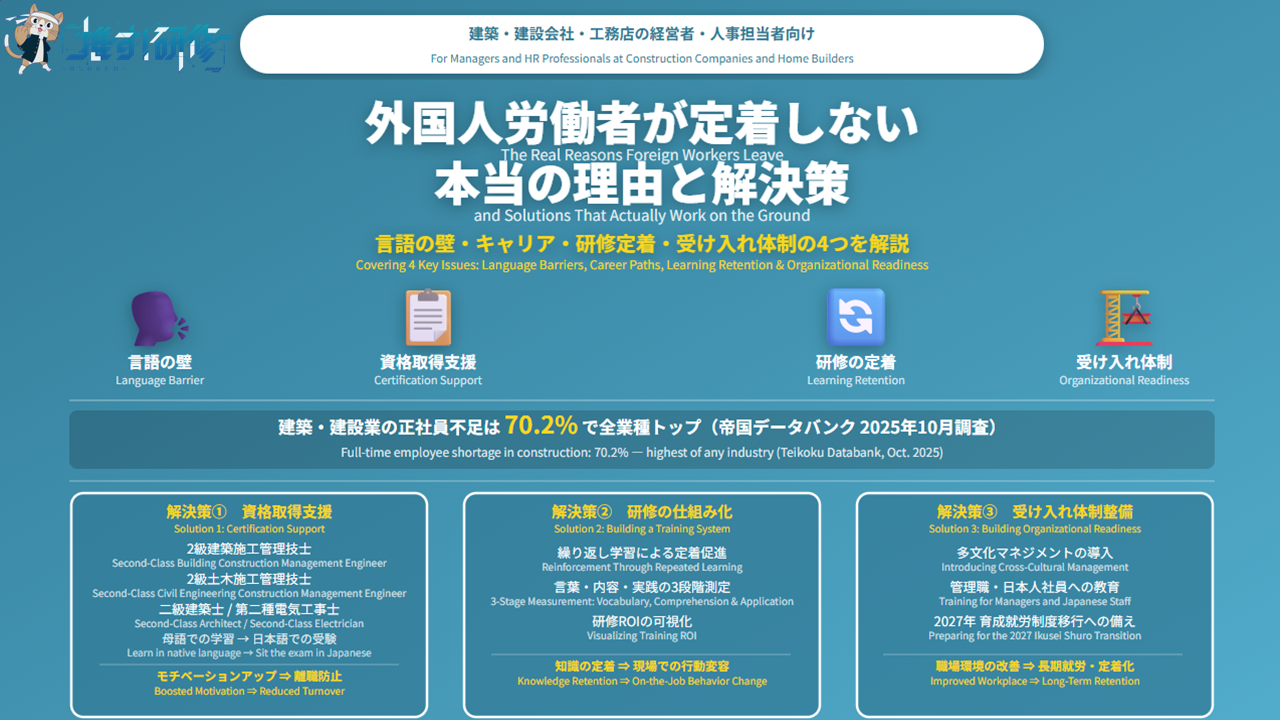
「採用してもすぐに辞めてしまう」「資格を取らせようとしても、日本語の壁が越えられない」「研修を実施しても、現場での行動が変わらない」——建築・建設会社、工務店でこうした悩みを抱える経営者・人事担当者は少なくありません。
“We hire them, but they leave almost immediately.” “We try to get them certified, but they can’t get past the language barrier.” “We run training sessions, but nothing changes on the job.” — These are concerns shared by many managers and HR professionals at construction companies and home builders across Japan.
しかしこの問題は、「外国人だから仕方ない」という話ではありません。構造的な原因があり、適切な対応によって解決できる問題です。本記事では、問題の背景にある外部環境の変化と構造的要因を整理したうえで、現場で実際に機能する解決策を解説します。
These challenges cannot be dismissed as simply “inevitable simply because they are foreign workers.” They have structural causes, and they are problems that can be solved with the right approach. This article identifies the external environmental shifts and structural factors underlying these issues, then presents solutions that actually work on the ground.
目次
建築・建設会社、工務店における外国人労働者をめぐる外部環境の変化 The Changing External Environment for Foreign Workers in the Construction Industry
人手不足は「一時的な問題」ではない The Labor Shortage Is Not a Temporary Problem
建築・建設業の就業者数は1997年の685万人をピークに減少を続け、2024年には477万人まで落ち込んでいます(出典:総務省「労働力調査」をもとに国土交通省作成 / 参考資料)。約30年間で200万人以上が業界を離れた計算です。60歳以上の技能者が全体の約4分の1を占める一方、29歳以下は約12%にとどまっており、若手入職者の確保は喫緊の課題となっています。
Employment in the construction industry has been on a continuous decline since its peak of 6.85 million workers in 1997, falling to 4.77 million by 2024 (Source: Ministry of Land, Infrastructure, Transport and Tourism, based on the Ministry of Internal Affairs and Communications “Labour Force Survey” / reference). This represents a loss of more than two million workers over roughly 30 years. While workers aged 60 and above now account for approximately one quarter of all skilled workers in the sector, those aged 29 and under make up only about 12%, making the recruitment of young entrants an urgent priority.
帝国データバンクの調査(2025年10月)によれば、「正社員が不足している」と回答した建築・建設業企業の割合は70.2%と全業種でトップとなっており、「案件があっても人手が不足して受注できない」という声が現場から相次いでいます(出典:帝国データバンク「人手不足に対する企業の動向調査(2025年10月)」/ 参考資料)。
According to a survey by Teikoku Databank (October 2025), 70.2% of construction companies reported a shortage of full-time employees — the highest rate of any industry, with many companies reporting that “we have the work, but we can’t take on the orders because we don’t have enough people” (Source: Teikoku Databank, “Corporate Trends Survey on Labor Shortages, October 2025” / reference).
外国人労働者の採用・活用が企業存続のカギになる時代 The Era When Hiring and Utilizing Foreign Workers Becomes Key to Business Survival
建築・建設分野で働く外国人技能者数は現在約14.6万人(全建築・建設技能者の約4.9%)に達しており、在留資格「特定技能」の建設分野への活用が急速に広がっています(出典:国土交通省「建設分野における外国人技能者の受入れ」/ 参考資料)。また、2027年に施行予定の育成就労制度への移行により、外国人労働者の転籍がより自由化される見込みです。これは「待遇が良い会社に外国人が流れる」競争環境が本格化することを意味します。外国人労働者の戦力化・定着は、もはや経営課題の中心に位置します。
The number of foreign skilled workers in the construction sector has now reached approximately 146,000 — about 4.9% of all skilled construction workers — and the use of the “Specified Skilled Worker” residency status in this field is expanding rapidly (Source: Ministry of Land, Infrastructure, Transport and Tourism, “Acceptance of Foreign Skilled Workers in the Construction Sector” / reference). In addition, the planned transition to the Ikusei Shuro (Training and Employment) system in 2027 is expected to make job changes for foreign workers considerably easier. This means that competition — where foreign workers gravitate toward companies with better conditions — is set to intensify in earnest. Developing foreign workers into productive contributors and keeping them with the organization has become a central management challenge.
なぜ外国人労働者はすぐ辞めるのか|問題の構造的原因 Why Do Foreign Workers Leave So Quickly? | The Structural Causes
原因① 言語の壁による孤立と「わかったふり」 Cause 1: Isolation and Pretending to Understand Due to the Language Barrier
建築・建設現場での指示・OJT・研修はほぼすべて日本語で行われます。日本語に不安を抱える外国人労働者は、内容を十分に理解できていなくても「わかった」と応答してしまいやすい状況に置かれます。この「わかったふり」が蓄積することで、ミス・事故・孤立感につながり、最終的に離職を引き起こします。言語の壁は「本人の努力不足」ではなく、正しく努力することができない「仕組みの問題」ともいえます。
Instructions, OJT, and training on construction sites are conducted almost entirely in Japanese. Foreign workers who are not confident in Japanese are frequently put in a position where they respond “I understand” even when they have not fully grasped the content. As this pattern of pretending to understand accumulates, it leads to mistakes, accidents, and a growing sense of isolation — and ultimately to resignation. The language barrier is not a matter of insufficient effort on the worker’s part; it is more accurately described as a systemic problem that prevents them from making the right kind of effort in the first place.
原因② キャリアパスが見えない Cause 2: No Clear Career Path
資格取得の機会が与えられない、または支援が不十分な職場では、外国人労働者は「この会社にいても成長できない」と判断し離職します。一方、資格取得を支援する企業は、外国人労働者に「ここで長く働きたい」という動機を与えると同時に、日本人従業員と同じ評価基準で能力を証明できる機会を提供できます。
In workplaces where opportunities for certification are not provided — or where support is inadequate — foreign workers conclude that “there is no room to grow at this company” and choose to leave. By contrast, companies that actively support certification give foreign workers a reason to want to stay long-term, while also providing them with an opportunity to demonstrate their abilities against the same evaluation criteria applied to Japanese employees.
原因③ 研修が「やりっぱなし」で終わっている Cause 3: Training That Ends Without Follow-Through
人は一度学んだ内容も、繰り返し復習しなければ定着しません。1回きりの研修では、知識が現場での行動変容につながらないのはそのためです。「研修した」という事実と「現場で使える」は、まったく別のことです。現場によくある昔ながらの「見て覚えて」文化は、母国語も文化的背景も異なる外国人労働者には特に機能しにくいという現実があります。繰り返し学習・確認できる仕組みを研修設計に組み込むことが不可欠です。
Even knowledge that has been learned once will not take root unless it is reviewed repeatedly. This is precisely why a single training session rarely translates into behavior change on the job. “Having conducted training” and “being able to apply it in the field” are two entirely different things. The traditional “watch and learn” culture common on many job sites is particularly ineffective for foreign workers who come from different linguistic and cultural backgrounds. Building a system of repeated learning and regular review into the training design is indispensable.
原因④ 受け入れ側の文化的対応の不足 Cause 4: Insufficient Cultural Responsiveness in the Organization
国籍・文化によって、労働観・コミュニケーションスタイル・指示への反応は大きく異なります。「同じように扱えばよい」という思い込みが、外国人労働者の孤立感や不満を生む一因となっています。外国人労働者の定着率は、本人の適応力だけでなく、受け入れ側の企業文化・管理職の行動に大きく左右されます。
Work values, communication styles, and responses to instructions vary significantly by nationality and cultural background. The assumption that “treating everyone the same is enough” is one of the contributing factors to the sense of isolation and frustration that foreign workers experience. Retention rates for foreign workers are shaped not only by the workers’ own adaptability, but to a significant degree by the company culture and the behavior of managers within the organization.
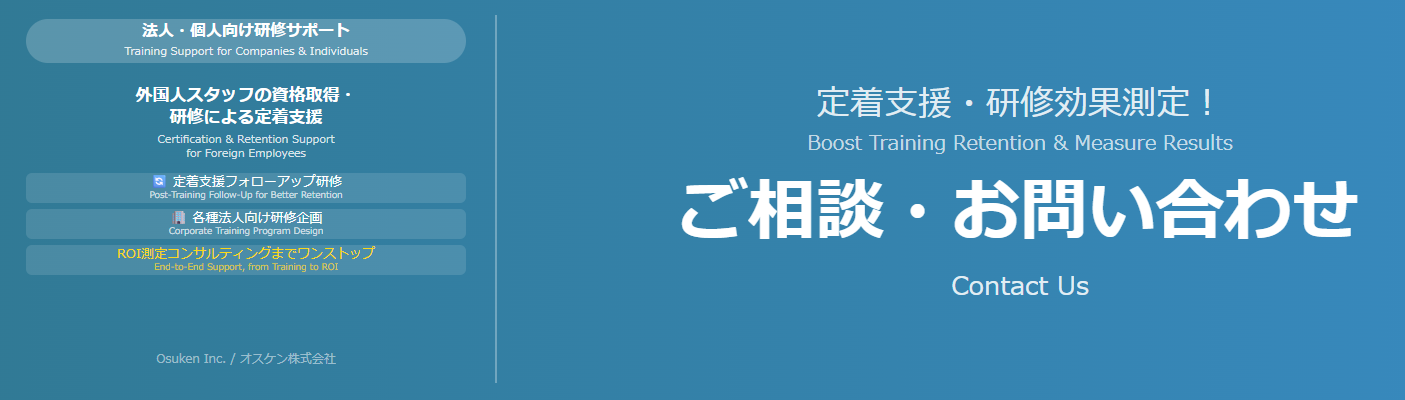
解決策① 資格取得支援でキャリアパスを可視化する Solution 1: Making Career Paths Visible Through Certification Support
建築・建設会社、工務店で取得を推奨したい資格 Recommended Certifications for Construction Companies and Home Builders
建築・建設会社、工務店で外国人労働者が取得することで、本人のキャリアと企業の戦力化の両方に貢献できる資格を以下に整理します。
The following table summarizes certifications that foreign workers at construction companies and home builders can pursue — qualifications that benefit both the individual’s career development and the organization’s operational capacity.
| 資格名 Certification | 主な対象業務 Primary Scope of Work | 学科・第一次検定合格率 Written / First-Stage Pass Rate | 受験資格(学科・第一次) Eligibility Requirements |
|---|---|---|---|
| 2級建築施工管理技士 Second-Class Building Construction Management Engineer | 建築工事全般の施工管理 Construction management for general building works | 約36〜45% Approx. 36–45% | 17歳以上・学歴・実務経験不問 Age 17+; no educational or work experience requirements |
| 2級土木施工管理技士 Second-Class Civil Engineering Construction Management Engineer | 道路・基礎・外構工事の施工管理 Construction management for road, foundation, and exterior works | 約40〜55% Approx. 40–55% | 17歳以上・学歴・実務経験不問 Age 17+; no educational or work experience requirements |
| 二級建築士 Second-Class Architect | 一定規模以下の建築物の設計・工事監理 Design and construction supervision of buildings up to a specified scale | 約40% Approx. 40% | 建築系学歴あり(令和2年改正後は実務経験不要) Architecture-related educational background required (work experience no longer required after 2020 revision) |
| 第二種電気工事士 Second-Class Electrician | 電気設備工事・配線作業 Electrical equipment installation and wiring work | 約55〜60% Approx. 55–60% | 年齢不問・学歴不問 No age or educational requirements |
※合格率は近年の実績に基づく概算値です。 ※Pass rates are approximate figures based on recent results.
すべての試験が「日本語のみ」という現実と対応策 The Reality That All Exams Are Conducted in Japanese Only — and How to Address It
上記4資格の試験は、いずれも日本語のみで実施されます。しかし、「試験が日本語」と「学習が日本語でなければならない」は別問題です。母語で概念を正確に理解したうえで日本語の試験に臨む「二段階アプローチ」が、外国人労働者の合格率を高める上で最も効果的です。
All four of the certifications listed above are examined in Japanese only. However, “the exam being in Japanese” and “learning having to be done in Japanese” are two separate issues. The most effective approach for improving pass rates among foreign workers is a two-step approach: first, build a thorough conceptual understanding in the learner’s native language, then take the Japanese-language exam.
現時点で、建築・建設分野の資格試験に特化した多言語学習教材は、民間事業者からほぼ提供されていません。厚生労働省・建設業労働災害防止協会による建築・建設現場の安全教材(多言語版)は存在しますが、資格試験対策を目的としたものではなく、内容も限定的です。母語で試験内容を学べる環境の整備が、外国人労働者の資格取得支援において今後の重要な課題となっています。
At present, multilingual study materials specifically designed for certification exams in the construction field are virtually nonexistent from private-sector providers. Multilingual safety materials for construction sites do exist — produced by the Ministry of Health, Labour and Welfare and the Construction Industry Safety and Health Association — but these are not intended for exam preparation and their content is limited in scope. Building an environment where foreign workers can study exam content in their native language has emerged as an important challenge for the future of certification support.
解決策② 研修効果を現場に定着させる仕組みをつくる Solution 2: Building a System That Embeds Training Outcomes into the Workplace
定着を生む研修設計の3原則 3 Principles of Training Design That Drive Retention
外国人労働者の研修効果を現場に根付かせるためには、以下の3原則が有効です。
The following three principles are effective for embedding training outcomes in the workplace for foreign workers.
- 研修後のフォローアップを「設計」に組み込む:研修は「実施して終わり」ではなく、2日後・7日後・30日後・60日後と継続的に理解度を確認する仕組みが必要です。繰り返し学習の機会を設けることで、知識の定着が促進されます。
Build post-training follow-up into the design: Training should not end the moment the session is over. A system of continuous comprehension checks — at 2 days, 7 days, 30 days, and 60 days after training — is essential. Providing repeated learning opportunities accelerates knowledge retention. - 「言葉の理解」「内容の理解」「実践」の3段階で定着を測定する:専門用語を知っているか(言葉)→その意味を理解しているか(内容)→現場で実際に学習した内容を適用し、行動できているか(実践)の順に確認することで、どの段階でつまずいているかが明確になります。
Measure retention across three stages — vocabulary, comprehension, and application: Checking in sequence — whether the learner knows the terminology (vocabulary) → whether they understand its meaning (comprehension) → whether they can actually apply what they learned and act on it in the field (application) — makes it clear exactly where the breakdown is occurring. - 定量的な効果測定で改善サイクルを回す:研修目的の達成状況を数値化し、次の研修設計に反映することで、研修の質を継続的に高められます。
Use quantitative effectiveness measurement to drive a cycle of improvement: Quantifying the degree to which training objectives have been achieved and feeding those results into the next program design enables the ongoing improvement of training quality.
研修ROI(投資対効果)の視点 The Training ROI Perspective
外国人労働者1名の採用には、紹介手数料・ビザ申請費用等を含めると数十万〜100万円超のコストがかかるケースもあります。早期離職が発生すれば、そのコストは回収されないまま、再採用・引き継ぎ・生産性低下のコストが新たに発生します。
Hiring a single foreign worker can cost anywhere from several hundred thousand yen to well over one million yen when recruitment fees, visa application costs, and related expenses are factored in. When early turnover occurs, those costs go unrecouped while new costs for re-hiring, handover, and reduced productivity immediately begin to accumulate.
ここで重要なのが、研修投資との関係です。研修に費用をかけることに経営層から「効果があるのか」と問われる場面は少なくありません。しかし、採用コストと比較すれば、定着率を高める研修投資は十分に合理的な判断です。研修の目標達成率・行動変容・定着率などを数値で可視化することで、「研修費用 対 離職コスト削減効果」を経営層に示すことができ、人材育成への継続的な投資判断が可能になります。
This is where the relationship with training investment becomes critical. Senior management frequently questions whether spending on training is worthwhile. However, when weighed against recruitment costs, investing in training to improve retention is a thoroughly rational decision. By quantifying training goal achievement rates, behavior change, and retention figures, organizations can present leadership with a clear picture of “training costs versus the cost savings from reduced turnover” — enabling ongoing, data-driven investment in people development.
解決策③ 受け入れ側の意識・体制を整える Solution 3: Building Awareness and Organizational Readiness
定着問題は「外国人側」だけの問題ではない Retention Is Not Solely a Problem on the Foreign Workers’ Side
外国人労働者の定着率を左右する最大の要因の一つは、受け入れ側の企業文化と管理職の行動です。「察してくれ」式のコミュニケーションが通じない相手への具体的な指示の出し方、フィードバックの伝え方、信頼関係の構築方法——これらは研修・教育によって習得できるスキルです。受け入れ側の意識改革なくして、外国人労働者の定着率向上は難しいという現実があります。
One of the most significant factors influencing foreign worker retention is the company culture and behavior of managers within the organization. How to give clear, explicit instructions to someone who cannot be expected to “read the room,” how to deliver feedback effectively, and how to build trust — these are all skills that can be developed through training and education. The reality is that improving foreign worker retention is difficult without a shift in awareness within the host company itself.
育成就労制度移行後を見据えた体制づくり Building a Structure With an Eye on the Post-Ikusei Shuro Transition
2027年の育成就労制度施行後は、外国人労働者の転籍がより自由化される見込みです。つまり、待遇・成長機会・職場環境に魅力がなければ、外国人労働者は他社に移ることができるようになります。「選ばれる会社」になるための定着支援体制を今から整えることが、中長期的な競争優位につながります。
Following the implementation of the Ikusei Shuro system in 2027, job changes for foreign workers are expected to become considerably easier. In practical terms, this means that if a company’s compensation, growth opportunities, and work environment are not attractive enough, foreign workers will be free to move on. Building a retention support system now — one that makes the company worth choosing — will translate into a sustainable competitive advantage over the medium to long term.
まとめ Summary
外国人労働者の定着問題に関する重要ポイントを整理します。
The following summarizes the key points regarding foreign worker retention.
- 建築・建設業の就業者数はピーク時から約30%減少しており、人手不足は構造的・長期的問題。外国人労働者の活用は避けられない選択となっている
Employment in the construction industry has fallen by approximately 30% from its peak, making the labor shortage a structural, long-term problem. Utilizing foreign workers has become an unavoidable choice. - 建築・建設業企業の約7割が正社員不足を訴えており、2027年の育成就労制度移行で「選ばれる企業」競争が本格化する
Approximately 70% of construction companies report a shortage of full-time employees, and competition to become a “company worth choosing” will intensify with the transition to the Ikusei Shuro system in 2027. - 定着問題の本質は、言語の壁・キャリアパスの不透明さ・研修の形骸化・受け入れ側の文化的対応不足にある
The root causes of retention challenges lie in the language barrier, opaque career paths, ineffective training practices, and insufficient cultural responsiveness within the organization. - 解決策の3本柱は「資格取得支援(母語での学習)」「繰り返し学習を前提とした研修の仕組み化」「受け入れ側の体制整備」
The three pillars of the solution are: certification support (learning in the native language), building training systems that incorporate repeated learning, and strengthening organizational readiness. - 建築・建設分野の資格試験対策に特化した多言語学習教材は現時点でほぼ整備されておらず、外国人労働者が母語で試験内容を学べる環境づくりが急務となっている
Multilingual study materials specifically designed for construction-sector certification exams are currently almost nonexistent, and creating an environment where foreign workers can study exam content in their native language has become an urgent priority.
定着問題に向き合い、仕組みで解決に取り組む企業が、これからの建築・建設業界において持続的な競争優位を築きます。
Companies that confront the retention challenge head-on and address it through systematic solutions will be the ones that build lasting competitive advantage in the construction industry going forward.