ITパスポート試験の難易度は?合格率・合格基準・勉強時間を徹底解説 IT Passport Exam Difficulty: Pass Rates, Passing Criteria, and Study Time Explained
「ITパスポートって、実際どのくらい難しいの?」——受験を検討し始めた方の多くが、まず気になるのがこの点ではないでしょうか。SNSや口コミでは「簡単」「余裕で受かる」という声も見かける一方、実際の合格率を見ると、単純に「誰でも受かる試験」とは言い切れない実態があります。本記事では、最新の公式データをもとに、合格率の推移・合格基準の仕組み・国家資格の中での位置づけ・勉強時間の目安・今後の制度改定の見通しを整理します。
“How hard is the IT Passport exam, really?” This is often the first question people ask when they start considering the exam. Social media and word of mouth sometimes suggest it’s an easy, guaranteed pass, but the actual pass rate tells a more nuanced story — this is not simply a test that anyone can clear without preparation. This article uses the latest official data to walk through the trend in pass rates, how the passing criteria actually work, where the exam stands among Japan’s national IT certifications, general guidance on study time, and the outlook for upcoming system changes.
この記事で学べること:令和7年度の最新合格率データ、総合600点+3分野300点という合格基準の仕組みと分野別の難易度の傾向、情報処理技術者試験の中での位置づけと基本情報技術者試験との比較、IT未経験者・経験者それぞれの勉強時間の考え方、2027年度から予定される新試験制度への移行、企業でITパスポート取得を推進する際の視点(外国人材の教育を含む)。
What you’ll learn: the latest FY2025 (Reiwa 7) pass rate data; how the passing criteria work — a 600-point overall score plus 300 points in each of the three domains — along with domain-by-domain difficulty trends; where the IT Passport exam stands among Japan’s national IT certification exams and how it compares to the Fundamental Information Technology Engineer Exam; how to think about study time whether you’re new to IT or already experienced; the system change planned to begin in FY2027; and a perspective on using the exam as part of corporate training, including for foreign talent.
目次
ITパスポート試験の合格率は?令和7年度の最新データ What Is the IT Passport Pass Rate? The Latest Reiwa 7 (FY2025) Data
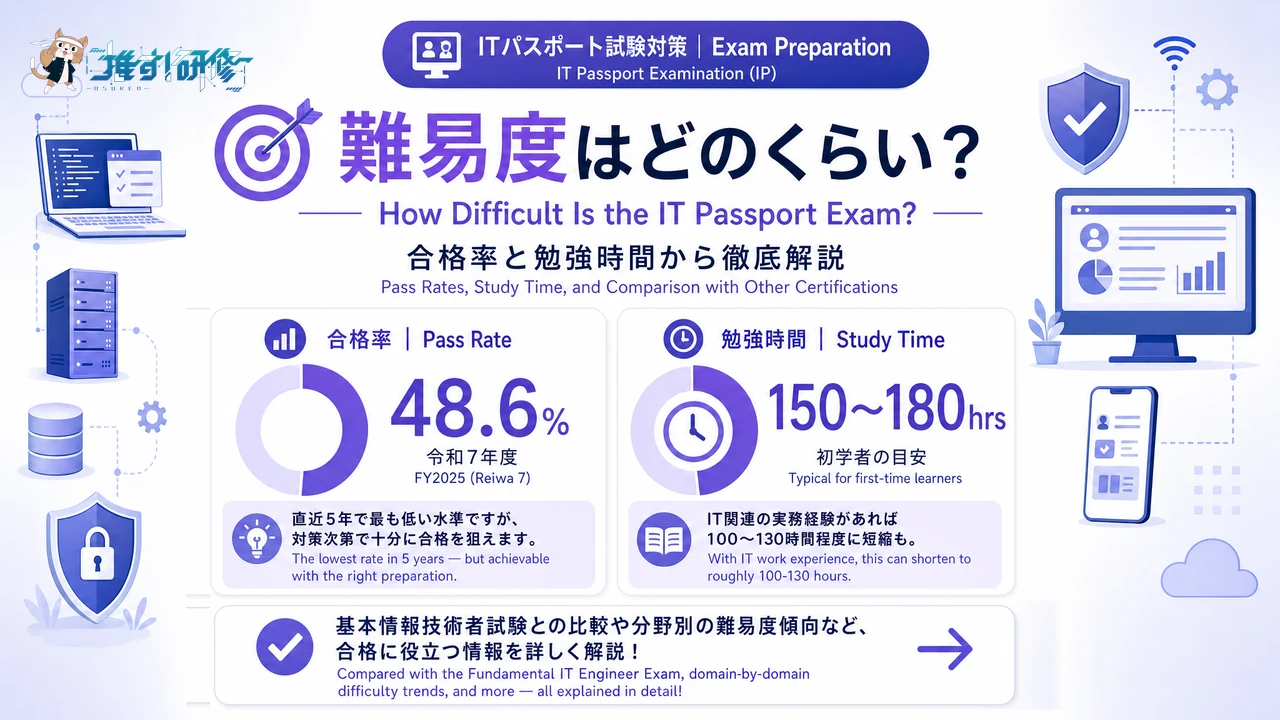
IPA(情報処理推進機構)が公表した「令和7年度iパス(ITパスポート試験)の年間応募者数等について」によると、令和7年度の応募者数は307,266人、合格者数は132,012人で、合格率は48.6%でした。この数値は、直近5年間で最も低い水準です。
According to the IPA (Information-technology Promotion Agency, Japan) report “Number of Annual Applicants for the FY2025 (Reiwa 7) IT Passport Exam,” there were 307,266 applicants and 132,012 passers in FY2025, for a pass rate of 48.6%. This is the lowest pass rate recorded in the past five years.
応募者・合格者数の推移と累計260万人という試験規模 Trends in Applicant and Passer Numbers, and a Cumulative 2.6 Million Applicants
ITパスポート試験は平成21年(2009年)に開始されて以来、多くの受験者に利用されてきました。令和8年(2026年)3月末時点で、累計応募者数は260万人を突破しています。単年度の合格率だけを見ると難易度の印象が変わりやすいですが、長期的に見れば、社会人・学生を問わず幅広い層に定着した国家試験であることがうかがえます。(出典:令和7年度iパス(ITパスポート試験)の年間応募者数等について)
The IT Passport exam has been in use since it began in 2009 (Heisei 21). As of the end of March 2026 (the end of FY2025), cumulative applicants have surpassed 2.6 million. While a single year’s pass rate can shift the impression of difficulty, the exam’s long history shows it has become a well-established national certification used broadly across working professionals and students alike. (Source: Number of Annual Applicants for the FY2025 (Reiwa 7) IT Passport Exam)
合格基準の仕組み:総合600点だけでは合格できない理由 How the Passing Criteria Work: Why a 600-Point Total Alone Isn’t Enough
ITパスポート試験の合格基準は、単純な総合点だけでは判定されません。総合評価点600点以上(1000点満点)に加えて、ストラテジ系・マネジメント系・テクノロジ系の3分野それぞれで300点以上を獲得する必要があります。いずれか1分野でも基準に届かなければ、総合点が600点を超えていても不合格となります。(出典:【ITパスポート試験】試験内容・出題範囲)
The IT Passport exam’s passing criteria are not based on a simple total score alone. Candidates need an overall score of 600 points or higher (out of 1,000), and in addition, at least 300 points in each of the three domains — Strategy, Management, and Technology. If a candidate falls short in even one domain, they will not pass, even if their overall score exceeds 600. (Source: IT Passport Exam: Exam Content and Scope)
| 評価区分 / Evaluation Category | 基準点 / Passing Score |
|---|---|
| 総合評価点 Overall score | 600点以上(1000点満点) 600 points or higher (out of 1,000) |
| ストラテジ系 Strategy | 300点以上 300 points or higher |
| マネジメント系 Management | 300点以上 300 points or higher |
| テクノロジ系 Technology | 300点以上 300 points or higher |
この「3分野の足切り」構造があるため、得意分野だけを伸ばす学習法では合格しづらく、3分野をバランスよく学習することが重要になります(学習計画の立て方は後述します)。
Because of this “three-domain minimum score” structure, focusing your studying only on your strongest domain makes passing difficult — balanced preparation across all three domains matters (more on how to plan your studying below).
分野別に見る難易度の傾向 Domain-by-Domain Difficulty Trends
IPAが公開している過去問の出題数を見ると、テクノロジ系が約45問、ストラテジ系が約35問、マネジメント系が約20問(100問中)と、分野によって出題数の配分に差があります。この出題数の違いに加え、受験者の職種・専攻によって「どの分野を苦手に感じやすいか」にも傾向が見られます。文系出身者・非IT職の受験者は、ネットワークやセキュリティなどの技術用語が中心となるテクノロジ系でつまずきやすい一方、エンジニア・理系出身の受験者は、バリューチェーンや貸借対照表(BS)・損益計算書(PL)といった経営・会計・法務系の用語が中心となるストラテジ系で苦戦するケースが、複数の情報源で共通して指摘されています。ただし、これはあくまで一般的な傾向であり、実際にどの分野でつまずくかには個人差がある点にご留意ください。(出典:【ITパスポート試験】試験内容・出題範囲)
According to the number of questions found in IPA’s published past exams, Technology accounts for roughly 45 questions, Strategy roughly 35, and Management roughly 20 out of the 100 total — the three domains are not weighted equally. On top of this difference in question volume, candidates also tend to struggle with different domains depending on their background. Multiple sources consistently point out that candidates from non-IT or humanities backgrounds tend to struggle with the Technology domain, which centers on technical terms like networking and security, while candidates with an engineering or science background more often struggle with the Strategy domain, which centers on business, accounting, and legal terms such as the value chain or balance sheets (BS) and income statements (PL). Keep in mind that this is only a general tendency, and which domain trips up a given candidate varies from person to person. (Source: IT Passport Exam: Exam Content and Scope)
難易度を上げる4つの要因 Four Factors That Make the Exam Harder
ITパスポート試験が「思ったより難しい」と感じられやすい背景には、主に4つの要因があります。
There are four main factors behind why the IT Passport exam often feels harder than expected.
- 出題範囲の広さ ストラテジ系・マネジメント系・テクノロジ系という3分野にまたがる幅広いテーマから出題される
Broad scope — questions are drawn from a wide range of themes spanning all three domains: Strategy, Management, and Technology - 専門用語の多さ 3分野それぞれに独自の専門用語が数多く登場し、暗記量が多くなりやすい
A large volume of technical terms — each domain brings its own set of specialized terminology, which adds up to a heavy memorization load - シラバスの頻繁な改訂 出題範囲を定めるシラバスは定期的に改訂されており、生成AI関連など新しい用語・トレンドが継続的に追加されている(出典:試験要綱・シラバスについて)
Frequent syllabus revisions — the syllabus defining the exam’s scope is revised on a regular basis, with new terms and trends such as generative AI continually being added (Source: About the Exam Outline and Syllabus) - 初見の問題への応用力が必要 過去問と全く同じ問題は出題されないため、暗記だけでなく、学んだ知識をその場で応用する力が求められる
Novel questions every time — because past questions are never reused verbatim, candidates need not just memorized knowledge but the ability to apply it to questions they are seeing for the first time
加えて、本記事の前半で触れた「総合600点以上に加え、3分野それぞれで300点以上が必要」という合格基準の仕組み自体も、単純に総合点を伸ばすだけでは合格できないという意味で、難易度を押し上げる要因の一つになっています。
In addition, the passing criteria described earlier in this article — requiring not just an overall score of 600 or higher, but also 300 or more points in each of the three domains — is itself one of the factors that raises the exam’s difficulty, since simply boosting your total score is not enough to pass.
出題形式:100問・120分・CBT方式 Exam Format: 100 Questions, 120 Minutes, CBT
試験は100問・120分のCBT(Computer Based Testing)方式で実施されます。CBT方式のため、通年にわたり、全国47都道府県の会場から都合の良い日程・会場を選んで受験できるという利便性があります。(出典:【ITパスポート試験】試験内容・出題範囲)
The exam consists of 100 questions administered over 120 minutes, using a CBT (Computer Based Testing) format. Because it’s CBT-based, candidates can choose a convenient date and testing venue from locations across all 47 prefectures, year-round. (Source: IT Passport Exam: Exam Content and Scope)
情報処理技術者試験の中でのITパスポートの位置づけ Where the IT Passport Exam Stands Among Japan’s National IT Certifications
ITパスポート試験は、経済産業省が認定する国家資格であり、情報処理技術者試験の体系の中では、ITに関する基礎的な知識を問う入門レベルの試験として位置づけられています。ITエンジニア向けの専門的な試験と異なり、ストラテジ系(経営全般)・マネジメント系(開発・運用管理)・テクノロジ系(技術要素)という3分野を幅広く問う構成になっており、職種を問わずすべての社会人に共通して求められる基礎的なITリテラシーを対象としています。合格率48.6%という数字は「簡単に取れる資格」ではないことを示していますが、出題範囲・形式が明確であるぶん、正しい対策を積めば十分に合格を狙えるレベルの試験だといえます。
The IT Passport exam is a national certification recognized by Japan’s Ministry of Economy, Trade and Industry, and within the broader system of Japan’s information-technology certification exams, it is positioned as an entry-level exam covering foundational IT knowledge. Unlike specialized exams aimed at IT engineers, it covers three domains — Strategy (general business management), Management (development and operations management), and Technology (technical elements) — broadly, targeting the basic IT literacy expected of working professionals across all job types, not just IT specialists. A 48.6% pass rate shows this is not a certification you can obtain casually, but because the exam’s scope and format are clearly defined, it is a level of exam that can realistically be passed with the right preparation.
基本情報技術者試験との違い How It Compares to the Fundamental Information Technology Engineer Exam
情報処理技術者試験は、IPAの現行の公式区分では、共通的知識層(ITパスポート試験)・基本的知識・技能層(情報セキュリティマネジメント試験、基本情報技術者試験)・応用的知識・技能層(応用情報技術者試験)・高度な知識・技能層(各種高度試験)という4つの階層に分類されており(出典:試験区分一覧)、基本情報技術者試験はITパスポート試験よりも一段上の階層に位置づけられています。なお、この体系の元になった「共通キャリア・スキルフレームワーク(2008年公開のアーカイブ資料)」との関連で、基本情報技術者試験はIPA公式のシラバス文書でも「基本情報技術者試験(レベル2)」と明記されており(出典:基本情報技術者試験(レベル2)シラバス Ver.9.2)、一般に「スキルレベル2」と呼ばれることがあります(ITパスポート試験についても、同様の文脈で「スキルレベル1」と呼ばれることがありますが、こちらは現行のIPA公式シラバス文書のタイトルには明記されていません)。
Under the IPA’s current official classification, Japan’s information-technology certification exams are grouped into four tiers: a common-knowledge tier (the IT Passport exam), a fundamental-knowledge-and-skills tier (the Information Security Management exam and the Fundamental Information Technology Engineer exam), an applied-knowledge-and-skills tier (the Applied Information Technology Engineer exam), and an advanced-knowledge-and-skills tier (the various advanced exams) (Source: List of Exam Categories), with the Fundamental Information Technology Engineer exam sitting one tier above the IT Passport exam. In connection with the “Common Career/Skill Framework (an archived 2008 resource)” that underlies this structure, the IPA’s own official syllabus document explicitly labels the Fundamental Information Technology Engineer exam as “(Level 2)” (Source: Fundamental Information Technology Engineer Exam (Level 2) Syllabus Ver.9.2), and it is commonly referred to as “Skill Level 2.” (The IT Passport exam is sometimes referred to in the same way as “Skill Level 1,” though this is not spelled out in the title of the IT Passport exam’s current official syllabus document.)
合格率の面では、基本情報技術者試験は、CBT方式へ移行した令和2年度以前の旧制度(紙試験)時代には20〜30%程度の水準でしたが、CBT移行後は上昇し、令和3年度以降は年度によって37〜47%程度で推移しています(令和7年度は38.3%)(出典:情報処理技術者試験・情報処理安全確保支援士試験 推移表)。ITパスポート試験の48.6%と比べても、両試験とも概ね40%前後の水準で推移しており、合格率の高低だけで難易度の優劣を単純に語ることは適切ではありません。基本情報技術者試験がより専門的な試験だと言える根拠は、合格率そのものよりも、試験構成の違いにあります。基本情報技術者試験は科目A・科目Bの2段階に分かれ、プログラミングやアルゴリズムなど、より専門的・実践的な知識が問われます。対象者の面でも、ITパスポート試験はITを利用するすべての社会人を対象とした基礎的な試験である一方、基本情報技術者試験はITを作る側であるエンジニアを主な対象としています。
In terms of pass rates, the Fundamental Information Technology Engineer exam ran at roughly 20-30% under the old paper-based system before its shift to CBT testing in FY2020, but has risen since the CBT transition, running at roughly 37-47% year to year from FY2021 onward (38.3% in FY2025) (Source: Information Technology Engineers Examination and Registered Information Security Specialist Examination: Trend Table). Compared with the IT Passport exam’s 48.6%, both exams have been running at roughly similar, around-40% levels, so it isn’t accurate to draw a simple conclusion about relative difficulty from the pass rate alone. The real basis for saying the Fundamental Information Technology Engineer exam is more specialized lies not in the pass rate but in its structure: it consists of two parts, Subject A and Subject B, testing more specialized and practical knowledge such as programming and algorithms. The two exams also differ in who they’re designed for: the IT Passport exam is a foundational exam for all working professionals who use IT, while the Fundamental Information Technology Engineer exam mainly targets engineers who build IT systems.
合格に必要な勉強時間の目安 How Much Study Time Do You Need to Pass?
必要な勉強時間は、受験者のITに関する予備知識によって大きく変わります。ITに馴染みのない未経験者は、用語・仕組みの理解に基礎から時間をかける必要がある一方、IT関連の業務経験がある方は、馴染みのある分野の学習を短縮し、不慣れな分野に重点的に時間を配分できます。一般的な目安としては、複数の情報源で共通して、IT未経験者は150〜180時間程度、IT関連の実務経験がある方は100〜130時間程度が挙げられることが多いようです。ただし、これはあくまで複数の独立した情報源に共通して見られる大まかな相場観であり、特定の1情報源のみに基づく数値ではありません。個人の学習ペース・予備知識・1日に確保できる学習時間によって、実際に必要な時間は大きく前後する点にはご留意ください。
The amount of study time you need varies significantly depending on your existing IT knowledge. Someone new to IT will need to spend more time building up their understanding of terminology and underlying concepts from the ground up, while someone with IT-related work experience can spend less time on domains they’re already familiar with and focus more time on unfamiliar ones. As a general benchmark that appears consistently across multiple sources, people new to IT often report studying for roughly 150 to 180 hours, while those with IT-related work experience often aim to pass with roughly 100 to 130 hours. These figures are not drawn from any single definitive source, but reflect a rough consensus seen across several independent sources — keep in mind that your actual study time will vary considerably based on your individual pace, prior knowledge, and how much time you can dedicate each day.
分野別の出題比率を踏まえた学習計画の立て方 Building a Study Plan Around the Domain Weighting
前述のとおり、ITパスポート試験は3分野それぞれで300点以上を獲得しなければ合格できません。そのため、学習計画を立てる際は「総合点をどう伸ばすか」ではなく、「3分野のうち、特に弱い分野をどう底上げするか」という視点が重要になります。まずは分野別の模擬試験・過去問演習で自分の弱点分野を把握し、苦手分野に学習時間を重点的に配分する——という進め方が、効率よく合格ラインに到達するための基本的な考え方です。
As explained above, passing the IT Passport exam requires scoring at least 300 points in each of the three domains — simply raising your overall score is not enough. When building a study plan, the key question is not “how do I raise my total score” but “which of the three domains is my weakest, and how do I strengthen it.” A practical approach is to first identify your weak domains through domain-specific mock exams and past-question practice, then concentrate your study time on those areas — this is the basic strategy for reaching the passing line efficiently.
2027年度からの新試験制度への移行について The Upcoming System Change Starting FY2027
ITパスポート試験は、2027年度から新試験制度へ移行する予定であることが、IPAより公式に発表されています。出題分野は、現行の「ストラテジ系」「マネジメント系」「テクノロジ系」から、「ビジネス」「テクノロジ」「セキュリティ・倫理」の3領域へ再編される予定で、DXに求められるマインド・スタンスやデータマネジメントの基礎知識の新規追加、AI時代に対応したセキュリティ・倫理分野の強化が予定されています。一方、試験時間120分・出題数100問というCBT方式の基本的な試験形式には変更がない見通しです。ただし、これらはあくまで現時点(2026年度)で示されている予定であり、今後変更される可能性もゼロではないため、断定的な理解は避け、今後IPAから公式に発表される最新情報を確認することをおすすめします。2026年度中の受験を検討している場合は、この制度改定の影響を受けない現行制度のもとで受験できます。(出典:情報処理技術者試験及び情報処理安全確保支援士試験の見直しの検討状況について)
The IT Passport exam is officially scheduled to transition to a new exam system starting in FY2027, according to an announcement from the IPA. The exam’s domains are set to be reorganized from the current Strategy, Management, and Technology categories into three new areas — Business, Technology, and Security/Ethics, with newly added content covering the mindset and stance needed for DX and the fundamentals of data management, along with strengthened security and ethics content for the age of AI. The exam’s basic format — a 120-minute, 100-question CBT exam — is expected to remain unchanged. That said, these are only the plans announced as of FY2026, and further changes remain possible, so we avoid treating any of this as final and recommend checking the latest official announcements from the IPA. If you’re planning to take the exam during FY2026, you can still do so under the current system, unaffected by this upcoming change. (Source: Status of the Review of the Information Technology Engineers Examination and the Registered Information Security Specialist Examination)
企業でのITパスポート活用:オスケンの研修支援 Using the IT Passport Exam in Corporate Training: How Osuken Can Help
企業が社員のITリテラシー向上にITパスポート取得を活用する場合、オスケンでは多言語対応の研修プログラムや、資格取得後の定着をフォローアップする体制もあわせてご相談いただけます。
When a company uses the IT Passport exam to help build employees’ IT literacy, Osuken can also support that effort with multilingual training programs and follow-up support to help retain what employees learn after certification.
外国人労働者にとっての専門用語の壁 The Terminology Barrier for Non-Native Japanese Speakers
ITパスポート試験は日本語での受験が基本となるため、カタカナ英語や専門用語の多さが、日本語を母語としない受験者にとって特に高い壁になりやすいという指摘があります。「ステークホルダー」「バリューチェーン」といったカタカナ表記のビジネス用語や、テクノロジ系の技術用語は、日本語の読み書きに不慣れな受験者ほど負担が大きくなりがちです。
Because the IT Passport exam is primarily administered in Japanese, the sheer volume of katakana loanwords and specialized terminology tends to be a particularly high barrier for candidates who are not native Japanese speakers. Katakana business terms such as “stakeholder” or “value chain,” along with technical terminology from the Technology domain, can place a disproportionate burden on candidates who are less comfortable reading and writing Japanese.
実際の試験対策としては、カタカナ用語・専門用語の意味を日本語で丁寧に確認しながら学習を進めることが有効です。オスケンでは、こうした言語面の負担を軽減する多言語対応の教材・研修プログラムに加え、資格取得後の知識定着をフォローアップする体制もご用意しており、外国人材の採用・育成を進める企業のご担当者様からのご相談を承っています。
In practical terms, a useful study approach is to carefully confirm the meaning of katakana and technical terms in Japanese as you study. Osuken offers multilingual materials and training programs to help ease this language burden, along with follow-up support to help retain what employees learn after certification — we welcome inquiries from companies hiring and developing foreign talent.
まとめ Summary
本記事のポイントをまとめます。
Here is a summary of the key points covered in this article.
- 令和7年度の合格率は48.6% 応募者307,266人に対し合格者132,012人で、直近5年間で最も低い水準
The FY2025 pass rate was 48.6% — 132,012 passers out of 307,266 applicants, the lowest rate in the past five years - 合格には総合600点以上+3分野それぞれ300点以上が必要 1分野でも基準未達なら不合格となる「3分野の足切り」構造
Passing requires 600+ points overall plus 300+ points in each of the three domains — falling short in even one domain means failing, regardless of the overall score - 出題形式は100問・120分・CBT方式 全国47都道府県の会場で通年受験できる
The exam format is 100 questions over 120 minutes via CBT — available year-round at venues across all 47 prefectures - 累計応募者数は260万人を突破 平成21年の試験開始以来、令和8年3月末時点で確認された規模
Cumulative applicants have surpassed 2.6 million — as of the end of March 2026, since the exam began in 2009 - 2027年度から新試験制度へ移行予定 出題構成の見直しは現在検討段階で、詳細は今後の公式発表を確認する必要がある
A new exam system is planned to begin in FY2027 — the specifics, including a possible revised question structure, are still under consideration and will be confirmed in future official announcements
- 危険物乙4|特殊引火物の性状を徹底解説【ジエチルエーテル・二硫化炭素・アセトアルデヒド・酸化プロピレン】 Class B, Group 4 Hazardous Materials Engineer | Properties of Special Flammable Liquids: Diethyl Ether, Carbon Disulfide, Acetaldehyde, and Propylene Oxide Explained
- 危険物乙4|第一石油類の性状を徹底解説【ガソリン・ベンゼン・トルエン・アセトンほか】 Class B, Group 4 Hazardous Materials Engineer | Properties of Category 1 Petroleum: Gasoline, Benzene, Toluene, Acetone, and More Explained
この記事を書いた人

関連記事
-
 ITパスポート試験|データベースの基礎知識と頻出問題 IT Passport Exam | Database: Fundamentals and Frequently Tested Topics
 -
ITパスポート試験|プロジェクトマネジメントの基礎知識と計算問題 IT Passport Exam | Project Management: Fundamentals and Calculation Problems
-
ITパスポート試験|法務の基礎知識 IT Passport Exam | Legal Affairs: Fundamentals and Key Concepts
-
ITパスポート試験|サービスマネジメントの基礎知識 IT Passport Exam | Service Management: Fundamentals and Key Concepts
-
ITパスポート試験|開発技術の基礎知識とソフトウェア開発モデル IT Passport Exam | Development Technology: Fundamentals and Software Development Models
-
ITパスポート試験|情報セキュリティの基礎知識と対策 IT Passport Exam | Information Security: Fundamentals and Security Measures