ITパスポート試験|サービスマネジメントの基礎知識 IT Passport Exam | Service Management: Fundamentals and Key Concepts
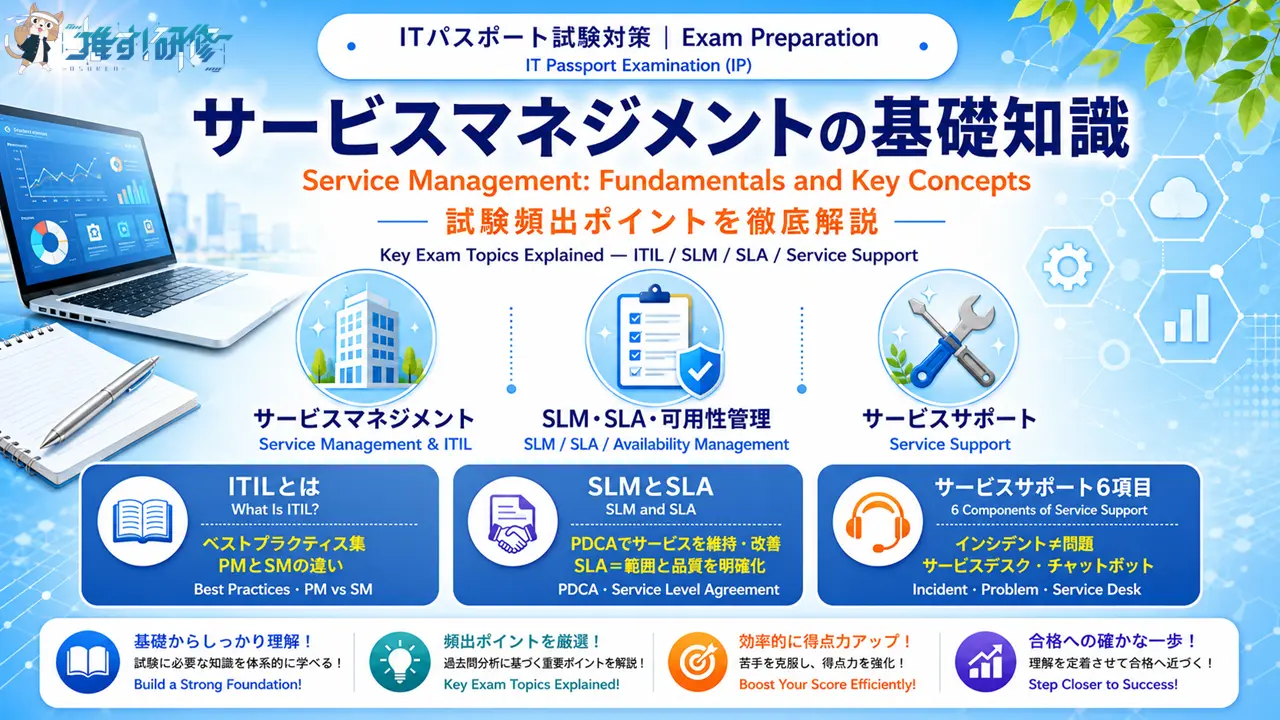
ITパスポート試験のマネジメント系分野の中で、「サービスマネジメント」は毎回安定して出題されるテーマです。「システムを作って終わり」ではなく、「作ったシステムをどう維持・改善し続けるか」という視点が問われます。難しく聞こえるかもしれませんが、仕組みを一つひとつ整理すれば、試験の問題パターンはすっきり見えてきます。本記事では、サービスマネジメントの基本概念から、SLM・SLA・サービスサポートの6つの構成要素まで、試験に直結する知識を体系的に解説します。
Service management is a topic that appears consistently in the management domain of the IT Passport exam. The focus is not on building a system and walking away, but on how to sustain and continuously improve what has been built. While it may sound complex at first, the exam question patterns become much clearer once you organize the concepts one by one. This article provides a structured explanation of the knowledge you need for the exam — from the core concepts of service management through SLM, SLA, and the six components of service support.
この記事で学べること:サービスとITサービスの定義・ITILとは何か・プロジェクトマネジメントとの違い・SLM(サービスレベル管理)とPDCA・SLA(サービスレベル合意書)・可用性管理・サービスサポートの6構成要素・インシデントと問題の区別・エスカレーション・チャットボット。すべて試験頻出ポイントに絞っています。
What you’ll learn in this article: the definitions of service and IT service; what ITIL is; how service management differs from project management; SLM (Service Level Management) and PDCA; SLA (Service Level Agreement); availability management; the six components of service support; the distinction between incidents and problems; escalation; and chatbots. Every point is selected specifically because it appears on the exam.
目次
サービスマネジメントとは What Is Service Management?
「サービス」とは、目に見えない形で利用者に提供される、価値ある活動や機能のことです。レストランの接客や、銀行の窓口対応なども「サービス」ですが、ITパスポート試験では「サービス」=情報システムが生み出す機能や価値として捉えます。財務システムを例にとれば、ユーザーが求めているのはシステムそのものではなく、そのシステムを通じて行われる「財務諸表の作成」や「データの照会」といった業務上の機能です。
“Service” refers to valuable activities or functions provided to users in an intangible form. Restaurant hospitality and bank counter service are both examples of “service,” but in the IT Passport exam, “service” means the functions and value that an information system delivers. Taking a financial system as an example, what users actually need is not the system itself, but the business functions it enables — such as generating financial reports or retrieving data.
サービスマネジメントとは、利用者に提供するサービスを継続的に維持・改善していく活動のことです。システム開発が「一度きりのプロジェクト」であるのに対し、サービスマネジメントは定期的・継続的に行われる活動という点が大きな違いです。また、サービスマネジメントのうち、インターネットや通信技術を活用したITサービスの維持・改善活動を特にITサービスマネジメントといいます。
Service management refers to the ongoing activities of maintaining and improving the services provided to users. Whereas system development is a one-time project with a defined end point, service management is distinguished by the fact that it is a continuous, recurring activity. IT service management refers specifically to maintaining and improving IT-based services.
サービスレベルとは What Is a Service Level?
サービスレベルとは、利用者に対して提供するサービスの品質・水準のことです。どれほど高度なシステムを構築しても、稼働・運用の段階でサービスの品質が低下すれば、利用者の評価は下がります。サービス提供者は、サービスレベルをできるだけ高く保ち、利用者の満足度を維持することが求められます。
Service level refers to the quality and standard of the service delivered to users. No matter how sophisticated a system is built, if the quality of the service deteriorates during operation, user satisfaction will decline. Service providers are expected to keep the service level as high as possible and sustain user confidence.
ITILとは What Is ITIL?
ITIL(Information Technology Infrastructure Library)とは、ITサービスマネジメントの分野における、実際に効果が実証された優れた実践事例をまとめたフレームワーク(知識体系)です。試験では「ベストプラクティス(最良の事例)」というキーワードが登場したら、ほぼ確実にITILに関する問題です。なお、ITILでは「サービス」と「ITサービス」が同義として扱われることが多く、試験問題でも「サービス」だけの表記でITサービスを指している場合があります。
ITIL (Information Technology Infrastructure Library) is a framework (body of knowledge) that compiles proven, real-world best practices in the field of IT service management. On the exam, whenever the keyword “best practices” appears, the question almost certainly concerns ITIL. Note that in ITIL, “service” and “IT service” are often used interchangeably — exam questions may refer to IT services using the word “service” alone.
プロジェクトマネジメントとの違い How Service Management Differs from Project Management
ITパスポート試験では、プロジェクトマネジメントとサービスマネジメントの違いが繰り返し出題されます。2つの概念の違いを以下の表で整理しましょう。
The IT Passport exam repeatedly tests the differences between project management and service management. Use the table below to organize the distinction between the two concepts.
| 比較項目 / Comparison | プロジェクトマネジメント / Project Management | サービスマネジメント / Service Management |
|---|---|---|
| 対象 / Target | プロジェクト(主にシステム) Project (mainly systems) | サービス(主にITサービス) Service (mainly IT services) |
| 工程 / Process | 開発プロセス Development process | 運用・保守プロセス Operation and maintenance process |
| 期間 / Duration | 一回限り One-time | 定期的に何度も Recurring |
| 成果物 / Deliverable | あり Yes | 継続的なサービス提供・改善、運用記録など Ongoing service delivery, improvement, and operational records |
| 関連書籍 / Reference | PMBOKガイド PMBOK Guide | ITIL ITIL |
SLMと可用性管理 SLM and Availability Management
SLM(サービスレベル管理)とPDCA SLM and the PDCA Cycle
SLM(Service Level Management:サービスレベル管理)とは、サービス提供者と利用者の双方が合意したサービスレベルを、継続的に維持・向上させるための管理活動です。SLMでは主にPDCAの手法を活用してサービスを維持・改善します。PDCAの各プロセスは、SLMの活動と次のように対応しています。
SLM (Service Level Management) is the management activity of continuously maintaining and improving the service level that both the service provider and the user have mutually agreed upon. SLM primarily uses the PDCA cycle to sustain and enhance services. Each PDCA process corresponds to SLM activities as shown below.
| PDCAのプロセス / PDCA Process | SLM(サービスレベル管理)の活動 / SLM Activity |
|---|---|
| Plan(計画) | サービスレベルの合意 Agreement on service level |
| Do(実行) | サービスの運用 Operation of the service |
| Check(評価) | サービスの監視・測定・レビュー Monitoring, measurement, and review of the service |
| Act(改善) | サービスのパフォーマンスを維持・向上させるための対策実施 Implementing measures to maintain and improve service performance |
試験ではPDCAに関する問題がほぼ確実に出題されます。ただし「PDCAの定義」が問われるのではなく、各プロセス(Plan・Do・Check・Act)に具体的な事例を当てはめる問題が中心です。「計画」に近い選択肢はPlan、「測定・比較」に近い選択肢はCheck、「見直し」に近い選択肢はActと判断するのが基本的な解法です。
Questions on PDCA appear on the exam with near certainty. However, rather than testing the definition of PDCA itself, the exam focuses on matching specific real-world scenarios to each process (Plan, Do, Check, Act). The basic approach is: options that suggest “planning” point to Plan; options involving “measuring or comparing” point to Check; and options implying “reviewing or revising” point to Act.
SLA(サービスレベル合意書) SLA: Service Level Agreement
SLA(Service Level Agreement:サービスレベル合意書)とは、サービス提供者と利用者の間で取り決めた、サービスの品質・範囲を文書化した合意書です。サービスは目に見えない無形の提供物であるため、品質の範囲を事前に明確にしておかないと、提供者と利用者の間でサービスのイメージが食い違い、後からトラブルが生じやすくなります。SLAを事前に作成することで、サービスの範囲と品質を双方が共有できます。SLAの目的については、「サービスの範囲と品質を明確にすること」というキーワードが試験では頻繁に正解の選択肢となります。
SLA (Service Level Agreement) is a documented agreement between a service provider and a user that specifies the quality and scope of the service. Because services are intangible, failing to clarify the scope and quality in advance makes it easy for the provider and user to have mismatched expectations, leading to disputes later. Creating an SLA in advance allows both parties to share a clear understanding of the service’s scope and quality. In exam questions about the purpose of an SLA, the phrase “clarifying the scope and quality of the service” frequently appears as the correct answer.
可用性管理 Availability Management
可用性管理とは、利用者がサービスを必要とするときに、実際にそのサービスを利用できる状態を確保するための活動です。可用性の意味を一言で表すと「使いたいときに使える」ということです。具体的な指標としては、サービスの提供時間や稼働率などが挙げられます。試験では「可用性とは何か」という問いに対し、「ITサービスを利用したいときに利用できること」が正解となる問題が出題されます。なお、「応答性」「完全性」「機密性」などと混同しないよう注意が必要です。
Availability management is the activity of ensuring that users can actually access and use a service whenever they need it. In a single phrase, availability means “usable when you want to use it.” Practical indicators include service hours and uptime. Exam questions asking “what is availability?” are answered correctly by “the ability to use an IT service whenever you wish to use it.” Take care not to confuse this with “responsiveness,” “integrity,” or “confidentiality.”
サービスサポートの構成 Components of Service Support
サービスサポートとは、日々のITサービスの運用を支える仕組みです。サービスサポートは6つの項目で構成されており、そのうち5つがプロセス、1つが機能として位置づけられています。プロセスとはビジネスの目標を達成するための活動、機能とは複数のプロセスを支える活動という区別があります。試験では特にインシデント管理が最頻出で、次いでサービスデスク・問題管理・変更管理が重要です。
Service support is the set of mechanisms that sustain the day-to-day operation of IT services. It consists of six components — five classified as processes and one as a function. Processes are activities that achieve business objectives; a function is an activity that supports multiple processes. Of the six, incident management is by far the most frequently tested, followed by the service desk, problem management, and change management.
| 項目 / Component | 種別 / Type | 説明 / Description |
|---|---|---|
| インシデント管理 Incident management | プロセス / Process | サービスを迅速に復旧させる活動 Activities to restore service as quickly as possible |
| 問題管理 Problem management | プロセス / Process | 障害の根本原因を究明し再発を防止する活動 Activities to identify the root cause of failures and prevent recurrence |
| 構成管理 Configuration management | プロセス / Process | IT資産を正確に把握し不正使用を防止する活動 Activities to accurately track IT assets and prevent unauthorized use |
| 変更管理 Change management | プロセス / Process | システムへの変更を承認し実施計画を策定する活動 Activities to approve system changes and develop implementation plans |
| リリース管理 Release management | プロセス / Process | 変更管理で承認された変更を本番環境に実装する活動 Activities to deploy approved changes to the production environment |
| サービスデスク Service desk | 機能 / Function | 利用者からのトラブルや問い合わせを受け付ける単一の窓口 Single point of contact for receiving user trouble reports and inquiries |
インシデント管理と問題管理の違い The Difference Between Incident and Problem Management
試験で最も区別が問われるのが、インシデント(Incident)と問題(Problem)の違いです。
The distinction most frequently tested on the exam is the difference between an incident and a problem.
インシデントとは、正常に業務を遂行できない状況(症状)そのもののことです。「PCが起動しない」「メールが送れない」といった状態がインシデントにあたります。インシデント管理の目的はサービスの迅速な復旧であり、根本原因の究明よりもサービスの継続を最優先とします。たとえ一時的な回避策(PCの再起動など)であっても、業務が再開できれば対応は完了です。
An incident is the situation (symptom) itself in which normal business operations cannot be carried out — for example, “the PC won’t start” or “email cannot be sent.” The purpose of incident management is rapid restoration of service, making continuity of service the top priority over identifying the root cause. Even a temporary workaround — such as restarting the PC — counts as a completed response if it allows business to resume.
問題とは、インシデントを引き起こしている根本原因のことです。風邪に例えるなら、インシデントは「発熱・咳」という症状であり、問題はそれを引き起こしている「ウイルスや細菌」です。問題管理の目的は、根本原因の究明と再発防止にあります。
A problem is the root cause that is producing the incident. Using a cold as an analogy: the incident is the symptom — fever and cough — while the problem is its underlying cause — the virus or bacteria responsible. The purpose of problem management is to identify that root cause and prevent the issue from recurring.
サービスデスク・エスカレーション・FAQ・チャットボット Service Desk, Escalation, FAQ, and Chatbot
サービスデスク(ヘルプデスク)とは、利用者からのトラブルや問い合わせを一元的に受け付ける単一の窓口です。サービスデスクの目的はサービスレベルを低下させないことであり、そのためにサービスの迅速な回復(インシデント管理)を最優先で行います。問い合わせを受け付ける手段は電話・メール・チャットなど複数利用できますが、窓口は必ず一本化(単一化)します。
The service desk (help desk) is a single, centralized point of contact for receiving all user trouble reports and inquiries. Its purpose is to prevent any decline in service level — achieved by prioritizing rapid service restoration (incident management) above all else. While multiple channels such as phone, email, and chat can be used to receive inquiries, the point of contact itself must always be unified into a single entry point.
エスカレーションとは、サービスデスクで対応できなかった技術的に高度な問い合わせを、上位の管理者や専門の技術部門へ引き継ぐことです。一次受付・二次受付・三次受付とレベルが上がるにつれ、対応の専門性が高まります。
Escalation refers to the process of passing technically complex inquiries that the service desk cannot resolve on to higher-level managers or specialist technical departments. Responses become increasingly specialized as they move from first-tier to second-tier to third-tier handling.
FAQ(Frequently Asked Questions)とは、よくある質問とその回答をまとめたものです。サービスデスクは問い合わせ件数を減らすためにWebサイト上にFAQを掲載します。利用者がサービスデスクに問い合わせる前にFAQを確認することで、問題を自己解決できる場合があります。
FAQ (Frequently Asked Questions) is a compiled set of common questions and their answers. Service desks publish FAQs on websites to reduce the volume of incoming inquiries. When users consult the FAQ before contacting the service desk, they may be able to resolve issues on their own.
チャットボットとは、AI(人工知能)を活用し、会話形式で利用者の問い合わせに自動的に応答する仕組みです。利用者がWebページの入力欄にメッセージを入力すると、システムが自動的に返答します。従来のFAQよりも素早く必要な情報を取り出せる点が特徴で、FAQの代替として活用する企業も増えています。試験では「会話形式で自動的に応答」というキーワードからチャットボットと判断します。
A chatbot is a system that uses AI (artificial intelligence) to automatically respond to user inquiries in a conversational format. When a user types a message into an input field on a web page, the system generates an automatic reply. Chatbots allow users to retrieve the information they need more quickly than traditional FAQs, and a growing number of organizations now use them as an FAQ alternative. On the exam, the phrase “automatically responds in a conversational format” is the key indicator that the correct answer is “chatbot.”
試験直前チェック Key Points to Remember
サービスマネジメントの重要ポイントをまとめます。
Here is a summary of the key points on service management.
- サービスマネジメントとプロジェクトマネジメントの違い サービスマネジメントは定期的・継続的な活動(関連書籍:ITIL)。プロジェクトマネジメントは一回限りの有期活動(関連書籍:PMBOKガイド)
Service management vs. project management — Service management is a continuous, recurring activity (reference: ITIL). Project management is a one-time, time-limited activity (reference: PMBOK Guide) - ITILのキーワード 「ベストプラクティス(最良の事例)」が出題文に登場したらITILを選ぶ。ITサービスマネジメントの知識体系・フレームワーク
ITIL keyword — When “best practices” appears in a question, choose ITIL. It is the knowledge framework for IT service management - SLMとPDCA Plan=サービスレベルの合意、Do=サービスの運用、Check=監視・測定・レビュー、Act=改善対策の実施
SLM and PDCA — Plan = agreement on service level; Do = operation of the service; Check = monitoring, measurement, review; Act = implementing improvement measures - SLAの目的 サービスの範囲と品質を明確にすること。「範囲と品質」というキーワードが正解の選択肢に含まれる
Purpose of SLA — To clarify the scope and quality of the service. Look for “scope and quality” in the correct answer option - 可用性の定義 「使いたいときに使える」こと。応答性・完全性・機密性と混同しないこと
Definition of availability — “Usable when you want to use it.” Do not confuse with responsiveness, integrity, or confidentiality - インシデントと問題の区別 インシデント=症状(正常に業務ができない状況)→迅速な復旧が目的。問題=根本原因→究明と再発防止が目的
Incident vs. problem — Incident = symptom (situation in which normal business cannot proceed) → goal is rapid restoration. Problem = root cause → goal is identification and prevention of recurrence - サービスデスクの目的と特徴 目的=サービスレベルを低下させないこと。特徴=単一の窓口(問い合わせ手段は複数可、窓口は一本化)
Purpose and characteristics of the service desk — Purpose = preventing any decline in service level. Characteristics = single point of contact (multiple inquiry channels permitted, but the entry point is unified) - チャットボットの識別 「会話形式で自動的に応答」→チャットボット。AIを活用した自動応答システム
Identifying a chatbot — “Automatically responds in a conversational format” → chatbot. An automated response system powered by AI
練習問題で理解を確認しよう Practice Questions
ここまでの内容を試験形式で確認しましょう。解答と解説は各問題の直下に記載しています。
Let’s test what you’ve learned with some exam-style practice questions. The answer and explanation for each question appear directly below it.
本練習問題3問は、ITパスポート試験 公式公開過去問題(サービスマネジメント分野)より引用しています(問題1=令和4年度 問44、問題2=令和5年度 問47、問題3=令和4年度 問54)。
All three practice questions are taken from the IT Passport Examination — Official Published Past Questions, Service Management Domain (Question 1 = Reiwa 4 (2022) Item 44, Question 2 = Reiwa 5 (2023) Item 47, Question 3 = Reiwa 4 (2022) Item 54).
第1問 Question 1
ITサービスマネジメントにおけるインシデント管理の目的として、適切なものはどれか。
Which of the following correctly describes the purpose of incident management in IT service management?
- ア インシデントの原因を分析し、根本的な原因を解決することによって、インシデントの再発を防止する。
By analyzing the cause of incidents and resolving the root cause, prevent incidents from recurring. - イ サービスに対する全ての変更を一元的に管理することによって、変更に伴う障害発生などのリスクを低減する。
By centrally managing all changes to services, reduce the risk of failures and other issues arising from those changes. - ウ サービスを構成する全ての機器やソフトウェアに関する情報を最新、正確に維持管理する。
Maintain up-to-date and accurate information about all devices and software that make up the service. - エ インシデントによって中断しているサービスを可能な限り迅速に回復する。
Restore services that have been interrupted by an incident as quickly as possible.
解答:エ / Answer: エ
インシデントとは、ITサービスの中断や品質低下、またはそのおそれがある事象のことです。インシデント管理の目的は、発生したインシデントに対して可能な限り迅速に通常のサービス運用を回復し、ビジネスへの悪影響を最小限に抑えることです。したがって正解はエです。選択肢アは「根本原因の解決によって再発を防止する」という内容であり、これはインシデント管理ではなく問題管理の目的です。選択肢イは「変更を一元管理してリスクを低減する」という内容であり、変更管理の目的です。選択肢ウは「機器やソフトウェアの情報を正確に維持管理する」という内容であり、構成管理の目的です。なお、インシデント管理では根本原因の究明よりも迅速な復旧を優先します。根本原因の分析と再発防止は、主に問題管理の役割です。
An incident is an event that interrupts an IT service, degrades its quality, or may lead to such disruption. The purpose of incident management is to restore normal service operation as quickly as possible in response to an incident and minimize the adverse impact on the business. The correct answer is therefore エ. Option ア — “prevent recurrence by resolving the root cause” — describes the purpose of problem management, not incident management. Option イ — “reduce risk by centrally managing all changes” — describes the purpose of change management. Option ウ — “maintain accurate, up-to-date information about all devices and software” — describes the purpose of configuration management. Note that in incident management, rapid restoration takes priority over investigating the root cause. Root cause analysis and prevention of recurrence are primarily the role of problem management.
第2問 Question 2
あるホスティングサービスのSLAの内容にa〜cがある。これらと関連するITサービスマネジメントの管理との適切な組合せはどれか。
A hosting service SLA contains items a through c below. Which combination correctly matches each item to the appropriate IT service management category?
a サーバが稼働している時間
The hours during which the server is in operation
b ディスクの使用量が設定したしきい値に達したことを検出した後に、指定された担当者に通知するまでの時間
The time from detecting that disk usage has reached the configured threshold to notifying the designated person in charge
c 不正アクセスの検知後に、指定された担当者に通知するまでの時間
The time from detecting unauthorized access to notifying the designated person in charge
| サービス可用性管理 Service Availability Management | 容量・能力管理 Capacity Management | 情報セキュリティ管理 Information Security Management | |
|---|---|---|---|
| ア | a | b | c |
| イ | a | c | b |
| ウ | b | a | c |
| エ | c | b | a |
解答:ア / Answer: ア
各SLA項目がどの管理区分に対応するかを確認します。aの「サーバが稼働している時間」は、サービスが必要なときに利用できる状態を維持することに関わるため、サービス可用性管理に該当します。bの「ディスク使用量がしきい値に達した後、担当者に通知するまでの時間」は、ネットワーク帯域やディスク容量などのリソースが一定量に達した際の対応に関わるため、容量・能力管理に該当します。cの「不正アクセス検知後、担当者に通知するまでの時間」は、セキュリティ侵害への対策に関わるため、情報セキュリティ管理に該当します。したがって、a=サービス可用性管理・b=容量・能力管理・c=情報セキュリティ管理となる「ア」が正解です。
Let’s confirm which management category each SLA item corresponds to. Item a — “the hours during which the server is in operation” — relates to keeping the service available whenever users need it, so it falls under service availability management. Item b — “the time from detecting that disk usage has reached the threshold to notifying the person in charge” — relates to responding when resources such as network bandwidth or disk capacity reach a certain level, so it falls under capacity management. Item c — “the time from detecting unauthorized access to notifying the person in charge” — relates to countermeasures against security breaches, so it falls under information security management. Therefore, the correct combination — a = service availability management, b = capacity management, c = information security management — is option ア.
第3問 Question 3
顧客からの電話による問合せに対応しているサービスデスクが、次のようなオペレータ支援システムを導入した。このシステム導入で期待できる効果a〜cのうち、適切なものだけを全て挙げたものはどれか。
A service desk handling customer telephone inquiries has introduced the following operator support system. Which of the options below correctly lists all and only the effects (a–c) that can reasonably be expected from introducing this system?
【システムの概要 / System Overview】
顧客とオペレータの会話をシステムが認識し、瞬時に知識データベースと照合、次に確認すべき事項や最適な回答の候補をオペレータのディスプレイに表示する。
The system recognizes the conversation between the customer and the operator in real time, instantly cross-references a knowledge database, and displays on the operator’s screen the items to confirm next and the best candidate responses.
a 経験の浅いオペレータでも最適な回答候補を基に顧客対応することができるので、オペレータによる対応のばらつきを抑えることができる。
Even less experienced operators can handle customer inquiries using the best candidate responses, reducing inconsistency in the quality of responses across operators.
b 顧客の用件を自動的に把握して回答するので、電話による問合せに24時間対応することができる。
Because the system automatically understands customer needs and provides responses, it enables 24-hour support for telephone inquiries.
c 対応に必要な情報をオペレータが探す必要がなくなるので、個々の顧客対応時間を短縮することができる。
Because operators no longer need to search for the information required to respond, the time spent on each individual customer interaction can be reduced.
| ア | イ | ウ | エ |
|---|---|---|---|
| a, b | a, b, c | a, c | b, c |
解答:ウ / Answer: ウ
各効果を個別に検討します。aについて、このシステムは知識データベースから最適な回答候補をオペレータに提示するため、経験の浅いオペレータでも一定水準の対応が可能になり、対応品質のばらつきを抑える効果が期待できます。→適切。bについて、電話による問合せに24時間対応するためには、システムが稼働し続けることに加えて、実際に電話を受けるオペレータが交代制で常駐していることが必要です。このシステムはオペレータの作業を支援するものであり、オペレータの代わりに応答するものではありません。→不適切。cについて、システムが会話内容を認識して必要な情報を自動的に提示するため、オペレータが情報を検索する手間が省け、個々の対応時間を短縮する効果が期待できます。→適切。したがって適切な効果はaとcのみであり、正解は「ウ」です。
Let’s evaluate each effect individually. For a: the system presents the best candidate responses from the knowledge database, enabling even less experienced operators to meet a consistent standard of service and reducing variation in response quality. → Appropriate. For b: providing 24-hour telephone support requires not only that the system operates continuously, but also that operators are rostered around the clock to actually answer calls. This system assists operators — it does not replace them. → Not appropriate. For c: because the system recognizes the conversation and automatically presents the necessary information, operators no longer need to spend time searching for it, reducing the time spent on each interaction. → Appropriate. Since only a and c are appropriate, the correct answer is ウ.
- 日商簿記3級|預金と当座借越の仕訳 Nissho Bookkeeping Level 3 | Deposits and Bank Overdraft Journal Entries
- 研修報告書・レポートの目的と活用法 How to Make the Most of Training Reports: Purpose, Report Design, and Follow-Up
この記事を書いた人

関連記事
-
 ITパスポート試験の難易度は?合格率・合格基準・勉強時間を徹底解説 IT Passport Exam Difficulty: Pass Rates, Passing Criteria, and Study Time Explained
 -
ITパスポート試験|データベースの基礎知識と頻出問題 IT Passport Exam | Database: Fundamentals and Frequently Tested Topics
-
ITパスポート試験|プロジェクトマネジメントの基礎知識と計算問題 IT Passport Exam | Project Management: Fundamentals and Calculation Problems
-
ITパスポート試験|法務の基礎知識 IT Passport Exam | Legal Affairs: Fundamentals and Key Concepts
-
ITパスポート試験|開発技術の基礎知識とソフトウェア開発モデル IT Passport Exam | Development Technology: Fundamentals and Software Development Models
-
ITパスポート試験|情報セキュリティの基礎知識と対策 IT Passport Exam | Information Security: Fundamentals and Security Measures